
Plantar Fasciitis: Stepwise Management of Heel Pain
Clinical Practice Update — Diagnosis and Conservative Management of Heel Pain in Adults
This is an original clinical education article informed by current guidelines and evidence. See References below for source documents.
- Clinical Focus
- Evidence-based plantar fasciitis treatment and diagnosis in adults
- Target Audience
- Family physicians, primary care clinicians, physiotherapists, nurse practitioners
- Setting
- Primary care, outpatient musculoskeletal clinics
- Source Evidence
- •JOSPT Clinical Practice Guideline: Heel Pain — Plantar Fasciitis (2023 revision)
- •NICE Clinical Knowledge Summary: Plantar Heel Pain
- •Cochrane Review — Injection Therapies for Plantar Heel Pain (2017)
- •BMJ Clinical Review — Plantar Fasciitis Diagnosis and Management (2021)
Key Clinical Takeaways
Effective plantar fasciitis treatment rests on a confident clinical diagnosis followed by a patient, stepwise escalation of conservative measures. The overwhelming majority of patients recover without surgery, and the clinician’s main task is to set expectations, layer simple interventions, and recognise the small number who need imaging or referral.
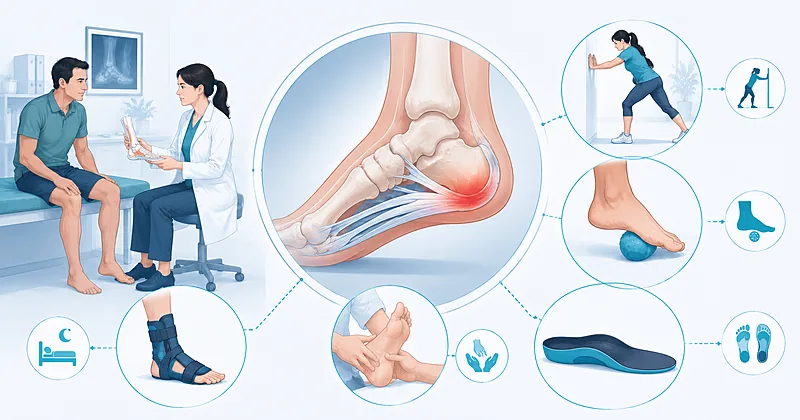
- 1Diagnose plantar fasciitis clinically from sharp medial heel pain that is worst with the first steps in the morning — the differential diagnosis of heel pain rarely requires imaging at first contact.
- 2Counsel every patient that recovery is usually measured in months, not weeks, and that adherence to stretching is the single biggest driver of outcome.
- 3Start plantar fascia-specific and calf stretching as the foundation of first-line plantar fasciitis treatment for all patients.
- 4Recommend a prefabricated insole or supportive footwear early — off-the-shelf orthoses work as well as custom devices for most patients.
- 5Reserve corticosteroid injection for persistent pain after several weeks of conservative care, and counsel on the small risk of fascia rupture.
- 6Consider extracorporeal shockwave therapy for recalcitrant cases that have failed at least three months of structured treatment.
- 7Investigate further when pain is bilateral, nocturnal, or accompanied by systemic features — these point away from simple plantar fasciitis.
- 8Refer to specialist care only after 6–12 months of well-documented, failed conservative management.
How to Diagnose Plantar Fasciitis Treatment Candidates
The diagnosis that precedes plantar fasciitis treatment is almost entirely clinical. A focused history and a brief examination identify the condition in most patients, and routine imaging adds little for a typical presentation. The hallmark is localised pain under the medial calcaneal tubercle that is sharpest with the first few steps after rest and eases with continued walking.
Examination typically reproduces tenderness at the fascia origin and may worsen when the toes are dorsiflexed, which tensions the fascia. The clinician’s job at this stage is to confirm the pattern and actively exclude the conditions that masquerade as heel pain.
Diagnose plantar fasciitis clinically when the patient reports sharp inferior heel pain that is worst with the first morning steps and reproducible with palpation of the medial calcaneal tubercle. Imaging is not required for a typical presentation.
Strong Rec High Evidence JOSPT 2023Evaluate for alternative diagnoses such as calcaneal stress fracture, tarsal tunnel syndrome, fat pad atrophy, and seronegative arthropathy when the history is atypical, bilateral, or includes systemic symptoms.
Moderate Rec Moderate Evidence BMJ 2021Avoid routine radiographs for the sole purpose of identifying a heel spur. Spurs are common in asymptomatic feet and their presence does not change conservative management.
Against Moderate Evidence JOSPT 2023Reconsider the diagnosis and broaden the workup when any of the following are present: pain that is constant or worse at night, true bilateral simultaneous onset, paraesthesia or burning radiating into the sole, focal bony tenderness suggesting stress fracture, or accompanying joint swelling, rash, or eye symptoms that raise the possibility of inflammatory disease.
First-Line Plantar Fasciitis Treatment
The foundation of plantar fasciitis treatment is stretching, activity modification, and simple analgesia. These measures are inexpensive, low-risk, and supported by the strongest evidence, and they should be offered to every patient before anything more invasive is considered.
Prescribe a structured programme of calf and plantar fascia stretching performed several times daily. Plantar fascia-specific stretching, where the patient pulls the toes back to tension the fascia before standing, has the best supporting evidence.
Strong Rec High Evidence JOSPT 2023Advise relative rest and temporary reduction of high-impact loading such as running or prolonged standing, while encouraging the patient to stay generally active to avoid deconditioning.
Moderate Rec Low Evidence NICE CKSConsider a short course of oral NSAIDs for symptom relief in patients without contraindications, recognising that they ease pain but do not alter the natural course of recovery.
Conditional Rec Moderate Evidence BMJ 2021Counsel patients on the favourable natural history: most heel pain resolves within 6 to 12 months with consistent conservative care, and persistence with stretching is more important than any single device or injection.
Strong Rec High Evidence JOSPT 2023Mechanical and Supportive Options
Once stretching is established, supportive devices add useful symptom control. The evidence favours simplicity: prefabricated insoles and night splints help many patients, while expensive custom orthoses rarely outperform off-the-shelf alternatives for routine cases.
Recommend prefabricated foot orthoses or a cushioned heel insert as an early adjunct. For most patients these provide equivalent relief to custom-moulded devices at a fraction of the cost.
Moderate Rec Moderate Evidence JOSPT 2023Consider a night splint that holds the ankle in slight dorsiflexion for patients whose dominant complaint is severe first-step pain, as overnight tensioning may reduce morning symptoms.
Conditional Rec Moderate Evidence BMJ 2021Advise supportive, cushioned footwear with a modest heel and adequate arch support, and discourage prolonged walking barefoot or in flat unsupportive shoes during the recovery period.
Moderate Rec Low Evidence NICE CKSConsider taping techniques that offload the fascia as a short-term measure to confirm whether mechanical support helps before committing the patient to an orthotic purchase.
Conditional Rec Moderate Evidence JOSPT 2023Conservative Options at a Glance
| Intervention | Best Suited For | Typical Timeframe | Practical Tips |
|---|---|---|---|
| Plantar fascia stretch | All patients, first line | Continue 8–12 weeks minimum | Do before the first morning step, seated |
| Prefabricated insole | Most patients, early adjunct | Trial 6 weeks | Try before custom devices |
| Night splint | Severe morning pain | Trial 4–6 weeks | Tolerability limits adherence |
| Supportive footwear | All patients | Ongoing | Avoid flat, unsupportive shoes |
| Low-dye taping | Short-term offload test | Days to 2 weeks | Predicts orthotic benefit |
When First-Line Measures Fail
When several weeks of stretching and supportive measures have not delivered adequate relief, escalation is reasonable. Injection therapy and shockwave treatment occupy this second tier, and both carry trade-offs that should be discussed openly with the patient.
Consider a corticosteroid injection for persistent pain that has not responded to several weeks of conservative care. It offers meaningful short-term relief but the benefit tends to fade by three months, and the patient should be warned about the small risk of plantar fascia rupture and fat pad atrophy.
Conditional Rec Moderate Evidence Cochrane 2017Consider extracorporeal shockwave therapy for recalcitrant heel pain persisting beyond three months despite structured conservative plantar fasciitis treatment. It is non-invasive and avoids the rupture risk of injection.
Moderate Rec Moderate Evidence JOSPT 2023Avoid routine use of repeated corticosteroid injections. Limit the number given to any one heel, as cumulative injections raise the risk of fascia rupture and local fat pad damage.
Against Low Evidence BMJ 2021Refer to podiatry, physiotherapy, or orthopaedics when symptoms persist beyond 6 to 12 months despite well-documented adherence to a full conservative programme, or earlier if the diagnosis is in doubt.
Moderate Rec Low Evidence NICE CKSClinical Decision Pathway
A practical, question-based approach to heel pain in primary care. Work through the questions in order at each visit.
Safety and Monitoring
Follow-up exists to reinforce adherence, escalate at the right moment, and catch the rare complication. A simple review schedule keeps patients engaged through a recovery that can feel frustratingly slow.
| What to Track | When to Review | Reassuring Sign | Common Pitfalls |
|---|---|---|---|
| Stretching adherence | 6 weeks | Daily routine established | Assuming non-response when stretches were skipped |
| Morning pain severity | 6–12 weeks | First-step pain easing | Escalating too early before measures take effect |
| Post-injection course | 2–6 weeks after injection | Gradual relief, no new tearing | Missing early signs of plantar fascia rupture |
| Diagnostic certainty | Each visit | Story still fits plantar fasciitis | Anchoring on the original label despite new features |
Evidence in Context
What the evidence shows, where the major sources agree, and where they diverge on plantar fasciitis treatment.
Where the Sources Agree
There is broad consensus that the diagnosis is clinical, that stretching is the cornerstone of first-line care, and that the natural history is favourable with most patients improving over months. All major sources place surgery firmly at the end of the pathway.
The Injection Debate
Cochrane evidence supports short-term pain relief from corticosteroid injection, but the effect is transient and rupture is a recognised harm. Sources differ on enthusiasm: some position injection as a reasonable early option for severe pain, while others reserve it for clear conservative failure.
Custom Versus Prefabricated Orthoses
Comparative trials have repeatedly found little meaningful difference between off-the-shelf and custom-moulded devices for typical heel pain. The practical conclusion across sources is to start with prefabricated inserts and reserve custom orthoses for unusual foot mechanics.
Shockwave Therapy Evidence
Extracorporeal shockwave therapy has accumulated moderate evidence for recalcitrant cases, with the advantage of being non-invasive. Access and cost vary widely, which influences how prominently each source recommends it.
References
- 1.Koc TA, Bise CG, Neville C, et al. Heel Pain — Plantar Fasciitis: Revision 2023 Clinical Practice Guidelines. J Orthop Sports Phys Ther. 2023;53(12):CPG1–CPG39. doi:10.2519/jospt.2023.0303
- 2.David JA, Sankarapandian V, Christopher PR, et al. Injected corticosteroids for treating plantar heel pain in adults. Cochrane Database Syst Rev. 2017;6(6):CD009348. doi:10.1002/14651858.CD009348.pub2
- 3.Trojian T, Tucker AK. Plantar Fasciitis. Am Fam Physician. 2019;99(12):744–750. pubmed.ncbi.nlm.nih.gov/31194492
- 4.National Institute for Health and Care Excellence. Plantar heel pain. Clinical Knowledge Summary. cks.nice.org.uk/topics/plantar-heel-pain
How to Read the Evidence Tags
Every recommendation carries two tags for recommendation strength and evidence quality — Medaptly’s own simplified interpretations, designed for quick clinical reading rather than formal guideline grading.
Recommendation Strength
| Tag | What It Means |
|---|---|
| Strong Rec | High-quality evidence broadly supports this action. |
| Moderate Rec | The weight of evidence favours this action. |
| Conditional Rec | The benefit is less certain — individualise. |
| Against | Evidence shows no benefit or potential harm. |
Evidence Quality
| Tag | What It Means |
|---|---|
| High Evidence | Multiple well-designed RCTs or high-quality meta-analyses. |
| Moderate Evidence | Single RCT or large observational studies. |
| Low Evidence | Expert consensus or small studies. |