
Adult Asthma Management: Proven GINA 2025 Practical Guide
Clinical Practice Update — Track 1 and Track 2 Therapy, Exacerbation Care, Biologics, and Severe Asthma Referral
This is an original clinical education article informed by current guidelines and evidence. See References below for source documents.
- Clinical Focus
- Evidence-based adult asthma management across outpatient, acute, and severe settings
- Target Audience
- Internists, primary care physicians, emergency physicians, pulmonologists, residents
- Setting
- Primary care, emergency department, specialty outpatient clinic
- Source Evidence
- •Global Initiative for Asthma (GINA) Main Report 2025
- •ERS/ATS Guideline on Severe Asthma (2020)
- •SYGMA 1 and SYGMA 2 Trials — As-Needed Budesonide-Formoterol (NEJM, 2018)
- •Novel-START Trial — Pragmatic As-Needed ICS-Formoterol (NEJM, 2019)
- •NAVIGATOR Trial — Tezepelumab in Severe Uncontrolled Asthma (NEJM, 2021)
Key Clinical Takeaways
Effective adult asthma management rests on three rules that have reshaped practice: every adult needs inhaled corticosteroid in their reliever, stepwise therapy follows Track 1 (ICS-formoterol) by default, and severe uncontrolled asthma deserves early biologic consideration. GINA 2025 extends these principles with refined biologic phenotyping and streamlined exacerbation guidance. The points below condense the evidence into actionable rules.
- 1Prescribe ICS-formoterol as the reliever for every adult with asthma — never SABA-only therapy → Stepwise Therapy
- 2Start at Step 1 or 2 with as-needed low-dose ICS-formoterol (AIR) for intermittent symptoms → Stepwise Therapy
- 3Escalate to MART (maintenance + reliever) at Step 3 for persistent symptoms — same inhaler for both roles → Stepwise Therapy
- 4Check inhaler technique and adherence before escalating any step — most “resistant” asthma is neither → Assessment
- 5Give a short course of oral corticosteroids (prednisolone 40–50 mg for 5–7 days) for moderate-to-severe exacerbations → Exacerbations
- 6Refer any adult on Step 4 or 5 therapy who remains uncontrolled, or needs maintenance OCS, for biologic assessment → Biologics
- 7Phenotype before picking a biologic — blood eosinophils, FeNO, IgE, and allergy history drive the choice → Biologics
- 8Give every patient a written asthma action plan and review at each visit → Monitoring
- 9Address modifiable factors: smoking, obesity, rhinitis, GERD, occupational exposures, and psychosocial triggers → Comorbidities
- 10Vaccinate against influenza annually and pneumococcal disease as per schedule → Monitoring
Assessment and Control in Adult Asthma Management
The first step in adult asthma management is confirming the diagnosis with objective lung function testing and then classifying current control. Control has two domains under GINA 2025: symptom control over the last four weeks and future risk of exacerbations, fixed airflow limitation, and treatment side effects. Both must be assessed at every visit.
Confirm the diagnosis with spirometry demonstrating variable expiratory airflow limitation (bronchodilator reversibility ≥12% AND ≥200 mL, or documented diurnal variability) before committing to long-term inhaled therapy.
Strong Rec High Evidence GINA 2025Classify symptom control at every visit using the four-question GINA tool: daytime symptoms more than twice a week, any night waking, reliever use more than twice a week, any activity limitation. Zero items → well controlled; 1–2 → partly controlled; 3–4 → uncontrolled.
Strong Rec Moderate Evidence GINA 2025Assess future risk separately from symptom control. Key predictors of exacerbations include prior exacerbation in the last year, high SABA use, poor adherence, incorrect inhaler technique, low FEV₁, smoking, and blood eosinophilia.
Strong Rec High Evidence GINA 2025Check inhaler technique by observing the patient use their device. Studies show errors in 70–80% of patients. Correct the technique before escalating therapy — it is the highest-yield intervention in adult asthma management.
Strong Rec High Evidence GINA 2025Stepwise Therapy: The Backbone of Adult Asthma Management
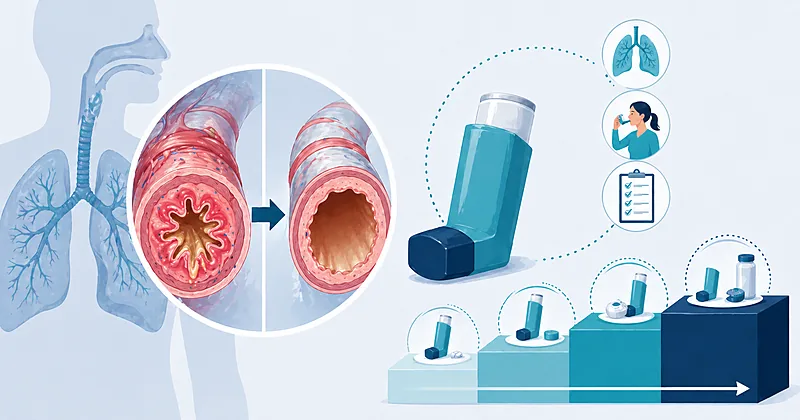
GINA 2025 organises pharmacotherapy into two tracks. Track 1 uses ICS-formoterol as both maintenance and reliever (the anti-inflammatory reliever, or AIR/MART strategy) and is preferred for every adult. Track 2 retains a SABA reliever with separate ICS-containing maintenance inhaler and is used when Track 1 is not feasible (cost, availability, device preference).
Choose Track 1 as the default pathway in adult asthma management. Preferred combination: budesonide-formoterol 200/6 µg or beclomethasone-formoterol 100/6 µg in a DPI or pMDI. Use the same inhaler for controller and reliever roles at every step.
Strong Rec High Evidence GINA 2025 SYGMA 1/2At Steps 1–2 (intermittent or mild persistent symptoms), prescribe as-needed low-dose ICS-formoterol only. This strategy halves severe exacerbations compared with SABA monotherapy.
Strong Rec High Evidence GINA 2025Step up to MART at Step 3 (daily maintenance + as-needed ICS-formoterol) if symptoms persist. Low-dose MART at Step 3, medium-dose MART at Step 4. Re-check technique and adherence before every step-up.
Strong Rec High Evidence GINA 2025Add a long-acting muscarinic antagonist (tiotropium) at Step 5 for persistent symptoms on medium-to-high-dose MART before escalating to biologics, or alongside if referral is planned.
Moderate Rec Moderate Evidence GINA 2025Use Track 2 only when Track 1 is not feasible. Reliever is SABA; maintenance is low-to-high-dose ICS with or without LABA. Always prescribe with an ICS — never SABA alone.
Moderate Rec High Evidence GINA 2025Do not prescribe SABA alone for symptom relief in any adult with asthma. SABA-only therapy is associated with higher exacerbations and mortality — a decades-long practice pattern that GINA reversed in 2019.
Against High Evidence GINA 2025GINA 2025 Steps: Track 1 vs Track 2 at a Glance
| Step | Track 1 (Preferred) — AIR / MART | Track 2 (Alternative) — SABA + ICS | When to Use Each Step |
|---|---|---|---|
| Step 1 | As-needed low-dose ICS-formoterol only | ICS whenever SABA is used (or daily low-dose ICS) | Infrequent symptoms (<2×/week); no night waking; no risk factors |
| Step 2 | As-needed low-dose ICS-formoterol | Daily low-dose ICS + SABA as needed | Symptoms ≥2×/week; no daily symptoms |
| Step 3 | Low-dose MART (daily + as-needed ICS-formoterol) | Low-dose ICS-LABA + SABA as needed | Daily symptoms or night waking ≥1×/week |
| Step 4 | Medium-dose MART | Medium-to-high-dose ICS-LABA + SABA as needed | Uncontrolled on Step 3 after technique/adherence check |
| Step 5 | Medium-high-dose MART + LAMA or biologic | High-dose ICS-LABA + LAMA and/or biologic | Uncontrolled on Step 4 → refer for phenotyping |
Exacerbation Management
An exacerbation is a progressive worsening of symptoms and lung function that requires a change in treatment. Mild exacerbations can be managed at home by stepping up reliever use; moderate-to-severe attacks need a short course of oral corticosteroids and close review. Life-threatening exacerbations need emergency care.
Give every adult with asthma a written action plan that specifies: recognising worsening symptoms, how to step up reliever use, when to start oral corticosteroids, and when to seek emergency care.
Strong Rec High Evidence GINA 2025Prescribe oral prednisolone 40–50 mg once daily for 5–7 days for moderate-to-severe exacerbations in adults. No taper is needed for a course of 14 days or less.
Strong Rec High Evidence GINA 2025In the emergency department, give oxygen to maintain SpO₂ 93–95%, repeated nebulised (or pMDI-spacer) salbutamol, ipratropium bromide for severe attacks, and systemic corticosteroids within the first hour of presentation.
Strong Rec High Evidence GINA 2025Consider IV magnesium sulfate 2 g over 20 minutes in adults with severe exacerbations and poor response to initial bronchodilator therapy. Evidence is strongest in patients with FEV₁ <30–50% predicted.
Moderate Rec Moderate Evidence GINA 2025Arrange a follow-up visit within 1–2 weeks of every exacerbation. Review the trigger, escalate long-term therapy if needed, re-check inhaler technique, reinforce adherence, and update the written action plan.
Strong Rec Moderate Evidence GINA 2025Biologics and Severe Asthma Referral
Severe asthma affects roughly 3–10% of all patients with asthma and accounts for the majority of exacerbations, hospital admissions, and healthcare cost. Biologic therapies now offer targeted options based on phenotype. Early referral matters: most patients eligible for biologics wait too long.
Refer to a severe asthma service when an adult remains uncontrolled on Step 4 or Step 5 therapy despite confirmed good adherence and correct inhaler technique, when two or more exacerbations needing OCS occurred in the prior year, or when maintenance OCS is being used.
Strong Rec High Evidence GINA 2025 ERS/ATS 2020Phenotype every candidate before choosing a biologic: total IgE, specific IgE or skin prick testing, blood eosinophils (baseline and off oral steroids if possible), and FeNO. These results guide the choice between anti-IgE, anti-IL-5/5R, anti-IL-4R, and anti-TSLP therapies.
Strong Rec Moderate Evidence GINA 2025Consider tezepelumab in patients without type 2 inflammation biomarkers (eosinophils <150, FeNO <25, low IgE) who remain uncontrolled — it is the only current biologic effective across the low-T2 phenotype.
Moderate Rec Moderate Evidence NAVIGATOR 2021 GINA 2025Biologic Selection by Phenotype
| Biologic (Target) | Best Candidate Profile | Typical Biomarkers | Practical Tips & Caveats |
|---|---|---|---|
| Omalizumab (anti-IgE) | Allergic asthma with perennial aeroallergen sensitisation | Total IgE 30–1500 IU/mL (weight-adjusted); positive allergen-specific IgE | Dosed by weight and IgE level; SC every 2–4 weeks |
| Mepolizumab (anti-IL-5) | Eosinophilic asthma, frequent exacerbations | Blood eosinophils ≥150–300/µL | Fixed 100 mg SC every 4 weeks; also used in EGPA and nasal polyps |
| Benralizumab (anti-IL-5R) | Eosinophilic asthma — rapid eosinophil depletion | Blood eosinophils ≥300/µL typically | SC every 4 weeks x 3 then every 8 weeks — fewer clinic visits |
| Dupilumab (anti-IL-4Rα) | Type 2 asthma, coexisting atopic dermatitis or nasal polyps | Eosinophils ≥150/µL or FeNO ≥25 ppb | SC every 2 weeks; watch for transient eosinophilia |
| Tezepelumab (anti-TSLP) | Severe uncontrolled asthma across all phenotypes, including low-T2 | Effective regardless of eosinophils or FeNO | SC every 4 weeks; only biologic active in low-T2 disease |
Clinical Decision Pathway
A question-based pathway for adult asthma management from diagnosis through severe-asthma referral. Work through the questions in order.
Monitoring and Comorbidities
| Parameter | When to Check | What to Look For | Common Pitfalls |
|---|---|---|---|
| GINA control assessment | Every visit (every 3–12 months) | Trend toward uncontrolled; change in reliever frequency | Relying on patient perception alone — always ask the four specific questions |
| Inhaler technique | Every visit; after any step change | Common errors for the specific device; coordination and breath-hold | Assuming technique is fine because the patient has used the inhaler for years |
| Spirometry | At diagnosis; 3–6 months after treatment start; then annually | FEV₁ decline; fixed airflow limitation | Missing declining FEV₁ in a patient who feels “fine” |
| Modifiable risk factors | Every visit | Smoking cessation, weight, rhinitis, GERD, occupational exposure, anxiety, depression | Focusing only on inhalers and missing the comorbidities driving poor control |
| Vaccinations | Annually (influenza); per schedule (pneumococcal, COVID-19) | Completion of age/risk-based schedule | Missing the teachable moment during follow-up |
| Action plan review | Every visit; after every exacerbation | Up-to-date doses; patient can describe escalation | Providing a plan that the patient never opens |
Evidence in Context
What the trials actually show, where the guidelines align, and where important questions remain.
Why GINA Moved Away From SABA-Only Therapy
Large observational studies and registry data showed that patients with mild asthma treated with SABA alone still had asthma deaths, often during a severe exacerbation. Over-reliance on reliever therapy without anti-inflammatory treatment allowed airway inflammation to progress unchecked. In 2019, GINA took the unusual step of reversing 50 years of practice and recommended ICS-containing reliever therapy for every adult.
SYGMA and Novel-START: The Evidence for As-Needed ICS-Formoterol
SYGMA 1 and SYGMA 2 randomised over 8,000 patients with mild asthma to as-needed budesonide-formoterol, as-needed terbutaline, or daily budesonide plus terbutaline as reliever. As-needed ICS-formoterol was superior to SABA alone for preventing exacerbations and similar to daily ICS for exacerbation prevention, with roughly one-fifth of the cumulative steroid exposure. Novel-START, a pragmatic New Zealand study, confirmed real-world effectiveness in mild asthma.
Biologic Era: From Trial to Real-World Practice
Anti-IL-5 agents (mepolizumab, reslizumab, benralizumab), anti-IgE (omalizumab), anti-IL-4Rα (dupilumab), and anti-TSLP (tezepelumab) have each demonstrated reductions in exacerbations of 40–70% in appropriately selected severe asthma populations. Head-to-head trials are few; choice is driven by phenotype, comorbidities (nasal polyposis, atopic dermatitis, EGPA), and payer constraints. NAVIGATOR established tezepelumab as the first biologic to work across the full phenotypic spectrum, including low-T2 disease.
Where GINA 2025 Refines Prior Recommendations
GINA 2025 strengthens the preference for Track 1 across every step, refines the trigger thresholds for severe asthma referral, provides clearer guidance on sustained biologic use versus step-down attempts after 12 months of good control, and updates recommendations on oral corticosteroid stewardship. It also reinforces that any maintenance OCS is a trigger for specialist review, regardless of other metrics.
What We Still Don’t Know
Several important questions remain unresolved in adult asthma management. The optimal sequence when a first biologic fails is still being defined. Duration of biologic therapy — lifelong vs time-limited — is under active study, and biomarkers that predict sustained remission off biologic are not yet validated. The role of digital adherence monitoring and remote spirometry in improving outcomes needs more evidence.
References
- 1.Global Initiative for Asthma. Global Strategy for Asthma Management and Prevention. Main Report. 2025. ginasthma.org/reports/
- 2.Holguin F, Cardet JC, Chung KF, et al. Management of severe asthma: a European Respiratory Society/American Thoracic Society guideline. Eur Respir J. 2020;55(1):1900588. doi:10.1183/13993003.00588-2019
- 3.O’Byrne PM, FitzGerald JM, Bateman ED, et al. Inhaled Combined Budesonide-Formoterol as Needed in Mild Asthma (SYGMA 1). N Engl J Med. 2018;378(20):1865–1876. doi:10.1056/NEJMoa1715274
- 4.Beasley R, Holliday M, Reddel HK, et al. Controlled Trial of Budesonide-Formoterol as Needed for Mild Asthma (Novel-START). N Engl J Med. 2019;380(21):2020–2030. doi:10.1056/NEJMoa1901963
- 5.Menzies-Gow A, Corren J, Bourdin A, et al. Tezepelumab in Adults and Adolescents with Severe, Uncontrolled Asthma (NAVIGATOR). N Engl J Med. 2021;384(19):1800–1809. doi:10.1056/NEJMoa2034975
- 6.Castro M, Corren J, Pavord ID, et al. Dupilumab Efficacy and Safety in Moderate-to-Severe Uncontrolled Asthma (LIBERTY ASTHMA QUEST). N Engl J Med. 2018;378(26):2486–2496. doi:10.1056/NEJMoa1804092
How to Read the Evidence Tags
Every recommendation carries two tags for strength and evidence quality, plus a source tag — Medaptly’s own simplified interpretations.
Recommendation Strength
| Tag | What It Means |
|---|---|
| Strong Rec | High-quality evidence broadly supports this action. |
| Moderate Rec | The weight of evidence favours this action. |
| Conditional Rec | The benefit is less certain — individualise. |
| Against | Evidence shows no benefit or potential harm. |
Evidence Quality
| Tag | What It Means |
|---|---|
| High Evidence | Multiple well-designed RCTs or high-quality meta-analyses. |
| Moderate Evidence | Single RCT or large observational studies. |
| Low Evidence | Expert consensus or small studies. |