
Cirrhosis Decompensation: 9 Essential Management Rules
Clinical Practice Update — Ascites, Hepatic Encephalopathy, and Variceal Bleeding in Adults
This is an original clinical education article informed by current guidelines and evidence. See References below for source documents.
- Clinical Focus
- Evidence-based cirrhosis decompensation management in immunocompetent adults
- Target Audience
- Internists, hospitalists, ED physicians, gastroenterology trainees, family physicians
- Setting
- Primary care, emergency department, hospital inpatient, hepatology clinic
- Source Evidence
- •AASLD Practice Guidance on the Management of Ascites in Cirrhosis (2021)
- •AASLD/EASL Practice Guideline on Hepatic Encephalopathy (2014)
- •Baveno VII Consensus on Portal Hypertension (J Hepatol, 2022)
- •EASL Clinical Practice Guidelines on Decompensated Cirrhosis (2018)
- •Pre-emptive TIPS in Acute Variceal Bleeding — meta-analyses (Hepatology, 2020)
Key Clinical Takeaways
Effective cirrhosis decompensation management hinges on rapid recognition of three syndromes — ascites, hepatic encephalopathy, and variceal bleeding — and on disciplined application of a few evidence-based therapies. The points below distil the practical rules every internist should be able to apply at the bedside.
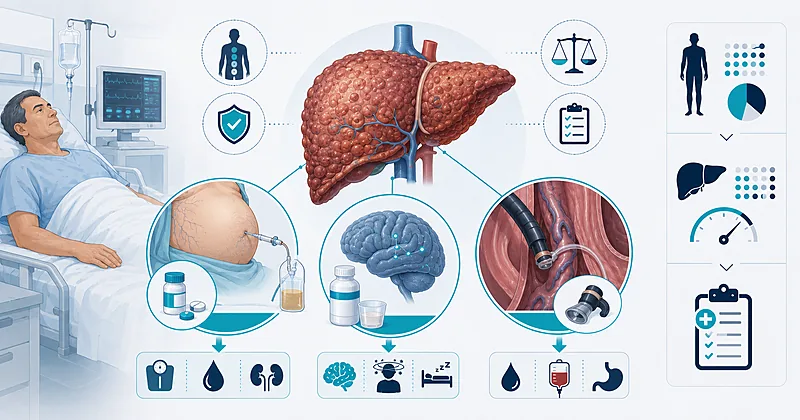
- 1Calculate Child-Pugh and MELD-Na score at every decompensation episode — these drive prognosis and transplant referral timing
- 2Start spironolactone and furosemide together at the 100:40 mg ratio — not as sequential monotherapy
- 3Restrict dietary sodium to under 88 mmol/day (2 g) — fluid restriction is only needed if serum sodium falls below 125 mmol/L
- 4Replace albumin (6–8 g per litre removed) after any large-volume paracentesis above 5 litres
- 5Look for the precipitant of every encephalopathy episode — infection, GI bleed, dehydration, constipation, or sedatives explain most cases
- 6Titrate lactulose to two or three soft stools per day — over-treatment causes dehydration and worsens encephalopathy
- 7Do not restrict protein routinely — cirrhotic patients need 1.2–1.5 g/kg/day to prevent sarcopenia
- 8Offer either non-selective beta-blockade or endoscopic banding for primary prophylaxis of medium or large varices — not both routinely
- 9In acute variceal bleeding, the trio is vasoactive drug, endoscopic banding within 12 hours, and prophylactic ceftriaxone — all three together
- 10Refer every patient with a first decompensation event for transplant evaluation — the prognosis changes the moment compensation is lost
Initial Assessment in Cirrhosis Decompensation Management
Every decompensation episode is a turning point. The same patient who has tolerated cirrhosis for years suddenly has a one-year mortality of roughly 20–50%. The first hour of cirrhosis decompensation management is about three questions: which complications are present, how severe is the underlying liver disease, and is there a reversible trigger.
Calculate the Child-Pugh score and the MELD-Na score on admission and at every subsequent decompensation event. These two scores guide transplant referral, antibiotic prophylaxis decisions, and the safety of further interventions.
Strong Rec High Evidence EASL 2018Perform diagnostic paracentesis in every patient admitted with ascites or with worsening hepatic function, even if the abdomen feels unchanged. Sub-clinical infection is the trigger in roughly a third of admissions.
Strong Rec High Evidence AASLD 2021Refer for liver transplantation evaluation at the first decompensation event regardless of MELD. Listing decisions are made later by the transplant team, but the conversation has to start early.
Strong Rec Moderate Evidence EASL 2018Stop nephrotoxins on admission: NSAIDs, aminoglycosides, IV contrast where avoidable, and proton pump inhibitors prescribed without indication. These accelerate hepatorenal physiology faster than any other intervention worsens it.
Strong Rec Moderate Evidence AASLD 2021Ascites in Cirrhosis Decompensation Management
Ascites is the most common first decompensation event and the gateway to renal injury, infection, and hyponatraemia. Diuretic therapy works only when sodium restriction is in place, and the dosing ratio matters more than the absolute dose.
Diuretic Initiation and Titration
Start spironolactone 100 mg and furosemide 40 mg orally once daily together in patients with moderate ascites. Maintain the 100:40 mg ratio as you titrate — this preserves normokalaemia and matches the aldosterone-driven physiology.
Strong Rec High Evidence AASLD 2021 EASL 2018Titrate every 3–5 days in steps of 100 mg spironolactone and 40 mg furosemide, up to maxima of 400 mg and 160 mg respectively. Aim for weight loss of 0.5 kg per day without peripheral oedema and 1 kg per day with peripheral oedema.
Strong Rec Moderate Evidence AASLD 2021Counsel patients on sodium restriction of less than 88 mmol (2 g) per day. Diuretics will fail unintentionally if dietary sodium remains uncontrolled.
Strong Rec Moderate Evidence AASLD 2021Stop diuretics if serum sodium falls below 120 mmol/L, creatinine rises above 2.0 mg/dL (180 µmol/L), encephalopathy develops, or potassium falls below 3.0 or rises above 6.0 mmol/L.
Strong Rec High Evidence AASLD 2021Switch to amiloride 10–40 mg daily for spironolactone-related painful gynaecomastia. Eplerenone is an alternative but is more expensive and offers no efficacy advantage.
Moderate Rec Low Evidence AASLD 2021Diuretic Dosing by Clinical Scenario
| Clinical Scenario | Spironolactone | Furosemide | Practical Tips |
|---|---|---|---|
| First mild ascites, outpatient | 100 mg daily | 40 mg daily | Weigh weekly; check electrolytes at week 1, week 2, then monthly |
| Moderate persistent ascites | 200 mg daily | 80 mg daily | Reinforce sodium counselling; consider dietician referral |
| Tense ascites with leg oedema | 300–400 mg daily | 120–160 mg daily | First do a therapeutic paracentesis; then resume diuretics |
| Hyperkalaemia on combination | Hold; reduce by 50% | Continue same | Recheck K within 48 h; review ACEi/ARB use |
| Hypokalaemia on combination | Increase | Reduce or hold | Hypokalaemia can precipitate encephalopathy — act fast |
| Refractory ascites | Often discontinue | Often discontinue | Repeated LVP with albumin; refer for TIPS evaluation |
Paracentesis and Albumin Replacement
Perform large-volume paracentesis as first-line therapy for tense or refractory ascites. Single-session removal of more than 5 litres requires intravenous albumin at 6–8 g per litre removed to prevent post-paracentesis circulatory dysfunction.
Strong Rec High Evidence AASLD 2021 EASL 2018Send ascitic fluid for cell count and culture with every paracentesis. A polymorphonuclear count of 250 cells/mm³ or higher confirms spontaneous bacterial peritonitis and mandates empirical third-generation cephalosporin therapy.
Strong Rec High Evidence AASLD 2021Initiate albumin 1.5 g/kg at diagnosis and 1.0 g/kg at day 3 in patients with SBP and either creatinine above 1.0 mg/dL, BUN above 30 mg/dL, or bilirubin above 4 mg/dL.
Strong Rec High Evidence AASLD 2021Prescribe long-term oral antibiotic prophylaxis (norfloxacin 400 mg daily or ciprofloxacin 500 mg daily) for survivors of a first SBP episode and for selected patients with low-protein ascites and advanced liver disease.
Strong Rec High Evidence AASLD 2021Hepatic Encephalopathy in Cirrhosis Decompensation Management
Hepatic encephalopathy is rarely a primary event — it almost always has a trigger. The first task is to find and reverse it; the second is to titrate lactulose to a defined stool target rather than a defined dose.
Identify and treat the precipitant in every episode of overt encephalopathy. The differential includes infection (especially SBP and UTI), gastrointestinal bleeding, electrolyte disturbance, dehydration from over-diuresis, constipation, recent benzodiazepine or opioid use, and acute kidney injury.
Strong Rec High Evidence AASLD/EASL 2014Start lactulose 25 mL orally every 1–2 hours until the first bowel movement, then titrate to a target of two to three soft bowel movements per day. Stool frequency — not blood ammonia — is the dosing endpoint.
Strong Rec High Evidence AASLD/EASL 2014Deliver lactulose by nasogastric tube or as a retention enema (300 mL lactulose in 700 mL water, held for 30–60 minutes) in patients who cannot safely swallow.
Strong Rec Moderate Evidence AASLD/EASL 2014Add rifaximin 550 mg twice daily to lactulose for secondary prophylaxis after a second overt encephalopathy episode, or earlier if lactulose alone fails to maintain remission. Continue indefinitely unless the trigger is permanently reversible.
Strong Rec High Evidence AASLD/EASL 2014Do not restrict protein intake. Target 1.2–1.5 g/kg/day to prevent sarcopenia, which itself predisposes to encephalopathy. Vegetable and dairy protein are better tolerated than animal protein in patients prone to recurrent episodes.
Against High Evidence AASLD/EASL 2014Avoid empirical ammonia level testing as a diagnostic or monitoring tool. Diagnosis and response are clinical — normal ammonia does not exclude encephalopathy and elevated ammonia does not confirm it.
Against Moderate Evidence AASLD/EASL 2014Lactulose Titration by Severity
| Encephalopathy Grade | Initial Lactulose | Endpoint | Add Rifaximin? | Common Pitfall |
|---|---|---|---|---|
| Covert / minimal | 15–30 mL twice daily | 2–3 soft stools/day | Not initially | Under-treatment — symptoms missed by family |
| Grade I–II (overt) | 25–30 mL every 4–6 h | 2–3 soft stools/day | After 2nd episode | Stopping at improvement — secondary prophylaxis required |
| Grade III | 25 mL every 1–2 h until BM | 2–3 soft stools/day | Yes | Aspiration risk — consider NGT or enema route |
| Grade IV (coma) | Enema 300 mL in 700 mL water q6h | 2–3 soft stools/day + reduced obtundation | Yes, via NGT | Airway protection takes priority over the laxative dose |
| Over-treated (>6 stools/day) | Halve the dose | 2–3 soft stools/day | As before | Dehydration — will worsen encephalopathy, not improve it |
Variceal Bleeding Prophylaxis and Acute Management
Variceal haemorrhage is the most lethal acute complication in cirrhosis decompensation management, with six-week mortality around 15–20% even with optimal care. The architecture of effective prevention rests on three pillars: screening, primary prophylaxis with either drug or banding, and a disciplined acute-bleed bundle.
Screening and Primary Prophylaxis
Apply Baveno VII non-invasive criteria to defer screening endoscopy in compensated cirrhosis: liver stiffness below 20 kPa and platelets above 150 × 10&sup9;/L identifies patients at very low risk of high-risk varices and avoids unnecessary upper endoscopy.
Strong Rec High Evidence Baveno VII 2022Prescribe a non-selective beta-blocker (NSBB) for any patient with clinically significant portal hypertension, even before varices appear. Carvedilol 6.25–12.5 mg daily is now preferred over propranolol for most patients because it lowers portal pressure more reliably.
Strong Rec High Evidence Baveno VII 2022Perform prophylactic endoscopic variceal ligation (EVL) for medium or large varices in patients who cannot tolerate or are intolerant to NSBB. Band every 2–4 weeks until varices are eradicated, then surveillance EGD at 3–6 months and yearly thereafter.
Strong Rec High Evidence Baveno VII 2022Do not combine NSBB and prophylactic banding routinely for primary prophylaxis — the additive benefit is small and the complication rate of combined therapy is higher. Reserve combined therapy for secondary prophylaxis after a first bleed.
Against Moderate Evidence Baveno VII 2022Acute Variceal Bleeding
Initiate vasoactive therapy (terlipressin, octreotide, or somatostatin) at the moment variceal bleeding is suspected — before endoscopy. Continue for 2–5 days.
Strong Rec High Evidence Baveno VII 2022Prescribe ceftriaxone 1 g IV daily for up to 7 days at admission for any cirrhotic patient with upper GI bleeding, irrespective of ascites status. Antibiotic prophylaxis reduces mortality, rebleeding, and infection.
Strong Rec High Evidence Baveno VII 2022Perform endoscopic band ligation within 12 hours of presentation in haemodynamically stable patients. Sclerotherapy is reserved for cases where banding is technically impossible.
Strong Rec High Evidence Baveno VII 2022Consider pre-emptive TIPS within 72 hours of admission in Child-Pugh class C (10–13 points) or class B with active bleeding at endoscopy. Early TIPS reduces rebleeding and mortality compared with continued medical therapy.
Moderate Rec High Evidence Baveno VII 2022Transfuse to a haemoglobin target of 7–8 g/dL using a restrictive strategy. Over-transfusion raises portal pressure and increases rebleeding risk.
Strong Rec High Evidence Baveno VII 2022After a first variceal bleed, prescribe combined NSBB plus serial banding to eradication as secondary prophylaxis. This combination outperforms either modality alone.
Strong Rec High Evidence Baveno VII 2022Clinical Decision Pathway
A practical question-based approach for the patient arriving with a decompensation event. Walk the questions in order.
Monitoring and Follow-Up After Decompensation
Post-discharge monitoring after a decompensation episode is where most preventable readmissions originate. Set the cadence at discharge, not at the first follow-up visit.
| Parameter | When to Check | Action Threshold | Common Pitfalls |
|---|---|---|---|
| Electrolytes and creatinine on diuretics | Week 1, week 2, then monthly | Na < 120, K < 3 or > 6, Cr doubled | Forgetting potassium — hypokalaemia precipitates encephalopathy |
| Weight | Daily by patient at home | Gain > 2 kg in a week → call clinic | Patients not given clear written instructions |
| MELD-Na | Every 1–3 months | Rising trend → expedite transplant evaluation | Waiting for symptoms before re-referral |
| HCC surveillance ultrasound + AFP | Every 6 months | Any new lesion > 1 cm | Skipped in alcohol-related cirrhosis when intervals lapse |
| EGD for varices | Post-eradication: 3–6 mo, then yearly | Recurrence of medium/large varices → reband | Stopping surveillance after a single clean EGD |
| Alcohol use disorder | Every visit | Any use → refer to addiction services | Treating it as a personal failing rather than a medical condition |
Evidence in Context
Where the major societies converge, where they still disagree, and what recent trials have changed in cirrhosis decompensation management.
Where AASLD, EASL, and Baveno VII Agree
The major societies converge on the core architecture: combined spironolactone-furosemide at the 100:40 ratio for ascites, lactulose titrated to stool output for encephalopathy with rifaximin as an add-on, and a three-part bundle (vasoactive drug, antibiotics, endoscopic banding) for acute variceal bleeding. All also recommend transplant referral at first decompensation event.
Carvedilol vs Propranolol: The Shift in Preference
Baveno VII formalised a preference for carvedilol over propranolol for most patients with portal hypertension because its added alpha-1 blockade produces a more reliable reduction in hepatic venous pressure gradient. However, in patients with refractory ascites or hypotension, propranolol or nadolol may still be preferable because they have less effect on systemic blood pressure.
Pre-emptive TIPS: What the Trials Show
Trials and pooled analyses of early TIPS in high-risk acute variceal bleeding (Child-Pugh C up to 13 points, and active bleeding Child-Pugh B) have consistently shown reduced rebleeding and reduced mortality compared with continued medical therapy. The window of benefit is the first 72 hours after admission, which is why the decision needs to be made during the index admission rather than at outpatient follow-up.
Albumin Beyond Paracentesis
Long-term albumin infusion for outpatients with persistent uncomplicated ascites has been proposed (ANSWER trial) but remains controversial — subsequent trials (ATTIRE) did not confirm survival benefit in hospitalised patients. Use albumin where the evidence is robust: large-volume paracentesis > 5 L, SBP, and hepatorenal syndrome.
Why Protein Restriction Was Abandoned
Empirical low-protein diets do not improve encephalopathy and do accelerate the sarcopenia that itself drives further decompensation. Cordoba and colleagues showed that normal-protein diets are at least as well tolerated and superior on mental status outcomes in cirrhotic patients during acute encephalopathy. The current consensus is 1.2–1.5 g/kg/day — including during acute episodes.
References
- 1.Biggins SW, Angeli P, Garcia-Tsao G, et al. Diagnosis, evaluation, and management of ascites, spontaneous bacterial peritonitis, and hepatorenal syndrome: 2021 Practice Guidance by the AASLD. Hepatology. 2021;74(2):1014–1048. doi:10.1002/hep.31884
- 2.Vilstrup H, Amodio P, Bajaj J, et al. Hepatic encephalopathy in chronic liver disease: 2014 Practice Guideline by the AASLD and EASL. Hepatology. 2014;60(2):715–735. doi:10.1002/hep.27210
- 3.de Franchis R, Bosch J, Garcia-Tsao G, Reiberger T, Ripoll C. Baveno VII — Renewing consensus in portal hypertension. J Hepatol. 2022;76(4):959–974. doi:10.1016/j.jhep.2021.12.022
- 4.European Association for the Study of the Liver. EASL Clinical Practice Guidelines for the management of patients with decompensated cirrhosis. J Hepatol. 2018;69(2):406–460. doi:10.1016/j.jhep.2018.03.024
- 5.García-Pagán JC, Caca K, Bureau C, et al. Early use of TIPS in patients with cirrhosis and variceal bleeding. N Engl J Med. 2010;362(25):2370–2379. doi:10.1056/NEJMoa0910102
How to Read the Evidence Tags
Every recommendation carries two tags that summarise Medaptly’s interpretation of the underlying evidence: recommendation strength and evidence quality, plus a source tag.
Recommendation Strength
| Tag | What It Means |
|---|---|
| Strong Rec | High-quality evidence broadly supports this action across patient groups. |
| Moderate Rec | The weight of evidence favours this action; individual judgement still applies. |
| Conditional Rec | Benefit is less certain — individualise based on comorbidity and patient values. |
| Against | Evidence shows no benefit or potential harm. |
Evidence Quality
| Tag | What It Means |
|---|---|
| High Evidence | Multiple well-designed RCTs or high-quality meta-analyses. |
| Moderate Evidence | Single RCT or large, well-conducted observational studies. |
| Low Evidence | Expert consensus, case series, or small studies. |