
Gout Management: 7 Essential Rules for Flares and ULT
Clinical Practice Update — Treat-to-Target Urate Lowering, Flare Therapy, and Comorbidity Care in Adults
This is an original clinical education article informed by current guidelines and evidence. See References below for source documents.
- Clinical Focus
- Evidence-based gout management in adults, from acute flare care through long-term urate-lowering therapy
- Target Audience
- Primary care physicians, internists, rheumatologists, nephrologists, residents
- Setting
- Primary care, outpatient internal medicine, rheumatology referral
- Source Evidence
- •ACR Guideline for the Management of Gout (2020)
- •EULAR Evidence-Based Recommendations for the Management of Gout (2016)
- •CARES Trial — Febuxostat vs Allopurinol Cardiovascular Safety (NEJM, 2018)
- •FAST Trial — Febuxostat Cardiovascular Safety (Lancet, 2020)
Key Clinical Takeaways
Effective gout management rests on two decisions: how to stop the current flare, and whether to start lifelong urate-lowering therapy (ULT) to prevent the next one. The ACR 2020 guideline is unambiguous — treat to a serum urate target, titrate allopurinol, and do not let myths about stopping ULT during a flare drive clinical decisions.
- 1Treat every acute flare within the first 24 hours with an NSAID, colchicine, or a glucocorticoid — any one as monotherapy → Flare Therapy
- 2Start urate-lowering therapy in any patient with ≥ 2 flares per year, tophi, radiographic damage, or CKD stage 3+ → ULT Indications
- 3Target serum urate < 6 mg/dL (< 360 µmol/L); aim for < 5 mg/dL in tophaceous or erosive disease → Treat-to-Target
- 4Use allopurinol as first-line ULT — including in patients with CKD — starting low and titrating to target → Drug Selection
- 5Test for HLA-B*58:01 in adults of Han Chinese, Korean, or Thai ancestry before starting allopurinol → Safety
- 6Give anti-inflammatory prophylaxis for at least 3–6 months when starting or titrating ULT → Prophylaxis
- 7Do not stop or adjust ULT during an acute flare — continue at the same dose → Flare Therapy
- 8Screen and treat for cardiovascular, metabolic, and renal comorbidities at every gout visit → Comorbidity Care
Flare Therapy: The First Half of Gout Management
Most adults arrive for gout management mid-flare: a red, hot, exquisitely tender first MTP, midfoot, knee, or ankle that started overnight. The single most important action is early, adequately dosed anti-inflammatory therapy — ideally within the first 24 hours. Three drug classes work. Which one you pick depends on the patient, not the disease.
Start an NSAID, colchicine, or a glucocorticoid as monotherapy within 24 hours of flare onset. All three are effective; the choice depends on comorbidity, interactions, and prior response.
Strong Rec High Evidence ACR 2020Use low-dose colchicine (1.2 mg at onset, then 0.6 mg one hour later) rather than older high-dose regimens. Low-dose matches high-dose for efficacy with far less gastrointestinal toxicity.
Strong Rec High Evidence ACR 2020Continue ULT without interruption or dose change during an acute flare. Stopping allopurinol does not shorten the flare and destabilizes the long-term treat-to-target plan.
Strong Rec Moderate Evidence ACR 2020Consider an intra-articular glucocorticoid injection for monoarticular flare when systemic therapy is undesirable (oral NSAID contraindicated, CKD, warfarin, frail patient).
Moderate Rec Moderate Evidence ACR 2020Choosing a Flare Drug by Clinical Scenario
| Patient Scenario | Preferred Agent | Typical Regimen | Common Pitfall |
|---|---|---|---|
| Young adult, no comorbidity | NSAID | Naproxen 500 mg BID or indomethacin 50 mg TID for 5–7 days | Underdosing; stopping at first symptom relief |
| CKD stage 3–4, or on anticoagulation | Glucocorticoid | Prednisone 30–40 mg daily, taper over 7–10 days | Forgetting to warn about transient hyperglycemia |
| Early flare, < 24 hours, no major comorbidity | Low-dose colchicine | 1.2 mg once, then 0.6 mg one hour later; 0.6 mg once or twice daily until resolution | Starting after 36 hours; co-prescribing with strong CYP3A4/P-gp inhibitors |
| Single inflamed joint, systemic therapy undesirable | Intra-articular steroid | Triamcinolone 10–40 mg depending on joint size | Failing to rule out septic arthritis first |
| Polyarticular or severe flare | Oral glucocorticoid (or dual therapy) | Prednisone 30–40 mg daily, taper over 10–14 days | Too-rapid taper producing a rebound flare |
| Refractory / cannot use above | IL-1 inhibitor (anakinra or canakinumab) | Specialist-led regimens | Under-recognized option in multi-comorbid patients |
Treat-to-Target Urate Lowering in Gout Management
The single biggest change in modern gout management is the shift from “treat symptoms” to “treat a number.” Lowering serum urate below the saturation point for monosodium urate crystals (roughly 6.8 mg/dL) halts new crystal deposition and dissolves existing tophi. The ACR 2020 guideline strongly supports a treat-to-target approach with an objective serum urate goal.
Start ULT in any adult with ≥ 2 gout flares per year, one or more subcutaneous tophi, radiographic evidence of gout-related joint damage, or CKD stage 3 or worse. These are the strongest ACR 2020 indications.
Strong Rec High Evidence ACR 2020Consider ULT after a single flare in patients with CKD stage 3+, serum urate > 9 mg/dL, or a history of urolithiasis — a shared decision given the higher recurrence risk and renal stakes.
Conditional Rec Low Evidence ACR 2020Prescribe allopurinol as first-line ULT in all patients, including those with CKD. Start at 100 mg/day (50 mg/day if CKD stage 3+) and titrate upward every 2–5 weeks until serum urate reaches target.
Strong Rec Moderate Evidence ACR 2020Test for HLA-B*58:01 in adults of Han Chinese, Korean, Thai, or African descent before starting allopurinol. The allele markedly elevates risk of severe cutaneous reactions including SJS/TEN and DRESS.
Strong Rec High Evidence ACR 2020Target a serum urate below 6 mg/dL (360 µmol/L) for all patients on ULT. Aim for below 5 mg/dL (300 µmol/L) in patients with tophi or erosive disease to accelerate crystal clearance.
Strong Rec Moderate Evidence ACR 2020Provide anti-inflammatory prophylaxis — colchicine 0.6 mg daily (or every other day in CKD), low-dose NSAID, or low-dose prednisone — for at least 3–6 months whenever ULT is started or titrated.
Strong Rec High Evidence ACR 2020Do not use ULT for asymptomatic hyperuricemia without flares, tophi, or urate nephrolithiasis. The risk-benefit balance does not support drug therapy in this group.
Against Moderate Evidence ACR 2020Urate-Lowering Drugs at a Glance
| Drug | Starting Dose | Titration to Target | Key Cautions and Practical Tips |
|---|---|---|---|
| Allopurinol Xanthine oxidase inhibitor; first-line | 100 mg/day (50 mg/day in CKD 3+) | Increase by 100 mg every 2–5 weeks (50 mg in CKD); maximum commonly 800 mg/day | Screen HLA-B*58:01 in at-risk ancestry. Doses above 300 mg are often needed — do not stop at the starting dose. |
| Febuxostat Non-purine XO inhibitor; allopurinol-intolerant | 40 mg/day | Increase to 80 mg/day if target not reached at 2–4 weeks | Reserve for allopurinol failure or intolerance if established CV disease. FDA boxed warning post-CARES trial. |
| Probenecid Uricosuric; second-line add-on | 250 mg BID | Increase to 500 mg BID, then up to 1–2 g/day in divided doses | Avoid if eGFR < 30 or history of urolithiasis. Encourage hydration. |
| Pegloticase Pegylated uricase; refractory / tophaceous disease | 8 mg IV every 2 weeks | Infusion-based; serum urate typically crashes quickly | Specialist-led. Check serum urate before each infusion — a rise signals immunogenicity and infusion reaction risk. |
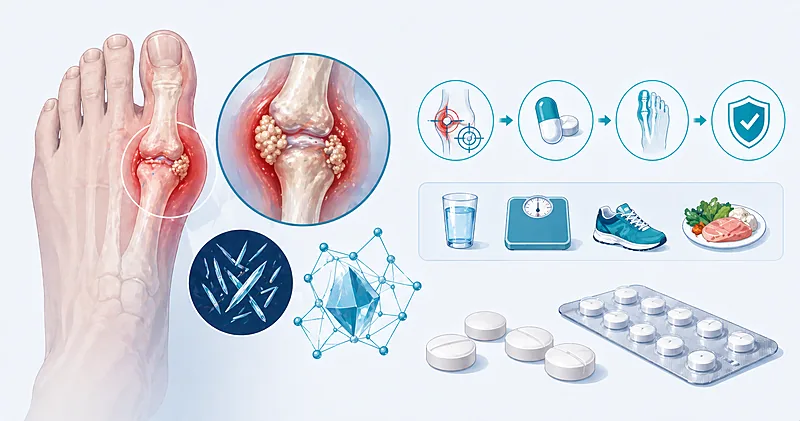
Clinical Decision Pathway
A practical four-question approach to gout management. Work through them in order — each answer tightens the next decision.
Special Populations and Comorbidity Care
Gout rarely travels alone. Hypertension, chronic kidney disease, cardiovascular disease, metabolic syndrome, and diuretic therapy are the usual fellow travelers. Good gout management attends to all of them.
Avoid febuxostat in adults with established cardiovascular disease unless allopurinol has failed or is contraindicated. The CARES trial showed higher cardiovascular and all-cause mortality in this subgroup.
Conditional Rec Moderate Evidence CARES Trial 2018Dose-reduce colchicine in severe chronic kidney disease and when co-prescribing strong CYP3A4 or P-glycoprotein inhibitors (e.g., clarithromycin, diltiazem, verapamil, cyclosporine). Fatal toxicity has been reported at standard doses in these combinations.
Strong Rec Moderate Evidence FDA LabelingCounsel every patient on limiting purine-rich foods (organ meats, seafood, red meat), minimizing alcohol (especially beer), cutting sugar-sweetened drinks, and achieving a healthy weight. These shifts meaningfully support gout management, though they rarely replace ULT at their own.
Moderate Rec Moderate Evidence ACR 2020Reassess diuretics in patients with recurrent gout. Switch thiazides to alternatives where possible, and consider losartan (which is modestly uricosuric) as the ARB of choice in hypertensive patients with gout.
Conditional Rec Low Evidence ACR 2020Screen every gout patient for hypertension, dyslipidemia, type 2 diabetes, chronic kidney disease, and obesity at diagnosis, and address each per their own guidelines.
Strong Rec Moderate Evidence ACR 2020Monitoring and Follow-Up
Titration is where gout management most often goes wrong — not at starting, and not at stopping, but in the slow drift toward target that never quite arrives. Schedule the recheck when you write the prescription.
| Parameter | When to Check | Target or Action Threshold | Common Pitfalls |
|---|---|---|---|
| Serum urate | Every 2–5 weeks during titration, then every 6–12 months | < 6 mg/dL (< 5 mg/dL if tophi) | Stopping titration at 300 mg allopurinol without checking urate |
| Renal function and electrolytes | Baseline, 2–4 weeks after each dose change, then per CKD-stage schedule | Stable eGFR; no new AKI | Attributing stable CKD progression to allopurinol |
| LFTs / FBC | Baseline, then periodically on ULT | No unexplained transaminitis, no cytopenia | Over-ordering routinely; under-ordering in dose escalations |
| Flare frequency and location | At every visit | Decreasing frequency after month 3; near-absent by month 12 | Stopping prophylaxis too early and blaming ULT |
| Tophi | Every 6–12 months | Gradual shrinkage or disappearance | Expecting rapid resolution — it takes many months |
| Blood pressure / metabolic profile | At least annually | Per condition-specific targets | Treating gout in isolation from its metabolic company |
Evidence in Context
What the major guidelines and trials say about modern gout management, where they agree, and where the evidence is weaker than the enthusiasm.
Where ACR 2020 and EULAR 2016 Agree
Both major frameworks endorse a treat-to-target approach, allopurinol as first-line ULT, the three co-equal flare drug classes (NSAID, colchicine, glucocorticoid), and the principle that ULT should continue uninterrupted during flares. Both also recommend anti-inflammatory prophylaxis when starting ULT.
Where They Differ
EULAR is slightly more permissive about starting ULT after a single flare, while ACR 2020 reserves that for high-risk subgroups (CKD, high urate, stones). There are also modest differences in prophylaxis duration and in emphasis on dietary intervention, which EULAR weighs more heavily as a standalone measure.
CARES and FAST: The Febuxostat CV Safety Story
The CARES trial, conducted in a North American population with established cardiovascular disease, found higher cardiovascular and all-cause mortality with febuxostat versus allopurinol. The subsequent European FAST trial, in a broader population, did not replicate the signal. The ACR 2020 guideline reads these together conservatively — prefer allopurinol in established CV disease; reserve febuxostat for genuine intolerance or failure.
HLA-B*58:01 Screening in Practice
The HLA-B*58:01 allele is strongly associated with allopurinol-induced SJS, TEN, and DRESS, with particularly high prevalence in Han Chinese, Korean, and Thai populations, and meaningful prevalence in some African groups. Pre-prescription testing in these populations is cost-effective and strongly endorsed by ACR 2020. In low-prevalence populations, routine screening is not recommended.
What We Still Do Not Know
Open questions include: whether treating asymptomatic hyperuricemia prevents incident CKD or cardiovascular events (current evidence says no clear benefit); the optimal serum urate target in long-standing tophaceous disease; the true incremental role of GLP-1 receptor agonists and bariatric surgery in disease modification; and whether pre-symptomatic imaging (ultrasound double-contour sign, dual-energy CT) should guide when to start ULT in atypical presentations.
References
- 1.FitzGerald JD, Dalbeth N, Mikuls T, et al. 2020 American College of Rheumatology Guideline for the Management of Gout. Arthritis Care Res (Hoboken). 2020;72(6):744–760. doi:10.1002/acr.24180
- 2.Richette P, Doherty M, Pascual E, et al. 2016 updated EULAR evidence-based recommendations for the management of gout. Ann Rheum Dis. 2017;76(1):29–42. doi:10.1136/annrheumdis-2016-209707
- 3.White WB, Saag KG, Becker MA, et al. Cardiovascular Safety of Febuxostat or Allopurinol in Patients with Gout. N Engl J Med. 2018;378(13):1200–1210. doi:10.1056/NEJMoa1710895
- 4.Mackenzie IS, Ford I, Nuki G, et al. Long-term cardiovascular safety of febuxostat compared with allopurinol in patients with gout (FAST): a multicentre, prospective, randomised, open-label, non-inferiority trial. Lancet. 2020;396(10264):1745–1757. doi:10.1016/S0140-6736(20)32234-0
- 5.Terkeltaub RA, Furst DE, Bennett K, et al. High versus low dosing of oral colchicine for early acute gout flare: Twenty-four-hour outcome of the first multicenter, randomized, double-blind, placebo-controlled, parallel-group, dose-comparison colchicine study. Arthritis Rheum. 2010;62(4):1060–1068. doi:10.1002/art.27327
How to Read the Evidence Tags
Every recommendation above carries two tags for recommendation strength and evidence quality — Medaptly’s own simplified interpretations — plus a source tag.
Recommendation Strength
| Tag | What It Means |
|---|---|
| Strong Rec | High-quality evidence broadly supports this action in most patients. |
| Moderate Rec | The weight of evidence favours this action in most patients. |
| Conditional Rec | Benefit is less certain — individualize based on patient factors and preference. |
| Against | Evidence shows no benefit or potential harm in this setting. |
Evidence Quality
| Tag | What It Means |
|---|---|
| High Evidence | Multiple well-designed RCTs or high-quality meta-analyses. |
| Moderate Evidence | Single RCT or large high-quality observational studies. |
| Low Evidence | Expert consensus, small studies, or indirect evidence. |