
Inpatient Hyperglycemia Management: Glucose Targets and Insulin Strategies
Clinical Practice Update — Basal-Bolus Dosing, Correction Scales, and Transitions of Care
This is an original clinical education article informed by current guidelines and evidence. See References below for source documents.
- Clinical Focus
- Evidence-based inpatient hyperglycemia management in non-pregnant adults on medical and surgical wards
- Target Audience
- Hospitalists, internists, surgical teams, residents, pharmacists, ward nurses
- Setting
- Hospital wards, step-down units, perioperative care, hospital discharge
- Source Evidence
- •ADA Standards of Care in Diabetes — Section 16 (Diabetes Care in the Hospital), 2024
- •Endocrine Society Clinical Practice Guideline: Management of Hyperglycemia in Hospitalized Adults (2022)
- •NICE-SUGAR Investigators: Intensive vs Conventional Glucose Control in Critically Ill Adults (NEJM, 2009)
- •RABBIT 2 & RABBIT 2 Surgery Trials: Basal-Bolus vs Sliding Scale Insulin
Key Clinical Takeaways
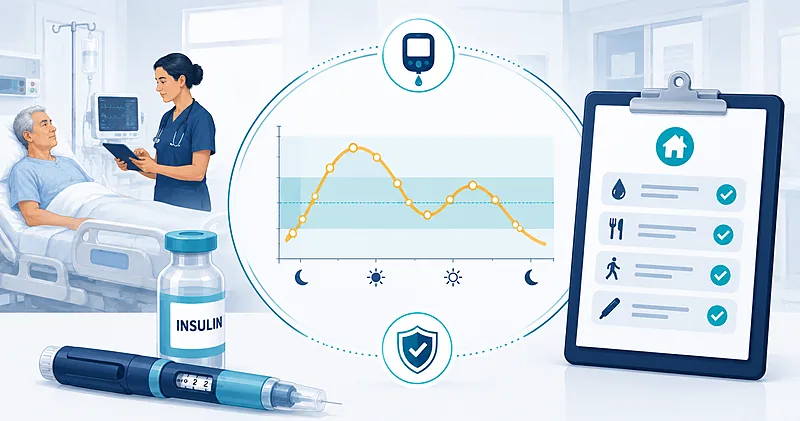
Effective inpatient hyperglycemia management rests on three decisions: pick a sensible glucose target, build a basal-bolus regimen sized to the patient, and plan the transition home before discharge day. The points below distill the evidence into actionable rules you can apply on rounds.
- 1Aim for 140–180 mg/dL in most hospitalized adults — the proven sweet spot between hyperglycemia harm and hypoglycemia risk
- 2Start scheduled basal-bolus insulin for any patient with persistent glucose above 180 mg/dL — not sliding scale alone
- 3Calculate total daily dose at 0.4–0.5 units/kg/day for typical adults; reduce to 0.2–0.3 for elderly, frail, or renal-impaired patients
- 4Split the total daily dose 50/50 between basal (glargine, detemir, degludec) and nutritional (lispro, aspart, glulisine)
- 5Use correction insulin alongside scheduled doses — never as standalone therapy for ongoing hyperglycemia
- 6Hold prandial insulin when patients are NPO; continue basal at 50–80% of usual dose
- 7Treat glucose below 70 mg/dL immediately and review the regimen the same shift — one hypoglycemic event predicts the next
- 8Start discharge planning at admission, not the day before discharge — the riskiest transition is back to outpatient care
- 9Order an HbA1c on admission if none documented in the prior 3 months — it shapes the discharge regimen
- 10Adjust the regimen daily based on the 24-hour pattern, not single readings
Inpatient Hyperglycemia Management: Setting the Glucose Target
Glucose targets sit at the heart of inpatient hyperglycemia management. The evidence is now unambiguous on one point: tighter is not better. The NICE-SUGAR trial, randomising 6,104 ICU patients to intensive (81–108 mg/dL) versus conventional (≤180 mg/dL) targets, showed higher 90-day mortality in the intensive group, driven largely by severe hypoglycemia.
Whether glucose elevation reflects established diabetes, undiagnosed diabetes, or stress hyperglycemia of acute illness, the immediate target is the same. The difference matters at discharge, not in the first 24 hours.
Target a glucose range of 140–180 mg/dL (7.8–10.0 mmol/L) for most hospitalized adults, both critically and non-critically ill.
Strong Rec High Evidence ADA 2024 Endocrine Society 2022Do not pursue intensive glucose targets below 110 mg/dL in critically ill adults; this approach raises severe hypoglycemia and 90-day mortality.
Against High Evidence NICE-SUGAR 2009Consider a tighter range of 110–140 mg/dL only in selected patients (postoperative cardiac surgery, low hypoglycemia risk, continuous glucose monitoring available).
Conditional Rec Moderate Evidence ADA 2024Accept a relaxed target of 180–250 mg/dL in patients with limited life expectancy, end-of-life care, or where the burden of glucose monitoring outweighs the benefit.
Moderate Rec Low Evidence Endocrine Society 2022Order an HbA1c within 24 hours of admission for any patient with hyperglycemia (glucose ≥140 mg/dL) and no documented HbA1c in the prior 3 months.
Strong Rec Moderate Evidence ADA 2024Treat glucose below 70 mg/dL as hypoglycemia regardless of symptoms and review the insulin regimen the same shift.
Strong Rec High Evidence ADA 2024Basal-Bolus Strategies for Inpatient Hyperglycemia Management
Basal-bolus is the cornerstone of inpatient hyperglycemia management for any patient who is eating. The RABBIT 2 trial randomised general medicine patients with type 2 diabetes to basal-bolus or sliding scale insulin alone — the basal-bolus arm achieved better mean glucose with no excess hypoglycemia. RABBIT 2 Surgery showed the same advantage in surgical patients, with lower rates of postoperative wound infection and pneumonia.
Calculating the Total Daily Dose
Start scheduled subcutaneous insulin in any non-critically ill adult with persistent glucose >180 mg/dL who is eating, using weight-based dosing.
Strong Rec High Evidence ADA 2024 RABBIT 2Use a starting total daily dose (TDD) of 0.4–0.5 units/kg/day for insulin-naïve adults with normal renal function.
Strong Rec Moderate Evidence Endocrine Society 2022Reduce the starting TDD to 0.2–0.3 units/kg/day in adults ≥70 years, frail patients, or those with eGFR <45 mL/min/1.73m².
Strong Rec Moderate Evidence Endocrine Society 2022For patients already on home insulin, restart at 60–80% of the prior home TDD during acute illness, then adjust to response.
Moderate Rec Low Evidence Endocrine Society 2022Split the calculated TDD as 50% basal (long-acting, given once or twice daily) and 50% nutritional (rapid-acting, split across three meals).
Strong Rec Moderate Evidence RABBIT 2Do not use sliding scale regular insulin as the sole regimen for ongoing inpatient hyperglycemia management — it reacts to glucose rather than preventing excursions.
Against High Evidence RABBIT 2 ADA 2024Choosing the Insulin Type
| Insulin Role | Preferred Agents | Onset / Duration | Typical Use on the Ward | Watch Out For |
|---|---|---|---|---|
| Basal | Glargine U-100, detemir, degludec | Onset 1–2 h / Duration 20–42 h | Once daily at bedtime (or AM) | Overnight hypoglycemia if patient becomes NPO |
| Nutritional (prandial) | Lispro, aspart, glulisine | Onset 10–20 min / Duration 3–5 h | Just before or with meals | Give AFTER meal if intake unpredictable |
| Correction | Same rapid-acting as prandial | Same as prandial | Added to scheduled prandial dose | Stacking if doses given <3–4 h apart |
| IV infusion | Regular insulin | Half-life ~5 min | DKA, HHS, ICU titration | Rapid rebound if stopped without overlap |
| Pre-mixed (avoid inpatient) | 70/30, 75/25 formulations | Varies | Not recommended for acute illness | Inflexible; risky if NPO |
Building Correction Scales That Work
Correction insulin is the rescue layer on top of scheduled basal-bolus. The mistake is to use it as the whole plan. A well-constructed correction scale uses the same rapid-acting analog as the prandial dose, is tied to the patient’s total daily dose, and is reviewed daily.
Calculate the insulin sensitivity factor (correction factor) using the Rule of 1800: ISF = 1800 ÷ TDD. This tells you how many mg/dL one unit of rapid-acting insulin should lower glucose.
Moderate Rec Low Evidence Endocrine Society 2022Stratify the correction scale into three sensitivities (insulin-sensitive, usual, insulin-resistant) based on TDD or estimated insulin resistance, rather than using one scale for everyone.
Moderate Rec Moderate Evidence Endocrine Society 2022Add the correction dose to the scheduled prandial dose at the same injection time — do not give as a separate injection 1–2 hours later.
Strong Rec Moderate Evidence Endocrine Society 2022Give correction-only doses for bedtime hyperglycemia — do not add correction at 0200–0600 unless the patient is on tube feeds or TPN running through the night.
Moderate Rec Low Evidence Endocrine Society 2022Reassess the regimen any day the patient receives correction insulin at 2 or more time points — the scheduled doses are too low.
Strong Rec Moderate Evidence ADA 2024Sample Correction Scale Tiers
| Glucose (mg/dL) | Insulin-Sensitive (TDD <40 U) | Usual (TDD 40–80 U) | Insulin-Resistant (TDD >80 U) | When to Reassess |
|---|---|---|---|---|
| 141–180 | + 1 U | + 2 U | + 3 U | If needed ≥2x in 24h |
| 181–220 | + 2 U | + 4 U | + 6 U | Daily |
| 221–260 | + 3 U | + 6 U | + 9 U | Daily; escalate basal |
| 261–300 | + 4 U | + 8 U | + 12 U | Check ketones; review |
| >300 | Call provider; check ketones | Call provider; check ketones | Call provider; check ketones | Rule out DKA / HHS |
Clinical Decision Pathway
A question-based walkthrough for the new admission with elevated glucose. Use it on rounds or at the bedside.
Special Situations on the Ward
A handful of scenarios bend the rules of inpatient hyperglycemia management. Recognising them early prevents the predictable downstream events.
When patients receive high-dose glucocorticoids, add an intermediate-acting insulin (NPH) timed to the steroid dose, or increase basal by 20–30% rather than relying on correction alone.
Moderate Rec Moderate Evidence Endocrine Society 2022For perioperative diabetes care, hold prandial insulin on the morning of surgery (NPO) but continue 50–80% of basal to prevent rebound ketosis in type 1 diabetes and stress hyperglycemia in type 2.
Strong Rec Moderate Evidence RABBIT 2 SurgeryNever abruptly discontinue insulin in a patient with type 1 diabetes — even when NPO — due to the risk of euglycemic DKA.
Strong Rec High Evidence ADA 2024When transitioning off an IV insulin infusion, give the first subcutaneous basal dose 2–4 hours before stopping the drip to prevent glucose rebound.
Strong Rec Moderate Evidence ADA 2024For patients on continuous tube feeds, give basal plus regular insulin every 6 hours (or rapid-acting every 4 hours) rather than splitting nutritional doses around imagined meals.
Moderate Rec Moderate Evidence Endocrine Society 2022Consider real-time continuous glucose monitoring (CGM) in non-ICU adults at high risk of hypoglycemia, where institutional protocols allow.
Conditional Rec Moderate Evidence ADA 2024Transitions of Care After Inpatient Hyperglycemia Management
Discharge is the most dangerous handoff. A patient who leaves on the wrong regimen, without supplies, or without follow-up will be back within 30 days. The discharge plan should be written on the admission day and refined as the picture clarifies.
Use admission HbA1c to anchor the discharge regimen: HbA1c <7% → consider resuming home regimen; HbA1c 7–9% → intensify oral therapy or add basal insulin; HbA1c >9% → discharge on basal-bolus or basal + GLP-1 RA.
Moderate Rec Moderate Evidence ADA 2024 Endocrine Society 2022Reduce the inpatient TDD by 20% when calculating the discharge insulin dose, since outpatient activity, appetite, and stress are different.
Moderate Rec Low Evidence Endocrine Society 2022Refer every insulin-naïve patient discharged on insulin for diabetes self-management education before or within 30 days of discharge.
Strong Rec High Evidence ADA 2024Document and dispense at discharge: prescriptions for all insulins, syringes or pen needles, glucose test strips, lancets, glucose meter, and glucagon kit.
Strong Rec Moderate Evidence ADA 2024Schedule outpatient follow-up within 2–4 weeks of discharge for all patients leaving on a new insulin regimen.
Strong Rec Moderate Evidence ADA 2024Communicate the discharge regimen to the outpatient primary care or endocrinology team in writing on the discharge summary — not by phone alone.
Strong Rec Moderate Evidence ADA 2024Verify cost and access for prescribed insulins before discharge; substitute to a covered formulation if needed rather than discovering the gap at the pharmacy counter.
Moderate Rec Low Evidence Endocrine Society 2022Monitoring and Follow-Up
A practical monitoring schedule keyed to what the patient is eating, what insulin they receive, and how recently they had hypoglycemia.
| What to Check | When | Action Threshold | Common Pitfalls |
|---|---|---|---|
| Point-of-care glucose (eating) | Before each meal and bedtime (4x/day) | <70 or >180 mg/dL | Stick before, dose after the meal — if delayed, the carbs are already in |
| Point-of-care glucose (NPO) | Every 4–6 hours | <70 or >180 mg/dL | Don’t forget the 0200 check if on a long-acting basal |
| IV insulin titration | Every 1–2 hours until stable, then q2–4h | Outside target by >30 mg/dL | Delayed checks lead to overshoot in both directions |
| HbA1c | Once on admission (if not done in past 3 months) | ≥6.5% confirms diabetes | Falsely low in recent transfusion, hemolysis, late pregnancy |
| Beta-hydroxybutyrate or anion gap | When glucose >300 mg/dL or SGLT2i was recently held | Ketones positive or AG >14 | Euglycemic DKA missed in type 1 or SGLT2i users |
| Hypoglycemia review | Same shift as any glucose <70 mg/dL | Adjust the dose that caused it | Treating the number without changing the regimen guarantees a repeat |
Evidence in Context
Where the major recommendations come from, where guidelines agree, and where evidence is still evolving.
Why 140–180 mg/dL Became the Standard Target
The shift away from tight glycemic control (81–108 mg/dL) followed the NICE-SUGAR trial, which enrolled critically ill adults and demonstrated higher absolute risk of death at 90 days in the intensive arm. Severe hypoglycemia (≤40 mg/dL) was six times more common with intensive control. Subsequent meta-analyses confirmed that the harms of hypoglycemia outweigh modest improvements in hyperglycemia for most hospitalized patients. The 140–180 mg/dL window is the practical compromise endorsed by both the ADA and the Endocrine Society.
Basal-Bolus vs Sliding Scale: What RABBIT 2 Settled
RABBIT 2 randomised general medicine patients with type 2 diabetes to glargine-plus-glulisine basal-bolus versus regular insulin sliding scale alone. The basal-bolus group achieved a mean glucose roughly 30 mg/dL lower with no excess hypoglycemia. RABBIT 2 Surgery extended the finding to surgical patients, where basal-bolus also reduced the composite of postoperative wound infection, pneumonia, respiratory failure, acute kidney injury, and bacteremia. Sliding scale alone is no longer a defensible primary strategy for ward-level inpatient hyperglycemia management in patients who are eating.
Where the ADA and Endocrine Society Differ
The two frameworks converge on the 140–180 mg/dL target, the preference for basal-bolus over sliding scale, and discharge-planning principles. They differ in emphasis on continuous glucose monitoring (the 2022 Endocrine Society guidance gives it a more prominent role in selected ward patients than earlier ADA statements) and on the use of non-insulin agents during admission (the Endocrine Society explicitly supports continuing or starting DPP-4 inhibitors and, in some settings, GLP-1 receptor agonists in clinically stable patients with mild hyperglycemia).
The Case for Continuous Glucose Monitoring on the Ward
Several non-ICU studies have shown that real-time CGM reduces hypoglycemia events compared with point-of-care testing in hospitalized patients on insulin. The 2022 Endocrine Society guidance gives CGM a conditional recommendation in selected high-risk adults. Adoption is uneven and depends on nursing comfort, IT integration, and the local protocol for when fingerstick confirmation is required.
Non-Insulin Agents in the Hospital
Metformin and SGLT2 inhibitors are typically held on admission for acute illness, contrast, or planned surgery. DPP-4 inhibitors are weight-neutral and low-hypoglycemia-risk; small trials suggest they can match basal insulin in mildly hyperglycemic stable patients. GLP-1 receptor agonists have an emerging hospital role but should not be started in patients with gastroparesis, severe nausea, or recent pancreatitis.
References
- 1.American Diabetes Association. 16. Diabetes Care in the Hospital: Standards of Care in Diabetes—2024. Diabetes Care. 2024;47(Suppl 1):S295–S306. doi:10.2337/dc24-S016
- 2.Korytkowski MT, Muniyappa R, Antinori-Lent K, et al. Management of Hyperglycemia in Hospitalized Adult Patients in Non-Critical Care Settings: An Endocrine Society Clinical Practice Guideline. J Clin Endocrinol Metab. 2022;107(8):2101–2128. doi:10.1210/clinem/dgac278
- 3.NICE-SUGAR Study Investigators, Finfer S, Chittock DR, et al. Intensive versus conventional glucose control in critically ill patients. N Engl J Med. 2009;360(13):1283–1297. doi:10.1056/NEJMoa0810625
- 4.Umpierrez GE, Smiley D, Zisman A, et al. Randomized study of basal-bolus insulin therapy in the inpatient management of patients with type 2 diabetes (RABBIT 2 trial). Diabetes Care. 2007;30(9):2181–2186. doi:10.2337/dc07-0295
- 5.Umpierrez GE, Smiley D, Jacobs S, et al. Randomized study of basal-bolus insulin therapy in the inpatient management of patients with type 2 diabetes undergoing general surgery (RABBIT 2 Surgery). Diabetes Care. 2011;34(2):256–261. doi:10.2337/dc10-1407
- 6.Pasquel FJ, Lansang MC, Dhatariya K, Umpierrez GE. Management of diabetes and hyperglycaemia in the hospital. Lancet Diabetes Endocrinol. 2021;9(3):174–188. doi:10.1016/S2213-8587(20)30381-8
How to Read the Evidence Tags
Every recommendation carries two Medaptly tags — one for strength, one for evidence quality — plus a source tag. These are simplified summaries of underlying guideline grading systems.
Recommendation Strength
| Tag | What It Means |
|---|---|
| Strong Rec | High-quality evidence broadly supports this action. |
| Moderate Rec | The weight of evidence favours this action. |
| Conditional Rec | Benefit is less certain — individualise. |
| Against | Evidence shows no benefit or potential harm. |
Evidence Quality
| Tag | What It Means |
|---|---|
| High Evidence | Multiple well-designed RCTs or high-quality meta-analyses. |
| Moderate Evidence | Single RCT or large observational studies. |
| Low Evidence | Expert consensus or small studies. |