
Obstructive Sleep Apnea: 8 Essential CPAP Treatment Rules
Clinical Practice Update — Screening, Diagnosis, CPAP Therapy, and Alternatives in Adults
This is an original clinical education article informed by current guidelines and evidence. See References below for source documents.
- Clinical Focus
- Evidence-based obstructive sleep apnea treatment in adults, from screening through long-term management
- Target Audience
- Primary care physicians, hospitalists, cardiologists, residents, advanced practice providers
- Setting
- Primary care, outpatient internal medicine, sleep clinic referral
- Source Evidence
- •AASM Clinical Practice Guideline for Diagnostic Testing of Adult OSA (2017)
- •AASM Clinical Practice Guideline for Treatment of OSA with PAP (2019)
- •AASM/AADSM Guideline on Oral Appliance Therapy (2015)
- •STAR Trial — Hypoglossal Nerve Stimulation (NEJM, 2014)
- •SAVE Trial — CPAP for Cardiovascular Prevention (NEJM, 2016)
Key Clinical Takeaways
Effective obstructive sleep apnea treatment in adults hinges on recognizing at-risk patients, choosing the right diagnostic study, and matching therapy to severity and patient preference. The rules below distill current AASM evidence and landmark trial data into actions you can take at the bedside and in clinic.
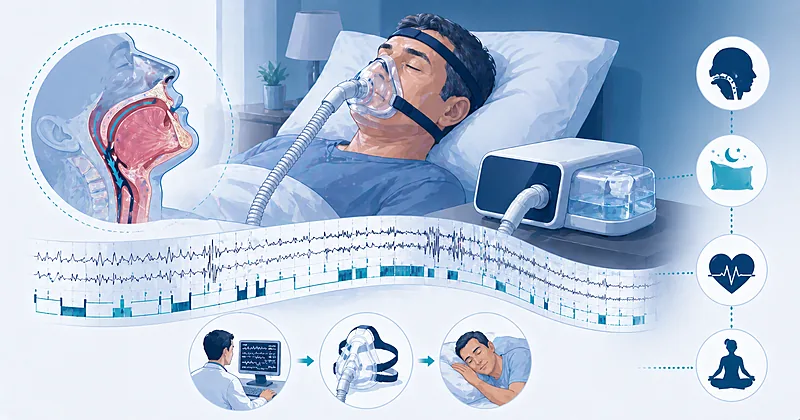
- 1Screen adults with snoring, witnessed apneas, daytime sleepiness, or cardiometabolic disease using the STOP-Bang questionnaire → Screening & Diagnosis
- 2Choose home sleep apnea testing when pretest probability is high and comorbidity is low; choose in-lab polysomnography when it is not → Screening & Diagnosis
- 3Start CPAP as first-line therapy for moderate-to-severe OSA (AHI ≥ 15) → CPAP Initiation
- 4Aim for at least 4 hours of CPAP use per night on 70% or more of nights within the first 90 days → Monitoring
- 5Offer a custom mandibular advancement device for mild-to-moderate OSA or CPAP intolerance → Alternatives
- 6Consider hypoglossal nerve stimulation in carefully selected CPAP-intolerant adults with moderate-to-severe OSA → Alternatives
- 7Pair every therapy with weight loss counseling, positional advice, and alcohol timing guidance → Adjunctive Measures
- 8Screen every newly diagnosed patient for hypertension, atrial fibrillation, diabetes, and depression → Comorbidity Care
Screening and Diagnosis for Obstructive Sleep Apnea Treatment
The first step in obstructive sleep apnea treatment is identifying who actually has the disease. Undiagnosed OSA remains common, particularly in adults presenting with resistant hypertension, atrial fibrillation, or type 2 diabetes. A short validated questionnaire plus the right sleep study answers the question in a week.
The STOP-Bang tool (Snoring, Tiredness, Observed apnea, high blood Pressure, BMI > 35, Age > 50, Neck > 40 cm, male Gender) is the workhorse screener. A score of 3 or more flags intermediate risk; 5 or more suggests a high probability of moderate-to-severe OSA and warrants testing.
Screen adults with habitual snoring, witnessed apneas, or excessive daytime sleepiness using STOP-Bang. Pair the score with an Epworth Sleepiness Scale to document subjective sleepiness as a treatment baseline.
Strong Rec High Evidence AASM 2017Order home sleep apnea testing (HSAT) for adults with a high pretest probability of moderate-to-severe OSA and no significant cardiopulmonary or neuromuscular comorbidity. HSAT is cheaper, faster, and performs well in this population.
Strong Rec High Evidence AASM 2017Perform in-lab polysomnography when HSAT is technically inadequate, non-diagnostic in a symptomatic patient, or when the patient has heart failure, severe COPD, chronic opioid use, neuromuscular disease, or suspected parasomnia.
Strong Rec Moderate Evidence AASM 2017Matching the Sleep Study to the Patient
| Patient Profile | Preferred Study | Rationale | Common Pitfall |
|---|---|---|---|
| Loud snorer, BMI 35, HTN, no heart/lung disease | HSAT | High pretest probability; uncomplicated | Accepting a negative HSAT as “no OSA” despite strong symptoms |
| Systolic heart failure, orthopnea | In-lab PSG | Rule out central or mixed apnea; HSAT underestimates | Missing treatment-emergent central apnea on CPAP |
| Chronic opioid therapy | In-lab PSG | Higher prevalence of central apnea and hypoventilation | Assuming CPAP will fix an opioid-induced ventilation pattern |
| Suspected parasomnia or nocturnal seizures | In-lab PSG with EEG | HSAT cannot capture sleep stages or epileptiform activity | Labeling as OSA and missing another diagnosis |
| Commercial driver, safety-sensitive job | In-lab PSG (often required) | Regulatory thresholds; higher diagnostic yield | Delayed certification due to indeterminate HSAT |
| Negative HSAT, persistent symptoms | Escalate to in-lab PSG | HSAT false-negative rate is meaningful in lighter OSA | Reassuring the patient and closing the workup prematurely |
CPAP Initiation: The Core of Obstructive Sleep Apnea Treatment
CPAP remains the most effective therapy available for obstructive sleep apnea treatment in adults. It reduces the apnea-hypopnea index toward zero in most users, improves daytime sleepiness, lowers blood pressure modestly, and reduces motor vehicle crash risk. The challenge is not the evidence — it is getting patients to use the device consistently.
Auto-titrating PAP (APAP) delivers variable pressure within a set range and matches fixed CPAP for symptom improvement in most uncomplicated patients. Fixed CPAP, titrated in-lab or by average APAP pressure, remains appropriate for patients with heart failure, hypoventilation syndromes, or poor response to APAP.
Start CPAP as first-line therapy for adults with moderate-to-severe OSA (AHI ≥ 15 events/hour), regardless of symptoms. CPAP is the most consistently effective option in obstructive sleep apnea treatment at these severities.
Strong Rec High Evidence AASM 2019Offer CPAP to adults with mild OSA (AHI 5–14) when symptoms impair quality of life, when there is cardiovascular comorbidity, or when the patient prefers it after a discussion of options.
Moderate Rec Moderate Evidence AASM 2019Prescribe APAP or fixed-pressure CPAP in uncomplicated adults — both are acceptable and deliver comparable outcomes. APAP can simplify initiation by avoiding an in-lab titration night.
Strong Rec High Evidence AASM 2019Provide structured behavioral and educational support alongside device delivery — this is the single most effective intervention for improving CPAP adherence. A follow-up visit or call within 2–4 weeks catches early problems.
Strong Rec High Evidence AASM 2019Do not use BPAP as the initial device in uncomplicated OSA. Reserve bilevel therapy for documented CPAP pressure intolerance, co-existing hypoventilation (OHS, neuromuscular, or severe COPD overlap), or treatment-emergent central apneas.
Against Moderate Evidence AASM 2019CPAP Troubleshooting in the First 90 Days
| Patient Complaint | Likely Cause | First Fix at the Bedside | When to Escalate |
|---|---|---|---|
| Dry nose or epistaxis | Insufficient humidification | Turn up heated humidifier; add saline spray at bedtime | Persistent bleeding or anatomical obstruction |
| Air leak, red eyes in the morning | Mask fit or wear issue | Refit at the DME provider; trial a different mask style | Leak persists after two mask changes |
| Aerophagia (bloating, belching) | Pressure too high or mouth breathing | Lower APAP ceiling; switch to full-face mask or add chinstrap | Severe symptoms — consider BPAP |
| Claustrophobia | Mask style or anxiety | Trial nasal pillows; desensitization (wear daytime 10–15 min) | Consider oral appliance as alternative |
| Persistent sleepiness on treatment | Insufficient use, residual AHI, or other cause | Download adherence data; check residual AHI & leak | Evaluate for narcolepsy, depression, shift-work disorder |
| Central apneas on device report | Treatment-emergent central sleep apnea | Lower pressures if possible; monitor for spontaneous resolution | Refer for ASV trial if persistent and without HFrEF |
Clinical Decision Pathway
A practical four-question approach to obstructive sleep apnea treatment. Work through the questions in order — each one narrows the next.
Alternatives When CPAP Is Not the Answer
Roughly a third of patients will not tolerate CPAP long term. For these adults, several well-studied alternatives complete the obstructive sleep apnea treatment toolkit: oral appliances, hypoglossal nerve stimulation, positional therapy, and sustained weight loss (surgical or pharmacological).
Offer a custom, titratable mandibular advancement device fitted by a qualified dentist to adults with mild-to-moderate OSA who decline or cannot tolerate CPAP. Confirm efficacy with a repeat sleep study once titration is complete.
Moderate Rec Moderate Evidence AASM/AADSM 2015Consider hypoglossal nerve stimulation in adults with moderate-to-severe OSA (typically AHI 15–65), BMI below the device-specific threshold (often 32–35 kg/m²), documented CPAP intolerance, and absence of complete concentric palatal collapse on drug-induced sleep endoscopy.
Conditional Rec Moderate Evidence STAR Trial 2014Advise weight loss of at least 10% of body weight in overweight adults with OSA. Meaningful weight reduction can cut AHI substantially and may eliminate mild-to-moderate disease. Bariatric surgery and GLP-1 receptor agonists are reasonable adjuncts when indicated.
Strong Rec Moderate Evidence AASM 2019Consider positional therapy (wearable vibration alarms or positional pillows that discourage supine sleep) in adults with supine-predominant OSA, either alone for mild disease or as an adjunct to other therapies.
Conditional Rec Low Evidence AASM 2019Matching Therapy to Clinical Scenario
| Clinical Scenario | First-Line Option | Reasonable Alternatives | Practical Considerations |
|---|---|---|---|
| Mild OSA, minimal symptoms | Weight loss + positional advice | MAD, CPAP | Reassess with sleep study after meaningful weight change |
| Moderate OSA, sleepy, working-age | CPAP (APAP) | MAD if CPAP refused | Early follow-up is critical in this group |
| Severe OSA, obese | CPAP + weight loss program | Bariatric referral; GLP-1 if indicated | Weight loss can reduce required CPAP pressure |
| CPAP intolerant, BMI < 32, AHI 20 | MAD trial | Hypoglossal nerve stimulation after DISE | Document genuine CPAP trial before stimulator referral |
| Supine-predominant OSA | Positional therapy | CPAP or MAD if positional fails | Wearable devices outperform simple back-pillow tricks |
| OSA + resistant hypertension | CPAP | MAD if CPAP refused | Expect modest BP reduction (roughly 2–3 mmHg) |
Monitoring Adherence and Response
Modern CPAP devices report use, leak, and residual AHI through a cloud platform. This objective data transforms follow-up from a symptom-only conversation into a diagnosis-grade review. Look at it at every visit.
Review objective CPAP adherence data within 90 days of initiation. Target at least 4 hours per night on 70% or more of nights — the threshold used by most payers and a floor below which benefits drop sharply.
Strong Rec High Evidence AASM 2019Reassess every patient on any obstructive sleep apnea treatment at least annually for symptom recurrence, weight change, mask fit, and device age. Replace supplies (mask cushions, tubing, filters) on the schedule recommended by the manufacturer.
Moderate Rec Low Evidence AASM 2019What to Check, When, and Why
| Parameter | When to Check | Target or Action Threshold | Common Pitfalls |
|---|---|---|---|
| Nightly use (hours) | 2–4 weeks, 90 days, annually | ≥ 4 hours on ≥ 70% of nights | Averaging hides nights of zero use |
| Residual AHI on device | Every follow-up | < 5 events/hour | Device AHI is not PSG-grade — trust trends, not absolutes |
| Mask leak | Every follow-up | Below manufacturer threshold; no red flags | Large leak can artificially lower AHI readings |
| Epworth score | Baseline, 90 days, annually | Meaningful drop from baseline | Persistent sleepiness with good adherence needs workup |
| Weight / BMI | Annually | Reconsider pressure settings after > 10% change | Weight loss can make fixed CPAP overshoot; APAP adapts |
| Blood pressure | Routinely, at least annually | Per usual HTN targets | Expect only modest BP improvement from CPAP alone |
Managing OSA Comorbidities
OSA travels with a familiar set of cardiometabolic conditions. Addressing them in parallel is as important as the device at the bedside.
Screen every newly diagnosed OSA patient for hypertension, atrial fibrillation, type 2 diabetes, and depression. Initial workup should include resting blood pressure, a fasting glucose or HbA1c, a lipid panel, and either an ECG or rhythm check if symptoms suggest AF.
Strong Rec Moderate Evidence AHA/AASMEvaluate for OSA in every adult with resistant hypertension, recurrent atrial fibrillation after rhythm control, or unexplained pulmonary hypertension. Confirmation and obstructive sleep apnea treatment may improve rhythm control and BP response.
Strong Rec Moderate Evidence AHA Scientific StatementEvidence in Context
What the major trials and guidelines say about obstructive sleep apnea treatment, where they agree, and where the evidence is softer than the enthusiasm.
Where AASM and ERS Agree
Both the AASM and European Respiratory Society endorse CPAP as first-line therapy for moderate-to-severe OSA, support home testing in uncomplicated adults with high pretest probability, and recommend structured adherence support. Both also recognize mandibular advancement devices as a reasonable alternative when CPAP fails.
Where the Guidelines Diverge
AASM is more permissive about HSAT use in uncomplicated adults. Some European bodies prefer in-lab studies more readily, particularly where HSAT infrastructure is limited. Position statements on hypoglossal nerve stimulation also differ in the BMI and AHI thresholds used for candidate selection.
The SAVE Trial: What CPAP Did and Did Not Do
The SAVE trial enrolled adults with established cardiovascular disease and moderate-to-severe OSA. CPAP improved sleepiness, quality of life, and mood, but did not reduce the composite of major cardiovascular events versus usual care. Mean nightly use was modest (about 3.3 hours), which some interpret as an adherence rather than efficacy result. The practical lesson: treat OSA for symptoms and comorbidity control — do not oversell CV event reduction.
The STAR Trial: Hypoglossal Nerve Stimulation
STAR demonstrated that upper-airway stimulation reduced AHI substantially at 12 months in carefully selected CPAP-intolerant adults. Durable responses have now been reported out past 5 years. Patient selection is the key variable: inclusion criteria (AHI range, BMI cap, absence of complete concentric palatal collapse) were tight and matter clinically.
What We Still Do Not Know
Open questions include: whether CPAP prevents cardiovascular events when adherence is high enough; how best to personalize obstructive sleep apnea treatment to OSA endotypes (loop gain, arousal threshold, upper-airway collapsibility); and the comparative effectiveness of GLP-1 receptor agonists versus bariatric surgery as disease-modifying interventions.
References
- 1.Kapur VK, Auckley DH, Chowdhuri S, et al. Clinical Practice Guideline for Diagnostic Testing for Adult Obstructive Sleep Apnea: An American Academy of Sleep Medicine Clinical Practice Guideline. J Clin Sleep Med. 2017;13(3):479–504. doi:10.5664/jcsm.6506
- 2.Patil SP, Ayappa IA, Caples SM, et al. Treatment of Adult Obstructive Sleep Apnea with Positive Airway Pressure: An American Academy of Sleep Medicine Clinical Practice Guideline. J Clin Sleep Med. 2019;15(2):335–343. doi:10.5664/jcsm.7640
- 3.Ramar K, Dort LC, Katz SG, et al. Clinical Practice Guideline for the Treatment of Obstructive Sleep Apnea and Snoring with Oral Appliance Therapy: An Update for 2015. J Clin Sleep Med. 2015;11(7):773–827. doi:10.5664/jcsm.4858
- 4.Strollo PJ Jr, Soose RJ, Maurer JT, et al. Upper-Airway Stimulation for Obstructive Sleep Apnea. N Engl J Med. 2014;370(2):139–149. doi:10.1056/NEJMoa1308659
- 5.McEvoy RD, Antic NA, Heeley E, et al. CPAP for Prevention of Cardiovascular Events in Obstructive Sleep Apnea. N Engl J Med. 2016;375(10):919–931. doi:10.1056/NEJMoa1606599
- 6.Yeghiazarians Y, Jneid H, Tietjens JR, et al. Obstructive Sleep Apnea and Cardiovascular Disease: A Scientific Statement From the American Heart Association. Circulation. 2021;144(3):e56–e67. doi:10.1161/CIR.0000000000000988
How to Read the Evidence Tags
Every recommendation above carries two tags for recommendation strength and evidence quality — Medaptly’s own simplified interpretations, plus a source tag.
Recommendation Strength
| Tag | What It Means |
|---|---|
| Strong Rec | High-quality evidence broadly supports this action in most patients. |
| Moderate Rec | The weight of evidence favours this action for most patients. |
| Conditional Rec | Benefit is less certain — individualize based on patient factors and preference. |
| Against | Evidence shows no benefit or potential harm in this setting. |
Evidence Quality
| Tag | What It Means |
|---|---|
| High Evidence | Multiple well-designed RCTs or high-quality meta-analyses. |
| Moderate Evidence | Single RCT or large high-quality observational studies. |
| Low Evidence | Expert consensus, small studies, or indirect evidence. |