
Pulmonary Embolism Treatment: 2024 Proven Clinical Guide
Clinical Practice Update — Risk Stratification, Anticoagulation, Advanced Therapies, and Duration Decisions in Adults
This is an original clinical education article informed by current guidelines and evidence. See References below for source documents.
- Clinical Focus
- Evidence-based pulmonary embolism treatment in hemodynamically stable and unstable adults
- Target Audience
- Internists, emergency physicians, hospitalists, pulmonologists, residents
- Setting
- Emergency department, hospital inpatient, ambulatory follow-up
- Source Evidence
- •2019 ESC Guidelines on Acute Pulmonary Embolism
- •ACCP/CHEST 2021 Antithrombotic Therapy for VTE
- •PEITHO Trial — Thrombolysis in Intermediate-Risk PE (NEJM, 2014)
- •HOT-PE Trial — Home Treatment of Low-Risk PE (Eur Heart J, 2020)
- •CARAVAGGIO Trial — Apixaban in Cancer-Associated VTE (NEJM, 2020)
Key Clinical Takeaways
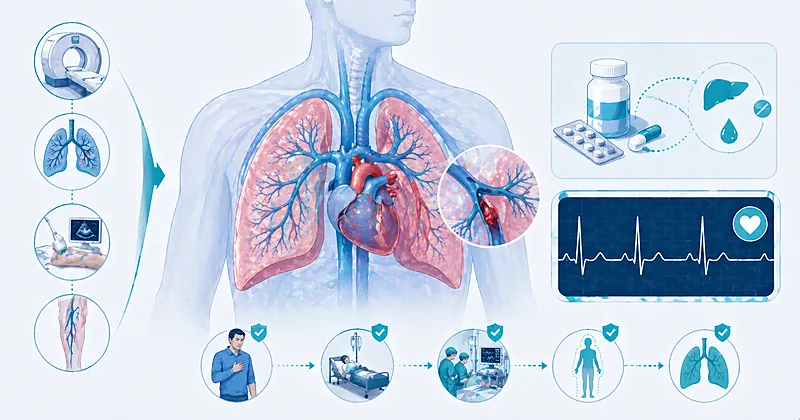
Effective pulmonary embolism treatment rests on three fast-moving decisions at the bedside: stratify risk accurately, choose the right anticoagulant, and decide whether advanced therapies or extended anticoagulation are needed. The points below condense current evidence into actionable rules for adults with acute PE.
- 1Perform risk stratification on every confirmed PE using PESI or sPESI plus hemodynamic status → Risk Stratification
- 2Start apixaban or rivaroxaban as first-line anticoagulation for most adults with acute PE → Anticoagulation
- 3Give systemic thrombolysis to hemodynamically unstable (high-risk) PE without delay → Advanced Therapies
- 4Do not routinely thrombolyse normotensive intermediate-risk PE — bleeding outweighs benefit → Advanced Therapies
- 5Consider home treatment for carefully selected low-risk PE (sPESI 0, HESTIA-negative) → Disposition
- 6Use a DOAC or LMWH in active cancer — apixaban is preferred in most solid tumours → Special Populations
- 7Anticoagulate for at least 3 months; extend indefinitely for unprovoked PE with low bleeding risk → Duration
- 8Use reduced-dose apixaban (2.5 mg BID) or rivaroxaban (10 mg daily) for extended therapy beyond 6 months → Duration
- 9Reserve IVC filters for patients with an absolute contraindication to anticoagulation → Advanced Therapies
- 10Reassess bleeding and recurrence risk at 3–6 months before deciding on extended anticoagulation → Monitoring
Risk Stratification in Pulmonary Embolism Treatment
Risk stratification is the single most consequential step in pulmonary embolism treatment because it drives every downstream decision: disposition, choice of anticoagulant, need for thrombolysis, and level of monitoring. Hemodynamic status is assessed first, followed by clinical scoring and, when relevant, imaging and biomarkers.
Assess hemodynamic status first in every confirmed PE. Persistent hypotension (SBP <90 mmHg for >15 minutes, or needing vasopressors) defines high-risk PE and mandates urgent consideration of reperfusion therapy.
Strong Rec High Evidence ESC 2019Calculate sPESI for every normotensive patient — a score of 0 identifies a 30-day mortality under 1% and supports outpatient treatment in selected patients. PESI is more granular but slower; sPESI is preferred in time-pressured settings.
Strong Rec High Evidence ESC 2019 ACCP 2021Obtain transthoracic echocardiography and cardiac biomarkers (troponin, NT-proBNP) in any patient with sPESI ≥1 to detect right ventricular dysfunction. The combination of RV strain and positive troponin defines intermediate-high risk.
Moderate Rec Moderate Evidence ESC 2019Classify every patient into one of four risk tiers — high, intermediate-high, intermediate-low, or low — and document the category in the chart. Each tier has a distinct management pathway for pulmonary embolism treatment.
Strong Rec Moderate Evidence ESC 2019Risk Tier Profile: What Each Category Means in Practice
| Risk Tier | Defining Features | Approximate 30-Day Mortality | Disposition | Key Action |
|---|---|---|---|---|
| High | Hemodynamic instability (SBP <90, vasopressors, or arrest) | >15% | ICU | Systemic thrombolysis or embolectomy |
| Intermediate-high | Normotensive + RV dysfunction + positive troponin | 3–15% | Monitored inpatient bed | Anticoagulate; rescue thrombolysis if decompensating |
| Intermediate-low | Normotensive + RV dysfunction OR positive troponin (not both) | ~3% | General ward | Standard anticoagulation; no thrombolysis |
| Low | Normotensive, sPESI 0, no RV dysfunction, negative biomarkers | <1% | Home or short-stay observation | Outpatient anticoagulation if HESTIA-negative |
Anticoagulation Selection for Pulmonary Embolism Treatment
Anticoagulation is the backbone of pulmonary embolism treatment in every risk tier except those needing reperfusion. DOACs are now preferred for most patients because of fewer drug interactions, no routine monitoring, and lower intracranial bleeding rates than warfarin. Agent choice is driven by renal function, weight, pregnancy status, active cancer, and drug interactions.
Prescribe apixaban 10 mg BID for 7 days, then 5 mg BID, as first-line anticoagulation for hemodynamically stable adults with acute PE and no active cancer.
Strong Rec High Evidence ACCP 2021 ESC 2019Alternatively, prescribe rivaroxaban 15 mg BID for 21 days, then 20 mg daily with food, in the same population. Apixaban has a slightly lower major bleeding rate in head-to-head comparisons.
Strong Rec High Evidence ACCP 2021In patients with active cancer and acute PE, prescribe apixaban or a low-molecular-weight heparin (enoxaparin 1.5 mg/kg daily). Avoid edoxaban and rivaroxaban in luminal gastrointestinal malignancies due to higher GI bleeding.
Strong Rec High Evidence ACCP 2021 ISTH 2022Use LMWH throughout pregnancy for acute PE. Do not use DOACs or warfarin in pregnancy — DOACs lack pregnancy safety data and warfarin crosses the placenta.
Strong Rec Moderate Evidence ESC 2019Choose warfarin (target INR 2–3) only when DOACs are contraindicated: mechanical heart valves, triple-positive antiphospholipid syndrome, severe renal impairment (CrCl <15 mL/min), or cost barriers with no DOAC access.
Moderate Rec Moderate Evidence ACCP 2021Bridge with therapeutic LMWH for 5–10 days before starting dabigatran or edoxaban. Apixaban and rivaroxaban do not require LMWH lead-in — they can be started immediately after PE is confirmed.
Strong Rec High Evidence ACCP 2021Anticoagulant Options at a Glance
| Agent | Acute Dose | Best Patient Profile | Key Cautions & Practical Tips |
|---|---|---|---|
| Apixaban | 10 mg BID × 7 days, then 5 mg BID | First choice for most adults; cancer-associated VTE; elderly; CrCl ≥25 | Lowest major bleeding rate among DOACs. No food requirement. Avoid with strong CYP3A4/P-gp inhibitors. |
| Rivaroxaban | 15 mg BID × 21 days, then 20 mg daily | Patients who prefer once-daily dosing after the initial 3 weeks | Must be taken with food (bioavailability). Avoid in GI cancers. |
| Dabigatran | 150 mg BID (after 5–10 days LMWH) | Patients who tolerated LMWH lead-in; idarucizumab reversal available | Capsule cannot be split. Dyspepsia common. Avoid CrCl <30. |
| Edoxaban | 60 mg daily (after 5–10 days LMWH); 30 mg if CrCl 15–50 or weight ≤60 kg | Renal dose-adjusted; cancer-associated VTE (non-GI) | Do NOT use if CrCl >95 (reduced efficacy). Avoid in GI cancers. |
| LMWH (enoxaparin) | 1 mg/kg SC BID or 1.5 mg/kg SC daily | Pregnancy; selected cancer patients; temporary initial therapy | Dose-adjust for CrCl <30. Monitor anti-Xa in pregnancy or extreme weight. |
| Warfarin | Start with LMWH overlap ≥5 days AND INR ≥2 for 24 hours | Mechanical valves; triple-positive APS; severe CKD; cost-limited settings | Multiple interactions. Requires regular INR monitoring. |
Advanced Therapies: Thrombolysis, Catheter-Directed, and Surgical Options
Advanced therapies shift the balance between clot resolution and bleeding risk. Systemic thrombolysis saves lives in hemodynamically unstable PE but causes a roughly two-fold increase in major bleeding in stable patients. Catheter-directed options aim to deliver the benefit with less bleeding — promising but still evolving.
Give systemic thrombolysis (alteplase 100 mg IV over 2 hours) to every hemodynamically unstable PE patient who has no absolute contraindication to bleeding. In cardiac arrest, use 50 mg IV bolus over 15 minutes.
Strong Rec Moderate Evidence ESC 2019 ACCP 2021Do not routinely give systemic thrombolysis to normotensive intermediate-risk PE. The PEITHO trial showed reduced hemodynamic decompensation but a doubled rate of major bleeding and a 10-fold increase in intracranial hemorrhage compared with anticoagulation alone.
Against High Evidence PEITHO 2014 ESC 2019Consider catheter-directed thrombolysis or mechanical thrombectomy for intermediate-high risk patients who deteriorate despite anticoagulation, and for high-risk patients with contraindications to systemic thrombolysis.
Conditional Rec Low Evidence ESC 2019Screen for absolute thrombolysis contraindications before dosing alteplase: recent hemorrhagic stroke, active internal bleeding, recent major surgery (<3 weeks), intracranial neoplasm, and severe uncontrolled hypertension.
Strong Rec Moderate Evidence ESC 2019Reserve IVC filters for patients with acute PE and an absolute contraindication to anticoagulation, or for recurrent PE despite therapeutic anticoagulation. Remove the filter as soon as anticoagulation becomes safe.
Moderate Rec Moderate Evidence ACCP 2021Disposition: Who Can Go Home?
Carefully selected low-risk PE patients have equivalent outcomes whether managed at home or admitted. The HOT-PE study demonstrated safety of early discharge with rivaroxaban in patients without RV dysfunction or significant comorbidity. Success depends on disciplined selection and robust follow-up.
Consider home treatment for a patient with sPESI 0, HESTIA criteria negative, preserved RV function on echo, normal biomarkers, adequate social support, and reliable 24–72-hour follow-up.
Moderate Rec Moderate Evidence HOT-PE 2020 ESC 2019Admit every intermediate-risk or high-risk patient. Do not discharge a patient with RV strain on echo, positive troponin, or any HESTIA-positive criterion, even if they look clinically well.
Strong Rec High Evidence ESC 2019Duration of Anticoagulation
Every patient needs at least 3 months of anticoagulation. The real question is what happens at month 3: stop, continue, or continue at a reduced dose. Recurrence risk after stopping is about 10% in the first year for unprovoked PE but under 3% for PE with a transient major risk factor.
Prescribe a minimum of 3 months of anticoagulation for every patient with acute PE, regardless of the initial provoking factor.
Strong Rec High Evidence ACCP 2021 ESC 2019Extend anticoagulation indefinitely for patients with unprovoked PE or with persistent major risk factors, unless bleeding risk is high. Reassess risk annually.
Strong Rec Moderate Evidence ACCP 2021Reduce the dose when extending beyond 6 months: apixaban 2.5 mg BID or rivaroxaban 10 mg daily. Trials (AMPLIFY-EXT, EINSTEIN-CHOICE) showed equivalent prevention of recurrence with roughly half the bleeding of full-dose therapy.
Strong Rec High Evidence ACCP 2021Stop anticoagulation after 3 months in patients whose PE was clearly provoked by a major transient risk factor (surgery, pregnancy, trauma, estrogen therapy) that has resolved.
Moderate Rec Moderate Evidence ACCP 2021Do not routinely perform thrombophilia testing or extensive cancer screening in all patients with unprovoked PE. Results rarely change duration decisions and often generate incidental findings.
Against Moderate Evidence ACCP 2021Duration Decisions by Clinical Scenario
| Clinical Scenario | Minimum Duration | Extended Therapy Default | Preferred Reduced Dose | Reassessment Plan |
|---|---|---|---|---|
| PE after major surgery, trauma, or pregnancy | 3 months | Stop at 3 months | Not needed | Clinical review at 3 months |
| PE after a transient risk factor (long flight, hospitalization) | 3–6 months | Individualise based on residual risk | Apixaban 2.5 mg BID if extended | Shared decision at 3 months |
| Unprovoked PE, low bleeding risk | Indefinite | Continue indefinitely | Apixaban 2.5 mg BID or rivaroxaban 10 mg daily | Annual bleed-risk reassessment |
| Recurrent unprovoked PE | Indefinite | Continue indefinitely at full dose | Consider full-dose continuation | Annual review |
| PE with active cancer | While cancer is active | Continue until cancer is in durable remission | Usually full dose throughout | Every 3 months with oncology |
Clinical Decision Pathway
A practical, question-based approach to pulmonary embolism treatment from the moment diagnosis is confirmed. Work through the questions in order.
Monitoring and Follow-Up
| Parameter | Timing | What to Look For | Common Pitfalls |
|---|---|---|---|
| Clinical review | 48–72 hours, then 2 weeks, then 3 months | Resolution of dyspnea, bleeding signs, medication adherence | Missing adherence problems — always ask about missed doses |
| Renal function | Before DOAC, then annually (every 6 months if CrCl <60) | Decline triggering dose reduction or agent switch | Forgetting to monitor in stable patients on long-term DOAC |
| Hemoglobin & platelets | Baseline, then annually or if symptoms | Occult bleeding (GI or GU) | Attributing fatigue to post-PE deconditioning without checking Hb |
| Symptom screen for CTEPH | 3 and 6 months post-PE | Persistent dyspnea → consider chronic thromboembolic pulmonary hypertension | Dismissing persistent breathlessness as deconditioning |
| Bleeding-vs-recurrence review | 3 months, then annually if extending | Changes in comorbidities, falls, cognition, medications | Continuing full-dose therapy when reduced dose is equally effective |
Evidence in Context
How the major guidelines align, where they diverge, and what the landmark trials actually tell us.
Where ESC and ACCP/CHEST Agree
Both guideline bodies converge on several central points. DOACs are preferred over warfarin for most patients with acute PE. Apixaban and rivaroxaban can be initiated without parenteral lead-in. Systemic thrombolysis is indicated for high-risk (hemodynamically unstable) PE and should be avoided in normotensive intermediate-risk PE. A minimum of 3 months of anticoagulation is required, and unprovoked PE warrants consideration of indefinite therapy.
Where They Differ
Risk stratification framework: ESC uses a 4-tier system (high, intermediate-high, intermediate-low, low) that integrates PESI, RV dysfunction, and troponin. ACCP emphasises sPESI and clinical judgement, with less formal subdivision of the intermediate category.
Extended therapy dose: Both endorse reduced-dose DOAC, but ESC places somewhat more weight on estimating residual risk using tools like DASH or HERDOO2 in women before stopping.
Catheter-directed therapy: ESC discusses this as an option for deteriorating intermediate-high risk patients; ACCP is more cautious pending stronger randomised data.
PEITHO and the Case Against Routine Thrombolysis
The PEITHO trial randomised over 1,000 normotensive patients with intermediate-risk PE to tenecteplase plus heparin or heparin alone. The primary outcome (death or hemodynamic decompensation within 7 days) was reduced by the thrombolytic, but this was offset by a near-tripling of major bleeding and a roughly ten-fold rise in intracranial hemorrhage — particularly in patients over 75. The trial firmly established that routine thrombolysis should not be used in stable intermediate-risk PE.
Home Treatment Evidence: HOT-PE
HOT-PE was a prospective single-arm study of over 500 patients with low-risk PE (no RV dysfunction, no significant comorbidity) treated with rivaroxaban and discharged within 48 hours. Recurrent VTE at 3 months was approximately 0.6%, and major bleeding was low. This established early discharge as a reasonable strategy when selection is disciplined.
Cancer-Associated VTE: What CARAVAGGIO Changed
For years LMWH was the default for cancer-associated VTE. CARAVAGGIO randomised patients with active cancer to apixaban or dalteparin and found apixaban non-inferior for recurrent VTE without an excess of major bleeding. Unlike edoxaban (Hokusai-VTE Cancer) and rivaroxaban (SELECT-D), apixaban did not show increased GI bleeding. Apixaban is now a preferred first-line option in most solid tumours.
What We Still Don’t Know
Several important questions remain unresolved in pulmonary embolism treatment. The role of catheter-directed therapy in intermediate-high risk PE awaits definitive randomised trials. The best strategy for stopping anticoagulation after unprovoked PE is still being refined, and whether D-dimer-guided strategies are ready for routine use is debated. Optimal management of sub-segmental PE, especially incidentally discovered, is evolving as lower-acuity findings are identified more often on imaging.
References
- 1.Konstantinides SV, Meyer G, Becattini C, et al. 2019 ESC Guidelines for the diagnosis and management of acute pulmonary embolism. Eur Heart J. 2020;41(4):543–603. doi:10.1093/eurheartj/ehz405
- 2.Stevens SM, Woller SC, Kreuziger LB, et al. Antithrombotic Therapy for VTE Disease: Second Update of the CHEST Guideline. Chest. 2021;160(6):e545–e608. doi:10.1016/j.chest.2021.07.055
- 3.Meyer G, Vicaut E, Danays T, et al. Fibrinolysis for patients with intermediate-risk pulmonary embolism. N Engl J Med. 2014;370(15):1402–1411. doi:10.1056/NEJMoa1302097
- 4.Barco S, Schmidtmann I, Ageno W, et al. Early discharge and home treatment of patients with low-risk acute pulmonary embolism (HOT-PE). Eur Heart J. 2020;41(4):509–518. doi:10.1093/eurheartj/ehz367
- 5.Agnelli G, Becattini C, Meyer G, et al. Apixaban for the treatment of venous thromboembolism associated with cancer (CARAVAGGIO). N Engl J Med. 2020;382(17):1599–1607. doi:10.1056/NEJMoa1915103
- 6.Agnelli G, Buller HR, Cohen A, et al. Apixaban for extended treatment of venous thromboembolism (AMPLIFY-EXT). N Engl J Med. 2013;368(8):699–708. doi:10.1056/NEJMoa1207541
How to Read the Evidence Tags
Every recommendation carries two tags for strength and evidence quality, plus a source tag — Medaptly’s own simplified interpretations.
Recommendation Strength
| Tag | What It Means |
|---|---|
| Strong Rec | High-quality evidence broadly supports this action. |
| Moderate Rec | The weight of evidence favours this action. |
| Conditional Rec | The benefit is less certain — individualise. |
| Against | Evidence shows no benefit or potential harm. |
Evidence Quality
| Tag | What It Means |
|---|---|
| High Evidence | Multiple well-designed RCTs or high-quality meta-analyses. |
| Moderate Evidence | Single RCT or large observational studies. |
| Low Evidence | Expert consensus or small studies. |