
Carpal Tunnel Syndrome: 7 Essential Treatment Rules
Clinical Practice Update — Diagnostic Criteria, Imaging, Conservative Care, and Surgical Release
This is an original clinical education article informed by current guidelines and evidence. See References below for source documents.
- Clinical Focus
- Evidence-based diagnosis and treatment of carpal tunnel syndrome in adults
- Target Audience
- Primary care physicians, neurologists, hand surgeons, occupational medicine, physiotherapists
- Setting
- Primary care, neurology outpatient, hand clinic, occupational health
- Source Evidence
- •AAOS Clinical Practice Guideline on Management of Carpal Tunnel Syndrome (2016)
- •AAN Practice Parameter on Electrodiagnostic Studies in CTS
- •Padua L et al. CTS clinical features, diagnosis, management (Lancet Neurol, 2016)
- •Graham B et al. CTS-6 Clinical Diagnostic Criteria
- •Cartwright MS et al. Ultrasound for CTS — AANEM Evidence-Based Review
Key Clinical Takeaways
Modern management of carpal tunnel syndrome rests on three decisions: confirm the diagnosis (usually clinically, not electrically), decide whether conservative measures are worth a trial, and recognise when surgical release is the right next step. Most patients can be diagnosed at the bedside, most can start treatment without electrodiagnostic studies, and most who meet surgical criteria benefit from release regardless of technique. The points below distil the evidence into rules you can apply in a ten-minute consultation.
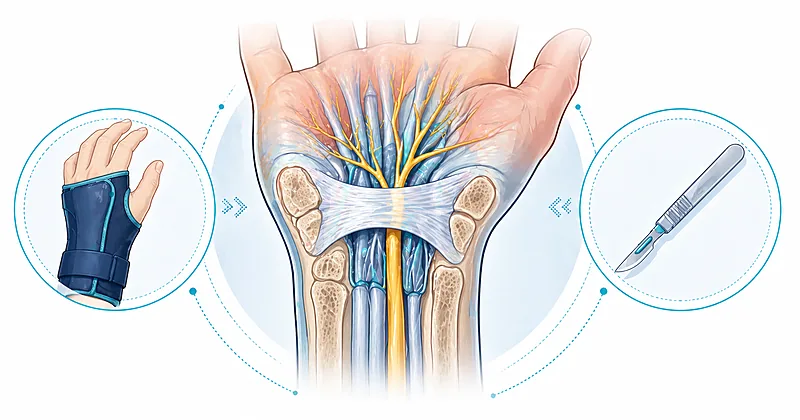
- 1Diagnose carpal tunnel syndrome clinically in most cases — structured criteria such as CTS-6 match electrodiagnostic accuracy in typical presentations → Clinical Diagnosis
- 2Reserve electrodiagnostic testing for atypical features, surgical planning, or when the diagnosis is clinically uncertain → Imaging and EDX
- 3Use ultrasound as a rapid, radiation-free confirmatory tool — median nerve cross-sectional area at the carpal tunnel inlet is the key measure → Imaging and EDX
- 4Offer nocturnal wrist splinting as first-line conservative treatment for mild-to-moderate carpal tunnel syndrome — it is cheap, safe, and effective → Conservative
- 5Consider a single local corticosteroid injection for short-term relief — valuable as a diagnostic confirmer and as a bridge to surgery → Conservative
- 6Refer early for surgical release in severe carpal tunnel syndrome (thenar atrophy, constant numbness, weakness) — do not prolong conservative trials → Surgical
- 7Expect rapid symptom relief after carpal tunnel release — nocturnal symptoms typically resolve within days, though residual numbness may linger if disease was long-standing → Surgical
- 8Counsel patients on return to activity — light use within days, driving in 1–2 weeks, manual work in 4–6 weeks depending on procedure and occupation → Return to Activity
- 9Screen for systemic contributors — diabetes, hypothyroidism, rheumatoid arthritis, and pregnancy each meaningfully alter the management plan → Monitoring
Diagnosing Carpal Tunnel Syndrome Clinically
Carpal tunnel syndrome is primarily a clinical diagnosis. Structured criteria such as the CTS-6 tool approach the accuracy of electrodiagnostic testing in classical presentations, which cover the majority of patients seen in primary care and hand clinics. The test questions are simple: is there numbness or tingling in the median nerve distribution, does it wake the patient at night, does it worsen with activities that flex the wrist, and is there any objective evidence of median nerve compromise?
Classical Symptoms to Elicit
Typical features are numbness, tingling, or pain in the thumb, index, middle, and radial half of the ring finger; nocturnal wakening relieved by shaking the hand (“flick sign”); and symptom provocation by sustained wrist flexion — holding a phone, driving, reading a newspaper, or riding a bicycle. Proximal radiation of aching pain into the forearm is common and does not argue against the diagnosis.
Diagnose carpal tunnel syndrome using structured clinical criteria (such as CTS-6) in every adult with characteristic symptoms. Electrodiagnostic confirmation is not required for most patients before starting conservative treatment.
Strong Rec High Evidence AAOS 2016 Graham 2006Perform provocative manoeuvres at the first visit. The Durkan carpal compression test (direct thumb pressure over the carpal tunnel for 30 seconds) has the best sensitivity and specificity; Phalen and Tinel add information but are less discriminating.
Strong Rec Moderate Evidence AAOS 2016Assess for severity markers at every visit. Thenar wasting, loss of thumb abduction strength, persistent (not intermittent) numbness, and impaired two-point discrimination all indicate advanced disease warranting surgical referral rather than extended conservative care.
Strong Rec Moderate Evidence AAOS 2016 Padua 2016Screen for systemic drivers at the first consultation: diabetes, hypothyroidism, rheumatoid arthritis, pregnancy, obesity, and recent weight gain are each overrepresented in carpal tunnel syndrome. Addressing the contributor can alter the management plan.
Strong Rec Moderate Evidence Padua 2016Differential Diagnoses Not to Miss
| Condition | Distinguishing Feature | Tip for the Bedside |
|---|---|---|
| Cervical radiculopathy (C6/C7) | Neck pain, dermatomal radiation, worsened by neck movement | Positive Spurling test, reflex changes, symptoms extending above the elbow |
| Pronator syndrome | Median nerve compression at the elbow — forearm aching, day-time predominant, palmar cutaneous branch involved | Numbness over the thenar eminence (spared in CTS), tenderness at pronator teres |
| Diabetic or other polyneuropathy | Glove-and-stocking distribution, bilateral, distal lower limbs often involved | Examine the feet; polyneuropathy can coexist with carpal tunnel syndrome |
| Thoracic outlet syndrome | Ulnar-predominant numbness, arm positional symptoms, vascular features | Symptoms worsen with overhead arm position (Roos test) |
| De Quervain’s tenosynovitis | Pain localised to radial wrist, triggered by thumb movement, no numbness | Positive Finkelstein test, tenderness over the first dorsal compartment |
Imaging and Electrodiagnostic Testing in Carpal Tunnel Syndrome
Confirmatory testing in carpal tunnel syndrome has shifted over the last decade. Ultrasound has emerged as a rapid, inexpensive, point-of-care tool with diagnostic performance approaching nerve conduction studies in experienced hands. Electrodiagnostic testing remains the long-standing reference standard but is no longer required before treatment in clinically straightforward cases.
Use ultrasound as a first-line confirmatory imaging modality when confirmation is needed. A median nerve cross-sectional area at the carpal tunnel inlet of > 10–12 mm² is the commonly cited threshold, with higher cut-offs increasing specificity.
Moderate Rec Moderate Evidence AANEM AAOS 2016Order nerve conduction studies when the clinical picture is atypical, when a coexisting polyneuropathy or proximal lesion is suspected, when surgical planning requires severity grading, or when medico-legal documentation is needed for occupational carpal tunnel syndrome.
Strong Rec High Evidence AAN AAOS 2016Do not routinely order MRI of the wrist in suspected carpal tunnel syndrome. MRI is reserved for atypical imaging findings on ultrasound, suspected space-occupying lesions, or postoperative assessment when recurrent symptoms are unexplained.
Against Moderate Evidence AAOS 2016Record a severity grade when electrodiagnostic testing is performed — mild (sensory changes only), moderate (sensory plus motor conduction abnormalities), or severe (reduced amplitudes or absent responses, with or without denervation). Severity correlates loosely with symptoms but informs surgical urgency.
Moderate Rec Moderate Evidence AAN Padua 2016Choosing Between Ultrasound and EDX
| Modality | What It Shows | Best Used For | Practical Tip |
|---|---|---|---|
| Ultrasound | Median nerve CSA, tendon anatomy, space-occupying lesions, flexor tenosynovitis | Rapid confirmation, anatomical variants, guiding injection | Measure CSA at the distal wrist crease; compare both sides |
| NCS / EMG | Conduction velocity, amplitude, distal latency, denervation on EMG | Severity grading, surgical planning, coexisting neuropathies | Mildly false-negative early in disease; repeat if clinically atypical |
| MRI | Nerve signal changes, mass lesions, postoperative anatomy | Recurrent symptoms after surgery, suspected mass | Low first-line yield; reserve for targeted questions |
Conservative Treatment of Carpal Tunnel Syndrome
Conservative treatment is reasonable for most patients with mild-to-moderate carpal tunnel syndrome without motor signs. The two interventions with the best evidence are nocturnal wrist splinting and local corticosteroid injection. Oral steroids have modest short-term effect; NSAIDs, pyridoxine, diuretics, yoga, and laser therapy have weak or inconsistent evidence and should not be relied on as primary treatment.
Offer a neutral-position wrist splint worn at night for a minimum of 6 weeks as first-line conservative treatment. Daytime splinting during provocative activities may be added but is not required for all patients.
Strong Rec High Evidence AAOS 2016Consider a single local corticosteroid injection (methylprednisolone 40 mg or triamcinolone 20–40 mg into the carpal tunnel) when symptoms persist despite splinting, or as a diagnostic confirmer when the clinical picture is unclear. Ultrasound guidance improves accuracy but is not mandatory.
Strong Rec High Evidence AAOS 2016Counsel patients that benefit from injection is typically short-term — median duration of meaningful relief is 2–6 months. Repeated injections are discouraged; two injections with rapid relapse is a strong signal to proceed to surgical referral rather than a third.
Strong Rec Moderate Evidence AAOS 2016Consider a short course of oral prednisolone (e.g., 20 mg daily for 10–14 days) when injection is unavailable or declined. Benefit is modest and short-lived; reserve this option rather than making it standard.
Conditional Rec Moderate Evidence AAOS 2016Do not recommend pyridoxine (vitamin B6), diuretics, or magnets for the treatment of carpal tunnel syndrome. Evidence does not support benefit over placebo, and pyridoxine in high doses can cause its own neuropathy.
Against Moderate Evidence AAOS 2016Surgical Release for Carpal Tunnel Syndrome
Surgical decompression remains the most effective definitive treatment for carpal tunnel syndrome. Open release, mini-open release, and endoscopic release all deliver similar long-term outcomes; the choice is usually surgeon-dependent rather than patient-dependent. Early surgery — rather than prolonged conservative trials — is now recommended for patients with objective motor signs or severe electrodiagnostic findings.
Refer for surgical release when any of the following are present: thenar wasting or measurable weakness, constant numbness, severe EDX findings at presentation, failure of 6 weeks of splinting, or rapid relapse after a corticosteroid injection.
Strong Rec High Evidence AAOS 2016Counsel patients that open, mini-open, and endoscopic release produce comparable long-term outcomes. Endoscopic release is associated with slightly faster early recovery but marginally higher rates of transient nerve irritation; long-term symptom relief is equivalent.
Strong Rec High Evidence AAOS 2016Do not routinely perform epineurotomy, neurolysis, flexor retinaculum reconstruction, or tenosynovectomy in uncomplicated carpal tunnel syndrome. These add-on procedures do not improve outcomes over simple division of the transverse carpal ligament.
Against Moderate Evidence AAOS 2016Do not routinely immobilise the wrist after carpal tunnel release. Postoperative splinting beyond 1–2 weeks delays recovery of hand function without reducing complications. Early gentle mobilisation is encouraged.
Against Moderate Evidence AAOS 2016Set realistic expectations pre-operatively. Nocturnal paraesthesiae typically resolve within days; residual daytime numbness, dexterity loss, and thenar weakness may take months and may not fully recover if disease was severe or prolonged.
Strong Rec Moderate Evidence AAOS 2016Comparing Surgical Techniques
| Technique | Best Candidate | Early Recovery | Main Trade-Offs |
|---|---|---|---|
| Open release | Standard default; revision surgery; suspected anatomical variant | Scar tenderness 4–6 weeks | Pillar pain; tried and tested; lowest equipment cost |
| Mini-open | Cosmetic preference; rapid return to light work | Marginally faster than standard open | Less exposure; similar long-term outcomes |
| Endoscopic release | Bilateral disease, rapid return to occupation, patient preference | Fastest return to work (days to < 2 weeks) | Slightly higher transient nerve irritation rate; higher equipment cost |
Clinical Decision Pathway
A practical, question-based walk-through of carpal tunnel syndrome from first presentation to definitive treatment. Move through the questions in order.
Monitoring and Return-to-Activity Counselling
Post-treatment follow-up in carpal tunnel syndrome should track symptom trajectory, functional recovery, and the possibility of persistent or recurrent disease. Structured questionnaires such as the Boston Carpal Tunnel Questionnaire (BCTQ) are useful to capture change over time.
| Parameter | When to Check | What to Look For | Common Pitfalls |
|---|---|---|---|
| Symptom score (BCTQ) | Baseline, 6 weeks, 3 months, 12 months | Trend in symptom severity and functional scales | Comparing a single score to “normal” rather than to the patient’s own baseline |
| Grip and pinch strength | Baseline, 6 weeks post-op, 3 months | Recovery to pre-disease level; persistent pillar pain | Mistaking normal postoperative weakness at 6 weeks for failed surgery |
| Two-point discrimination | Baseline, 3 and 12 months post-op | Gradual improvement; plateau suggests persistent axonal injury | Over-interpreting small changes in an inconsistent examiner’s hands |
| Return to work | At 2, 6, and 12 weeks post-op | Graduated increase in task tolerance; limit repetitive loading early | Blanket “off work 6 weeks” notes without assessing the actual job tasks |
| Systemic contributors | Baseline and annually thereafter | Glycaemic control, thyroid function, weight trend | Treating the wrist but not the underlying driver — risk of contralateral disease |
Typical Return-to-Activity Milestones After Surgical Release
| Activity | Open Release | Endoscopic Release | Counselling Point |
|---|---|---|---|
| Light household tasks | Days 2–3 | Day 1–2 | Encourage gentle finger use from day one |
| Driving | 1–2 weeks | 3–7 days | Patient must be able to make an emergency stop safely |
| Office/desk work | 1–2 weeks | 3–7 days | Short sessions initially; ergonomic setup helps |
| Manual labour | 4–6 weeks | 3–4 weeks | Graduated lifting and gripping; avoid sudden heavy loading |
| Sport / heavy training | 6–8 weeks | 4–6 weeks | Pillar pain may limit weight-bearing on the palm |
Evidence in Context
What the current evidence supports, where the major guidelines align, and where clinically relevant gaps remain in the management of carpal tunnel syndrome.
Where AAOS and AAN Align
Both bodies endorse clinical diagnosis supplemented by confirmatory testing when needed, night-time splinting as first-line conservative therapy, local corticosteroid injection as an effective short-term option, and surgical release as the definitive treatment for failed conservative management or severe disease. Both recognise that open and endoscopic techniques produce comparable long-term outcomes.
Ultrasound’s Growing Role
Meta-analyses comparing ultrasound against EDX show comparable diagnostic accuracy for typical carpal tunnel syndrome, with ultrasound offering substantial advantages in cost, comfort, and speed. The AANEM evidence-based review supports ultrasound as a diagnostic tool, and many centres now use it as the first-line confirmatory test, reserving EDX for atypical presentations or surgical planning.
Splinting vs Injection vs Surgery — What Trials Show
Head-to-head trials consistently find that corticosteroid injection produces faster short-term relief than splinting but carries only transient benefit. Surgical release outperforms all conservative options at 6–12 months and beyond in moderate-to-severe disease. In mild disease, a stepwise approach starting with splinting remains reasonable, as many patients experience spontaneous improvement, particularly pregnancy-related carpal tunnel syndrome.
Special Populations: Pregnancy, Diabetes, Dialysis
Pregnancy-related carpal tunnel syndrome often resolves spontaneously within months of delivery; conservative management is usually appropriate. Diabetic patients have a higher baseline risk of coexisting polyneuropathy, which muddies both diagnosis and outcome prediction. Dialysis-associated amyloid deposition can produce refractory carpal tunnel syndrome with particularly severe nerve involvement, often requiring early surgical release.
What We Still Don’t Know
The optimal duration of splinting, the best ultrasound CSA cut-off across populations, and the role of newer modalities such as hydrodissection and perineural platelet-rich plasma injections remain active areas of investigation. Predictive models for identifying patients who will fail conservative treatment could reduce unnecessary delays, but none is yet in routine use.
References
- 1.American Academy of Orthopaedic Surgeons. Management of Carpal Tunnel Syndrome: Evidence-Based Clinical Practice Guideline. 2016. aaos.org/quality/carpal-tunnel-syndrome
- 2.Padua L, Coraci D, Erra C, et al. Carpal tunnel syndrome: clinical features, diagnosis, and management. Lancet Neurol. 2016;15(12):1273–1284. doi:10.1016/S1474-4422(16)30231-9
- 3.Graham B, Regehr G, Naglie G, Wright JG. Development and validation of diagnostic criteria for carpal tunnel syndrome. J Hand Surg Am. 2006;31(6):919–924. doi:10.1016/j.jhsa.2006.03.005
- 4.Cartwright MS, Hobson-Webb LD, Boon AJ, et al. Evidence-based guideline: neuromuscular ultrasound for the diagnosis of carpal tunnel syndrome. Muscle Nerve. 2012;46(2):287–293. doi:10.1002/mus.23389
- 5.Jarvik JG, Comstock BA, Kliot M, et al. Surgery versus non-surgical therapy for carpal tunnel syndrome: a randomised parallel-group trial. Lancet. 2009;374(9695):1074–1081. doi:10.1016/S0140-6736(09)61517-8
- 6.American Association of Neuromuscular & Electrodiagnostic Medicine. Practice parameter for electrodiagnostic studies in carpal tunnel syndrome. Muscle Nerve. 2002;25(6):918–922. doi:10.1002/mus.10185
How to Read the Evidence Tags
Every recommendation in this article carries two tags — one for recommendation strength and one for evidence quality — using Medaptly’s own simplified interpretations.
Recommendation Strength
| Tag | What It Means |
|---|---|
| Strong Rec | High-quality evidence broadly supports this action. |
| Moderate Rec | The weight of evidence favours this action. |
| Conditional Rec | The benefit is less certain — individualise based on patient factors. |
| Against | Evidence shows no benefit or potential harm. |
Evidence Quality
| Tag | What It Means |
|---|---|
| High Evidence | Multiple well-designed RCTs or high-quality meta-analyses. |
| Moderate Evidence | Single RCT or large observational studies. |
| Low Evidence | Expert consensus or small studies. |