
Essential Tremor Treatment: Medical and Procedural Options
Clinical Practice Update — Medical Therapy, DBS, Focused Ultrasound, and Referral Criteria in Adults
This is an original clinical education article informed by current guidelines and evidence. See References below for source documents.
- Clinical Focus
- Evidence-based essential tremor treatment: diagnostic assessment, first- and second-line pharmacotherapy, botulinum toxin, deep brain stimulation, and MR-guided focused ultrasound in adults
- Target Audience
- Primary care physicians, general neurologists, movement disorder specialists, residents
- Setting
- Primary care, general neurology, movement disorder clinics, functional neurosurgery centres
- Source Evidence
- •AAN Practice Parameter — Therapies for Essential Tremor (Zesiewicz et al., 2005)
- •AAN Practice Parameter Update (Zesiewicz et al., 2011)
- •MDS Consensus Statement on Tremor Classification (Bhatia et al., 2018)
- •Focused Ultrasound Thalamotomy Trial (Elias et al., NEJM 2016)
- •MDS Evidence-Based Medicine Review on Tremor Therapies (Ferreira et al.)
Key Clinical Takeaways
Effective essential tremor treatment follows a tiered approach: confirm the diagnosis, quantify functional impact, trial first-line oral medication, and escalate thoughtfully to procedural options when tremor becomes disabling. Propranolol and primidone remain the most evidence-supported first-line agents. Deep brain stimulation and MR-guided focused ultrasound offer substantial improvement for selected patients with medication-refractory disease.
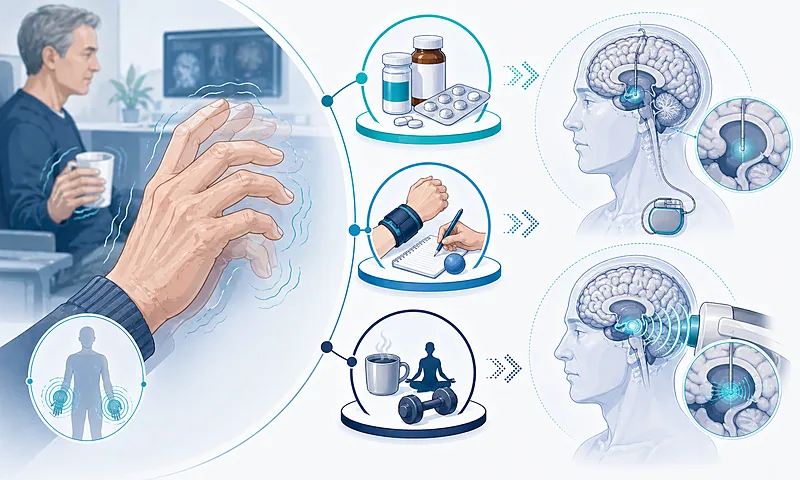
- 1Diagnose essential tremor clinically using the MDS tremor classification — bilateral upper-limb action tremor without parkinsonism, dystonia, or other neurological signs → Diagnosis
- 2Recognise the distinction between classical essential tremor and “ET plus” — additional soft neurological signs may alter prognosis and treatment choices → Diagnosis
- 3Not every patient needs medication — reserve pharmacotherapy for functional, social, or psychological impact that matters to the patient → First-Line Therapy
- 4Start propranolol or primidone as first-line pharmacotherapy; both have AAN Level A evidence for efficacy in essential tremor treatment → First-Line Therapy
- 5Combine propranolol and primidone when monotherapy delivers inadequate control but partial response — effects are additive → First-Line Therapy
- 6Consider topiramate or gabapentin as second-line options when propranolol and primidone are ineffective or intolerable → Second-Line Therapy
- 7Refer for deep brain stimulation or MR-guided focused ultrasound when two adequate medication trials fail and tremor remains disabling → Procedural Options
- 8Offer botulinum toxin injections as a targeted option for head and voice tremor when these are the dominant complaint → Second-Line Therapy
- 9Review medications regularly — caffeine, beta-agonists, valproate, lithium, and SSRIs can unmask or worsen underlying tremor → Monitoring
Diagnosing Essential Tremor
Essential tremor is the most common movement disorder in adults, with prevalence rising sharply after age 65. The 2018 MDS consensus statement defines it as an isolated tremor syndrome characterised by bilateral upper-limb action tremor of at least 3 years’ duration, with or without tremor in other locations (head, voice, lower limbs), and in the absence of other neurological signs such as parkinsonism, dystonia, or ataxia.
Diagnosis is clinical. The main decision at first presentation is separating classical essential tremor from close mimics: enhanced physiologic tremor, dystonic tremor, Parkinson’s disease, cerebellar tremor, and drug-induced tremor.
Document the tremor characteristics carefully — distribution, activation (rest, postural, action, intention), frequency (classically 4–12 Hz in essential tremor), and response to voluntary tasks. Action tremor during pouring, writing, or drinking is the cardinal feature.
Strong Rec Moderate Evidence MDS 2018Actively exclude common mimics. Look for rest tremor, bradykinesia, or rigidity (Parkinson’s disease), abnormal posturing (dystonic tremor), ataxia or dysmetria (cerebellar tremor), and review the medication list for tremor-inducing drugs.
Strong Rec Moderate Evidence MDS 2018Check thyroid function, electrolytes, and an initial B12 level in atypical presentations. Do not order routine imaging in the absence of focal signs; MRI adds little unless the examination suggests a secondary cause.
Moderate Rec Low Evidence MDS 2018Quantify functional impact at baseline using a validated scale such as TETRAS or FTM, or a brief patient-reported functional checklist (drinking, writing, fine motor tasks). The score anchors follow-up comparisons.
Moderate Rec Moderate Evidence MDS 2018Distinguishing Essential Tremor from Common Mimics
| Feature | Essential Tremor | Parkinson’s Disease | Dystonic Tremor |
|---|---|---|---|
| Activation | Postural and action | Rest (re-emerging on posture after delay) | Position-dependent, task-specific |
| Symmetry | Bilateral, largely symmetric | Asymmetric onset | Often focal or segmental |
| Additional signs | None in classical form; mild in ET plus | Bradykinesia, rigidity, postural changes | Dystonic posturing, sensory tricks relieve |
| Alcohol response | Often substantial reduction | Minimal | Variable |
| Family history | Common (up to 60%) | Sometimes | Sometimes |
First-Line Essential Tremor Treatment
First-line essential tremor treatment rests on two agents with the strongest evidence base: propranolol and primidone. Both reduce tremor amplitude by roughly 50% on average in responders, though about half of patients achieve only partial benefit and a minority are true non-responders. Not all patients require treatment — offer medication when tremor produces functional, social, or psychological impact that matters to the patient.
Start propranolol 10 mg three times daily and titrate up to 60–320 mg/day in divided doses (long-acting formulations simplify adherence). Screen for beta-blocker contraindications including asthma, decompensated heart failure, and symptomatic bradycardia.
Strong Rec High Evidence AAN 2005 AAN 2011Consider primidone 25–50 mg at bedtime as an alternative first-line option, titrating by 25–50 mg every few days toward a typical effective range of 250–750 mg/day in divided doses. Primidone and propranolol are broadly equivalent in efficacy; choose by comorbidity profile.
Strong Rec High Evidence AAN 2005 AAN 2011Counsel patients on the acute first-dose reaction to primidone — sedation, ataxia, and nausea are common and usually resolve over a few days. Starting low (25 mg nocte) and titrating slowly prevents most early dropouts.
Strong Rec Moderate Evidence AAN 2011Combine propranolol and primidone when one agent alone produces partial benefit. Their effects are additive, and combination therapy often converts partial responders into good responders before a second-line agent is needed.
Moderate Rec Moderate Evidence AAN 2011Choosing Between Propranolol and Primidone
| Patient Profile | Preferred Agent | Reasoning | Practical Tips |
|---|---|---|---|
| Comorbid hypertension or anxiety | Propranolol | Single agent addresses two problems | Use long-acting formulation once daily for adherence |
| Asthma, reactive airway disease, or bradycardia | Primidone | Beta-blockers contraindicated or poorly tolerated | Start low, titrate slowly to minimise sedation |
| Elderly with cognitive vulnerability | Propranolol | Primidone’s sedation and confusion risk is particularly problematic | Monitor heart rate and blood pressure closely |
| Younger patient with poor response to propranolol | Primidone or combination | Partial responders benefit from additive effect | Keep propranolol dose moderate and add primidone rather than maximising one agent |
| Episodic situational tremor (e.g. public speaking) | Propranolol as needed | Short half-life allows on-demand use 30–60 minutes before triggers | 10–40 mg standard-release 30–60 min before event |
Second-Line Essential Tremor Treatment
When first-line essential tremor treatment fails or is not tolerated, a range of second-line options is available. Topiramate and gabapentin have the strongest supporting evidence among alternatives. Benzodiazepines (particularly clonazepam) can help where anxiety prominently worsens tremor. Botulinum toxin is an effective option for isolated head or voice tremor.
Consider topiramate, titrated slowly from 25 mg daily up to 200–400 mg/day in divided doses, as a second-line option. Counsel on topiramate tolerability — paraesthesiae, cognitive slowing, and weight loss are common and often limit long-term use.
Moderate Rec High Evidence AAN 2011Consider gabapentin as a second-line option, typically 1200–3600 mg/day in divided doses. It is reasonably well tolerated, particularly useful in older patients who do not tolerate primidone, and easy to combine with propranolol.
Moderate Rec Moderate Evidence AAN 2011Consider clonazepam 0.25–2 mg at bedtime, especially when anxiety amplifies tremor or when co-existing muscle tension compounds functional impact. Counsel on dependence, falls risk, and sedation.
Conditional Rec Moderate Evidence AAN 2005Offer onabotulinumtoxinA injections for patients in whom head or voice tremor is the dominant complaint. Inject experienced target muscles (splenius capitis and sternocleidomastoid for head; thyroarytenoid for voice). Counsel on temporary weakness and the need for repeat sessions every 3–4 months.
Moderate Rec Moderate Evidence AAN 2011Do not use levetiracetam, pregabalin, flunarizine, or zonisamide as routine essential tremor treatment. Evidence is inconsistent, and better-supported alternatives exist.
Against Moderate Evidence AAN 2011Procedural Options: DBS and Focused Ultrasound
Two procedural approaches have high-quality evidence for medication-refractory essential tremor: deep brain stimulation (DBS) of the ventral intermediate (Vim) nucleus of the thalamus, and MR-guided focused ultrasound (MRgFUS) Vim thalamotomy. Both produce substantial and durable tremor reduction in appropriate candidates. The choice between them rests on patient preference, lateralisation of symptoms, procedural appetite, and access.
Refer for functional neurosurgery evaluation when adequate trials of at least two first-line or second-line agents have failed and the tremor continues to cause significant functional or psychosocial impact. Do not withhold referral on the basis of age alone — older patients can do well with careful selection.
Strong Rec High Evidence AAN 2011Consider deep brain stimulation of the Vim thalamus as the preferred procedural option for patients with bilateral tremor, younger age, or a preference for a reversible intervention. Efficacy is robust and durable, and bilateral implants can be safely staged.
Strong Rec High Evidence AAN 2011Consider MR-guided focused ultrasound thalamotomy as an incisionless option for patients with asymmetric or predominantly unilateral tremor, those who decline implanted hardware, or those with comorbidities that raise open-surgery risk. Benefits are durable, and a contralateral procedure may be possible later.
Strong Rec High Evidence Elias NEJM 2016Ensure every candidate undergoes multidisciplinary evaluation — movement disorder neurology, functional neurosurgery, neuropsychology, and imaging review. Screening for cognitive impairment, untreated depression, and unrealistic expectations reduces postoperative dissatisfaction.
Strong Rec Moderate Evidence AAN 2011DBS vs Focused Ultrasound: A Practical Comparison
| Feature | Vim DBS | MRgFUS Thalamotomy |
|---|---|---|
| Mechanism | Reversible electrical modulation via implanted electrode | Focal thermal lesion created by ultrasound, no incision |
| Laterality | Bilateral implantation feasible and common | Typically unilateral; bilateral lesioning carries higher risk |
| Reversibility | Settings adjustable; hardware removable | Irreversible lesion |
| Procedural burden | Cranial surgery; pulse generator in chest; ongoing programming | Single incisionless session in MRI suite |
| Adverse effects | Infection, lead migration, hardware failure, stimulation-related dysarthria or ataxia | Paraesthesiae, gait disturbance, transient dysgeusia |
| Screening obstacle | Bleeding risk, anaesthetic risk, cognitive impairment | Low skull density ratio precludes effective sonication |
Clinical Decision Pathway
A practical, question-based approach to building a treatment plan. Work through the questions in order from diagnosis to referral.
Patient Selection for DBS and FUS
Good selection is what separates satisfied and dissatisfied procedural patients. The general principle is shared: disabling medication-refractory tremor, realistic expectations, and absence of factors that raise procedural risk or compromise benefit.
Favourable Features for Procedural Referral
| Domain | Favours Referral | Argues Against Referral |
|---|---|---|
| Tremor severity | Disabling, interfering with work or self-care | Mild, manageable with aids and technique |
| Medication trial | Propranolol and primidone tried at therapeutic doses | Only one agent tried, sub-therapeutic dose, or for short duration |
| Cognitive status | Intact or minimally impaired | Significant cognitive impairment (especially frontal-executive) |
| Mood and expectations | Realistic outlook; depression treated and stable | Unrealistic expectations; active severe depression |
| Comorbidities | Reasonable operative risk; no active bleeding risk | Uncontrolled bleeding disorder, severe frailty |
Monitoring and Follow-Up
Structured follow-up catches dose-limiting adverse effects, quantifies treatment response, and identifies when to escalate. Link review visits to concrete milestones (starting a new drug, reaching target dose, annual reassessment).
| Parameter | When to Check | What to Look For | Common Pitfalls |
|---|---|---|---|
| Tremor response (functional tasks, TETRAS/FTM) | 4–6 weeks after starting or dose adjustment | Meaningful improvement in writing, drinking, daily tasks | Relying on clinic observation alone; use patient diaries |
| Propranolol adverse effects | Every visit in the first 3 months | Bradycardia, hypotension, fatigue, bronchospasm | Not checking BP and pulse at titration steps |
| Primidone adverse effects | Within first 2 weeks, then monthly until stable | Sedation, ataxia, mood changes, rash | Dismissing early sedation — it usually resolves |
| Medication list review | Every visit | New agents causing drug-induced tremor (SSRIs, lithium, valproate, beta-agonists) | Adding a new drug for tremor while an offender remains unaddressed |
| Psychosocial impact | At least annually | Social avoidance, work limitations, mood change | Focusing only on motor metrics; ask about activity restriction |
Evidence in Context
A brief map of the key trials and consensus documents that define modern essential tremor treatment.
AAN Practice Parameters: The Foundation
The AAN Practice Parameter (Zesiewicz and colleagues, 2005) and its 2011 update remain the most widely cited evidence summaries for essential tremor treatment. Both establish propranolol and primidone as the highest-evidence first-line agents and provide Level A and Level B recommendations for a range of alternatives including topiramate, gabapentin, and botulinum toxin for head and voice tremor.
The 2018 MDS Tremor Consensus
The 2018 MDS consensus statement (Bhatia and colleagues) reframed the classification of tremor disorders along two axes — clinical syndrome and aetiology. It formalised the distinction between classical essential tremor and ET plus, and has influenced how contemporary trials enrol and stratify patients.
The Focused Ultrasound Trial
The pivotal trial by Elias and colleagues (NEJM 2016) established MR-guided focused ultrasound thalamotomy as an effective option for medication-refractory essential tremor, producing substantial and sustained reduction in tremor amplitude. Longer-term follow-up has confirmed durable benefit, with a meaningful subset of patients experiencing mild paraesthesiae or gait disturbance that usually improves over months.
Open Questions
Outstanding questions include the optimal approach for bilateral focused ultrasound thalamotomy, the role of emerging wearable non-invasive neurostimulation devices, genetic predictors of treatment response, and whether the ET/ET plus distinction will prove clinically important for pharmacological response as it appears to be for prognosis.
References
- 1.Zesiewicz TA, Elble R, Louis ED, et al. Practice parameter: therapies for essential tremor: report of the Quality Standards Subcommittee of the American Academy of Neurology. Neurology. 2005;64(12):2008–2020. doi:10.1212/01.WNL.0000163769.28552.CD
- 2.Zesiewicz TA, Elble RJ, Louis ED, et al. Evidence-based guideline update: treatment of essential tremor: report of the Quality Standards Subcommittee of the American Academy of Neurology. Neurology. 2011;77(19):1752–1755. doi:10.1212/WNL.0b013e318236f0fd
- 3.Bhatia KP, Bain P, Bajaj N, et al. Consensus Statement on the classification of tremors from the task force on tremor of the International Parkinson and Movement Disorder Society. Mov Disord. 2018;33(1):75–87. doi:10.1002/mds.27121
- 4.Elias WJ, Lipsman N, Ondo WG, et al. A Randomized Trial of Focused Ultrasound Thalamotomy for Essential Tremor. N Engl J Med. 2016;375(8):730–739. doi:10.1056/NEJMoa1600159
- 5.Ferreira JJ, Mestre TA, Lyons KE, et al. MDS evidence-based review of treatments for essential tremor. Mov Disord. 2019;34(7):950–958. doi:10.1002/mds.27700
How to Read the Evidence Tags
Every recommendation in this article carries two tags — for recommendation strength and evidence quality — along with a source tag. These are Medaptly’s own simplified interpretations, not reproductions of any guideline body’s classification system.
Recommendation Strength
| Tag | What It Means |
|---|---|
| Strong Rec | High-quality evidence broadly supports this action. |
| Moderate Rec | The weight of evidence favours this action. |
| Conditional Rec | The benefit is less certain — individualise. |
| Against | Evidence shows no benefit or potential harm. |
Evidence Quality
| Tag | What It Means |
|---|---|
| High Evidence | Multiple well-designed RCTs or high-quality meta-analyses. |
| Moderate Evidence | Single RCT or large observational studies. |
| Low Evidence | Expert consensus or small studies. |