
Vestibular Migraine: Diagnosis and Treatment of Migrainous Vertigo
Clinical Practice Update — Diagnostic Criteria, Differential Workup, and Evidence-Based Management in Adults
This is an original clinical education article informed by current guidelines and evidence. See References below for source documents.
- Clinical Focus
- Diagnosis, differential workup, and evidence-based vestibular migraine treatment in adults
- Target Audience
- Neurologists, primary care physicians, otolaryngologists, emergency physicians, residents
- Setting
- Neurology and ENT clinics, primary care, emergency departments
- Source Evidence
- •Bárány Society / International Headache Society Diagnostic Criteria (2012)
- •Smyth et al. — Vestibular Migraine Treatment: Comprehensive Review (Brain, 2022)
- •Cochrane Review — Pharmacological Prophylaxis of Vestibular Migraine (2023)
- •Chu et al. — Network Meta-Analysis of Prophylactic Treatments (Front Pharmacol, 2023)
Key Clinical Takeaways
Effective vestibular migraine treatment begins with a confident diagnosis: recurrent vertigo, a personal history of migraine, and the deliberate exclusion of mimics such as Menière disease and posterior-circulation stroke. The points below distill diagnosis and management into rules you can apply in clinic.
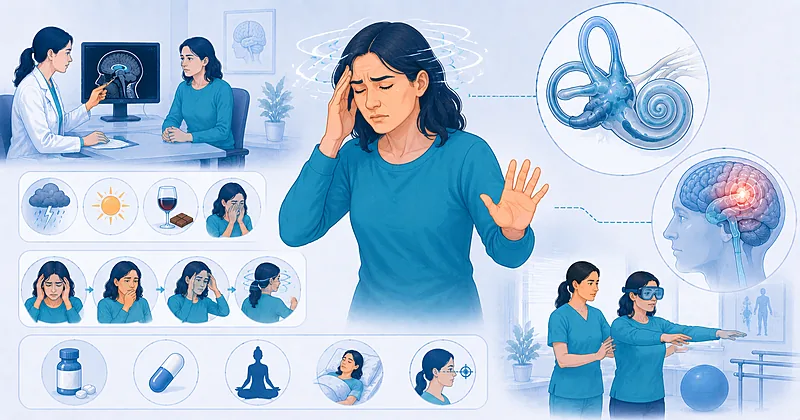
- 1Diagnose vestibular migraine using three pillars: recurrent vestibular symptoms, a current or past history of migraine, and exclusion of other causes
- 2Require at least five episodes lasting 5 minutes to 72 hours, of moderate or greater intensity, to meet criteria
- 3Use neuroimaging selectively — reserve MRI for atypical features, abnormal neurological signs, or a first severe attack suggesting stroke
- 4Start lifestyle and trigger management first — sleep, hydration, and headache-diary tracking benefit most patients before drugs
- 5Reserve daily prophylaxis for frequent or disabling attacks, choosing the agent by comorbidity profile rather than by a fixed hierarchy
- 6Counsel patients that vestibular migraine treatment is preventive, not curative, and that benefit accrues over weeks to months
- 7Refer for vestibular rehabilitation when interictal imbalance or motion sensitivity persists between attacks
- 8Screen for and treat coexisting anxiety and persistent postural-perceptual dizziness, which frequently complicate the picture
- 9Reassess the diagnosis if attacks change character or fail to respond — relabel rather than escalate doses indefinitely
Confirming the Diagnosis Before Vestibular Migraine Treatment
Diagnosis is the foundation of vestibular migraine treatment. The condition is clinical — there is no confirmatory test — so the work is in recognising the pattern and ruling out dangerous or treatable mimics. The Bárány Society and International Headache Society criteria provide the scaffolding most clinicians now use.
Confirm at least five episodes of vestibular symptoms of moderate or severe intensity, each lasting between 5 minutes and 72 hours, before applying the diagnosis. Document duration explicitly — attacks shorter than 5 minutes or longer than 3 days point elsewhere.
Strong Rec Moderate Evidence Bárány/IHS 2012Establish a current or prior history of migraine with or without aura, and look for migrainous features during at least half of the vertigo episodes — headache, photophobia, phonophobia, or visual aura.
Strong Rec Moderate Evidence Bárány/IHS 2012Evaluate for fluctuating low-frequency hearing loss, aural fullness, and tinnitus that would instead suggest Menière disease, since early presentations of the two conditions overlap considerably.
Moderate Rec Moderate Evidence Smyth 2022Perform MRI of the brain with attention to the posterior fossa when the first attack is sudden and severe, when neurological signs are present, or when vascular risk factors raise concern for a central cause.
Strong Rec Low Evidence Smyth 2022A probable category exists for patients who meet most but not all criteria — for example, those with characteristic vertigo and migraine history but without migrainous features documented during attacks. These patients can reasonably be offered a trial of management while the picture is observed over time.
Distinguishing Migrainous Vertigo From Its Mimics
Migrainous vertigo is a diagnosis of pattern recognition plus exclusion. The conditions that most often masquerade as it — or coexist with it — each have a tell that distinguishes them when sought deliberately.
Apply HINTS examination components in the acutely vertiginous patient to separate a peripheral from a central cause when an attack is witnessed, recognising that vestibular migraine itself can produce central-appearing eye signs.
Moderate Rec Moderate Evidence Smyth 2022Perform a Dix-Hallpike manoeuvre when vertigo is provoked by lying down or rolling over, since benign paroxysmal positional vertigo is common, treatable in minutes, and frequently coexists with migraine.
Strong Rec High Evidence Smyth 2022Evaluate for persistent postural-perceptual dizziness when patients describe constant unsteadiness aggravated by motion and visual stimulation between discrete attacks, as this commonly develops alongside vestibular migraine and needs its own approach.
Moderate Rec Low Evidence Smyth 2022Acute and Preventive Vestibular Migraine Treatment
Management splits into three layers: relieving the acute attack, reducing attack frequency with prevention, and addressing the behavioural and rehabilitative factors that sustain symptoms. The evidence base is thinner than for headache migraine, so much of vestibular migraine treatment is extrapolated and individualised.
Counsel patients on lifestyle modification as the first intervention: regular sleep, consistent meals, hydration, caffeine moderation, and identifying personal dietary and stress triggers through a symptom diary.
Moderate Rec Low Evidence Smyth 2022Consider a triptan during the acute attack when migraine headache is a prominent accompanying feature, while recognising that evidence for aborting the vertigo itself is limited and of low certainty.
Conditional Rec Low Evidence Cochrane 2023Offer an antiemetic such as a vestibular suppressant for short-term symptomatic relief during severe acute attacks, limiting use to the attack itself to avoid impairing central compensation.
Conditional Rec Low Evidence Smyth 2022Initiate daily preventive therapy when attacks are frequent, prolonged, or disabling despite lifestyle measures, setting the expectation of a 6-to-8 week trial at adequate dose before judging response.
Moderate Rec Moderate Evidence Chu 2023Select the preventive agent by comorbidity: a beta-blocker when hypertension coexists, an antiseizure agent such as topiramate when weight loss is desirable, or an SNRI such as venlafaxine when mood symptoms accompany the attacks.
Moderate Rec Moderate Evidence Chu 2023Refer for vestibular rehabilitation when interictal imbalance, dizziness, or motion intolerance persists, as supervised habituation and balance training can reduce residual disability between attacks.
Moderate Rec Moderate Evidence Cochrane 2022Avoid routine use of long-term vestibular suppressants for prevention, since continuous use can delay the central adaptation that underlies lasting recovery.
Against Low Evidence Smyth 2022Clinical Decision Pathway
A practical, question-based approach to the patient presenting with recurrent vertigo and a migraine history. Work through the questions in order.
Practical Reference Tables
Preventive Agents by Patient Profile
Organised by the clinical situation that should steer your choice, rather than by drug class.
| Patient Situation | Preferred Agent | Why It Fits | Watch For |
|---|---|---|---|
| Coexisting hypertension | Propranolol or metoprolol | Treats both conditions at once | Fatigue, bronchospasm; avoid in asthma |
| Overweight, seeking weight loss | Topiramate | Appetite suppression is a useful side effect here | Cognitive slowing, paraesthesia; titrate slowly |
| Prominent low mood or anxiety | Venlafaxine | Addresses mood and attacks together | Nausea early; taper to stop |
| Insomnia or tension-type overlap | Amitriptyline (low dose, nocturnal) | Sedation aids sleep; helps coexisting headache | Anticholinergic effects; caution in elderly |
| Refractory to first-line agents | Flunarizine (where available) | Useful alternative in network analyses | Weight gain, depression, extrapyramidal effects |
Telling Vestibular Migraine From Its Closest Mimics
Built around the discriminating feature for each condition, with the practical next step.
| Condition | Typical Attack Length | Discriminating Feature | Practical Next Step |
|---|---|---|---|
| Vestibular migraine | 5 min to 72 hours | Migraine features during attacks; no progressive hearing loss | Apply diagnostic criteria; start management |
| Menière disease | 20 min to 12 hours | Fluctuating low-frequency hearing loss, aural fullness | Audiometry; ENT involvement |
| BPPV | Seconds per movement | Provoked by position change; positive Dix-Hallpike | Repositioning manoeuvre |
| Vestibular neuritis | Days, single event | Acute, sustained, unidirectional; no recurrence pattern | Supportive care; rehabilitation |
| Posterior-circulation stroke | Sustained, abrupt onset | Focal signs, severe gait failure, central HINTS pattern | Urgent imaging and stroke pathway |
Monitoring and Follow-Up
| What to Track | When to Review | Goal | Common Pitfalls |
|---|---|---|---|
| Attack frequency (headache diary) | 6–8 weeks after starting prevention | Meaningful reduction in monthly attacks | Judging response before the dose is adequate or the trial is long enough |
| Medication tolerability | 2–4 weeks after each titration | Effective dose the patient will keep taking | Stopping early for side effects that fade with slow titration |
| Interictal symptoms | Each visit | Detect emerging PPPD or chronic imbalance | Attributing all between-attack symptoms to the migraine alone |
| Diagnosis itself | If attacks change or fail to respond | Catch an evolving Menière or second pathology | Escalating doses instead of revisiting the label |
Evidence in Context
What the evidence supports, and where the literature remains genuinely uncertain.
Why the Evidence Base Is Thinner Than for Headache Migraine
Most preventive agents used in vestibular migraine were adopted from headache migraine practice rather than tested directly in large trials. Cochrane reviewers have repeatedly noted that the randomised evidence specific to this condition is limited and of low to moderate certainty, which is why management leans on expert synthesis and individualisation.
What the Network Meta-Analyses Suggest
Comparative analyses of preventive options have ranked beta-blockers, calcium channel blockers such as flunarizine, antiseizure agents, and certain antidepressants as broadly useful, without one agent emerging as clearly superior across all outcomes. This supports choosing by comorbidity and tolerability rather than following a rigid first-line order.
Acute Treatment: A Genuine Evidence Gap
Evidence for aborting an acute vestibular migraine attack is sparse, with only a small number of studies offering low-certainty support for triptans when headache is present. Acute strategies therefore remain pragmatic: treat the headache component, relieve nausea, and limit vestibular suppressants to the attack itself.
Emerging Therapies on the Horizon
CGRP monoclonal antibodies, now established in headache migraine prevention, are being studied in vestibular migraine and appear in recent reviews as a promising direction. Their role is not yet defined by high-quality vestibular-specific trials, so they currently sit as an option for refractory cases rather than first-line therapy.
References
- 1.Lempert T, Olesen J, Furman J, et al. Vestibular migraine: diagnostic criteria. Consensus document of the Bárány Society and the International Headache Society. J Vestib Res. 2012;22(4):167–172. pubmed.ncbi.nlm.nih.gov/23532572
- 2.Smyth D, Britton Z, Murdin L, et al. Vestibular migraine treatment: a comprehensive practical review. Brain. 2022;145(11):3741–3754. doi:10.1093/brain/awac264
- 3.Webster KE, Dor A, Galbraith K, et al. Pharmacological interventions for prophylaxis of vestibular migraine. Cochrane Database Syst Rev. 2023;4:CD015187. doi:10.1002/14651858.CD015187.pub2
- 4.Chu H, Wang Y, Ling X, Li K, Yang X. Prophylactic treatments for vestibular migraine: a systematic review and network meta-analysis of randomized clinical trials. Front Pharmacol. 2023;14:1332973. doi:10.3389/fphar.2023.1332973
- 5.Webster KE, Harrington-Benton NA, Judd O, et al. Non-pharmacological interventions for prophylaxis of vestibular migraine. Cochrane Database Syst Rev. 2022;3:CD015321. doi:10.1002/14651858.CD015321
How to Read the Evidence Tags
Every recommendation carries a strength tag and an evidence-quality tag — Medaptly’s own simplified interpretations, not any guideline body’s classification system.
Recommendation Strength
| Tag | What It Means |
|---|---|
| Strong Rec | High-quality evidence broadly supports this action. |
| Moderate Rec | The weight of evidence favours this action. |
| Conditional Rec | The benefit is less certain — individualise. |
| Against | Evidence shows no benefit or potential harm. |
Evidence Quality
| Tag | What It Means |
|---|---|
| High Evidence | Multiple well-designed RCTs or high-quality meta-analyses. |
| Moderate Evidence | Single RCT or large observational studies. |
| Low Evidence | Expert consensus or small studies. |