
Enhanced Recovery After Cesarean Delivery (ERAS)
Clinical Practice Update — A Phase-Based Enhanced Recovery Protocol for Scheduled and Unscheduled Cesarean Birth
This is an original clinical education article informed by current guidelines and evidence. See References below for source documents.
- Clinical Focus
- Perioperative enhanced recovery after cesarean in healthy adults
- Target Audience
- Obstetricians, anesthesiologists, midwives, maternity nurses, residents
- Setting
- Labor and delivery, obstetric operating theatre, postpartum ward
- Source Evidence
- •ERAS Society Consensus on Cesarean Delivery, Parts 1–3 (2018–2019)
- •SOAP Consensus on Enhanced Recovery After Cesarean (2021)
- •ACOG Committee Opinion on Postpartum Pain Management (2018)
- •Cochrane Review — Early Oral Intake After Cesarean (2002, updated)
Key Clinical Takeaways
A well-run enhanced recovery after cesarean program rests on a simple idea: most of the interventions that speed recovery are individually small, cheap, and low-risk, but they only deliver when bundled and applied consistently. The points below distill the protocol into actionable rules that span the hour before incision through the day of discharge.
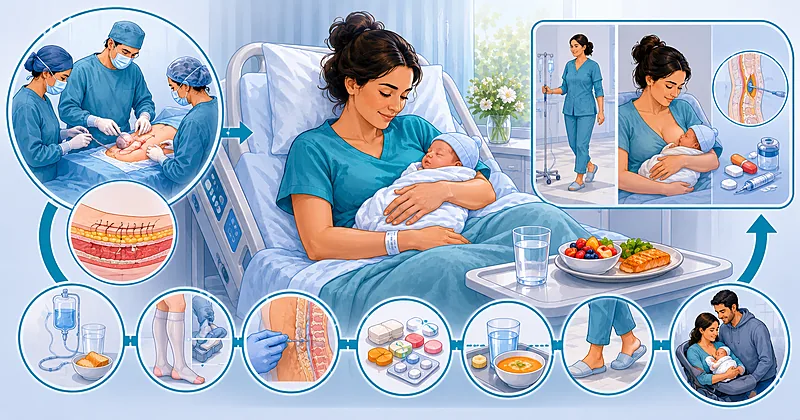
- 1Shorten preoperative fasting — allow clear fluids up to 2 hours before a scheduled cesarean rather than the traditional midnight cutoff.
- 2Offer a carbohydrate drink 2 hours preoperatively to non-diabetic patients to reduce insulin resistance and improve comfort.
- 3Use long-acting neuraxial morphine at delivery as the analgesic backbone for the first 24 hours.
- 4Schedule acetaminophen and an NSAID around the clock as the foundation of multimodal analgesia, reserving opioids for breakthrough pain only.
- 5Offer regular diet within the first 1–2 hours after an uncomplicated cesarean rather than waiting for bowel sounds.
- 6Remove the urinary catheter and support standing within 6–8 hours to enable early mobilization.
- 7Maintain normothermia throughout surgery with active warming to reduce blood loss and wound complications.
- 8Plan discharge from admission, set expectations early, and aim for departure on postoperative day 2–3 when criteria are met.
Why Enhanced Recovery After Cesarean Matters
Cesarean birth is among the most common major operations performed worldwide, yet recovery practices have historically lagged behind those refined in colorectal and orthopedic surgery. Enhanced recovery after cesarean adapts those surgical principles to a population that is unique: the patient is usually young and healthy, must care for a newborn within hours, and wants to breastfeed and bond rather than convalesce.
The goal is not simply a faster discharge. It is a smoother one, with less pain, less nausea, earlier return of function, and fewer opioids carried home to a household with an infant. Programs that implement the full bundle consistently report shorter stays without higher readmission rates.
Preoperative Preparation
Preparation begins well before the patient reaches the theatre. The decisions made in the antenatal clinic and on the morning of surgery set the trajectory for everything that follows.
Counsel patients antenatally on what to expect from surgery, pain management, and the recovery timeline. Setting realistic expectations early reduces anxiety and shortens the perceived recovery.
Strong Rec Moderate Evidence ERAS Society 2018Permit clear fluids until 2 hours before a scheduled cesarean and a light meal until 6 hours before. Prolonged fasting offers no aspiration benefit in elective surgery and worsens patient comfort.
Strong Rec High Evidence ERAS Society 2018Administer prophylactic antibiotics within 60 minutes before skin incision to lower the risk of surgical site infection. Add azithromycin for patients in labor or with ruptured membranes where local protocols support it.
Strong Rec High Evidence ACOG 2018Offer a carbohydrate-rich drink 2 hours before surgery to non-diabetic patients. This reduces postoperative insulin resistance, thirst, and hunger, and may shorten the time to readiness for discharge.
Moderate Rec Moderate Evidence ERAS Society 2018Screen for and correct antenatal anemia with oral or intravenous iron well before a scheduled cesarean. Optimizing hemoglobin builds reserve against intraoperative blood loss.
Moderate Rec Moderate Evidence ERAS Society 2018Intraoperative Management
The intraoperative phase is where the analgesic plan is laid down and where physiologic stability is protected. Choices here echo through the next 48 hours.
Use neuraxial anesthesia as the default technique for cesarean unless contraindicated. It avoids the risks of general anesthesia and enables single-dose neuraxial morphine for prolonged analgesia.
Strong Rec High Evidence SOAP 2021Administer long-acting neuraxial morphine at the time of spinal or epidural dosing. A single intrathecal dose provides roughly 18–24 hours of analgesia and is the cornerstone of opioid-sparing recovery.
Strong Rec High Evidence SOAP 2021Maintain maternal normothermia with forced-air warming and warmed intravenous fluids. Active warming reduces blood loss, wound infection, and the shivering that distresses patients on the table.
Strong Rec Moderate Evidence ERAS Society 2018Give prophylactic uterotonics after delivery to lower the risk of postpartum hemorrhage. A low-dose oxytocin infusion is generally preferred over a high-dose bolus to limit hypotension and nausea.
Strong Rec High Evidence ACOG 2018Consider a transversus abdominis plane block when neuraxial morphine cannot be used, such as after general anesthesia. It is not an automatic add-on when intrathecal morphine has already been given.
Conditional Rec Moderate Evidence SOAP 2021Pain Management in Enhanced Recovery After Cesarean
Analgesia is the engine of enhanced recovery after cesarean. The aim is comfortable movement and breastfeeding with the smallest possible opioid burden, achieved by stacking agents that work through different mechanisms.
Schedule acetaminophen 1 g every 6 hours around the clock as the base layer of multimodal analgesia, not as needed. Regular dosing maintains a steady analgesic floor.
Strong Rec High Evidence SOAP 2021Prescribe a scheduled NSAID such as ibuprofen alongside acetaminophen unless contraindicated. The two agents are synergistic and most patients need nothing stronger.
Strong Rec High Evidence ACOG 2018Reserve oral opioids for breakthrough pain that persists despite scheduled non-opioid analgesia. Use the lowest effective dose and document the indication each time.
Moderate Rec Moderate Evidence SOAP 2021Do not discharge patients with a default large opioid prescription. Tailor the take-home quantity to in-hospital use, and many patients who used minimal opioids on the ward need none at home.
Against Moderate Evidence SOAP 2021The Analgesic Ladder by Pain Severity
| Pain Scenario | What to Use | Breastfeeding Note | Common Pitfall |
|---|---|---|---|
| Baseline, all patients | Scheduled acetaminophen + NSAID | Both compatible with lactation | Switching to as-needed dosing too early |
| First 24h, surgical site | Add single-dose neuraxial morphine | Minimal transfer at neuraxial doses | Forgetting respiratory monitoring |
| Breakthrough pain | Short-acting oral opioid, lowest dose | Avoid codeine; monitor infant sedation | Using opioids before optimizing baseline |
| No neuraxial morphine given | Add transversus abdominis plane block | Local anesthetic compatible | Adding it on top of intrathecal morphine |
| Persistent severe pain | Reassess for complication; do not just escalate opioids | — | Missing hematoma, infection, or ileus |
Postoperative Care and Early Recovery
The ward phase is where enhanced recovery is won or lost. Early eating, early moving, and early removal of tethers return the patient to function and to her baby.
Offer a regular diet within 1–2 hours of an uncomplicated cesarean rather than waiting for flatus or bowel sounds. Early oral intake is safe and speeds return of gut function.
Strong Rec High Evidence Cochrane ReviewRemove the urinary catheter within 6–12 hours once the patient is mobile, provided neuraxial block has resolved. Earlier removal reduces urinary tract infection and encourages walking.
Strong Rec Moderate Evidence ERAS Society 2019Assess every patient for venous thromboembolism prophylaxis and combine early mobilization with mechanical or pharmacologic measures based on individual risk. The puerperium is a high-risk window for clotting.
Strong Rec Moderate Evidence ERAS Society 2019Facilitate skin-to-skin contact and breastfeeding support in the recovery area. Effective analgesia that preserves alertness directly enables earlier and more successful feeding.
Strong Rec Moderate Evidence ERAS Society 2019Support standing and a short walk within 6–8 hours of surgery, with assistance for the first attempt. Early mobilization lowers thromboembolic and respiratory complications.
Strong Rec Moderate Evidence ERAS Society 2019Discontinue the intravenous line once oral intake is established and analgesia is oral. Removing the drip is a concrete signal of progress and frees the patient to care for her newborn.
Moderate Rec Low Evidence ERAS Society 2019Clinical Decision Pathway
A practical, question-based walk through the recovery phases. Follow the questions in order from the morning of surgery onward.
Discharge Planning and Readiness
Discharge is planned from admission, not improvised on the day. Each domain below should be confirmed before departure, with a clear plan for what the patient watches for at home.
| Readiness Domain | Target Before Discharge | Home Action Plan |
|---|---|---|
| Pain | Controlled on oral acetaminophen + NSAID | Scheduled non-opioids; minimal opioid only if used in hospital |
| Diet and gut | Tolerating regular diet, passing flatus | Resume normal eating; hydration guidance |
| Mobility | Walking independently, voiding normally | Gradual activity increase; avoid heavy lifting |
| Wound | Dry, intact, no infection signs | Red-flag symptoms; when to seek review |
| Feeding and mood | Feeding established, screened for low mood | Lactation contact; perinatal mental health resources |
Monitoring and Follow-Up
| Parameter | When to Check | What to Look For | Common Pitfall |
|---|---|---|---|
| Respiratory status | First 12–24h after neuraxial morphine | Respiratory rate, sedation level | Stopping monitoring too early |
| Bleeding and tone | First few hours postpartum | Lochia volume, fundal tone, vital signs | Attributing tachycardia to pain alone |
| Pain and function | Each nursing round | Pain with movement, not just at rest | Scoring rest pain only and missing functional limitation |
| Wound | Daily and at follow-up | Erythema, discharge, dehiscence | No clear plan for who reviews the wound after discharge |
| Mood and bonding | Before discharge and at postnatal visit | Signs of low mood, feeding difficulty | Focusing on the physical and overlooking the psychological |
Evidence in Context
What the evidence supports, where the major frameworks align, and where genuine uncertainty remains.
Where the Major Frameworks Agree
The ERAS Society and SOAP consensus statements converge on the essentials: neuraxial anesthesia with long-acting morphine, scheduled multimodal non-opioid analgesia, early feeding, early mobilization, and minimizing take-home opioids. These are the high-confidence backbone of any program.
The Role of Carbohydrate Loading
Evidence for carbohydrate loading in obstetrics is extrapolated largely from general surgery. The comfort and metabolic benefits are plausible and low-risk in non-diabetic patients, but the obstetric-specific data are thinner than for other bundle elements, which is why it sits as a moderate rather than strong recommendation.
Abdominal Wall Blocks: When They Help
Transversus abdominis plane blocks clearly help when neuraxial morphine has not been given, but trials show little added benefit when stacked on top of intrathecal morphine. The nuance matters: a block is a rescue for the general-anesthesia patient, not a routine addition for everyone.
Bundle Effect Versus Individual Components
The strongest signal comes from implementing the full pathway rather than cherry-picking elements. Individual interventions show modest effects in isolation; the meaningful gains in length of stay, opioid use, and patient experience appear when the bundle is applied as a coordinated whole.
References
- 1.Wilson RD, Caughey AB, Wood SL, et al. Guidelines for Antenatal and Preoperative care in Cesarean Delivery: ERAS Society Recommendations (Part 1). Am J Obstet Gynecol. 2018;219(6):523.e1–523.e15. doi:10.1016/j.ajog.2018.09.015
- 2.Caughey AB, Wood SL, Macones GA, et al. Guidelines for Intraoperative care in Cesarean Delivery: ERAS Society Recommendations (Part 2). Am J Obstet Gynecol. 2018;219(6):533–544. doi:10.1016/j.ajog.2018.08.006
- 3.Bollag L, Lim G, Sultan P, et al. Society for Obstetric Anesthesia and Perinatology: Consensus Statement and Recommendations for Enhanced Recovery After Cesarean. Anesth Analg. 2021;132(5):1362–1377. doi:10.1213/ANE.0000000000005257
- 4.Committee on Obstetric Practice. ACOG Committee Opinion No. 742: Postpartum Pain Management. Obstet Gynecol. 2018;132(1):e35–e43. doi:10.1097/AOG.0000000000002683
- 5.Macones GA, Caughey AB, Wood SL, et al. Guidelines for Postoperative care in Cesarean Delivery: ERAS Society Recommendations (Part 3). Am J Obstet Gynecol. 2019;221(3):247.e1–247.e9. doi:10.1016/j.ajog.2019.04.012
How to Read the Evidence Tags
Every recommendation carries two tags for recommendation strength and evidence quality — Medaptly’s own simplified interpretations, not reproductions of any guideline body’s grading system.
Recommendation Strength
| Tag | What It Means |
|---|---|
| Strong Rec | High-quality evidence broadly supports this action. |
| Moderate Rec | The weight of evidence favours this action. |
| Conditional Rec | The benefit is less certain — individualise. |
| Against | Evidence shows no benefit or potential harm. |
Evidence Quality
| Tag | What It Means |
|---|---|
| High Evidence | Multiple well-designed RCTs or high-quality meta-analyses. |
| Moderate Evidence | Single RCT or large observational studies. |
| Low Evidence | Expert consensus or small studies. |