
Polycystic Ovary Syndrome: Diagnosis and Management in 2026
Clinical Practice Update — Diagnostic Criteria, Lifestyle Interventions, Pharmacological Treatment, Fertility Management, and Metabolic Screening
This is an original clinical education article informed by current guidelines and evidence. See References below for source documents.
- Clinical Focus
- Diagnostic criteria (including AMH as alternative to ultrasound), lifestyle management, COCP and metformin therapy, hirsutism treatment, ovulation induction with letrozole, and cardiometabolic screening
- Target Audience
- Obstetrician-gynaecologists, endocrinologists, family physicians, reproductive endocrinologists, residents, nurse practitioners
- Setting
- Outpatient gynaecology, endocrinology, primary care, fertility clinics
- Source Evidence
- •2023 International Evidence-Based Guideline for the Assessment and Management of PCOS (Teede et al.)
- •Endorsed by the Endocrine Society, ASRM, ESE, and ESHRE
- •ACOG Practice Bulletin No. 194 — Polycystic Ovary Syndrome (2018)
- •Legro et al. — Letrozole vs Clomiphene for PCOS Infertility (NEJM, 2014)
Key Clinical Takeaways
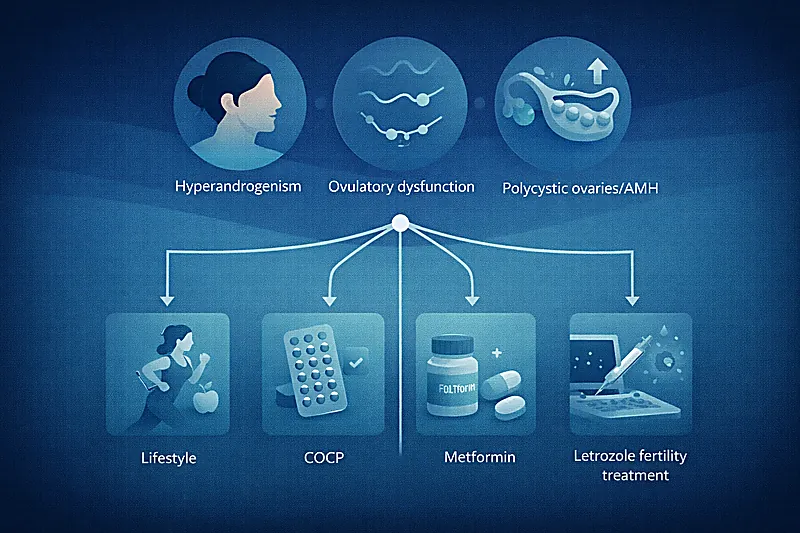
- 1Diagnose PCOS using evidence-based Rotterdam criteria: 2 of 3 features (hyperandrogenism, ovulatory dysfunction, polycystic ovaries) after excluding other causes → Diagnosis
- 2New in 2023: AMH can now replace ultrasound for the third diagnostic criterion in adults (but NOT in adolescents) → Diagnosis
- 3When both hyperandrogenism and ovulatory dysfunction are present, ultrasound and AMH are NOT required — diagnosis is simplified → Diagnosis
- 4Lifestyle intervention is first-line for all patients — no single diet or exercise regimen is superior to another → Lifestyle
- 5COCPs are first-line pharmacological therapy for menstrual irregularity and hyperandrogenism; prefer lower ethinyl oestradiol doses and preparations with fewer side effects → Pharmacological Therapy
- 6Metformin is recommended primarily for metabolic features (insulin resistance, glucose, lipids) and has greater efficacy than inositol → Pharmacological Therapy
- 7Letrozole is the first-line pharmacological treatment for ovulation induction — it has higher live birth rates and lower multiple pregnancy risk than clomiphene → Fertility Management
- 8Screen all PCOS patients for cardiovascular risk factors, anxiety, depression, and disordered eating → Screening
- 9Minimise weight bias and stigma — seek permission before weighing and explain weight-related risks → Lifestyle
- 10PCOS should be considered an enduring, lifelong condition requiring long-term follow-up across the lifespan → Long-Term Care
How Should You Diagnose PCOS?
PCOS is the most common endocrine disorder in reproductive-aged women, affecting 10–13% of this population. Despite this prevalence, diagnosis is frequently delayed and women report dissatisfaction with the diagnostic process. The 2023 International Guideline simplified and strengthened the diagnostic algorithm, building on the evidence-based 2018 criteria which refined the original 2003 Rotterdam consensus.
Diagnose PCOS in adults when at least 2 of the following 3 criteria are present, after excluding other causes: (i) clinical and/or biochemical hyperandrogenism, (ii) ovulatory dysfunction or irregular cycles, (iii) polycystic ovarian morphology on ultrasound or elevated serum anti-Müllerian hormone (AMH). When both hyperandrogenism and ovulatory dysfunction are present, ultrasound and AMH are not required.
Strong Rec High Evidence 2023 Int’l GuidelineIn adolescents (defined as ages 10–19 per WHO), require both hyperandrogenism and ovulatory dysfunction for diagnosis. Do not use pelvic ultrasound for PCOS diagnosis until 8 years post-menarche, and do not use AMH in adolescents, due to poor specificity in this age group.
Strong Rec Moderate Evidence 2023 Int’l GuidelineExclude other aetiologies at all stages of diagnosis using: TSH (thyroid disease), prolactin (hyperprolactinaemia), 17-hydroxyprogesterone (non-classic congenital adrenal hyperplasia), and FSH/LH (if indicated to exclude premature ovarian insufficiency or hypothalamic amenorrhoea). Consider Cushing syndrome and androgen-secreting tumours when clinically appropriate.
Strong Rec High Evidence 2023 Int’l GuidelineWhich Pharmacological Therapy Should You Prescribe?
Treatment choice depends on the patient’s primary concern: menstrual regulation, hyperandrogenism, metabolic features, or fertility. Lifestyle intervention should accompany all pharmacological approaches.
PCOS Pharmacological Therapy by Patient Goal
| Patient Goal | First-Line | Second-Line | Practical Tip |
|---|---|---|---|
| Menstrual regulation | COCP (prefer EE ≤30 mcg) | Cyclical progestin; metformin | No specific COCP preparation is recommended; balance efficacy, metabolic risk, side effects, cost |
| Hirsutism / acne | COCP + mechanical laser/light therapy | Anti-androgens (spironolactone, cyproterone) if suboptimal after 6+ months; must use with contraception | Anti-androgens are teratogenic; ensure reliable contraception. Laser ineffective for blond/grey/white hair. |
| Metabolic features (insulin resistance, glucose, lipids) | Lifestyle + metformin (especially if BMI ≥25) | Anti-obesity agents or bariatric surgery per general population guidelines | Metformin has greater efficacy than inositol for metabolic outcomes. Inositol offers limited clinical benefits. |
| Fertility (ovulation induction) | Letrozole 2.5–7.5 mg daily ×5 days, starting cycle day 3–5 | Clomiphene +/- metformin; gonadotrophins (low-dose) or laparoscopic ovarian surgery; IVF +/- IVM (third-line) | Letrozole: higher live birth rate, lower multiple pregnancy risk vs clomiphene. Contraindicated in pregnancy — confirm negative test first. |
- Metformin is not routinely recommended in pregnant women with PCOS per the 2023 guideline.
- IVF should be offered as third-line therapy when first- and second-line ovulation induction has failed and there is no other absolute indication for IVF.
Clinical Decision Pathway
Evidence in Context
The 2023 Guideline: What Changed From 2018
The most significant change is the inclusion of AMH as an alternative to ultrasound for defining polycystic ovarian morphology in adults. AMH was highlighted as a rapidly evolving area in 2018 but evidence was insufficient. By 2023, data were strong enough for a formal recommendation. Other key changes include: strengthened recognition of the psychological burden (anxiety, depression, eating disorders), emphasis on weight stigma reduction, confirmation of letrozole as first-line fertility treatment, and clarification that metformin is superior to inositol for metabolic outcomes.
Letrozole vs Clomiphene: The Evidence
The landmark Legro et al. trial (NEJM 2014) randomised 750 anovulatory women with PCOS to letrozole or clomiphene for up to 5 cycles. Letrozole produced higher live birth rates (27.5% vs 19.1%) with a comparable rate of congenital abnormalities and lower risk of twin pregnancies. Multiple subsequent studies and meta-analyses have confirmed this advantage, leading to the 2023 guideline’s strong recommendation of letrozole as first-line.
Metformin vs Inositol: What the 2023 Guideline Says
Inositol has gained popularity as a supplement for PCOS, but the 2023 guideline concludes that metformin has greater efficacy than inositol, which offers limited clinical benefits in PCOS for hirsutism, weight, and ovulation. Metformin remains the recommended agent for metabolic features, particularly in women with BMI of 25 or higher. The guideline does not recommend inositol as a replacement for metformin.
What We Still Don’t Know
References
- 1.Teede HJ, Tay CT, Laven JJE, et al.; International PCOS Network. Recommendations From the 2023 International Evidence-Based Guideline for the Assessment and Management of Polycystic Ovary Syndrome. J Clin Endocrinol Metab. 2023;108(10):2447–2469. doi:10.1210/clinem/dgad463
- 2.Teede HJ, Tay CT, Laven JJE, et al. Recommendations From the 2023 International Evidence-Based Guideline for the Assessment and Management of Polycystic Ovary Syndrome. Fertil Steril. 2023;120(4):767–793. doi:10.1016/j.fertnstert.2023.07.025
- 3.Legro RS, Brzyski RG, Diamond MP, et al.; NICHD Reproductive Medicine Network. Letrozole Versus Clomiphene for Infertility in the Polycystic Ovary Syndrome. N Engl J Med. 2014;371(2):119–129. doi:10.1056/NEJMoa1313517
- 4.Rotterdam ESHRE/ASRM-Sponsored PCOS Consensus Workshop Group. Revised 2003 Consensus on Diagnostic Criteria and Long-Term Health Risks Related to Polycystic Ovary Syndrome. Hum Reprod. 2004;19(1):41–47. doi:10.1093/humrep/deh098
- 5.ACOG Practice Bulletin No. 194. Polycystic Ovary Syndrome. Obstet Gynecol. 2018;131(6):e157–e171. doi:10.1097/AOG.0000000000002656
How to Read the Evidence Tags
Every recommendation carries two tags. These are Medaptly’s own simplified interpretations.
Recommendation Strength
| Tag | Meaning | In Practice |
|---|---|---|
| Strong Rec | Benefits clearly outweigh risks. | Standard practice. |
| Moderate Rec | Evidence favours benefit; some uncertainty. | Most patients should receive this. |
| Conditional Rec | Depends on patient context. | Shared decision-making. |
| Against | Risks outweigh benefits. | Avoid. |
Evidence Quality
| Tag | Meaning | Confidence |
|---|---|---|
| High Evidence | Multiple RCTs or large prospective cohorts. | Very confident. |
| Moderate Evidence | Single RCT or large observational studies. | Reasonably confident. |
| Low Evidence | Expert consensus or small studies. | Less certain. |
For full classification systems, consult the original documents in References.