
Vaginitis Treatment: Differentiating and Treating Common Causes
Clinical Practice Update — Diagnosis and Targeted Therapy for Bacterial Vaginosis, Candidiasis, and Trichomoniasis
This is an original clinical education article informed by current guidelines and evidence. See References below for source documents.
- Clinical Focus
- Diagnosis and targeted vaginitis treatment in adult women
- Target Audience
- Primary care physicians, gynecologists, nurse practitioners, residents
- Setting
- Primary care, gynecology clinics, urgent care, student health
- Source Evidence
- •CDC Sexually Transmitted Infections Treatment Guidelines (2021)
- •ACOG Practice Bulletin on Vaginitis in Nonpregnant Patients (No. 215, 2020)
- •IUSTI/WHO European Guideline on Vaginal Discharge (2018)
- •BASHH UK National Guideline for Bacterial Vaginosis (2012)
Key Clinical Takeaways
Effective vaginitis treatment depends entirely on getting the diagnosis right first. Three conditions account for the overwhelming majority of symptomatic cases, yet they respond to completely different therapies, and treating by symptom alone is wrong roughly a third of the time. The points below distill the evidence into actionable rules for the bedside.
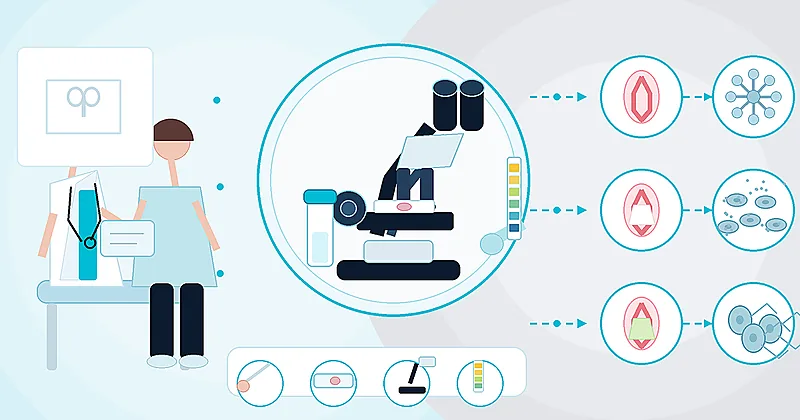
- 1Never treat vaginitis on symptoms alone — vaginal pH testing plus microscopy or molecular testing changes management in a large share of cases
- 2Bacterial vaginosis is the most common cause — a high pH with clue cells and a positive whiff test confirms it
- 3Oral or intravaginal metronidazole is first-line for bacterial vaginosis — both are equally effective
- 4A single 150 mg dose of oral fluconazole clears most uncomplicated yeast infections
- 5Trichomoniasis is a sexually transmitted infection — treat with oral metronidazole and arrange partner therapy
- 6Use nucleic acid amplification testing for trichomoniasis when available — it far outperforms wet mount microscopy
- 7The classic clue — a fishy odour points to bacterial vaginosis or trichomoniasis, never to yeast
- 8Reserve cultures and molecular panels for recurrent, resistant, or diagnostically uncertain cases
How to Diagnose Vaginitis Before Treatment
Accurate diagnosis is the foundation of vaginitis treatment, because the three common causes look similar at the bedside but demand different drugs. A structured office workup anchored by vaginal pH and a wet mount resolves most presentations in minutes.
Measure vaginal pH with narrow-range paper as the first objective step in every symptomatic patient. A normal pH of 4.0 to 4.5 makes bacterial vaginosis and trichomoniasis unlikely and points toward candidiasis or a non-infectious cause.
Strong Rec Moderate Evidence ACOG 2020Diagnose bacterial vaginosis when at least three of the four Amsel criteria are present: thin homogeneous discharge, pH above 4.5, a positive amine (whiff) test, and clue cells on saline microscopy.
Strong Rec High Evidence CDC 2021 BASHH 2012Examine a saline and a 10% potassium hydroxide wet mount to distinguish causes: clue cells signal bacterial vaginosis, budding yeast or pseudohyphae signal candidiasis, and motile flagellated organisms signal trichomoniasis.
Strong Rec Moderate Evidence ACOG 2020Order a nucleic acid amplification test for Trichomonas vaginalis when microscopy is negative but suspicion remains, since wet mount detects only a little over half of true infections.
Strong Rec High Evidence CDC 2021Avoid relying on a vaginal culture to diagnose bacterial vaginosis. Because the responsible organisms are part of the normal flora, a positive culture cannot distinguish infection from colonisation.
Against Moderate Evidence IUSTI/WHO 2018Targeted Vaginitis Treatment by Cause
Once the cause is confirmed, vaginitis treatment becomes straightforward, because each condition has a well-established first-line regimen. The recommendations below cover the three common causes and the most important prescribing nuances.
Bacterial Vaginosis
Prescribe oral metronidazole 500 mg twice daily for 7 days as first-line therapy for symptomatic bacterial vaginosis. Intravaginal metronidazole gel and intravaginal clindamycin cream are equally effective alternatives.
Strong Rec High Evidence CDC 2021Do not routinely treat male partners of women with bacterial vaginosis, as partner treatment has not reduced recurrence in heterosexual couples.
Against Moderate Evidence CDC 2021Consider suppressive intravaginal metronidazole twice weekly for recurrent bacterial vaginosis after a standard induction course, since maintenance therapy reduces relapse while it is being used.
Conditional Rec Moderate Evidence CDC 2021Vulvovaginal Candidiasis
Prescribe a single 150 mg oral dose of fluconazole, or a short course of a topical azole, for uncomplicated vulvovaginal candidiasis. Both routes achieve comparable cure rates in healthy non-pregnant women.
Strong Rec High Evidence ACOG 2020Extend therapy to multiple sequential fluconazole doses for complicated or severe candidiasis, including infections in poorly controlled diabetes or immunocompromised patients.
Moderate Rec Moderate Evidence CDC 2021Evaluate for a non-albicans species, particularly Candida glabrata, when symptoms persist despite azole therapy. These strains often need boric acid or alternative agents rather than repeated fluconazole.
Conditional Rec Low Evidence CDC 2021Trichomoniasis
Treat women with trichomoniasis using oral metronidazole 500 mg twice daily for 7 days, which clears infection more reliably than a single 2 g dose in this group.
Strong Rec High Evidence CDC 2021Refer or test for other sexually transmitted infections in any patient diagnosed with trichomoniasis, since co-infection with chlamydia, gonorrhoea, and HIV is common.
Strong Rec Moderate Evidence CDC 2021Counsel patients on abstaining from sex until both they and all partners have completed treatment and symptoms have resolved, to prevent reinfection.
Strong Rec Low Evidence IUSTI/WHO 2018Clinical Decision Pathway
A practical, question-based approach to the woman who presents with abnormal discharge. Work through the questions in order.
Distinguishing the Three Common Causes at a Glance
This table is organised by diagnostic feature rather than by condition, so you can read across a single finding and see how it shifts the differential.
| Feature | Bacterial Vaginosis | Candidiasis | Trichomoniasis |
|---|---|---|---|
| Typical discharge | Thin, grey-white, homogeneous | Thick, white, curd-like | Frothy, yellow-green |
| Vaginal pH | Above 4.5 | Normal (4.0–4.5) | Above 4.5 |
| Odour | Fishy, whiff-positive | Absent | May be malodorous |
| Microscopy | Clue cells | Budding yeast, pseudohyphae | Motile flagellates |
| First-line therapy | Metronidazole (oral or vaginal) | Fluconazole or topical azole | Oral metronidazole, 7-day course |
| Partner treatment | Not recommended | Not needed | Required (STI) |
Special Populations and Prescribing Cautions
Certain situations change the choice or safety of therapy. This table groups the most clinically relevant scenarios with the practical adjustment for each.
| Scenario | Practical Adjustment | Why It Matters |
|---|---|---|
| Pregnancy with symptomatic BV | Treat symptomatic disease; oral metronidazole is acceptable | Symptom relief is the goal; vaginitis in pregnancy needs individual assessment |
| Pregnancy with trichomoniasis | Treat with metronidazole and counsel on partner treatment | Untreated infection is associated with adverse outcomes |
| Recurrent yeast (4+ per year) | Induction then weekly maintenance fluconazole | Suppression markedly reduces recurrence during therapy |
| HIV co-infection | Use the 7-day metronidazole course for trichomoniasis | Multi-day dosing outperforms single-dose in this group |
| Suspected azole resistance | Send a culture with speciation before re-treating | Non-albicans species respond poorly to standard azoles |
Monitoring and Follow-Up
Most patients need no routine follow-up once symptoms resolve. The table flags the specific situations where re-evaluation or re-testing is worthwhile.
| Situation | When to Act | What to Do | Common Pitfall |
|---|---|---|---|
| Uncomplicated case, symptoms resolved | No routine visit needed | Reassure; safety-net for recurrence | Ordering a test of cure that is not indicated |
| Trichomoniasis | Within 3 months of treatment | Retest because reinfection is frequent | Assuming a single course ends the risk |
| Persistent symptoms after therapy | At the end of the course | Re-examine and re-test; question the diagnosis | Repeating the same drug without re-testing |
| Frequent recurrence | After confirming the cause | Start an appropriate suppressive regimen | Treating empirically without confirming organism |
Evidence in Context
What the evidence shows, where the major guideline bodies agree, and where their emphasis differs.
Where the guidelines agree
CDC, ACOG, and IUSTI/WHO converge on the core principles: confirm the cause objectively before treating, use nitroimidazoles for bacterial vaginosis and trichomoniasis, and reserve azoles for candidiasis. All three treat trichomoniasis as a sexually transmitted infection requiring partner management.
Where the emphasis differs
Diagnostic technology: recent CDC guidance leans further toward molecular and point-of-care testing, while older European and UK documents place more weight on bedside microscopy and clinical criteria where laboratory access is limited.
Trichomoniasis dosing: the evidence shift
A randomised trial in women demonstrated that a 7-day metronidazole course produced fewer treatment failures than a single 2 g dose, which is why current guidance favours the multi-day regimen for women rather than the historical single dose.
The challenge of recurrence
Recurrent bacterial vaginosis remains a major unsolved problem. Suppressive regimens reduce relapse while in use, but a substantial proportion of patients relapse after stopping, underscoring that current therapy controls rather than cures the disturbed vaginal microbiome.
References
- 1.Workowski KA, Bachmann LH, Chan PA, et al. Sexually Transmitted Infections Treatment Guidelines, 2021. MMWR Recomm Rep. 2021;70(4):1–187. doi:10.15585/mmwr.rr7004a1
- 2.American College of Obstetricians and Gynecologists. Vaginitis in Nonpregnant Patients: ACOG Practice Bulletin No. 215. Obstet Gynecol. 2020;135(1):e1–e17. doi:10.1097/AOG.0000000000003604
- 3.Sherrard J, Wilson J, Donders G, et al. 2018 European (IUSTI/WHO) International Union against sexually transmitted infections guideline on the management of vaginal discharge. Int J STD AIDS. 2018;29(13):1258–1272. doi:10.1177/0956462418785451
- 4.Kissinger P, Muzny CA, Mena LA, et al. Single-dose versus 7-day-dose metronidazole for the treatment of trichomoniasis in women. Lancet Infect Dis. 2018;18(11):1251–1259. doi:10.1016/S1473-3099(18)30423-7
- 5.Hainer BL, Gibson MV. Vaginitis: diagnosis and treatment. Am Fam Physician. 2011;83(7):807–815. pubmed.ncbi.nlm.nih.gov/21524046
How to Read the Evidence Tags
Every recommendation carries tags for recommendation strength and evidence quality — Medaptly’s own simplified interpretations, not any guideline body’s classification system.
Recommendation Strength
| Tag | What It Means |
|---|---|
| Strong Rec | High-quality evidence broadly supports this action. |
| Moderate Rec | The weight of evidence favours this action. |
| Conditional Rec | The benefit is less certain — individualise. |
| Against | Evidence shows no benefit or potential harm. |
Evidence Quality
| Tag | What It Means |
|---|---|
| High Evidence | Multiple well-designed RCTs or high-quality meta-analyses. |
| Moderate Evidence | Single RCT or large observational studies. |
| Low Evidence | Expert consensus or small studies. |