
Croup in Children: Severity Scoring and Corticosteroid Therapy
Clinical Practice Update — Severity Assessment, Dexamethasone Dosing, and Disposition in Children
This is an original clinical education article informed by current guidelines and evidence. See References below for source documents.
- Clinical Focus
- Croup severity scoring and corticosteroid therapy in immunocompetent children
- Target Audience
- Pediatricians, emergency physicians, family physicians, residents, nurses
- Setting
- Primary care, emergency departments, pediatric inpatient
- Source Evidence
- •Aregbesola et al. Glucocorticoids for Croup in Children, Cochrane Review (2023)
- •Canadian Paediatric Society — Acute Management of Croup (reaffirmed 2023)
- •TREKK Bottom Line Recommendation — Croup, v4.0 (2023)
- •Tyler et al. Variation in Dexamethasone Dosing for Inpatient Croup (Hosp Pediatr, 2022)
Key Clinical Takeaways
Reliable croup severity scoring is the hinge of every management decision in the barking, stridulous child: it tells you who needs nebulized epinephrine, who can go home, and how aggressively to dose steroids. Nearly every child who presents with croup benefits from a single dose of corticosteroid, and the points below translate the evidence into rules you can apply at the bedside in minutes.
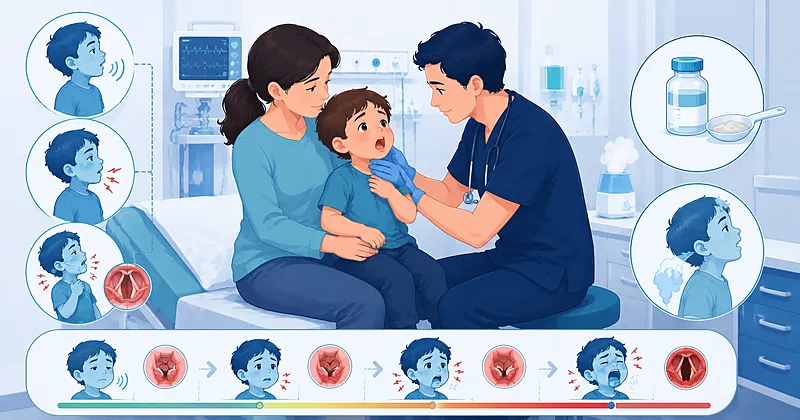
- 1Grade every child with barky cough and stridor using a structured croup severity scoring tool rather than gestalt alone.
- 2Stridor at rest is the single finding that separates mild from moderate disease and changes your immediate plan.
- 3Give a single dose of dexamethasone to essentially every child with croup, regardless of severity.
- 4Dexamethasone 0.15 mg/kg appears as effective as 0.6 mg/kg for most children; the higher dose is traditional, not mandatory.
- 5Reserve nebulized epinephrine for moderate-to-severe disease with stridor at rest and respiratory distress.
- 6Observe any child who receives epinephrine for at least 2 to 4 hours before considering discharge.
- 7Keep the child calm and on a caregiver’s lap; agitation worsens airway narrowing and inflates the apparent severity.
- 8Re-examine the diagnosis when a child fails to respond to steroids and epinephrine; consider bacterial tracheitis or a foreign body.
How to Approach Croup Severity Scoring
Croup severity scoring exists to make a fuzzy clinical impression reproducible. The widely used research instrument weights five observations, but the everyday clinical question collapses to a simpler one: is there stridor at rest, and how hard is the child working to breathe? Anchoring your assessment to those findings keeps scoring fast and bedside-ready.
Perform structured croup severity scoring on every child, combining stridor, retractions, air entry, colour, and conscious level with overall work of breathing. Treat the number as a guide to disposition, not a substitute for repeated examination.
Moderate Rec Moderate Evidence CPS 2023Evaluate for stridor at rest before deciding on epinephrine. Stridor only with agitation points to mild disease; persistent stridor in a quiet child marks at least moderate severity.
Strong Rec Moderate Evidence CPS 2023 TREKK 2023Do not order routine neck radiographs to confirm croup. Imaging delays treatment, agitates the child, and rarely changes management in a classic presentation.
Against Moderate Evidence TREKK 2023Reading Severity at the Bedside
The table below reframes croup severity scoring around what you actually watch for and the action each tier triggers, rather than reproducing any single instrument’s point allocation. Use it as a quick translation from observation to plan.
| Severity Tier | What You See | Immediate Action | Disposition Tendency |
|---|---|---|---|
| Mild | Barky cough, no stridor at rest, no or minimal retractions | Single oral dexamethasone, reassurance | Discharge with safety-netting |
| Moderate | Stridor at rest, suprasternal/intercostal retractions, child still interactive | Dexamethasone; add epinephrine if distress | Observe 2–4 h, then reassess |
| Severe | Marked stridor, sternal retraction, agitation or lethargy, poor air entry | Nebulized epinephrine plus dexamethasone, minimal handling | Admit; prepare for escalation |
| Impending failure | Tiring, decreasing stridor with rising effort, cyanosis, depressed consciousness | Senior airway support, anesthesia/ICU, oxygen | ICU; possible intubation |
Corticosteroid Therapy Across Every Severity Tier
The benefit of corticosteroids in croup is one of the most consistent findings in pediatric emergency medicine. Pooled trial data show improved croup scores within two hours of a single dose, fewer return visits, and shorter time in care. Once your croup severity scoring places a child anywhere on the spectrum from mild to severe, a steroid is almost always indicated.
Start a single dose of dexamethasone for essentially every child presenting with croup, including mild disease, because corticosteroids reduce symptom duration and return visits across all severity tiers.
Strong Rec High Evidence Cochrane 2023 CPS 2023Prescribe oral dexamethasone where the child can swallow; the oral, intramuscular, and intravenous routes are comparably effective, so reserve injection for vomiting or severe distress.
Strong Rec Moderate Evidence CPS 2023Consider the lower 0.15 mg/kg dexamethasone dose for mild-to-moderate croup. Trial evidence suggests it relieves symptoms comparably to 0.6 mg/kg, which reduces steroid exposure without sacrificing benefit.
Conditional Rec Moderate Evidence Cochrane 2023May be appropriate to use nebulized budesonide when a child cannot tolerate oral dosing and injection is undesirable, though dexamethasone generally produces better symptom scores and remains first choice.
Conditional Rec Moderate Evidence Cochrane 2023Avoid routine repeat dosing of dexamethasone in hospitalized children. Cohort data link multiple doses to longer length of stay without a clear reduction in return visits, so reserve a second dose for selected cases.
Conditional Rec Moderate Evidence Hosp Pediatr 2022Do not give antibiotics for uncomplicated croup. The illness is viral, and antibiotics add no benefit while exposing the child to unnecessary harm.
Against High Evidence TREKK 2023Epinephrine and Supportive Care
When croup severity scoring lands in the moderate-to-severe range, nebulized epinephrine buys time while the steroid takes effect. Its benefit is fast but short-lived, which is precisely why the observation window after dosing matters so much for safe discharge.
Perform nebulized epinephrine for moderate-to-severe croup with stridor at rest and respiratory distress; clinical improvement typically appears within 10 to 30 minutes.
Strong Rec Moderate Evidence CPS 2023Monitor any child who received epinephrine for at least 2 to 4 hours, because the airway effect wears off and symptoms can recur as the drug fades.
Strong Rec Moderate Evidence CPS 2023 TREKK 2023Ensure the child stays as calm as possible, ideally on a caregiver’s lap, since crying and struggling amplify airway turbulence and can make croup severity scoring read falsely high.
Moderate Rec Low Evidence TREKK 2023Avoid routine use of cool mist or humidified air as a therapeutic measure; controlled studies have not shown it changes croup scores, and it can delay more effective treatment.
Conditional Rec Moderate Evidence CPS 2023Clinical Decision Pathway
A practical, question-based route through the child with suspected croup. Work the questions in order.
Monitoring and Follow-Up
Most children improve within hours and recover fully within a few days. The table below organises monitoring around the practical question of what to watch and where mistakes commonly happen.
| What to Watch | When | Reassuring Sign | Common Pitfall |
|---|---|---|---|
| Stridor at rest | Hourly during observation | Resolves while child is calm | Mistaking a tiring child’s quiet airway for improvement |
| Response after epinephrine | 2–4 h post-dose | No return of rest stridor | Discharging before the rebound window has passed |
| Hydration and intake | Throughout the visit | Drinking, wet diapers, no exhaustion | Overlooking poor intake in a child focused on breathing |
| Caregiver understanding | At discharge | Can state safety-netting advice back to you | Handing over a leaflet without confirming comprehension |
Evidence in Context
What the evidence shows, where the major sources align, and where uncertainty remains.
How strong is the corticosteroid evidence?
A large 2023 systematic review pooling dozens of randomized trials in several thousand children found that glucocorticoids improved croup scores by two hours after treatment, with benefit sustained at later time points, alongside fewer return visits and shorter time in care. Dexamethasone was the agent studied in most trials.
Does the dexamethasone dose matter?
Comparative data suggest the lower 0.15 mg/kg dose performs similarly to the traditional 0.6 mg/kg for symptom relief in mild-to-moderate disease, though the trials informing this are relatively small. The higher dose persists largely by convention; many clinicians now favour the lowest effective dose, particularly outside severe presentations.
Is a second steroid dose worthwhile in admitted children?
A cohort study of hospitalized children found that those receiving more than one dose of dexamethasone had a substantially longer length of stay without a statistically significant reduction in 30-day return visits. This points away from reflexive repeat dosing and toward reserving additional steroid for selected, clearly indicated cases.
How safe is discharge after epinephrine?
Prospective and retrospective data support discharging children after treatment with dexamethasone and nebulized epinephrine, provided symptoms do not recur during a 2-to-4-hour observation window. This evidence underpins the now-common practice of safe outpatient management for many children who once would have been admitted.
References
- 1.Aregbesola A, Tam CM, Kothari A, Le ML, Ragheb M, Klassen TP. Glucocorticoids for croup in children. Cochrane Database Syst Rev. 2023;1(1):CD001955. doi:10.1002/14651858.CD001955.pub5
- 2.Gates A, Gates M, Vandermeer B, et al. Glucocorticoids for croup in children. Cochrane Database Syst Rev. 2018;8(8):CD001955. doi:10.1002/14651858.CD001955.pub4
- 3.Tyler A, Bryan MA, Zhou C, et al. Variation in dexamethasone dosing and use outcomes for inpatient croup. Hosp Pediatr. 2022;12(1):22–29. doi:10.1542/hpeds.2021-005854
- 4.Fernandes RM, Wingert A, Vandermeer B, et al. Safety of corticosteroids in young children with acute respiratory conditions: a systematic review and meta-analysis. BMJ Open. 2019;9(8):e028511. doi:10.1136/bmjopen-2018-028511
- 5.Ortiz-Alvarez O; Canadian Paediatric Society. Acute management of croup in the emergency department. Paediatr Child Health. 2017;22(3):166–169. doi:10.1093/pch/pxx019
How to Read the Evidence Tags
Each recommendation carries two tags — one for recommendation strength and one for evidence quality — using Medaptly’s own simplified interpretation. They are a quick orientation, not a substitute for the source evidence.
Recommendation Strength
| Tag | What It Means |
|---|---|
| Strong Rec | High-quality evidence broadly supports this action. |
| Moderate Rec | The weight of evidence favours this action. |
| Conditional Rec | The benefit is less certain — individualise. |
| Against | Evidence shows no benefit or potential harm. |
Evidence Quality
| Tag | What It Means |
|---|---|
| High Evidence | Multiple well-designed RCTs or high-quality meta-analyses. |
| Moderate Evidence | Single RCT or large observational studies. |
| Low Evidence | Expert consensus or small studies. |