
Febrile Neutropenia in Children: Risk Stratification and Empiric Therapy
Clinical Practice Update — Risk Stratification, Initial Workup, and Empiric Antibiotic Selection
This is an original clinical education article informed by current guidelines and evidence. See References below for source documents.
- Clinical Focus
- Risk stratification and empiric antibiotic therapy for febrile neutropenia in children
- Target Audience
- Pediatricians, pediatric oncologists, emergency physicians, residents, pharmacists
- Setting
- Emergency departments, pediatric oncology wards, inpatient units
- Source Evidence
- •International Pediatric Fever and Neutropenia Guideline (2017 update)
- •IDSA Guideline on Antimicrobial Use in Neutropenic Patients with Cancer (2010)
- •NICE Guideline NG12 — Neutropenic Sepsis (2012)
- •Cochrane Review — Oral vs IV Antibiotics for Low-Risk Febrile Neutropenia (2019)
Key Clinical Takeaways
Managing febrile neutropenia in children turns on a handful of fast, sequential decisions: confirm fever and neutropenia, draw cultures without delay, start broad-spectrum antibiotics within an hour, and sort each child into a risk category that dictates the route and duration of therapy. The points below condense the evidence into bedside rules.
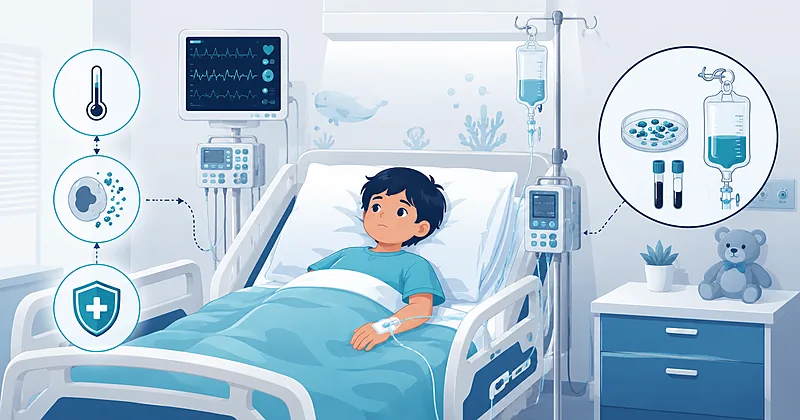
- 1Define the syndrome precisely: a single temperature of 38.0°C sustained, or 38.3°C once, plus an absolute neutrophil count below 500 cells/microlitre (or expected to fall below it).
- 2Treat the first hour as the priority: draw blood cultures, then give the first dose of empiric antibiotics within 60 minutes of presentation.
- 3Start an anti-pseudomonal beta-lactam as monotherapy for most children — cefepime, piperacillin-tazobactam, or meropenem.
- 4Do not add vancomycin routinely — reserve it for specific indications such as suspected line infection or hemodynamic instability.
- 5Apply a validated risk-stratification approach to separate low-risk children from those who need intensive inpatient care.
- 6Selected low-risk children can step down to oral therapy or ambulatory management once they are stable and cultures are reassuring.
- 7Reassess at 48–72 hours: a child who is afebrile with recovering counts and negative cultures is a candidate for de-escalation or stopping.
- 8Consider empiric antifungal cover in children with persistent fever beyond 96 hours of broad-spectrum antibiotics.
How to Define Febrile Neutropenia in Children
Getting the definition right matters because the threshold determines who enters the urgent pathway. Febrile neutropenia in children is the combination of a measured fever and a depleted neutrophil count, and both halves of the definition carry nuance.
Confirm fever as a single oral or axillary temperature of 38.3°C, or a sustained temperature of 38.0°C lasting at least one hour. Avoid rectal thermometry in a neutropenic child because of mucosal injury risk.
Strong Rec Moderate Evidence IPFN 2017Define neutropenia as an absolute neutrophil count below 500 cells/microlitre, or a count below 1,000 cells/microlitre that is predicted to decline below 500 within 48 hours. Treat profound neutropenia (below 100 cells/microlitre) as the highest-risk band.
Strong Rec High Evidence IDSA 2010Initial Workup Before Antibiotics
The workup should never delay the first antibiotic dose. The aim is to capture microbiology before antibiotics sterilise the blood, while moving fast enough that nothing holds up therapy in the first hour.
Draw blood cultures from every lumen of any central venous catheter, and add a peripheral set when feasible. Paired sampling helps distinguish a line infection from bacteraemia of another source.
Strong Rec Moderate Evidence IDSA 2010Perform a focused examination of the mouth, perineum, skin, and catheter site, and obtain targeted cultures only where symptoms point. Avoid a digital rectal examination in a neutropenic child.
Strong Rec Low Evidence IPFN 2017Do not order a routine chest radiograph in a child without respiratory signs. Reserve imaging for those with cough, tachypnoea, hypoxia, or focal findings.
Against Moderate Evidence IPFN 2017Risk Stratification in Febrile Neutropenia in Children
Risk stratification is the decision that shapes everything downstream — route of antibiotics, duration, and whether a child can leave hospital. The goal is to identify the minority who are genuinely low-risk while never under-treating a child who might deteriorate. Classification rests on the underlying malignancy, the depth and expected duration of neutropenia, and the clinical picture at presentation.
Classify a child as high-risk in the presence of hemodynamic compromise, signs of septic shock, profound neutropenia expected to last beyond seven days, or significant comorbidity such as mucositis impairing oral intake.
Strong Rec Moderate Evidence IPFN 2017Apply a validated decision rule rather than clinical impression alone when designating a child as low-risk. Local adaptation of a published rule improves reproducibility across clinicians.
Moderate Rec Moderate Evidence IPFN 2017Reassess the risk category at each review rather than treating it as fixed. A child labelled low-risk who develops a positive culture or new instability moves immediately into the high-risk pathway.
Strong Rec Low Evidence NICE NG12Features That Point Toward Each Risk Band
| Clinical Domain | Points Toward Low-Risk | Points Toward High-Risk | Why It Matters in Practice |
|---|---|---|---|
| Underlying disease | Solid tumour, maintenance-phase leukaemia | Induction-phase or relapsed leukaemia, post-transplant | Intensity of therapy predicts depth and length of the nadir |
| Expected nadir | Recovery anticipated within 7 days | Profound neutropenia beyond 7 days | Longer neutropenia widens the window for invasive infection |
| Haemodynamics | Well-perfused, normal vital signs | Hypotension, prolonged capillary refill, tachycardia | Instability mandates inpatient broad-spectrum cover |
| Comorbidity | No mucositis, tolerating fluids | Severe mucositis, vomiting, new organ dysfunction | Oral intolerance rules out oral step-down |
| Social context | Reliable carer, lives near the centre | Long travel time, limited support | Ambulatory care depends on rapid return if worsening |
Empiric Antibiotic Therapy for Febrile Neutropenia in Children
The cornerstone of empiric antibiotic therapy is rapid, broad cover against Gram-negative organisms, including Pseudomonas. The major guideline frameworks converge on anti-pseudomonal beta-lactam monotherapy as the default, with additions reserved for defined situations.
Start an anti-pseudomonal beta-lactam as monotherapy — cefepime, piperacillin-tazobactam, or meropenem — as soon as cultures are drawn, within 60 minutes of presentation.
Strong Rec High Evidence IPFN 2017 IDSA 2010Add vancomycin only for a specific trigger: suspected central venous catheter infection, skin or soft-tissue infection, hemodynamic instability, or known colonisation with a resistant Gram-positive organism. Stop it within 48 hours if cultures do not support it.
Moderate Rec Moderate Evidence IDSA 2010Escalate to dual Gram-negative cover or a carbapenem in a child who is unstable or known to be colonised with a resistant organism, guided by local resistance data and any prior isolates.
Conditional Rec Low Evidence IDSA 2010Adjust dosing for renal function and weight, and confirm the local formulary dose before prescribing. Beta-lactam efficacy depends on adequate exposure across the dosing interval.
Strong Rec Low Evidence IPFN 2017Empiric Agents: A Drug-by-Drug Guide
| Agent | Typical Pediatric Dose | Best Suited For | Practical Tips |
|---|---|---|---|
| Cefepime | 50 mg/kg IV every 8 hours | Default monotherapy in most units | Watch for neurotoxicity in renal impairment; cap at adult dose. |
| Piperacillin-tazobactam | 90 mg/kg (piperacillin component) IV every 6–8 hours | Units favouring broad Gram-negative plus anaerobic cover | Extended infusion may improve target attainment. |
| Meropenem | 20 mg/kg IV every 8 hours | Known ESBL colonisation or prior resistant isolate | Reserve to preserve carbapenem activity; not routine first-line. |
| Vancomycin (add-on) | 15 mg/kg IV every 6 hours, level-guided | Line infection, instability, resistant Gram-positive risk | Add only on indication; stop at 48 h if not supported. |
| Amikacin (add-on) | 15–20 mg/kg IV once daily | Second Gram-negative agent in the unstable child | Monitor renal function; short course only. |
When Can a Child Be Managed as Low-Risk
For carefully selected children, the evidence supports stepping down from intravenous inpatient therapy to oral or ambulatory care. The Cochrane evidence shows comparable outcomes between oral and intravenous routes in low-risk episodes, provided selection and follow-up are rigorous.
Consider a switch to outpatient oral therapy in a low-risk child who has been observed in hospital, remains stable after an initial intravenous dose, has negative cultures at 24–48 hours, and can return rapidly if needed.
Moderate Rec High Evidence Cochrane 2019Counsel the family on clear return criteria before any ambulatory plan: recurrence of fever, new symptoms, poor oral intake, or any caregiver concern warrants immediate return to the centre.
Strong Rec Low Evidence NICE NG12Monitoring and Follow-Up
Ongoing review drives the decisions to stop, switch, or escalate. The reassessment at 48–72 hours is the pivot point, and persistent fever beyond four days reframes the question toward fungal disease.
| Parameter | When to Check | What to Look For | Common Pitfalls |
|---|---|---|---|
| Temperature and vitals | Continuously, formal review at 48–72 h | Defervescence and stable perfusion | Changing antibiotics at 24 h for persistent fever alone |
| Neutrophil count | Daily | Recovery trend above 500/microlitre | Reading a single value without the trajectory |
| Blood cultures | At presentation, repeat if fever persists | A pathogen to narrow or broaden therapy | Not repeating cultures in ongoing fever |
| Persistent fever review | At 96 h of broad-spectrum cover | Triggers for empiric antifungal therapy and imaging | Delaying fungal assessment past day 4–5 |
Discontinue empiric antibiotics in a child who is afebrile for at least 24 hours with negative cultures, irrespective of neutrophil count, when local protocol supports count-independent stopping in stable low-risk patients.
Moderate Rec Moderate Evidence IPFN 2017Evaluate for invasive fungal infection — with chest and sinus imaging and a fungal biomarker where available — in any child with fever persisting beyond 96 hours despite broad-spectrum antibiotics.
Moderate Rec Moderate Evidence IPFN 2017Evidence in Context
What the evidence shows, where the major frameworks agree, and where their emphasis differs.
Where the Major Frameworks Agree
The pediatric, IDSA, and NICE frameworks all centre on early antibiotics within the first hour, anti-pseudomonal beta-lactam monotherapy as the default, and a structured low-risk pathway that permits stepping down therapy in stable children.
Where Their Emphasis Differs
The pediatric-specific guideline gives the most detailed criteria for an oral step-down and count-independent stopping, whereas adult-derived frameworks lean more conservative on early discharge. Local resistance shapes whether monotherapy or a combination is the starting point.
Oral Versus Intravenous Therapy: What the Trials Show
Pooled trial data indicate that oral antibiotics are non-inferior to intravenous therapy for treatment failure and mortality in low-risk episodes, supporting ambulatory pathways when selection and follow-up are robust.
Routine Empiric Vancomycin: Why It Fell Out of Favour
Adding vancomycin to every regimen has not improved outcomes and contributes to resistance and toxicity, which is why current practice restricts it to defined Gram-positive triggers and prompt review at 48 hours.
References
- 1.Lehrnbecher T, Robinson P, Fisher B, et al. Guideline for the Management of Fever and Neutropenia in Children With Cancer and Hematopoietic Stem-Cell Transplantation Recipients: 2017 Update. J Clin Oncol. 2017;35(18):2082–2094. doi:10.1200/JCO.2016.71.7017
- 2.Freifeld AG, Bow EJ, Sepkowitz KA, et al. Clinical Practice Guideline for the Use of Antimicrobial Agents in Neutropenic Patients With Cancer: 2010 Update by the IDSA. Clin Infect Dis. 2011;52(4):e56–e93. doi:10.1093/cid/cir073
- 3.Manji A, Beyene J, Dupuis LL, et al. Outpatient and oral antibiotic management of low-risk febrile neutropenia in children: a systematic review of prospective trials. Support Care Cancer. 2012;20(6):1135–1145. doi:10.1007/s00520-012-1425-8
- 4.National Institute for Health and Care Excellence. Neutropenic sepsis: prevention and management in people with cancer (CG151). 2012. nice.org.uk/guidance/cg151
How to Read the Evidence Tags
Every recommendation carries two tags for recommendation strength and evidence quality — Medaptly’s own simplified interpretations, not any guideline body’s classification system.
Recommendation Strength
| Tag | What It Means |
|---|---|
| Strong Rec | High-quality evidence broadly supports this action. |
| Moderate Rec | The weight of evidence favours this action. |
| Conditional Rec | The benefit is less certain — individualise. |
| Against | Evidence shows no benefit or potential harm. |
Evidence Quality
| Tag | What It Means |
|---|---|
| High Evidence | Multiple well-designed RCTs or high-quality meta-analyses. |
| Moderate Evidence | Single RCT or large observational studies. |
| Low Evidence | Expert consensus or small studies. |