
Neonatal Hyperbilirubinemia: 2022 AAP Essential Guide
Clinical Practice Update — Risk Assessment, Phototherapy, Exchange Transfusion, and Follow-Up in Infants 35 Weeks Gestation or Greater
This is an original clinical education article informed by current guidelines and evidence. See References below for source documents.
- Clinical Focus
- Evidence-based neonatal hyperbilirubinemia management in infants 35 weeks gestation or greater
- Target Audience
- Pediatricians, neonatologists, family physicians, hospitalists, NICU and nursery nurses
- Setting
- Newborn nursery, NICU, pediatric emergency, primary care follow-up
- Source Evidence
- •AAP Clinical Practice Guideline Revision: Management of Hyperbilirubinemia in the Newborn (Pediatrics, 2022)
- •AAP Hyperbilirubinemia Subcommittee Guideline (Pediatrics, 2004)
- •NICE Guideline NG98 — Jaundice in Newborn Babies Under 28 Days (updated 2023)
- •Bhutani VK et al. Hour-Specific Bilirubin Nomogram (Pediatrics, 1999)
- •Maisels MJ et al. Hyperbilirubinemia Update With Clarifications (Pediatrics, 2009)
Key Clinical Takeaways
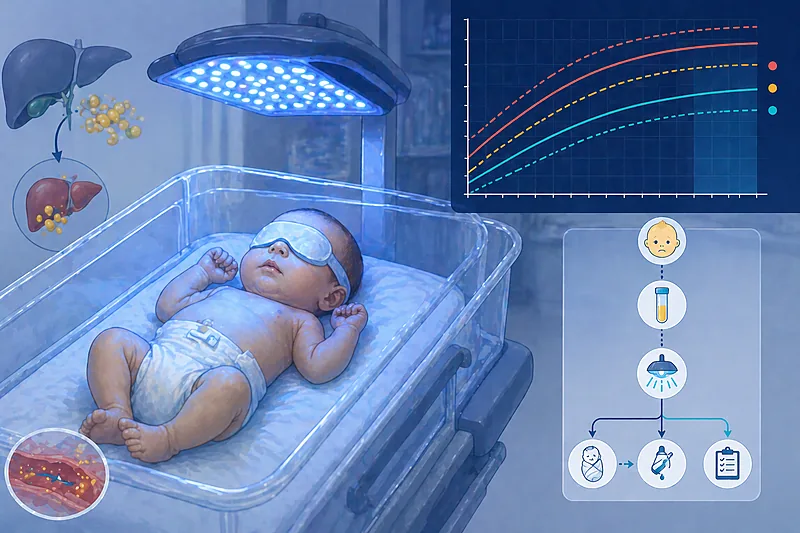
Safe management of neonatal hyperbilirubinemia comes down to three rhythms that every clinician caring for newborns must internalise: screen every baby, act on hour-specific thresholds, and close the loop with timely follow-up. The 2022 AAP revision raised phototherapy thresholds modestly, formalised the role of neurotoxicity risk factors, and tightened follow-up expectations. The points below distill that framework into bedside rules.
- 1Assess every newborn for neurotoxicity risk factors and hemolysis risk within the first hours of life → Risk Assessment
- 2Measure total serum or transcutaneous bilirubin between 24 and 48 hours of life in every infant, and sooner if jaundice is visible in the first 24 hours → Measuring Bilirubin
- 3Apply phototherapy thresholds specific to gestational age and neurotoxicity risk, not a single cut-off → Phototherapy
- 4Trigger escalation-of-care when TSB is within 2 mg/dL of the exchange threshold or rising rapidly despite phototherapy → Escalation
- 5Order a direct antiglobulin test when maternal blood type predicts isoimmunisation or when hemolysis is suspected → Risk Assessment
- 6Perform exchange transfusion for TSB at or above the gestational-age threshold, or for any sign of acute bilirubin encephalopathy → Escalation
- 7Support feeding aggressively — dehydration and inadequate caloric intake amplify bilirubin levels → Feeding
- 8Stop phototherapy when TSB drops at least 2 mg/dL below the starting threshold and check a rebound level within 24 hours in high-risk infants → Monitoring
- 9Time post-discharge follow-up to discharge TSB and risk profile — some infants need to be seen within 24 hours → Follow-Up
- 10Never discharge a jaundiced infant without a documented follow-up plan and a bilirubin trajectory that is clearly declining → Follow-Up
Risk Assessment in Neonatal Hyperbilirubinemia
Effective management of neonatal hyperbilirubinemia begins before any bilirubin has been measured. Two categories of risk should be assessed in every newborn: the risk that bilirubin will rise to a concerning level (hyperbilirubinemia risk), and the risk that a given bilirubin level will cause neurotoxicity (neurotoxicity risk). The 2022 AAP update formalised the second category and made it a direct input into phototherapy thresholds.
Perform a structured risk assessment on every newborn before discharge, documenting both hyperbilirubinemia risk factors (lower gestational age, jaundice in first 24 hours, exclusive breastfeeding with weight loss, cephalohematoma, East Asian ancestry, sibling who required phototherapy) and neurotoxicity risk factors (gestational age under 38 weeks, isoimmune hemolysis, G6PD deficiency, sepsis, albumin under 3 g/dL).
Strong Rec High Evidence AAP 2022Treat gestational age as a continuous modifier rather than a binary term/preterm classification. An infant at 36 weeks carries meaningfully more neurotoxicity risk than one at 40 weeks even when both are clinically well.
Strong Rec Moderate Evidence AAP 2022Order a direct antiglobulin test on any infant of a mother with blood type O or Rh-negative, or when early jaundice, rapidly rising bilirubin, or a positive family history suggests isoimmune hemolytic disease.
Strong Rec Moderate Evidence AAP 2022 NICE NG98Evaluate for G6PD deficiency in infants with family or ethnic risk (Mediterranean, African, Middle Eastern, Southeast Asian origin) and in any infant whose bilirubin rises faster than expected despite adequate phototherapy.
Moderate Rec Moderate Evidence AAP 2022Document visual assessment of jaundice at every newborn examination, but do not rely on it to estimate bilirubin level — visual estimates are unreliable, especially in infants with pigmented skin.
Strong Rec High Evidence AAP 2022 NICE NG98Neurotoxicity Risk Factors at a Glance
| Risk Factor | Why It Matters | Practical Action |
|---|---|---|
| Gestational age under 38 weeks | Immature blood-brain barrier; lower bilirubin binding capacity | Use the neurotoxicity-risk threshold curves |
| Isoimmune hemolysis (ABO or Rh) | Rapid bilirubin rise; bilirubin may exceed binding capacity | Check DAT; recheck TSB every 4–6 hours |
| G6PD deficiency | Risk of acute hemolytic crisis; unpredictable trajectory | Consider testing in at-risk ancestry |
| Sepsis or clinical instability | Acidosis displaces bilirubin from albumin | Treat infection; lower the threshold for intervention |
| Albumin under 3.0 g/dL | Less free binding capacity | Check albumin when escalation is being considered |
| Clinical signs of acute bilirubin encephalopathy | Evolving neurologic injury | Proceed to exchange transfusion regardless of TSB |
Measuring and Interpreting Bilirubin Levels
Universal bilirubin screening is the foundation of safe newborn care. The 2022 AAP revision reaffirms that every infant should have a measured bilirubin before discharge, with the result plotted on the hour-specific nomogram to guide follow-up.
Measure total serum bilirubin or transcutaneous bilirubin between 24 and 48 hours of age in every newborn, regardless of clinically visible jaundice.
Strong Rec High Evidence AAP 2022Confirm a transcutaneous bilirubin with serum measurement whenever the TcB is within 3 mg/dL of the phototherapy threshold, when TcB reads above 15 mg/dL, or when the infant has received phototherapy already.
Strong Rec High Evidence AAP 2022Initiate urgent bilirubin testing — within hours, not routinely at 24 hours — for any infant with visible jaundice before 24 hours of age. Jaundice this early is pathologic until proven otherwise.
Strong Rec High Evidence AAP 2022 NICE NG98Calculate and record a rate of rise when two bilirubin values are available. A rate above 0.3 mg/dL per hour in the first 24 hours, or above 0.2 mg/dL per hour thereafter, flags likely hemolysis.
Moderate Rec Moderate Evidence AAP 2022Phototherapy Thresholds for Neonatal Hyperbilirubinemia
Phototherapy remains the cornerstone of treatment for neonatal hyperbilirubinemia. The 2022 AAP revision raised thresholds modestly across gestational age categories, reflecting updated evidence that neurotoxicity risk at previously accepted thresholds was overestimated in low-risk term infants. Thresholds are now expressed as curves that depend on both gestational age and the presence of neurotoxicity risk factors.
Start phototherapy when the total serum bilirubin crosses the gestational-age-specific threshold that corresponds to the infant’s neurotoxicity risk profile (no risk factors vs any risk factor present).
Strong Rec High Evidence AAP 2022Deliver intensive phototherapy using a narrow-spectrum blue LED device covering the maximal skin surface possible. Spectral irradiance should be at least 30 microwatts per cm² per nm measured at skin level.
Strong Rec High Evidence AAP 2022Consider home phototherapy only when the infant is at or above 38 weeks gestation, bilirubin is within 2 mg/dL of the phototherapy threshold, no neurotoxicity risk factors are present, and reliable home monitoring can be arranged.
Conditional Rec Low Evidence AAP 2022Do not interrupt phototherapy for routine feeding in infants whose bilirubin is within 2 mg/dL of the exchange threshold — use nasogastric feeds or expressed milk delivered under the lights instead.
Moderate Rec Low Evidence AAP 2022Approximate Phototherapy Thresholds by Age and Risk (TSB in mg/dL)
| Postnatal Age | 40 Weeks GA — No Risk Factors | 38 Weeks GA — Any Risk Factor | 35 Weeks GA — Any Risk Factor | Bedside Action |
|---|---|---|---|---|
| 24 hours | ~12 | ~10 | ~8 | Start phototherapy at threshold |
| 48 hours | ~16 | ~13 | ~11 | Recheck TSB in 4–8 hours |
| 72 hours | ~19 | ~15 | ~12 | Confirm trajectory is falling |
| 96 hours | ~21 | ~17 | ~13 | Stop phototherapy if 2 mg/dL below threshold |
Values above are approximations for bedside orientation only — always plot the actual TSB on the 2022 AAP hour-specific curves, which are continuous rather than banded by age, and which include gestational ages between those shown. Neurotoxicity risk factors: GA under 38 weeks, isoimmune hemolysis, G6PD deficiency, sepsis, albumin below 3 g/dL, or any sign of acute bilirubin encephalopathy.
Escalation of Care and Exchange Transfusion
The 2022 AAP revision introduced formal escalation-of-care criteria — a bilirubin zone between the phototherapy threshold and the exchange threshold where additional urgency is warranted even if exchange is not yet indicated. Recognising this zone early can prevent progression to bilirubin encephalopathy.
Escalate care when the TSB is within 2 mg/dL of the exchange threshold. Immediate actions include transfer to a higher level of care, IV fluids, repeat TSB every 2 hours, albumin measurement, and preparation for possible exchange transfusion.
Strong Rec Moderate Evidence AAP 2022Administer IV immunoglobulin (0.5–1 g/kg over 2 hours) in infants with isoimmune hemolytic disease whose TSB continues to rise despite intensive phototherapy and who are approaching the exchange threshold.
Moderate Rec Moderate Evidence AAP 2022Perform exchange transfusion when TSB reaches or exceeds the gestational-age-specific exchange threshold, or at any TSB level when the infant shows signs of acute bilirubin encephalopathy (hypertonia, retrocollis, opisthotonos, high-pitched cry, fever).
Strong Rec High Evidence AAP 2022Calculate the bilirubin-to-albumin ratio when considering exchange. A B/A ratio above 8.0 in term infants (above 7.2 in late preterm with risk factors) lowers the exchange threshold.
Conditional Rec Low Evidence AAP 2022Do not delay exchange transfusion to send further labs in an infant with clinical signs of acute bilirubin encephalopathy — the clinical picture overrides the number.
Against Low Evidence AAP 2022Clinical Decision Pathway
A practical, question-based approach to the jaundiced newborn. Work through the questions in order at each reassessment point.
Feeding and Supportive Care
Inadequate feeding is the single most common and most modifiable driver of hyperbilirubinemia in otherwise healthy newborns. Most infants whose bilirubin rises to treatment thresholds in the first week are not ill — they are dehydrated and underfed. Supporting feeding effectively often resolves the problem before phototherapy is needed.
Initiate structured breastfeeding support — minimum 8–12 feeds per 24 hours, documented latch assessment, and daily weight checks — for every breastfed infant approaching the phototherapy threshold.
Strong Rec Moderate Evidence AAP 2022Consider temporary supplementation with expressed breast milk or formula when weight loss exceeds 10% of birth weight, when feeding is inadequate, or when phototherapy is underway.
Conditional Rec Low Evidence AAP 2022Reserve IV fluids for infants in the escalation-of-care zone, for signs of dehydration unresponsive to oral feeds, or when exchange transfusion preparation is underway.
Moderate Rec Moderate Evidence AAP 2022Do not use sunlight exposure, water supplementation, or herbal remedies as a substitute for medical phototherapy — these interventions are ineffective and can be dangerous.
Against Moderate Evidence AAP 2022 NICE NG98Monitoring Neonatal Hyperbilirubinemia After Discharge
Most readmissions for severe hyperbilirubinemia happen because follow-up timing did not match the bilirubin trajectory at discharge. The 2022 AAP framework ties follow-up timing explicitly to the difference between discharge TSB and the phototherapy threshold.
Plan post-discharge follow-up timing from the pre-discharge TSB plotted against the phototherapy threshold, not from chronological age alone. The closer the TSB to threshold, the sooner the follow-up, and this is central to newborn discharge criteria.
Strong Rec Moderate Evidence AAP 2022Schedule a post-phototherapy rebound bilirubin measurement within 24 hours of stopping treatment in infants with GA under 38 weeks, isoimmune hemolysis, G6PD deficiency, or those treated close to the exchange threshold.
Moderate Rec Low Evidence AAP 2022Counsel every family on the warning signs — increasing yellowness, poor feeding, lethargy, high-pitched cry, fever — that should trigger immediate clinical review, and document that this counselling was performed.
Strong Rec Low Evidence AAP 2022 NICE NG98Follow-Up Timing by Discharge Bilirubin
| Discharge TSB Relative to Phototherapy Threshold | Timing | Type of Visit | Practical Pitfalls |
|---|---|---|---|
| More than 3 mg/dL below threshold | Within 2–3 days | Routine clinic visit, clinical assessment | Don’t skip the visit even when the baby “looks fine” |
| 2–3 mg/dL below threshold | Within 1–2 days | Clinic visit with TcB or TSB | Arrange before discharge — don’t rely on family to phone |
| Less than 2 mg/dL below threshold | Within 24 hours | Clinic visit with TSB | Consider delaying discharge instead |
| At or above threshold | Do not discharge | In-hospital phototherapy | Check TSB before initiating treatment |
Evidence in Context
What changed between the 2004 and 2022 AAP guidelines, where AAP and NICE align or differ, and what the evidence supports most strongly.
What Changed From AAP 2004 to AAP 2022
The 2022 revision made four substantive changes: slightly higher phototherapy thresholds in low-risk term infants, continuous gestational age curves (rather than the prior 35–37 vs 38-plus weeks binary), formal escalation-of-care criteria in the zone below exchange, and tighter follow-up tied to the distance between discharge TSB and threshold. The Bhutani nomogram remains the risk-stratification tool at discharge.
Where AAP 2022 and NICE NG98 Agree
Both frameworks support universal pre-discharge bilirubin measurement, intensive phototherapy as first-line treatment, exchange transfusion at gestational-age-specific thresholds, and early investigation for hemolytic disease when clinical features point that way. Both emphasise that visual assessment alone is inadequate for quantifying jaundice.
Where AAP 2022 and NICE NG98 Differ
NICE uses bilirubin in micromol/L and slightly different threshold curves; AAP uses mg/dL. NICE relies more heavily on gestational-age-specific charts without a separate risk-factor curve, whereas AAP 2022 creates parallel threshold curves for risk-factor vs no-risk-factor groups. NICE is more conservative on home phototherapy. Clinicians working in one system should not transpose thresholds directly across unit conventions.
The Evidence Behind Higher Thresholds
The modest threshold increase in 2022 rests on large contemporary cohort data showing that the absolute risk of neurotoxicity at thresholds that would have triggered phototherapy under the 2004 guidance was lower than previously estimated in well, term infants. The trade-off is fewer separations for phototherapy and less family disruption without a measurable increase in encephalopathy.
What We Still Don’t Know
The precise neurotoxicity threshold in infants below 35 weeks is not well characterised — current recommendations for that group rely largely on extrapolation and expert consensus. The role of genetic polymorphisms (UGT1A1 variants, for instance) in individual risk prediction remains an active research area.
References
- 1.Kemper AR, Newman TB, Slaughter JL, et al. Clinical Practice Guideline Revision: Management of Hyperbilirubinemia in the Newborn Infant 35 or More Weeks of Gestation. Pediatrics. 2022;150(3):e2022058859. doi:10.1542/peds.2022-058859
- 2.American Academy of Pediatrics Subcommittee on Hyperbilirubinemia. Management of Hyperbilirubinemia in the Newborn Infant 35 or More Weeks of Gestation. Pediatrics. 2004;114(1):297–316. doi:10.1542/peds.114.1.297
- 3.Bhutani VK, Johnson L, Sivieri EM. Predictive ability of a predischarge hour-specific serum bilirubin for subsequent significant hyperbilirubinemia in healthy term and near-term newborns. Pediatrics. 1999;103(1):6–14. doi:10.1542/peds.103.1.6
- 4.Maisels MJ, Bhutani VK, Bogen D, et al. Hyperbilirubinemia in the Newborn Infant ≥35 Weeks’ Gestation: An Update With Clarifications. Pediatrics. 2009;124(4):1193–1198. doi:10.1542/peds.2009-0329
- 5.NICE Guideline [NG98]. Jaundice in Newborn Babies Under 28 Days. National Institute for Health and Care Excellence. Updated 2023. nice.org.uk/guidance/ng98
How to Read the Evidence Tags
Every recommendation carries two Medaptly-specific tags for strength and evidence quality, plus a source tag. These are our own simplified interpretations — consult the original guidelines for their full classification systems.
Recommendation Strength
| Tag | What It Means |
|---|---|
| Strong Rec | High-quality evidence broadly supports this action. |
| Moderate Rec | The weight of evidence favours this action. |
| Conditional Rec | Benefit is less certain; individualise to the patient. |
| Against | Evidence shows no benefit or potential harm. |
Evidence Quality
| Tag | What It Means |
|---|---|
| High Evidence | Multiple well-designed RCTs or high-quality meta-analyses. |
| Moderate Evidence | Single RCT or large observational studies. |
| Low Evidence | Expert consensus or small studies. |