
Pediatric Anaphylaxis Management: Recognition, Epinephrine, and Disposition
Clinical Practice Update — Rapid Recognition and Emergency Management in Children
This is an original clinical education article informed by current guidelines and evidence. See References below for source documents.
- Clinical Focus
- Recognition and emergency management of pediatric anaphylaxis
- Target Audience
- Pediatricians, emergency physicians, primary care clinicians, nurses, residents
- Setting
- Emergency departments, urgent care, primary care, prehospital
- Source Evidence
- •WAO Anaphylaxis Guidance Update (2020)
- •EAACI Anaphylaxis Guidelines (2021)
- •AAAI/ACAAI Joint Task Force Anaphylaxis Practice Parameter (2020)
- •NIAID/FAAN Symposium Diagnostic Criteria (J Allergy Clin Immunol)
Key Clinical Takeaways
Effective pediatric anaphylaxis management turns on two reflexes: recognizing the reaction quickly and giving intramuscular epinephrine without delay. Most fatal outcomes trace back to hesitation, not to the wrong drug. The points below distill current evidence into actionable rules you can apply the moment a child deteriorates.
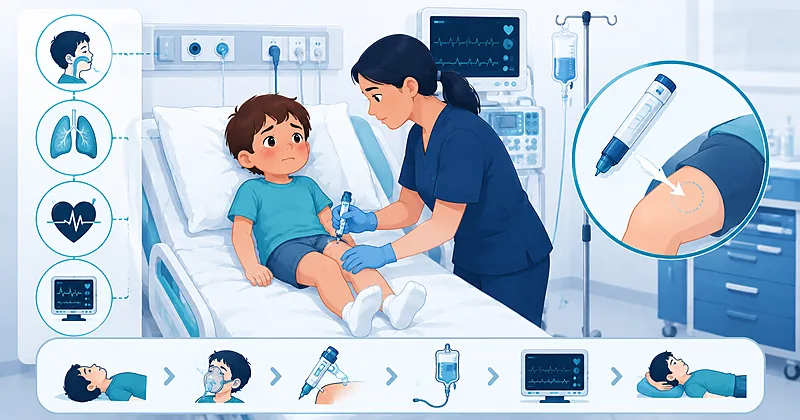
- 1Suspect anaphylaxis whenever a child develops acute skin or mucosal changes plus respiratory or cardiovascular compromise after a likely trigger → Recognition
- 2Give intramuscular epinephrine immediately into the mid-outer thigh — it is the only first-line drug → Epinephrine
- 3Dose epinephrine at 0.01 mg/kg of the 1 mg/mL concentration, to a maximum of 0.5 mg per dose → Dosing
- 4Repeat epinephrine after 5–15 minutes if symptoms persist; most children respond to one or two doses → Repeat Dosing
- 5Place the child supine with legs elevated unless breathing is easier sitting up — sudden upright posture can precipitate collapse → Adjuncts
- 6Treat antihistamines and steroids as adjuncts only — neither relieves airway or circulatory compromise → Adjuncts
- 7Observe for a biphasic reaction before discharge; longer observation is warranted after severe or treatment-resistant episodes → Disposition
- 8Discharge every child with two epinephrine autoinjectors, a written action plan, and a referral for food allergy testing → Discharge
How to Recognize Pediatric Anaphylaxis
The first step in pediatric anaphylaxis management is recognizing it, and in children this is harder than in adults. Infants cannot describe throat tightness or impending doom, and early signs — irritability, drooling, a sudden behavior change — are easily mistaken for distress from another cause. Anaphylaxis is a clinical diagnosis made at the bedside; do not wait for laboratory confirmation.
The widely used NIAID diagnostic criteria are designed for speed rather than precision. In practice, two patterns should trigger treatment: acute illness involving the skin or mucosa together with breathing or circulation problems, or a rapid drop in blood pressure or sudden severe symptoms after exposure to a known allergen for that child.
Evaluate for anaphylaxis in any child with sudden symptoms across two or more organ systems after a likely trigger, even when classic hives are absent. Up to one in five reactions in children spares the skin entirely.
Strong Rec Moderate Evidence WAO 2020 EAACI 2021Recognize that isolated, rapid-onset hypotension or severe bronchospasm after a known allergen exposure qualifies as anaphylaxis, with or without skin involvement.
Strong Rec Moderate Evidence NIAID/FAANAssess infants for age-specific signs — persistent crying, drooling, sudden sleepiness, or floppiness — because they cannot report classic symptoms and deteriorate quickly.
Moderate Rec Low Evidence WAO 2020Epinephrine: The First and Only First-Line Drug
Every major guideline agrees on one thing: epinephrine is the cornerstone of pediatric anaphylaxis management and there is no substitute. It reverses airway swelling, bronchospasm, and vasodilation through actions no antihistamine can match. There are no absolute contraindications when anaphylaxis is suspected in a child.
The route matters as much as the drug. Intramuscular epinephrine into the mid-outer thigh produces faster, more reliable peak levels than subcutaneous or deltoid injection. The intravenous route is reserved for refractory shock under monitoring, because bolus IV dosing risks dangerous arrhythmia and severe hypertension.
Start intramuscular epinephrine immediately at the first recognition of anaphylaxis. Inject into the anterolateral thigh; delayed administration is the factor most consistently linked to fatal outcomes.
Strong Rec High Evidence WAO 2020 JTF 2020Prescribe a weight-based dose of 0.01 mg/kg using the 1 mg/mL concentration, to a maximum of 0.5 mg per dose. Use 0.15 mg for children roughly 7.5–25 kg and 0.3 mg for those above 25 kg.
Strong Rec High Evidence EAACI 2021Do not use antihistamines or corticosteroids as a substitute for epinephrine. They do not treat upper-airway edema, bronchospasm, or hypotension and may delay the one intervention that does.
Against Moderate Evidence JTF 2020Epinephrine Dosing by Child Weight Band
This reference is organized by the practical weight bands clinicians actually use at the bedside, with autoinjector equivalents and a column for the errors that most often delay correct dosing.
| Child Weight Band | IM Dose (1 mg/mL) | Autoinjector Equivalent | Common Dosing Pitfall |
|---|---|---|---|
| Under 7.5 kg (infant) | 0.01 mg/kg drawn up by syringe | No autoinjector licensed; use ampoule | Avoid rounding up to 0.15 mg autoinjector if a syringe dose is feasible |
| 7.5–25 kg | 0.15 mg | 0.15 mg autoinjector | Don’t withhold while hunting for an exact weight — estimate and treat |
| Above 25 kg | 0.3 mg | 0.3 mg autoinjector | Larger adolescents may need the 0.5 mg ampoule dose |
| Any weight, refractory | IV infusion, titrated, monitored | Not applicable | Never give an undiluted IV bolus — arrhythmia risk |
When the First Dose Isn’t Enough
Most children respond to one dose, and the large majority to no more than two. Persistent or worsening symptoms after two intramuscular doses define refractory anaphylaxis and call for escalation to intravenous fluids and, if needed, an epinephrine infusion under monitoring.
Repeat the intramuscular dose after 5–15 minutes if there is no improvement. Document the time of each dose to keep the interval clear during a fast-moving resuscitation.
Strong Rec Moderate Evidence WAO 2020Give a rapid bolus of isotonic crystalloid at 20 mL/kg for hypotension or poor perfusion, and repeat as guided by response. Distributive shock can sequester a large fraction of circulating volume.
Strong Rec Moderate Evidence EAACI 2021Initiate a titrated epinephrine infusion for refractory anaphylaxis after two intramuscular doses and fluid resuscitation, ideally with senior or critical care support and continuous cardiac monitoring.
Moderate Rec Low Evidence JTF 2020Consider an inhaled beta-agonist as an add-on for persistent wheeze once epinephrine has been given, but never in place of it. Bronchodilators do not address airway edema or shock.
Conditional Rec Low Evidence EAACI 2021Clinical Decision Pathway
A practical, question-based approach for the child in front of you. Work through the questions in order, and treat before you complete the list if the child is deteriorating.
Observation, Biphasic Risk, and Disposition
Disposition is the part of pediatric anaphylaxis management most often rushed. A biphasic reaction — recurrence after apparent resolution — affects a minority of children but can be severe, so observation should be matched to risk rather than fixed at a single number for everyone.
| Risk Profile | Suggested Observation | What Raises the Risk | Discharge Essentials |
|---|---|---|---|
| Lower risk | Around 4–6 hours after full response to one dose | None of the features at right present | Two autoinjectors, action plan, trigger avoidance advice |
| Higher risk | Extended monitoring, often overnight | Two or more epinephrine doses, severe presentation, slow response | Same essentials plus allergy follow-up arranged |
| Asthma + food allergy | Lowest threshold for prolonged observation | Reactive airways amplify respiratory compromise | Reinforce asthma control alongside allergy plan |
| Poor access to care | Individualize; lean toward longer | Distance from emergency care delays rescue | Confirm the family can use the device and reach help |
Prescribe two epinephrine autoinjectors at discharge for every child treated for anaphylaxis, and confirm a caregiver can demonstrate correct use before leaving.
Strong Rec Moderate Evidence JTF 2020Provide a written food allergy action plan and arrange allergy follow-up so the suspected trigger can be confirmed and a long-term plan established.
Strong Rec Moderate Evidence EAACI 2021Extend the observation period after severe episodes, repeated dosing, or in children with asthma, since these features carry a higher chance of a biphasic reaction.
Moderate Rec Low Evidence WAO 2020Monitoring During and After Treatment
Continuous observation matters as much as the initial drug. The table below frames monitoring around what each parameter tells you and the mistakes that most often catch teams out.
| Parameter | When to Check | What It Tells You | Common Pitfall |
|---|---|---|---|
| Airway and breathing | Continuously from arrival | Stridor or rising work of breathing signals worsening edema | Reassuring saturations can mask early upper-airway swelling |
| Perfusion and heart rate | Continuously during the acute phase | Tachycardia and poor capillary refill flag distributive shock | Hypotension is a late sign in children — don’t wait for it |
| Symptom recurrence | Throughout the observation window | Return of symptoms suggests a biphasic reaction | Discharging too early misses delayed recurrence |
Evidence in Context
Where the major guidance documents agree, where they diverge, and what the evidence base does and does not settle.
Where the Guidelines Agree
WAO, EAACI, and the Joint Task Force converge on the essentials: anaphylaxis is a clinical diagnosis, intramuscular epinephrine is the unrivaled first-line treatment, and antihistamines and steroids are at best adjuncts. None endorses delaying epinephrine for any reason.
Where the Guidelines Diverge
The main point of difference is the observation period. Rather than a single fixed duration, recent guidance has moved toward risk-stratified observation, weighting severity, the number of doses needed, and asthma history. The exact thresholds vary between documents.
The Biphasic Reaction Question
Biphasic reactions are uncommon but unpredictable. Severe initial presentations and the need for more than one epinephrine dose are the most consistent predictors, which is why observation is tailored to these features rather than applied uniformly.
The Limited Role of Steroids
Corticosteroids were once given routinely to prevent biphasic reactions, but the evidence for that benefit has not held up. Current guidance no longer supports steroids as a means of preventing recurrence, reinforcing that epinephrine remains the intervention that changes outcomes.
References
- 1.Cardona V, Ansotegui IJ, Ebisawa M, et al. World Allergy Organization Anaphylaxis Guidance 2020. World Allergy Organ J. 2020;13(10):100472. doi:10.1016/j.waojou.2020.100472
- 2.Muraro A, Worm M, Alviani C, et al. EAACI guidelines: Anaphylaxis (2021 update). Allergy. 2022;77(2):357–377. doi:10.1111/all.15032
- 3.Shaker MS, Wallace DV, Golden DBK, et al. Anaphylaxis—a 2020 practice parameter update, systematic review, and GRADE analysis. J Allergy Clin Immunol. 2020;145(4):1082–1123. doi:10.1016/j.jaci.2020.01.017
- 4.Sampson HA, Muñoz-Furlong A, Campbell RL, et al. Second symposium on the definition and management of anaphylaxis: summary report. J Allergy Clin Immunol. 2006;117(2):391–397. doi:10.1016/j.jaci.2005.12.1303
How to Read the Evidence Tags
Every recommendation carries tags for recommendation strength and evidence quality — Medaptly’s own simplified interpretations, not any guideline body’s classification system.
Recommendation Strength
| Tag | What It Means |
|---|---|
| Strong Rec | High-quality evidence broadly supports this action. |
| Moderate Rec | The weight of evidence favours this action. |
| Conditional Rec | The benefit is less certain — individualise. |
| Against | Evidence shows no benefit or potential harm. |
Evidence Quality
| Tag | What It Means |
|---|---|
| High Evidence | Multiple well-designed RCTs or high-quality meta-analyses. |
| Moderate Evidence | Single RCT or large observational studies. |
| Low Evidence | Expert consensus or small studies. |