
Bariatric Surgery: 8 Critical Patient Selection Rules
Clinical Practice Update — Updated BMI Criteria, Procedure Choice, GLP-1 Era Considerations, and Nutrition Surveillance
This is an original clinical education article informed by current guidelines and evidence. See References below for source documents.
- Clinical Focus
- Evidence-based patient selection, procedure choice, and longitudinal care in adult bariatric surgery
- Target Audience
- Bariatric and general surgeons, endocrinologists, primary care physicians, dietitians, anaesthetists, and surgical trainees
- Setting
- Multidisciplinary obesity clinic, preoperative assessment, operating theatre, lifelong follow-up
- Source Evidence
- •ASMBS/IFSO Indications for Metabolic and Bariatric Surgery (2022)
- •AACE/TOS/ASMBS/OMA/ASA Clinical Practice Guidelines on Perioperative Nutrition, Metabolic, and Nonsurgical Support (2019 Update)
- •STAMPEDE Trial — Bariatric Surgery vs Intensive Medical Therapy for Diabetes (NEJM, 2017)
- •Swedish Obese Subjects (SOS) Long-Term Mortality Study (NEJM, 2007)
Key Clinical Takeaways
Modern bariatric surgery is no longer reserved for the most extreme BMI categories. The 2022 joint ASMBS/IFSO statement lowered thresholds and widened indications, the era of GLP-1 receptor agonists has reshaped the relationship between medical and surgical therapy, and procedure choice now reflects a fuller appreciation of long-term outcomes. Effective bariatric surgery in 2026 is defined less by the operation itself than by the quality of patient selection, preoperative optimisation, and lifelong nutritional follow-up that surrounds it.
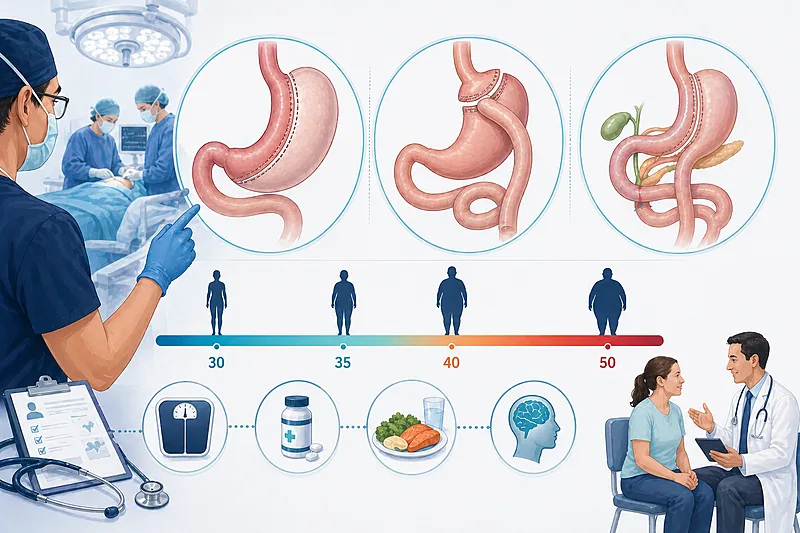
- 1Apply the 2022 ASMBS/IFSO thresholds: BMI ≥ 35 regardless of comorbidities, or BMI ≥ 30 with metabolic disease → BMI Criteria
- 2Adjust thresholds downward for Asian populations — metabolic disease occurs at lower BMI → BMI Criteria
- 3Do not exclude patients by age alone — carefully selected candidates in their 60s and 70s benefit → BMI Criteria
- 4Complete a multidisciplinary preoperative evaluation (medical, psychological, nutritional, surgical) before every case → Preop Workup
- 5Choose sleeve gastrectomy as the default for most primary operations with BMI 35–50 and no severe reflux → Procedure Choice
- 6Prefer Roux-en-Y gastric bypass for severe GERD, type 2 diabetes, or BMI over 50 → Procedure Choice
- 7Consider SADI-S for super-obesity or as a revisional option after inadequate sleeve gastrectomy → Procedure Choice
- 8Do not defer surgical referral because the patient is on a GLP-1 agonist — the two therapies are complementary, not mutually exclusive → GLP-1 Era
- 9Commit every patient to lifelong multivitamin-and-mineral supplementation and annual micronutrient screening → Nutrition Surveillance
- 10Flag the lifelong risks specific to each procedure — internal hernia after bypass, dumping syndrome, and thiamine deficiency with prolonged vomiting → Nutrition Surveillance
Updated BMI Criteria in Bariatric Surgery
The 2022 joint ASMBS/IFSO position paper represented the largest revision to bariatric surgery indications in over three decades. The previous NIH 1991 thresholds — BMI ≥ 40 or BMI ≥ 35 with comorbidity — were formally superseded by lower, more inclusive criteria reflecting three decades of accumulated safety and efficacy data.
Offer bariatric surgery to adults with BMI ≥ 35 kg/m² regardless of the presence or absence of comorbidities. The 2022 ASMBS/IFSO statement removed the comorbidity requirement at this threshold.
Strong Rec High Evidence ASMBS/IFSO 2022Consider metabolic bariatric surgery in adults with BMI 30–34.9 kg/m² and type 2 diabetes or other metabolic disease. Long-term data show durable glycaemic control and cardiovascular benefit at these BMI levels.
Moderate Rec High Evidence ASMBS/IFSO 2022 STAMPEDE 2017Apply lower BMI thresholds to patients of Asian descent: BMI ≥ 27.5 kg/m² with metabolic disease and BMI ≥ 32.5 kg/m² without. Body composition and metabolic risk profiles differ meaningfully from European populations.
Moderate Rec Moderate Evidence ASMBS/IFSO 2022Do not exclude patients by age alone. Carefully selected adolescents (13 years and above with severe obesity) and older adults up to their mid-70s benefit from operation when comorbidities and expected longevity justify the risk.
Moderate Rec Moderate Evidence ASMBS/IFSO 2022Require insight, adherence capacity, and the absence of active uncontrolled substance use disorder, rather than a specific psychological diagnosis, as psychiatric eligibility criteria.
Strong Rec Moderate Evidence AACE/TOS 2019BMI Thresholds by Population and Comorbidity
| Patient Group | BMI Without Metabolic Disease | BMI With Metabolic Disease | Practical Implications |
|---|---|---|---|
| General (non-Asian) adult | ≥ 35 kg/m² | ≥ 30 kg/m² | 2022 thresholds superseded the 1991 NIH criteria |
| Asian adult | ≥ 32.5 kg/m² | ≥ 27.5 kg/m² | Reflects earlier metabolic decompensation in Asian populations |
| Adolescent (≥ 13 y) | ≥ 120% of 95th centile | ≥ 35 kg/m² | Mandates specialist adolescent bariatric programme |
| Older adult (> 65 y) | ≥ 35 kg/m² with functional reserve | ≥ 30 kg/m² with functional reserve | Individualised risk/benefit; frailty assessment essential |
Preoperative Workup and Risk Optimisation
A structured preoperative pathway is what separates durable outcomes from early failure. The 2019 AACE/TOS/ASMBS/OMA/ASA guideline frames this as a multidisciplinary responsibility: medical, psychological, nutritional, and surgical. Each domain has specific, high-yield steps that should not be delegated or skipped.
Perform a full multidisciplinary evaluation: surgical consultation, anaesthetic review, nutritional assessment, and psychological screening. No patient should proceed to operation without input from all four domains.
Strong Rec Moderate Evidence AACE/TOS 2019Screen every candidate for obstructive sleep apnoea with a validated instrument (e.g., STOP-Bang). Positive screens trigger formal sleep study and CPAP titration before surgery.
Strong Rec High Evidence AACE/TOS 2019Establish baseline micronutrients before surgery — iron studies, vitamin B12, folate, 25-hydroxyvitamin D, thiamine, and ferritin. Correct deficiencies preoperatively because the postoperative malabsorptive window amplifies them.
Strong Rec Moderate Evidence AACE/TOS 2019Require smoking cessation for at least 6 weeks before elective bariatric surgery and ideally for life — tobacco exposure dramatically raises marginal ulcer rates after gastric bypass.
Strong Rec Moderate Evidence AACE/TOS 2019Optimise diabetes control and consider the patient’s insulin and GLP-1 regimens in surgical scheduling. Rapid postoperative dose reduction is the rule, not the exception, and requires clear written protocols.
Strong Rec Moderate Evidence AACE/TOS 2019Prescribe a preoperative low-calorie or very-low-calorie diet for approximately 2 weeks to reduce liver volume and facilitate laparoscopic exposure, particularly in patients with BMI > 40 or high-risk anatomy.
Moderate Rec Moderate Evidence AACE/TOS 2019Procedure Choice in Bariatric Surgery
Procedure choice in bariatric surgery is a shared decision driven by BMI, comorbidity profile, reflux disease, patient preference, and surgeon experience. Sleeve gastrectomy is now the most commonly performed operation worldwide, but Roux-en-Y gastric bypass retains a specific role, and SADI-S has emerged as a hybrid approach for super-obesity and revisional contexts.
Offer sleeve gastrectomy as the default first-line procedure for most patients with BMI 35–50 and without severe reflux disease. It is technically simpler, preserves the pyloric sphincter, avoids an anastomosis, and has low early and mid-term complication rates.
Strong Rec High Evidence ASMBS/IFSO 2022Prefer Roux-en-Y gastric bypass when the patient has severe GERD, Barrett’s oesophagus, type 2 diabetes with high HbA1c, BMI > 50, or prior upper-abdominal surgery that complicates sleeve anatomy. Bypass offers superior reflux control and greater durable glycaemic improvement.
Strong Rec High Evidence ASMBS/IFSO 2022 STAMPEDE 2017Consider Single-Anastomosis Duodeno-Ileal bypass with Sleeve gastrectomy (SADI-S) for patients with BMI > 50 or as a revisional option after inadequate weight loss with sleeve gastrectomy. ASMBS recognised SADI-S as a standalone bariatric procedure in 2020.
Moderate Rec Moderate Evidence ASMBS 2020 ASMBS/IFSO 2022Perform every bariatric procedure by a laparoscopic or robotic approach. Open bariatric surgery has largely disappeared from contemporary practice outside of extreme hostile abdomen scenarios.
Strong Rec High Evidence ASMBS/IFSO 2022Do not offer laparoscopic adjustable gastric banding as first-line bariatric surgery. Long-term data show high rates of complications, band erosion, and reoperation, and most dedicated programmes have abandoned the procedure.
Against High Evidence ASMBS/IFSO 2022Sleeve vs Roux-en-Y vs SADI-S: Side-by-Side
| Attribute | Sleeve Gastrectomy | Roux-en-Y Gastric Bypass | SADI-S |
|---|---|---|---|
| Best clinical fit | BMI 35–50; no severe reflux; first-line | Severe GERD; uncontrolled T2DM; BMI > 50 | Super-obesity; revision after failed sleeve |
| Mechanism | Restrictive + hormonal (ghrelin) | Restrictive + malabsorptive + hormonal | Restrictive + powerful malabsorptive |
| Expected TWL at 2 y | ~25–30% | ~30–35% | ~35–40% |
| GERD effect | Can worsen reflux; contraindicated in severe GERD | Resolves most reflux | Neutral to mildly favourable |
| Technical complexity | Lowest | Moderate (two anastomoses) | High (single duodenal anastomosis) |
| Nutritional burden | Low to moderate | Moderate (B12, iron, calcium) | High (fat-soluble vitamins, protein) |
| Most relevant risks | Staple-line leak; new-onset GERD; sleeve dilation | Marginal ulcer; internal hernia; dumping | Protein-calorie malnutrition; diarrhoea; less long-term data |
Bariatric Surgery in the GLP-1 Era
GLP-1 receptor agonists and the newer dual GIP/GLP-1 agents have changed the obesity pharmacotherapy landscape more than any class in decades. In the majority of patients, they do not replace bariatric surgery — but they do reshape the conversation around timing, eligibility, and perioperative management.
Do not defer surgical referral because the patient is on a GLP-1 receptor agonist. Surgery and pharmacotherapy address obesity through complementary mechanisms, and current evidence does not support withholding operation from medication-responsive patients who still meet indications.
Moderate Rec Low Evidence ASMBS Position 2023Hold GLP-1 and GIP/GLP-1 agonists before anaesthesia in line with current ASA guidance, given concerns about delayed gastric emptying and aspiration risk — typically 1 week for weekly formulations and 1 day for daily formulations, with individualised clinical judgement.
Strong Rec Moderate Evidence ASA Consensus 2023Consider postoperative GLP-1 use as an adjunct for weight regain or inadequate response, particularly 2–3 years after operation when plateau commonly occurs. Combination approaches may preserve long-term weight loss in selected patients.
Conditional Rec Low Evidence Expert ConsensusPostoperative Nutrition Surveillance
Every patient leaving theatre after bariatric surgery is committed to lifelong nutritional monitoring. The operation is a stable, durable anatomical change; the micronutrient deficiencies it produces are lifelong threats that only structured follow-up prevents.
Prescribe lifelong, daily bariatric-specific multivitamin-and-mineral supplementation to every patient — ordinary over-the-counter multivitamins do not provide adequate dosing for postoperative anatomy.
Strong Rec High Evidence AACE/TOS 2019Monitor vitamin B12, iron studies (including ferritin), folate, 25-hydroxyvitamin D, calcium, PTH, and albumin at 3, 6, 12 months and yearly thereafter. Supplement proactively rather than treat deficiency once it develops.
Strong Rec Moderate Evidence AACE/TOS 2019Give intravenous thiamine immediately in any postoperative bariatric patient presenting with prolonged vomiting, neurological symptoms, or rapid weight loss — do not wait for levels. Wernicke’s encephalopathy is under-recognised and catastrophic when missed.
Strong Rec Moderate Evidence AACE/TOS 2019Counsel post-bypass patients on internal hernia warning signs (intermittent crampy postprandial pain, especially during weight-loss phase), dumping syndrome triggers, and the need for urgent surgical review of new abdominal pain.
Strong Rec Moderate Evidence AACE/TOS 2019Screen annually for alcohol use disorder — the risk is substantially elevated after Roux-en-Y gastric bypass due to altered ethanol pharmacokinetics and absorption. Offer prompt addiction support.
Strong Rec Moderate Evidence AACE/TOS 2019Postoperative Monitoring Schedule
| Check | 3 mo | 6 mo | 12 mo & annually | Common Pitfalls |
|---|---|---|---|---|
| Weight, BMI, waist | ✓ | ✓ | ✓ | Focus on % total weight loss, not absolute kg |
| FBC, ferritin, iron studies | ✓ | ✓ | ✓ | Iron deficiency common in menstruating women after bypass |
| B12, folate | ✓ | ✓ | ✓ | B12 deficiency insidious; treat early |
| Calcium, 25(OH)D, PTH | – | ✓ | ✓ | Normal calcium with rising PTH = early secondary hyperparathyroidism |
| Glycaemic review / HbA1c | ✓ | ✓ | ✓ | Down-titrate diabetes medications promptly; hypoglycaemia risk |
| Psychosocial review | ✓ | ✓ | ✓ | Alcohol use, body image, relationship dynamics shift significantly |
Clinical Decision Pathway
A question-based walk-through for selecting and operating on a bariatric candidate.
Evidence in Context
Key themes across the updated ASMBS/IFSO statement, landmark long-term trials, and the remaining evidence gaps.
Why the 2022 ASMBS/IFSO Thresholds Changed
The 1991 NIH thresholds pre-dated laparoscopy, modern enhanced recovery pathways, and three decades of long-term outcome data. By 2022, cumulative evidence made clear that durable weight loss, diabetes remission, and mortality reduction applied to BMI ranges well below the original cutoffs. The joint statement formalised what most specialist centres had been practising for years.
The Swedish Obese Subjects (SOS) Study: The Long View
SOS remains the longest-duration prospective controlled study of bariatric surgery, following participants for over 20 years. It demonstrated sustained weight loss, reduced incidence of type 2 diabetes, lower cardiovascular events, and reduced overall mortality compared with matched medical controls. No pharmacotherapy has matched this durability.
STAMPEDE: Metabolic Surgery for Diabetes
The STAMPEDE randomised trial at 5 years showed that bariatric surgery (bypass or sleeve) was substantially more effective than intensive medical therapy at achieving and sustaining glycaemic targets in patients with type 2 diabetes, including those with BMI below 35. This evidence underpinned the extension of surgical indications to lower-BMI metabolically diseased patients.
Sleeve vs Bypass: The SM-BOSS and SLEEVEPASS Trials
Two major European randomised trials (SM-BOSS from Switzerland and SLEEVEPASS from Finland) directly compared sleeve gastrectomy with Roux-en-Y gastric bypass at 5 years. Both showed comparable weight loss, with bypass retaining an edge in GERD resolution and possibly diabetes control, while sleeve had a simpler early recovery. The broad picture is that both are durable, effective operations — and the choice depends on patient factors rather than overall superiority.
What We Still Don’t Know
Long-term comparative outcomes of SADI-S at 10+ years are still maturing. The optimal positioning of GLP-1 and dual agonist pharmacotherapy relative to surgery — before, after, or as a genuine alternative — is an active research frontier. The role of endoscopic bariatric therapies (intragastric balloons, endoscopic sleeve gastroplasty) in the care pathway continues to evolve, and standards for adolescent bariatric care are still being refined.
References
- 1.Eisenberg D, Shikora SA, Aarts E, et al. 2022 American Society for Metabolic and Bariatric Surgery (ASMBS) and International Federation for the Surgery of Obesity and Metabolic Disorders (IFSO): Indications for Metabolic and Bariatric Surgery. Surg Obes Relat Dis. 2022;18(12):1345–1356. doi:10.1016/j.soard.2022.08.013
- 2.Mechanick JI, Apovian C, Brethauer S, et al. Clinical Practice Guidelines for the Perioperative Nutrition, Metabolic, and Nonsurgical Support of Patients Undergoing Bariatric Procedures — 2019 Update (AACE/TOS/ASMBS/OMA/ASA). Surg Obes Relat Dis. 2020;16(2):175–247. doi:10.1016/j.soard.2019.10.025
- 3.Sjöström L, Narbro K, Sjöström CD, et al. Effects of bariatric surgery on mortality in Swedish obese subjects. N Engl J Med. 2007;357(8):741–752. doi:10.1056/NEJMoa066254
- 4.Schauer PR, Bhatt DL, Kirwan JP, et al. Bariatric Surgery versus Intensive Medical Therapy for Diabetes — 5-Year Outcomes. N Engl J Med. 2017;376(7):641–651. doi:10.1056/NEJMoa1600869
- 5.Peterli R, Wölnerhanssen BK, Peters T, et al. Effect of Laparoscopic Sleeve Gastrectomy vs Laparoscopic Roux-en-Y Gastric Bypass on Weight Loss in Patients With Morbid Obesity: The SM-BOSS Randomized Clinical Trial. JAMA. 2018;319(3):255–265. doi:10.1001/jama.2017.20897
- 6.Salminen P, Helmiö M, Ovaska J, et al. Effect of Laparoscopic Sleeve Gastrectomy vs Laparoscopic Roux-en-Y Gastric Bypass on Weight Loss at 5 Years Among Patients With Morbid Obesity: The SLEEVEPASS Randomized Clinical Trial. JAMA. 2018;319(3):241–254. doi:10.1001/jama.2017.20313
How to Read the Evidence Tags
Every recommendation in this Practice Update carries three inline tags: recommendation strength, evidence quality, and source. These are Medaptly’s own simplified interpretations — not reproductions of any single guideline body’s classification system.
Recommendation Strength
| Tag | What It Means |
|---|---|
| Strong Rec | High-quality evidence broadly supports this action. |
| Moderate Rec | The weight of evidence favours this action. |
| Conditional Rec | The benefit is less certain — individualise to the patient. |
| Against | Evidence shows no benefit or potential harm. |
Evidence Quality
| Tag | What It Means |
|---|---|
| High Evidence | Multiple well-designed RCTs or high-quality meta-analyses. |
| Moderate Evidence | Single RCT or large observational studies. |
| Low Evidence | Expert consensus or small studies. |