
ERAS Protocol: Proven Enhanced Recovery Guide 2026
Clinical Practice Update — Preoperative Counselling, Carb Loading, Opioid-Sparing Analgesia, Goal-Directed Fluids, and Specialty-Specific Pathways
This is an original clinical education article informed by current guidelines and evidence. See References below for source documents.
- Clinical Focus
- Evidence-based ERAS protocol implementation across the perioperative continuum for adult elective surgery
- Target Audience
- Surgeons, anaesthetists, perioperative nurses, pharmacists, nutritionists, physiotherapists, and surgical trainees
- Setting
- Preoperative clinic, operating theatre, post-anaesthesia care unit, surgical ward
- Source Evidence
- •ERAS Society Guidelines for Colorectal Surgery (2018)
- •ERAS Society Guidelines for Gynecologic/Oncology Surgery (2019)
- •ERAS Society Guidelines for Liver Surgery (2022)
- •Ljungqvist et al., Enhanced Recovery After Surgery: A Review (JAMA Surg, 2017)
Key Clinical Takeaways
An effective ERAS protocol is less a single innovation than a bundle of small, evidence-based decisions made consistently across the perioperative journey. The ERAS protocol replaces tradition with evidence — short fasting instead of overnight nil-by-mouth, multimodal opioid-sparing analgesia instead of reflexive morphine, goal-directed fluids instead of liberal crystalloid, and early feeding and mobilisation instead of prolonged bed rest. When implemented as a bundle rather than piecemeal, these changes shorten length of stay, reduce complications, and lower cost without compromising safety.
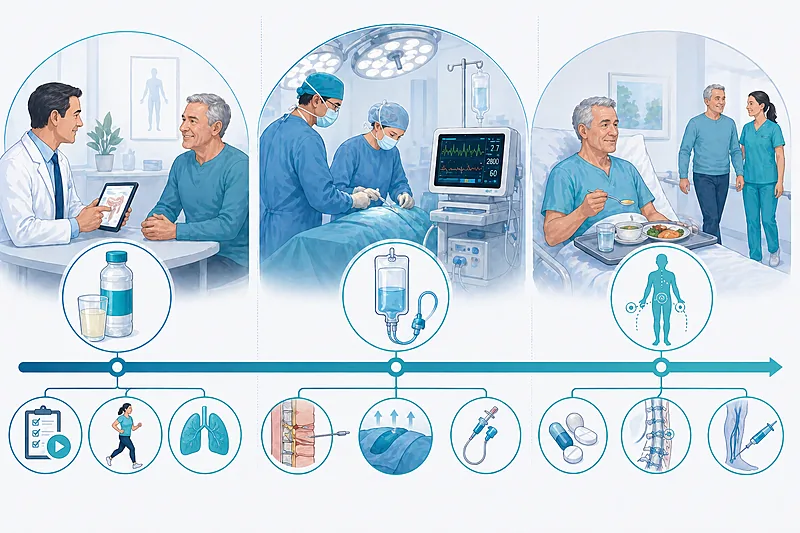
- 1Treat the ERAS protocol as a bundle — compliance with 70% or more of the elements predicts outcome improvement; cherry-picking does not → Implementation
- 2Start ERAS at the decision to operate, not on admission — counselling, prehabilitation, and risk optimisation are the foundation → Preoperative
- 3Allow clear fluids up to 2 hours before anaesthesia and provide a complex carbohydrate drink to blunt the surgical stress response → Preoperative
- 4Use goal-directed fluid therapy guided by stroke volume monitoring — aim for euvolaemia, not excess → Intraoperative
- 5Maintain intraoperative normothermia (core temperature ≥ 36°C) to reduce infection and coagulopathy → Intraoperative
- 6Prescribe multimodal opioid-sparing analgesia (paracetamol, NSAID, regional block, gabapentinoid when indicated) from the outset → Postoperative
- 7Start oral intake within 24 hours of surgery and mobilise the patient out of bed on the day of operation → Postoperative
- 8Remove urinary catheters, drains, and IV lines as soon as clinically safe — they are tethers that delay recovery → Postoperative
- 9Adapt the ERAS protocol to the specialty — colorectal, liver, gynaecology, and orthopaedics each have specific element modifications → Specialty-Specific
- 10Audit compliance and outcomes continuously — ERAS is sustained by measurement, not by one-off training → Monitoring
Preoperative Phase of the ERAS Protocol
The preoperative phase is where the ERAS protocol earns most of its long-term gains. Well-informed, well-optimised patients recover faster regardless of what happens in theatre. The aim is to arrive at surgery with a patient who is euvolaemic, well-nourished, metabolically primed, and psychologically ready — not dehydrated, anxious, and starving.
Provide structured, individualised preoperative counselling at the decision-to-operate visit. Cover what will happen on the day of surgery, expected recovery milestones, pain control plans, and the patient’s own role in their recovery.
Strong Rec Moderate Evidence ERAS 2018Offer a prehabilitation programme of at least 4 weeks when the clinical timeline allows. Focus on aerobic and resistance training, nutritional optimisation, smoking cessation, and alcohol reduction. Even brief prehabilitation (2–3 weeks) improves functional capacity.
Moderate Rec Moderate Evidence ERAS Liver 2022 ERAS 2018Allow clear fluids up to 2 hours before induction of anaesthesia and solid food up to 6 hours before. Prolonged fasting is outdated, uncomfortable, and increases insulin resistance without improving safety.
Strong Rec High Evidence ERAS 2018 ASA Fasting 2017Administer a complex carbohydrate drink (typically 800 mL the evening before and 400 mL up to 2 hours before surgery) to non-diabetic patients. Carbohydrate loading reduces postoperative insulin resistance and improves patient comfort.
Strong Rec High Evidence ERAS 2018Do not use long-acting sedative premedication routinely. Short-acting anxiolytics may be appropriate for highly anxious patients but delay postoperative mobilisation if over-dosed.
Against Moderate Evidence ERAS 2018Optimise modifiable risk factors — anaemia, smoking, alcohol, glycaemic control — before elective surgery. Iron therapy for preoperative anaemia, smoking cessation for at least 4 weeks, and alcohol abstention for 4 weeks all produce measurable postoperative benefit.
Strong Rec Moderate Evidence ERAS 2018Preoperative Fasting and Carb Loading: Practical Rules
| Intake | Stop Time Before Surgery | Typical Volume | Practical Notes |
|---|---|---|---|
| Solid food | 6 hours | Normal meal | Longer for fatty or fried foods; match theatre list timing |
| Breast milk (infants) | 4 hours | Ad libitum | Reassure parents; shorter than formula |
| Clear fluids | 2 hours | Unrestricted up to that time | Water, clear tea without milk, black coffee, clear juices |
| Carbohydrate drink (complex) | 2 hours | 800 mL evening before + 400 mL on morning | Omit in diabetics; use commercial preparation for correct osmolality |
Intraoperative Phase: Anaesthesia and Surgery
The intraoperative components of a modern ERAS protocol are shared between anaesthesia and surgery. The aim is to minimise the physiological insult of the operation itself — short-acting drugs, careful fluid balance, normothermia, regional blocks, and minimally invasive approaches whenever clinically appropriate.
Use short-acting anaesthetic agents (propofol for induction, sevoflurane or desflurane for maintenance, remifentanil or short-acting opioids for analgesia) to permit rapid emergence and early postoperative participation.
Strong Rec Moderate Evidence ERAS 2018Deliver goal-directed fluid therapy in major surgery, titrated to stroke volume or equivalent dynamic parameter rather than fixed weight-based volumes. Both excessive and restrictive fluids harm patients; the target is zero balance.
Strong Rec High Evidence ERAS 2018Maintain intraoperative core temperature at or above 36°C using active warming (forced-air warming blanket and warmed IV fluids). Hypothermia increases surgical site infection, blood loss, and cardiac events.
Strong Rec High Evidence ERAS 2018 NICE CG65Use regional anaesthesia as part of the analgesia plan whenever anatomically appropriate — thoracic epidural for open abdominal surgery, transversus abdominis plane (TAP) blocks for laparoscopic abdominal surgery, peripheral nerve blocks for limb surgery.
Strong Rec High Evidence ERAS 2018Favour minimally invasive (laparoscopic or robotic) approaches whenever clinically appropriate. The shift from open to laparoscopic surgery produces the single largest ERAS effect in colorectal, gynaecology, and hepatobiliary practice.
Strong Rec High Evidence ERAS 2018Do not insert nasogastric tubes routinely after elective abdominal surgery. Routine decompression prolongs ileus, increases respiratory complications, and delays feeding.
Against High Evidence ERAS 2018Postoperative Phase: Core ERAS Protocol Elements
The postoperative elements of the ERAS protocol are where most implementation failures occur. Each component is individually simple; collective success depends on ward-level culture, nurse empowerment, and consistent medical prescribing.
Prescribe routine postoperative nausea and vomiting (PONV) prophylaxis tailored to risk (dexamethasone at induction, ondansetron at emergence, consider a third agent for high-risk patients). Untreated PONV is the single most common reason patients delay resuming oral intake.
Strong Rec High Evidence ERAS 2018Deliver multimodal opioid-sparing analgesia: regularly scheduled paracetamol, a non-selective NSAID or COX-2 inhibitor when safe, adjuvants such as low-dose ketamine or dexmedetomidine where indicated, and opioids reserved for breakthrough pain only.
Strong Rec High Evidence ERAS 2018Start oral fluids and solid diet within 24 hours of surgery in most elective abdominal and non-abdominal procedures. Early feeding does not increase anastomotic leak or ileus and shortens length of stay.
Strong Rec High Evidence ERAS Colorectal 2018Mobilise the patient out of bed on the day of surgery or by the morning of day 1. Set daily mobilisation targets (e.g., sit out for lunch day 0, walk 20 metres day 1, independent ambulation day 2).
Strong Rec Moderate Evidence ERAS 2018Remove urinary catheters on postoperative day 1 in most procedures, and by day 2–3 in pelvic operations where early removal risks retention. Prolonged catheterisation increases UTI, delirium, and delays discharge.
Strong Rec Moderate Evidence ERAS 2018Avoid or minimise surgical drains in most elective operations. When drains are used, remove them early — prolonged drains tether the patient, delay mobilisation, and rarely change management.
Moderate Rec Moderate Evidence ERAS 2018Maintain perioperative euglycaemia. Target blood glucose 6–10 mmol/L (110–180 mg/dL); tighter control increases hypoglycaemia without outcome benefit outside specialist settings.
Strong Rec Moderate Evidence ERAS 2018Prescribe pharmacological thromboprophylaxis (LMWH or equivalent) combined with mechanical measures (graduated stockings or intermittent pneumatic compression) in all major surgery, with timing individualised to bleeding risk.
Strong Rec High Evidence ERAS 2018 ASH VTE 2018Multimodal Analgesia: Building the Stack
| Layer | Typical Agent | When to Use | Key Cautions |
|---|---|---|---|
| Foundation | Paracetamol 1 g every 6 h | All patients, scheduled regularly | Dose-adjust in hepatic impairment; low-weight adults |
| Anti-inflammatory | Ibuprofen or ketorolac (short course) | Most patients, 3–5 days | Avoid in renal impairment, GI ulcer history, some anastomoses |
| Regional | Epidural, TAP block, spinal, peripheral nerve block | Appropriate to procedure and anatomy | Coagulation, infection at site, patient preference |
| Adjuvants | Ketamine, dexmedetomidine, lidocaine infusion | High-risk, opioid-tolerant, chronic pain patients | Monitoring needs; individualise dose |
| Rescue opioid | Oral oxycodone or morphine PRN | Breakthrough pain only | Avoid long-acting on discharge; quantity-limit prescriptions |
Specialty-Specific ERAS Protocol Modifications
While the ERAS protocol shares a common skeleton across all surgery, each specialty has procedure-specific elements. The ERAS Society has now published dedicated guidelines for colorectal, hepatobiliary, pancreatic, oesophageal, gastric, bariatric, gynaecologic, cardiac, thoracic, urologic, and orthopaedic surgery, among others. The table below highlights the most distinctive modifications in common practice.
In elective colorectal surgery, combine mechanical bowel preparation with oral antibiotic preparation rather than mechanical preparation alone. This combination reduces surgical site infection more reliably than either intervention in isolation.
Strong Rec Moderate Evidence ERAS Colorectal 2018In gynaecologic oncology, add chewing gum postoperatively to accelerate return of bowel function, continue thromboprophylaxis for 28 days after major pelvic surgery, and routinely use abdominal wall nerve blocks.
Moderate Rec Moderate Evidence ERAS Gyn-Onc 2019In liver resection, avoid epidural analgesia in favour of intrathecal morphine or wound catheters due to concerns about postoperative coagulopathy; target early discharge of intraperitoneal drains.
Moderate Rec Moderate Evidence ERAS Liver 2022In orthopaedic arthroplasty, use tranexamic acid (IV, topical, or oral) to reduce transfusion, peripheral nerve blocks or periarticular infiltration for analgesia, and same-day or next-day discharge pathways where feasible.
Strong Rec High Evidence ERAS Ortho 2020Specialty Modifications at a Glance
| Specialty | Key Distinctive Element | Preferred Analgesia | Drain/Tube Policy | Notable Caveats |
|---|---|---|---|---|
| Colorectal | Combined mechanical + oral antibiotic bowel prep | TAP block or spinal for laparoscopic; epidural for open | No routine NG tube; no routine pelvic drain | Early feeding; target LOS 3–5 days |
| Gynae-oncology | Chewing gum for ileus; extended thromboprophylaxis | Abdominal wall block + multimodal | Remove catheter early; minimise drains | 28-day LMWH after major pelvic cancer surgery |
| Liver resection | Restrictive fluids with low CVP technique | Intrathecal morphine or wound catheter; epidural use contested | Early drain removal or no drain | Watch for postoperative coagulopathy delaying epidural removal |
| Pancreas (PD) | Early oral intake despite historic caution | Epidural with structured weaning plan | Selective drain use guided by fistula risk | Glycaemic variability is common; monitor closely |
| Bariatric | Opioid minimisation due to OSA and respiratory risk | Paracetamol + ketorolac + local infiltration; minimal opioid | Usually no drain; same-day mobilisation | Day-case or overnight discharge possible in selected cases |
| Ortho arthroplasty | Tranexamic acid; same-day/next-day pathways | Periarticular infiltration + spinal; adductor canal block for knee | Early catheter removal; usually no drain | Aggressive physiotherapy from day 0 is the single largest driver |
Clinical Decision Pathway
A question-based walk-through for implementing the ERAS protocol at the individual-patient level.
Monitoring, Audit, and Continuous Improvement
Sustained ERAS performance requires measurement. The ERAS Society’s Interactive Audit System (EIAS) and many local equivalents track compliance and outcomes at the individual, team, and institutional level.
| Domain | What to Measure | Review Interval | Common Pitfalls |
|---|---|---|---|
| Compliance | % of ERAS elements delivered per patient | Monthly | Self-reporting inflates compliance; audit against notes and drug charts |
| Length of stay | Median and interquartile range | Monthly | Watch the long tail; a few outliers skew averages |
| Complications | Clavien-Dindo grading; SSI rates; readmission | Quarterly | Define readmission windows consistently (30 d standard) |
| Patient experience | Pain scores, PONV, satisfaction, functional recovery | Per patient | Short length of stay without satisfied patients is not success |
| Team learning | Cases where elements were missed; root-cause review | Monthly huddle | Blame culture kills honest reporting; focus on process |
Evidence in Context
Key themes across ERAS Society guidelines, landmark trials, and the remaining evidence gaps.
Why Bundle Compliance Matters More Than Individual Elements
Multiple observational and registry studies have shown a dose-response relationship between ERAS compliance and outcomes. Institutions achieving compliance with 70% or more of the elements consistently show shorter length of stay and fewer complications than those implementing only some components. Individual elements in isolation (for example, early feeding without goal-directed fluids) produce smaller, less reliable effects.
Where the Evidence Is Strongest
The strongest evidence supports short-duration preoperative fasting, carbohydrate loading in non-diabetics, active intraoperative warming, goal-directed fluid therapy, multimodal opioid-sparing analgesia, and early feeding. These are near-universal across ERAS Society publications and sit at the top of almost every implementation checklist.
Where Recommendations Have Shifted
Mechanical bowel preparation is perhaps the most debated element. Early ERAS guidelines discouraged it; the current colorectal guideline now supports combined mechanical and oral antibiotic preparation based on evidence of reduced SSI. Preoperative smoking cessation windows have also shifted from a rigid 8-week cutoff to a more pragmatic “as long as possible, even short intervals help” framing. Routine drain avoidance is now more strongly endorsed across most specialties than it was a decade ago.
ERAS in Emergency and High-Risk Surgery
Emergency surgery was historically excluded from ERAS pathways, but emerging evidence suggests that a modified bundle (excluding preoperative counselling and carbohydrate loading) still reduces complications and length of stay in selected emergency cohorts. Similarly, frail and elderly patients benefit from ERAS elements, though the balance of elements requires tailoring — prehabilitation and optimised nutrition become disproportionately important in this group.
What We Still Don’t Know
The optimal intensity and duration of prehabilitation remains unclear. The role of structured digital health tools and wearables in monitoring postoperative recovery is an active research area. Long-term outcomes of day-case major surgery pathways are still accumulating. The best way to adapt ERAS to resource-limited settings where some elements (such as goal-directed fluid monitoring) may be unavailable is another ongoing question.
References
- 1.Ljungqvist O, Scott M, Fearon KC. Enhanced Recovery After Surgery: A Review. JAMA Surg. 2017;152(3):292–298. doi:10.1001/jamasurg.2016.4952
- 2.Gustafsson UO, Scott MJ, Hubner M, et al. Guidelines for Perioperative Care in Elective Colorectal Surgery: Enhanced Recovery After Surgery (ERAS®) Society Recommendations: 2018. World J Surg. 2019;43(3):659–695. doi:10.1007/s00268-018-4844-y
- 3.Nelson G, Bakkum-Gamez J, Kalogera E, et al. Guidelines for perioperative care in gynecologic/oncology: Enhanced Recovery After Surgery (ERAS) Society recommendations—2019 update. Int J Gynecol Cancer. 2019;29(4):651–668. doi:10.1136/ijgc-2019-000356
- 4.Joliat GR, Kobayashi K, Hasegawa K, et al. Guidelines for Perioperative Care for Liver Surgery: Enhanced Recovery After Surgery (ERAS) Society Recommendations 2022. World J Surg. 2023;47(1):11–34. doi:10.1007/s00268-022-06732-5
- 5.Melloul E, Lassen K, Roulin D, et al. Guidelines for Perioperative Care for Pancreatoduodenectomy: Enhanced Recovery After Surgery (ERAS) Recommendations 2019. World J Surg. 2020;44(7):2056–2084. doi:10.1007/s00268-020-05462-w
- 6.Wainwright TW, Gill M, McDonald DA, et al. Consensus statement for perioperative care in total hip replacement and total knee replacement surgery: Enhanced Recovery After Surgery (ERAS®) Society recommendations. Acta Orthop. 2020;91(1):3–19. doi:10.1080/17453674.2019.1683790
How to Read the Evidence Tags
Every recommendation in this Practice Update carries three inline tags: recommendation strength, evidence quality, and source. These are Medaptly’s own simplified interpretations — not reproductions of any single guideline body’s classification system.
Recommendation Strength
| Tag | What It Means |
|---|---|
| Strong Rec | High-quality evidence broadly supports this action. |
| Moderate Rec | The weight of evidence favours this action. |
| Conditional Rec | The benefit is less certain — individualise to the patient. |
| Against | Evidence shows no benefit or potential harm. |
Evidence Quality
| Tag | What It Means |
|---|---|
| High Evidence | Multiple well-designed RCTs or high-quality meta-analyses. |
| Moderate Evidence | Single RCT or large observational studies. |
| Low Evidence | Expert consensus or small studies. |