
Hemorrhoid Treatment: 7 Essential Office and Surgical Rules
Clinical Practice Update — Grading, Conservative Care, Rubber Band Ligation, Thrombosed Excision, and Modern Surgical Options
This is an original clinical education article informed by current guidelines and evidence. See References below for source documents.
- Clinical Focus
- Evidence-based hemorrhoid treatment in adults across the full care continuum — from conservative measures to day-case surgery
- Target Audience
- General and colorectal surgeons, primary care physicians, emergency physicians, nurse practitioners, surgical residents
- Setting
- Primary care clinic, outpatient surgical office, day-case operating theatre, emergency department
- Source Evidence
- •ASCRS Clinical Practice Guidelines for the Management of Hemorrhoids (2018)
- •European Society of Coloproctology (ESCP) Guideline for Haemorrhoidal Disease (2020)
- •eTHoS Trial — Stapled vs Excisional Hemorrhoidectomy (Lancet, 2016)
- •HubBLe Trial — Rubber Band Ligation vs Hemorrhoidal Artery Ligation (Lancet, 2016)
Key Clinical Takeaways
Effective hemorrhoid treatment in 2026 follows a clear stepwise logic: confirm the diagnosis, grade the disease, exhaust conservative measures, offer office-based procedures, and reserve surgery for disease that resists less invasive care or presents with complications. Modern practice is defined by the dominance of rubber band ligation for internal grades I–III, the narrow window for thrombosed external excision, and the re-assessment of stapled hemorrhoidopexy in light of eTHoS long-term data.
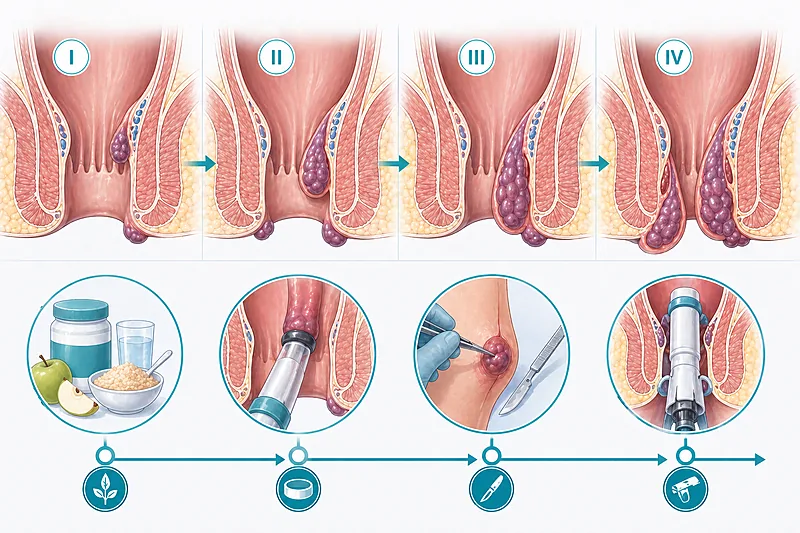
- 1Never attribute rectal bleeding to hemorrhoids without a proper anorectal examination and, when indicated, colonoscopy to exclude malignancy → Grading and Assessment
- 2Apply Goligher grading (I–IV) to every symptomatic internal hemorrhoid — it drives every treatment choice that follows → Grading and Assessment
- 3Start every patient on a fibre-and-fluids regimen before any procedure — conservative measures resolve a meaningful fraction of symptomatic disease → Conservative Measures
- 4Offer rubber band ligation as the first-line office procedure for grade I–III internal hemorrhoids that fail conservative care → Office Procedures
- 5Excise an acutely thrombosed external hemorrhoid only within roughly 72 hours of symptom onset — after that, manage conservatively → Thrombosed External
- 6Reserve excisional hemorrhoidectomy (Milligan-Morgan) for grade IV or grade III disease that fails office procedures → Surgical Options
- 7Counsel carefully before stapled hemorrhoidopexy — the eTHoS trial showed lower long-term symptom control than excisional surgery → Surgical Options
- 8Offer transanal hemorrhoidal dearterialisation (THD) as a less painful surgical alternative for grade II–III — recurrence is the main trade-off → Surgical Options
- 9Use modern energy devices (bipolar sealer, LigaSure, or harmonic scalpel) for excisional surgery — they reduce postoperative pain and blood loss → Surgical Options
- 10Plan structured post-procedure follow-up at 2–4 weeks and reinforce lifestyle measures to reduce recurrence → Monitoring
Grading and Assessment in Hemorrhoid Treatment
Accurate grading is the pivot on which all hemorrhoid treatment turns. Every subsequent decision — whether to band, whether to excise, whether to refer — depends on knowing exactly what you are treating. The single most common mistake in primary care is to assume that fresh bright-red bleeding must be hemorrhoidal without ruling out more serious causes.
Perform external inspection and digital rectal examination in every patient with anorectal symptoms. The exam distinguishes prolapsing from non-prolapsing disease, identifies anal fissures, detects external thrombosis, and excludes rectal masses.
Strong Rec High Evidence ASCRS 2018 ESCP 2020Confirm the diagnosis with anoscopy. Internal hemorrhoids cannot be reliably graded without visualising them during a Valsalva manoeuvre — digital rectal exam alone misses prolapse patterns.
Strong Rec Moderate Evidence ASCRS 2018Apply the Goligher grading system to every internal hemorrhoid. Grade I: bleeds but does not prolapse. Grade II: prolapses with strain, reduces spontaneously. Grade III: prolapses, requires manual reduction. Grade IV: irreducible prolapse.
Strong Rec Moderate Evidence ASCRS 2018 ESCP 2020Arrange colonoscopy when rectal bleeding occurs in patients aged 40 or older, when bleeding is associated with iron-deficiency anaemia, change in bowel habit, unexplained weight loss, or a family history of colorectal cancer. Hemorrhoids are common, but they co-exist with malignancy often enough to warrant caution.
Strong Rec Moderate Evidence ASCRS 2018Do not use flexible sigmoidoscopy as a substitute for full colonoscopy when the patient meets criteria for cancer screening or has red-flag symptoms — limited-distance endoscopy misses proximal lesions.
Against Moderate Evidence ASCRS 2018Grading Linked to Practical Management
| Goligher Grade | Clinical Picture | First-Line Approach | Procedural Options | Practical Notes |
|---|---|---|---|---|
| Grade I | Bleeding; no prolapse | Fibre, fluids, toilet-habit advice | Rubber band ligation; sclerotherapy; infrared coagulation | Most resolve with conservative care alone |
| Grade II | Prolapse with strain, reduces spontaneously | Conservative trial for 4–6 weeks | Rubber band ligation (preferred); THD; sclerotherapy | Band one pile per session to reduce pain |
| Grade III | Prolapse requiring manual reduction | Office procedure first-line; conservative care adjunct | Rubber band ligation; THD; excisional surgery | Progress to surgery if 2–3 band sessions fail |
| Grade IV | Irreducible prolapse; often thrombosed, skin tags | Surgical planning from the outset | Excisional hemorrhoidectomy (Milligan-Morgan or Ferguson) | Office procedures rarely adequate at this stage |
| External (any) | Distal to dentate line; skin-covered | Conservative unless thrombosed | Excision within 72 h of thrombosis | Not amenable to banding — somatic innervation |
Conservative Care: The Foundation
Every patient, at every grade, needs a conservative plan — both as first-line therapy and as adjuvant care around any procedure. The evidence for fibre supplementation in symptomatic internal hemorrhoids is robust, and the simple triad of fibre, fluids, and toilet-habit modification resolves a large fraction of grade I–II disease without any procedural intervention.
Counsel patients to adopt a high-fibre diet targeting 25–35 g per day and to increase fluid intake. Meta-analytic evidence shows fibre supplementation reduces both bleeding and symptom persistence compared with placebo.
Strong Rec High Evidence ASCRS 2018 ESCP 2020Prescribe a bulk-forming fibre supplement (psyllium 3.5 g twice daily, methylcellulose, or similar) when dietary intake is insufficient — start low and titrate upward to avoid bloating.
Strong Rec High Evidence ASCRS 2018Advise on toilet habits: limit toilet sitting to under 5 minutes, discourage straining, avoid reading or phone use on the toilet, and respond promptly to the urge to defecate. These behavioural shifts matter as much as diet.
Moderate Rec Low Evidence ASCRS 2018Offer warm sitz baths for 10–15 minutes twice daily for symptomatic relief of anal discomfort. The evidence for sitz baths is modest but they are safe and patients find them helpful.
Conditional Rec Low Evidence ASCRS 2018Limit topical steroid preparations to courses of 1–2 weeks. They provide symptomatic relief but prolonged use causes skin atrophy, contact dermatitis, and delayed wound healing.
Moderate Rec Low Evidence ESCP 2020Office-Based Hemorrhoid Treatment Procedures
Office-based hemorrhoid treatment fills the gap between conservative care and formal surgery. Three techniques dominate modern practice: rubber band ligation, sclerotherapy, and infrared coagulation. Of these, rubber band ligation has the strongest evidence base and the highest durable success rate for grade I–III disease.
Offer rubber band ligation as the first-line office procedure for grade I–III internal hemorrhoids that have failed an adequate conservative trial. The HubBLe trial confirmed it remains a cost-effective first-line procedural option for grade II–III disease.
Strong Rec High Evidence ASCRS 2018 HubBLe 2016Apply a single band per session in most patients. Multiple-band sessions increase pain and vasovagal complications without meaningfully shortening the overall treatment course. Repeat banding of other piles at 4–6 week intervals.
Moderate Rec Moderate Evidence ESCP 2020Place the band at least 1–2 cm above the dentate line. Banding visceral mucosa is painless; banding somatic skin causes severe pain and must be avoided. Confirm absence of sensation before firing the device.
Strong Rec Moderate Evidence ASCRS 2018Stop or bridge antithrombotic therapy before banding when clinically safe — the delayed bleeding window (7–14 days post-banding) is the most dangerous complication, and rates are substantially higher in patients on anticoagulants or antiplatelets.
Moderate Rec Moderate Evidence ASCRS 2018Consider sclerotherapy or infrared coagulation for grade I–II disease when banding is contraindicated (anticoagulation that cannot be held, significant immunosuppression). Both are less effective for prolapse but safer in bleeding-risk patients.
Moderate Rec Moderate Evidence ASCRS 2018 ESCP 2020Office Procedures Compared
| Procedure | Best Clinical Fit | Typical Sessions | Expected Pain | Common Pitfalls |
|---|---|---|---|---|
| Rubber band ligation | Grade I–III internal; first-line choice | 1–3 sessions, 4–6 wk apart | Mild pelvic heaviness; severe pain if too low | Delayed bleeding 7–14 d post-banding |
| Sclerotherapy | Grade I–II; patients on anticoagulants | 1–3 sessions | Minimal | Less durable than banding; injection misplacement |
| Infrared coagulation | Grade I–II internal; bleeding as main symptom | 2–3 sessions | Minimal to mild | Requires specialised device; limited availability |
| Cryotherapy | Largely historical | N/A | Significant | Prolonged discharge; not recommended in modern practice |
Thrombosed External Hemorrhoid: When to Excise
A thrombosed external hemorrhoid presents as a sudden, painful purple-blue perianal lump, typically without bleeding. The natural history is self-limiting: pain peaks at 48–72 hours, then resolves over 7–10 days as the thrombus organises and reabsorbs. The decision to excise hinges almost entirely on the timing of presentation relative to symptom onset.
Offer excision of a thrombosed external hemorrhoid within approximately 72 hours of symptom onset. Surgical excision at this point delivers faster symptom resolution and lower recurrence than incision-with-clot-evacuation or conservative management.
Strong Rec Moderate Evidence ASCRS 2018Perform the excision under local anaesthesia as an elliptical excision of the overlying skin with evacuation of the clot. Simple incision with clot extraction alone is associated with higher recurrence.
Moderate Rec Moderate Evidence ASCRS 2018Manage conservatively when the patient presents beyond 72 hours, when pain is already resolving, or when surgical access is unavailable: sitz baths, oral analgesia, topical anaesthetic, and fibre. Most patients recover fully within 10–14 days.
Strong Rec Moderate Evidence ASCRS 2018Surgical Hemorrhoid Treatment Options
Surgical hemorrhoid treatment is reserved for grade IV disease, large grade III disease with significant external components, and office-resistant symptoms. The modern surgeon chooses between three principal approaches: conventional excisional hemorrhoidectomy (Milligan-Morgan or Ferguson), stapled hemorrhoidopexy, and transanal hemorrhoidal dearterialisation (THD). The choice balances pain, recurrence, and anatomy.
Offer excisional hemorrhoidectomy (Milligan-Morgan open or Ferguson closed technique) for grade IV disease, symptomatic grade III with significant external component, and disease that has failed appropriate office procedures.
Strong Rec High Evidence ASCRS 2018 ESCP 2020Use a modern energy device (bipolar sealer, LigaSure, or harmonic scalpel) for the excision rather than monopolar diathermy or scissors with sutures. Randomised evidence supports lower postoperative pain and blood loss.
Moderate Rec High Evidence ESCP 2020Counsel carefully before offering stapled hemorrhoidopexy — the eTHoS trial showed it produces less immediate postoperative pain than excisional surgery but significantly worse long-term symptom control and higher recurrence at 24 months.
Conditional Rec High Evidence eTHoS 2016 ESCP 2020Offer Doppler-guided transanal hemorrhoidal dearterialisation (THD) with mucopexy as a less painful alternative to excisional surgery for grade II–III disease — with the important caveat that recurrence rates exceed those of excisional approaches.
Moderate Rec Moderate Evidence ESCP 2020 HubBLe 2016Use a structured multimodal postoperative analgesia plan: pudendal nerve block or long-acting local infiltration at the end of the operation, scheduled paracetamol and NSAIDs, and short-course oral opioids for breakthrough pain. Topical metronidazole and botulinum toxin have been studied as pain-reducing adjuncts.
Strong Rec Moderate Evidence ASCRS 2018 ESCP 2020Surgical Techniques: Side-by-Side
| Technique | Best Suited For | Key Advantages | Main Drawbacks | Practical Notes |
|---|---|---|---|---|
| Milligan-Morgan (open) | Grade III–IV, large external component | Best long-term cure; low recurrence | Significant postoperative pain; 2–4 weeks off work | Preserve adequate mucocutaneous bridges to prevent stenosis |
| Ferguson (closed) | Similar to Milligan-Morgan | Faster healing; slightly less pain | Technically more demanding | Absorbable sutures; watch for wound breakdown |
| Stapled hemorrhoidopexy | Circumferential grade III without external component | Lower short-term pain; faster return to work | Higher long-term recurrence (eTHoS); rare catastrophic complications | Counsel explicitly on long-term outcomes |
| THD / HAL with mucopexy | Grade II–III, bleeding-predominant | Low pain; no wounds | Higher recurrence than excisional | HubBLe trial found banding more cost-effective at 1 year |
Clinical Decision Pathway
A question-based walk-through of hemorrhoid treatment, from first consultation to definitive management.
Monitoring and Follow-Up
Follow-up closes the loop on hemorrhoid treatment: it confirms symptom resolution, catches complications early, and reinforces the lifestyle measures that protect against recurrence.
| Parameter | When to Check | What to Look For | Common Pitfalls |
|---|---|---|---|
| Post-banding safety call | Day 7–10 | Bleeding, fever, urinary retention, pelvic pain | Most bleeding is self-limited; be alert for pelvic sepsis |
| Office reassessment | 4–6 weeks post-procedure | Persistent bleeding, prolapse, or discomfort | A single banding session often needs a second round; counsel in advance |
| Post-surgical review | 2 and 6 weeks post-op | Wound healing, pain trajectory, continence | Do not dismiss new incontinence as “normal” — investigate |
| Lifestyle reinforcement | Every follow-up | Adherence to fibre, fluids, toilet habits | Without behaviour change, recurrence is likely within 2 years |
| Anal stenosis check | 6 weeks and 3 months post-excisional | Narrow calibre, difficulty evacuating | Preserved mucocutaneous bridges prevent most stenoses |
Evidence in Context
Where ASCRS and ESCP agree, where they differ, and the landmark trials that have reshaped modern hemorrhoid treatment.
Where ASCRS and ESCP Agree
Both societies agree that conservative measures with fibre and fluids are first-line for all grades, that rubber band ligation is the preferred office procedure for grade I–III internal disease, that excisional hemorrhoidectomy remains the most durable surgical option for advanced disease, and that thrombosed external hemorrhoids benefit from excision within the first 72 hours of symptoms. Both also emphasise the need to exclude malignancy before attributing bleeding to hemorrhoidal disease.
Where the Guidelines Differ
ESCP is more cautious about stapled hemorrhoidopexy in light of the eTHoS long-term data, recommending that it be reserved for carefully selected patients after explicit counselling. ASCRS positions stapled surgery as a reasonable option with similar caveats but slightly less negative framing. ESCP also gives a more positive role to flavonoid-based venotonics, which ASCRS regards as adjuncts with limited supporting evidence.
The eTHoS Trial: Rethinking Stapled Hemorrhoidopexy
The eTHoS trial (Lancet 2016) randomised more than 700 patients with grade II–IV disease to stapled hemorrhoidopexy or traditional excisional surgery. At 24 months, patients in the excisional arm reported significantly better disease-specific quality-of-life scores and lower recurrence. This finding substantially reframed the role of stapled surgery, which had previously been promoted primarily on the basis of short-term pain advantages.
The HubBLe Trial: Banding vs Hemorrhoidal Artery Ligation
The HubBLe trial compared rubber band ligation with hemorrhoidal artery ligation (HAL) for grade II–III disease. At one year, HAL produced slightly lower recurrence, but rubber band ligation was significantly more cost-effective per quality-adjusted life year gained. The practical conclusion is that banding remains the rational first-line procedural choice, with HAL/THD reserved for failures.
What We Still Don’t Know
Several questions remain unresolved. The optimal approach in patients on long-term anticoagulation is still debated, with no clear winner between sclerotherapy, infrared coagulation, and modified banding protocols. The role of flavonoid venotonics (diosmin, hesperidin) in acute and chronic symptoms is supported by heterogeneous evidence but not uniformly endorsed. Long-term comparative data for THD beyond 5 years remain limited, and the place of newer laser-based techniques is still being defined.
References
- 1.Davis BR, Lee-Kong SA, Migaly J, Feingold DL, Steele SR. The American Society of Colon and Rectal Surgeons Clinical Practice Guidelines for the Management of Hemorrhoids. Dis Colon Rectum. 2018;61(3):284–292. doi:10.1097/DCR.0000000000001030
- 2.van Tol RR, Kleijnen J, Watson AJM, et al. European Society of ColoProctology: guideline for haemorrhoidal disease. Colorectal Dis. 2020;22(6):650–662. doi:10.1111/codi.14975
- 3.Watson AJ, Hudson J, Wood J, et al. Comparison of stapled haemorrhoidopexy with traditional excisional surgery for haemorrhoidal disease (eTHoS): a pragmatic, multicentre, randomised controlled trial. Lancet. 2016;388(10058):2375–2385. doi:10.1016/S0140-6736(16)31803-7
- 4.Brown SR, Tiernan JP, Watson AJM, et al. Haemorrhoidal artery ligation versus rubber band ligation for the management of symptomatic second-degree and third-degree haemorrhoids (HubBLe): a multicentre, open-label, randomised controlled trial. Lancet. 2016;388(10042):356–364. doi:10.1016/S0140-6736(16)30584-0
- 5.Alonso-Coello P, Mills E, Heels-Ansdell D, et al. Fiber for the treatment of hemorrhoids complications: a systematic review and meta-analysis. Am J Gastroenterol. 2006;101(1):181–188. doi:10.1111/j.1572-0241.2005.00359.x
- 6.Greenspon J, Williams SB, Young HA, Orkin BA. Thrombosed external hemorrhoids: outcome after conservative or surgical management. Dis Colon Rectum. 2004;47(9):1493–1498. doi:10.1007/s10350-004-0607-y
How to Read the Evidence Tags
Every recommendation in this Practice Update carries three inline tags: recommendation strength, evidence quality, and source. These are Medaptly’s own simplified interpretations — not reproductions of any single guideline body’s classification system.
Recommendation Strength
| Tag | What It Means |
|---|---|
| Strong Rec | High-quality evidence broadly supports this action. |
| Moderate Rec | The weight of evidence favours this action. |
| Conditional Rec | The benefit is less certain — individualise to the patient. |
| Against | Evidence shows no benefit or potential harm. |
Evidence Quality
| Tag | What It Means |
|---|---|
| High Evidence | Multiple well-designed RCTs or high-quality meta-analyses. |
| Moderate Evidence | Single RCT or large observational studies. |
| Low Evidence | Expert consensus or small studies. |