
Infected Pancreatic Necrosis: A Step-Up Intervention Guide
Clinical Practice Update — Intervention Timing, Drainage-First Strategy, and Escalation to Necrosectomy
This is an original clinical education article informed by current guidelines and evidence. See References below for source documents.
- Clinical Focus
- Step-up intervention and timing in infected pancreatic necrosis treatment
- Target Audience
- General and HPB surgeons, surgical residents, intensivists, advanced endoscopists
- Setting
- Intensive care, surgical inpatient, tertiary pancreatic referral centers
- Source Evidence
- •PANTER Trial — Step-Up vs Open Necrosectomy (NEJM, 2010)
- •TENSION Trial — Endoscopic vs Surgical Step-Up (Lancet, 2018)
- •POINTER Trial — Immediate vs Postponed Drainage (NEJM, 2021)
- •AGA Clinical Practice Update on Pancreatic Necrosis (2020)
Key Clinical Takeaways
Modern infected pancreatic necrosis treatment rests on two disciplined ideas: control the source with the least invasive tool first, and resist the urge to operate early. The step-up approach — drainage followed only when needed by necrosectomy — has replaced upfront open surgery, and the latest timing evidence supports stabilizing patients on antibiotics rather than rushing to drain. The points below distill that evidence into rules you can apply at the bedside.
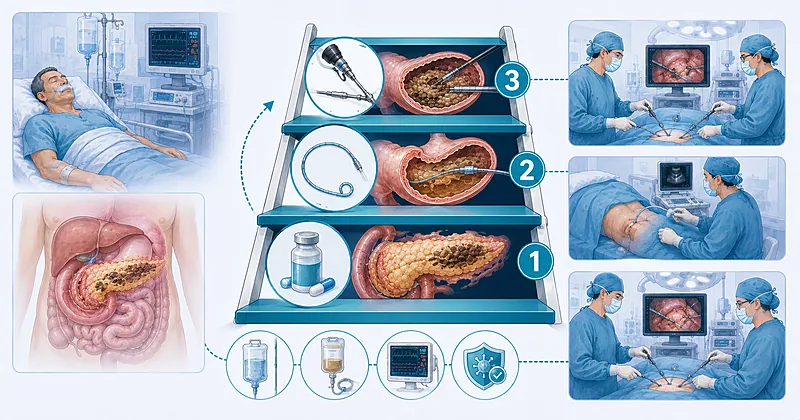
- 1Reserve invasive intervention for confirmed or strongly suspected infection — sterile necrosis alone is not an indication to drain or operate.
- 2Make catheter or transluminal drainage the first procedural step in every case — never primary open necrosectomy where a step-up route exists.
- 3Delay any intervention toward the fourth week when the patient’s condition allows it — encapsulation makes every subsequent step safer.
- 4Stabilize first with antibiotics — immediate drainage on diagnosis offers no advantage, and many patients improve without any procedure.
- 5Escalate to necrosectomy only after drainage fails to resolve sepsis — roughly one in three patients never needs that second step.
- 6Choose the endoscopic transluminal route when anatomy permits — it lowers pancreatic fistula rates and shortens hospital stay.
- 7Use antibiotics that penetrate necrotic tissue and reserve carbapenems for the sickest patients to limit resistance.
- 8Manage these patients in a multidisciplinary referral center with surgery, interventional radiology, and advanced endoscopy on the same team.
When Infected Pancreatic Necrosis Treatment Requires Intervention
The first decision in infected pancreatic necrosis treatment is whether a collection needs a procedure at all. Infection complicates roughly one in three patients with necrotizing pancreatitis and carries mortality in the region of 15 to 20 percent, so the threshold for action is real — but acting on sterile necrosis exposes a patient to risk without benefit.
Infection is usually a clinical and radiological diagnosis rather than a microbiological one. Gas within a collection on contrast-enhanced CT is the classic confirmatory sign; in its absence, persistent or recurrent sepsis after the first week, in a patient with known necrosis and no other source, is sufficient grounds to treat as infected.
Evaluate for invasive intervention when gas is present in a necrotic collection or when sepsis persists despite supportive care in a patient with known necrosis. Treat these as infected even without positive cultures.
Strong Rec Moderate Evidence AGA 2020 WSES 2019Avoid routine fine-needle aspiration to confirm infection. Its false-negative rate and added risk mean the clinical picture should usually drive the decision instead.
Conditional Rec Low Evidence AGA 2020Do not intervene on sterile necrosis solely because a collection is large or persistent. Reserve procedures for sterile disease for specific late complications such as gastric outlet or biliary obstruction, or intractable pain.
Against High Evidence AGA 2020Timing the First Step in Infected Pancreatic Necrosis Treatment
Timing is where the most important recent shift in infected pancreatic necrosis treatment has occurred. The historical rule — wait four weeks for the collection to wall off before doing anything — came from the open-surgery era, when operating on unencapsulated necrosis was disastrous. Two questions have since been tested directly: does drainage need that delay, and does drainage need to happen the moment infection is diagnosed?
The answers point in the same direction. A randomized comparison of immediate versus postponed catheter drainage found no benefit to draining within 24 hours of diagnosing infection. Patients managed with antibiotics first underwent fewer total procedures, and a substantial minority recovered on antibiotics alone without ever needing drainage. The lesson is that a stable, antibiotic-controlled patient buys time, and time allows encapsulation that makes every later step safer and more effective.
Initiate intravenous antibiotics and supportive care first when infection is diagnosed, rather than draining immediately. Immediate drainage within 24 hours confers no outcome advantage over a stabilize-first strategy.
Strong Rec High Evidence POINTER 2021Postpone intervention toward the fourth week of illness whenever the patient remains stable, allowing the collection to encapsulate. Better source control and fewer reinterventions follow when drainage targets walled-off necrosis.
Moderate Rec Moderate Evidence AGA 2020 PANTER 2010Perform earlier drainage when, and only when, a patient deteriorates with ongoing sepsis despite maximal support and cannot safely wait for encapsulation. Clinical instability, not the calendar, overrides the preference to delay.
Moderate Rec Low Evidence WSES 2019Step One: Drainage Before Necrosectomy
The defining principle of the step-up approach is that the first procedure is always drainage, not debridement. The landmark trial that established this randomized patients to primary open necrosectomy or to a step-up route of percutaneous drainage followed only when needed by minimally invasive necrosectomy. The step-up arm roughly halved the rate of major complications or death, and more than a third of patients were cured by drainage alone with no necrosectomy at all.
Drainage works for two reasons. It decompresses the infected collection and converts uncontrolled sepsis into a controlled, draining focus, often enough to let the patient turn the corner. And when necrosectomy is still required, the drain has already established a tract that the later procedure can exploit. The retroperitoneal percutaneous route is preferred where feasible because it keeps the working channel away from the peritoneal cavity.
Perform catheter or endoscopic transluminal drainage as the first intervention in every patient. A drainage-first strategy halves major complications and death compared with primary open necrosectomy.
Strong Rec High Evidence PANTER 2010Position a percutaneous drain via a retroperitoneal route through the left flank when the collection’s location allows it. This keeps the working tract extraperitoneal and sets up a corridor for video-assisted retroperitoneal debridement if escalation is needed.
Moderate Rec Moderate Evidence PANTER 2010 AGA 2020Reassess clinically and with cross-sectional imaging at 48 to 72 hours after drain placement. Upsize or reposition the catheter, or add a second drain, before concluding that drainage has failed.
Moderate Rec Low Evidence AGA 2020Endoscopic or Surgical: Choosing the Step-Up Route
Once drainage is chosen, the next question is which step-up pathway to follow: an endoscopic transluminal route through the stomach or duodenum, or a surgical route of percutaneous drainage with subsequent video-assisted retroperitoneal debridement. A multicenter trial compared the two head-to-head and found no difference in the combined rate of death or major complications. What differed was morbidity along the way.
Patients in the endoscopic arm developed fewer pancreatic fistulas and spent less time in hospital. Because the transluminal route drains the collection internally into the gut, it avoids the external pancreatic-cutaneous fistulas that can complicate percutaneous tracts, particularly when the pancreatic duct is disconnected. For collections that abut the stomach or duodenum, this makes the endoscopic route the preferred first choice where the expertise exists.
Anatomy still decides feasibility. Collections that extend laterally into the paracolic gutters or down toward the pelvis are often beyond endoscopic reach and are better served by a percutaneous, retroperitoneal approach. Many complex cases ultimately need both, and a disconnected pancreatic duct changes long-term management regardless of the route chosen.
Prefer the endoscopic transluminal step-up route for collections in contact with the stomach or duodenum. It produces fewer pancreatic fistulas and a shorter hospital stay than the surgical route, with equivalent mortality.
Moderate Rec High Evidence TENSION 2018Select a percutaneous, retroperitoneal step-up route for collections that extend laterally or caudally beyond endoscopic reach. Deep paracolic and pelvic extension is better controlled this way.
Moderate Rec Moderate Evidence AGA 2020Combine endoscopic and percutaneous routes for extensive disease that spans both central and lateral compartments, rather than forcing a single access into an unsuitable anatomy.
Conditional Rec Low Evidence Expert ConsensusComparing the Two Step-Up Routes
| Decision Factor | Endoscopic Transluminal | Percutaneous Surgical | Practical Tip |
|---|---|---|---|
| Best collection location | Central, adjacent to stomach or duodenum | Lateral, paracolic, or pelvic extension | Map the collection on CT before committing to a route |
| Pancreatic fistula risk | Lower — drains internally to gut | Higher — external cutaneous tract | Weigh duct integrity heavily in the choice |
| Hospital stay | Shorter in randomized data | Longer | Factor in local endoscopy availability |
| Escalation tool | Direct endoscopic necrosectomy | Video-assisted retroperitoneal debridement | Ensure the escalation skillset is on the team before step one |
| Mortality vs alternative | Equivalent | Equivalent | Choose on morbidity and anatomy, not survival |
Clinical Decision Pathway
A practical, question-based route through the step-up sequence. Work through the questions in order.
Step Two: Escalating to Necrosectomy
Necrosectomy is the second step, taken only when drainage has not controlled the source. The trigger is clinical: ongoing or worsening sepsis after the drain has been optimized, not the mere persistence of necrotic tissue on imaging. A collection can look unchanged on CT while the patient recovers, and that patient needs no debridement.
When debridement is required, it follows the access already created. An endoscopic drain becomes the portal for direct endoscopic necrosectomy; a retroperitoneal catheter tract becomes the corridor for video-assisted retroperitoneal debridement. Both are staged and often repeated, clearing necrosis in sessions rather than in one definitive operation, which spares the patient the physiological hit of open surgery.
Escalate to minimally invasive necrosectomy only after optimized drainage fails to reverse sepsis. Around one third of patients are cured by drainage and never reach this step.
Strong Rec High Evidence PANTER 2010Perform necrosectomy through the existing drainage tract — direct endoscopic necrosectomy for transluminal access, or video-assisted retroperitoneal debridement for a percutaneous tract. Stage and repeat sessions rather than attempting a single complete clearance.
Moderate Rec Moderate Evidence TENSION 2018Reserve primary open necrosectomy for situations where minimally invasive routes are anatomically impossible or have been exhausted. It is the last rung of the ladder, not the first.
Against High Evidence PANTER 2010Counsel patients and families that the step-up route lowers long-term harm. Compared with upfront open surgery it reduces incisional hernia and new-onset pancreatic insufficiency over years of follow-up.
Strong Rec High Evidence PANTER long-term 2019Antibiotics, Nutrition, and Monitoring
Antibiotics are the medical backbone of the stabilize-first strategy. Because they must reach poorly perfused necrotic tissue, agents with good pancreatic penetration are preferred. Carbapenems penetrate reliably but should be held back for the most critically ill given the cost of resistance; carbapenem-sparing regimens are appropriate for many patients.
Start broad-spectrum antibiotics with good necrosis penetration when infection is diagnosed, and reserve carbapenems for the most critically ill to limit resistance. Do not give prophylactic antibiotics for sterile necrosis.
Strong Rec Moderate Evidence WSES 2019Ensure early enteral nutrition, by the oral or nasoenteric route, to support gut integrity and reduce the risk of secondary infection. Avoid routine parenteral nutrition when the gut can be used.
Strong Rec Moderate Evidence AGA 2020Document pancreatic duct integrity during follow-up. A disconnected duct predicts recurrent collections and may require long-term transmural stenting or later surgery.
Moderate Rec Low Evidence AGA 2020Refer patients with infected necrosis early to a multidisciplinary referral center with surgery, interventional radiology, advanced endoscopy, and critical care. Outcomes are better where these teams coordinate the step-up sequence.
Strong Rec Moderate Evidence AGA 2020Monitoring the Step-Up Patient
| What to Track | When to Check | Signal of Progress | Common Pitfall |
|---|---|---|---|
| Clinical sepsis markers | Daily, and at 72h post-drainage | Falling temperature, vasopressor weaning | Calling drainage a failure before the drain is optimized |
| C-reactive protein | Every 48–72h around interventions | Sustained downward trend | Reacting to a single value rather than the trend |
| Drain output and character | Each shift | Decreasing volume with clinical improvement | Mistaking a blocked drain for resolution |
| Cross-sectional imaging | When clinical course stalls or worsens | Shrinking, well-drained collection | Routine daily scans that change nothing |
Evidence in Context
What the trials actually showed, and where the field still debates the details.
Why drainage-first replaced open surgery
The pivotal trial randomized patients with infected or suspected-infected necrosis to primary open necrosectomy or a step-up route. The step-up arm cut the combined rate of major complications or death from roughly 70 percent to around 40 percent, driven mainly by less new-onset organ failure. Crucially, simple drainage alone resolved the infection in more than a third of patients, who avoided any necrosectomy. Extended follow-up confirmed durable benefits, including fewer hernias and less pancreatic insufficiency, with no rise in reinterventions.
Endoscopic versus surgical: what the head-to-head trial found
The randomized comparison of endoscopic transluminal and surgical step-up approaches found no difference in death or major complications. The endoscopic route produced fewer pancreatic-cutaneous fistulas and a shorter hospital stay, advantages that persisted at long-term follow-up alongside fewer late reinterventions. The practical reading is that the two are equivalent for survival, so the choice turns on anatomy, local expertise, and morbidity rather than on a survival difference. Where endoscopy is unavailable, video-assisted retroperitoneal debridement remains an excellent escalation tool.
The timing question: immediate versus postponed drainage
The trial testing immediate drainage within 24 hours against postponed drainage found no benefit to acting immediately. The postponed strategy led to fewer invasive procedures overall, and a notable share of patients assigned to wait recovered on antibiotics alone with no drainage at all. This reframed the old four-week rule: the delay is not a rigid wait for a fixed date but a willingness to let a stabilized patient improve, intervening earlier only if they deteriorate.
Where uncertainty remains
Open questions persist around the optimal moment to escalate from drainage to necrosectomy, whether very early endoscopic intervention before full encapsulation is safe in selected patients, and how best to handle a disconnected pancreatic duct. Several trials of endoscopically centered early intervention and of upfront versus stepwise necrosectomy are addressing these gaps, but for now the disciplined drainage-first, stabilize-first sequence remains the standard.
References
- 1.van Santvoort HC, Besselink MG, Bakker OJ, et al. A step-up approach or open necrosectomy for necrotizing pancreatitis. N Engl J Med. 2010;362(16):1491–1502. doi:10.1056/NEJMoa0908821
- 2.van Brunschot S, van Grinsven J, van Santvoort HC, et al. Endoscopic or surgical step-up approach for infected necrotising pancreatitis: a multicentre randomised trial. Lancet. 2018;391(10115):51–58. doi:10.1016/S0140-6736(17)32404-2
- 3.Boxhoorn L, van Dijk SM, van Grinsven J, et al. Immediate versus postponed intervention for infected necrotizing pancreatitis. N Engl J Med. 2021;385(15):1372–1381. doi:10.1056/NEJMoa2100826
- 4.Baron TH, DiMaio CJ, Wang AY, Morgan KA. American Gastroenterological Association Clinical Practice Update: Management of Pancreatic Necrosis. Gastroenterology. 2020;158(1):67–75.e1. doi:10.1053/j.gastro.2019.07.064
- 5.Hollemans RA, Bakker OJ, Boermeester MA, et al. Superiority of step-up approach vs open necrosectomy in long-term follow-up of patients with necrotizing pancreatitis. Gastroenterology. 2019;156(4):1016–1026. doi:10.1053/j.gastro.2018.10.045
- 6.Leppäniemi A, Tolonen M, Tarasconi A, et al. 2019 WSES guidelines for the management of severe acute pancreatitis. World J Emerg Surg. 2019;14:27. doi:10.1186/s13017-019-0247-0
How to Read the Evidence Tags
Each recommendation carries two tags — one for recommendation strength and one for evidence quality. These are Medaptly’s own simplified interpretations, not reproductions of any guideline body’s grading system.
Recommendation Strength
| Tag | What It Means |
|---|---|
| Strong Rec | High-quality evidence broadly supports this action. |
| Moderate Rec | The weight of evidence favours this action. |
| Conditional Rec | The benefit is less certain — individualise. |
| Against | Evidence shows no benefit or potential harm. |
Evidence Quality
| Tag | What It Means |
|---|---|
| High Evidence | Multiple well-designed RCTs or high-quality meta-analyses. |
| Moderate Evidence | Single RCT or large observational studies. |
| Low Evidence | Expert consensus or small studies. |