
Pancreatic Cancer Surgery: From Resectability to the Whipple
Clinical Practice Update — Resectability Staging, Neoadjuvant Sequencing, and Pancreaticoduodenectomy in Adults
This is an original clinical education article informed by current guidelines and evidence. See References below for source documents.
- Clinical Focus
- Resectability assessment and surgical management of pancreatic adenocarcinoma for adults with pancreatic ductal adenocarcinoma
- Target Audience
- General and hepatobiliary surgeons, surgical residents, medical and radiation oncologists, gastroenterologists
- Setting
- High-volume surgical centres, multidisciplinary cancer clinics, tertiary hepatobiliary units
- Source Evidence
- •NCCN Guidelines, Pancreatic Adenocarcinoma (2024)
- •ASCO Clinical Practice Guideline on Potentially Curable Pancreatic Cancer (2017, updated)
- •PRODIGE 24/CCTG PA.6 Adjuvant Trial (NEJM, 2018)
- •PREOPANC Neoadjuvant Chemoradiotherapy Trial (JCO, 2020/2022)
Key Clinical Takeaways
Success in pancreatic cancer surgery is decided long before the patient reaches the operating table. It rests on three early judgements: classifying the tumour as resectable, borderline, or locally advanced; sequencing systemic therapy correctly; and reserving the operation for patients who can withstand a pancreaticoduodenectomy. The points below distil the evidence into practical rules for the surgical pathway.
- 1Stage every new diagnosis with a pancreatic-protocol CT and route it through multidisciplinary team review before any treatment decision → Defining Resectability
- 2Define resectability by the relationship of tumour to the superior mesenteric artery, coeliac axis, and portomesenteric veins — not by size alone → Defining Resectability
- 3Treat borderline resectable disease with neoadjuvant therapy first, reserving immediate surgery for clearly resectable tumours → Neoadjuvant Timing
- 4Aim for a margin-negative (R0) resection — the strongest modifiable predictor of long-term survival → The Whipple Procedure
- 5Refer pancreaticoduodenectomy to high-volume centres — surgical volume correlates directly with lower mortality → The Whipple Procedure
- 6Anticipate postoperative pancreatic fistula and delayed gastric emptying as the dominant complications driving recovery → Monitoring
- 7Complete adjuvant chemotherapy after recovery — modern combination regimens substantially extend survival → Adjuvant Therapy
- 8Re-stage with imaging and CA 19-9 after neoadjuvant therapy to confirm a window for resection before committing to surgery → Neoadjuvant Timing
Defining Resectability: The First Decision in Pancreatic Cancer Surgery
Resectability is the gateway decision in the surgical pathway. It is determined almost entirely by the anatomic relationship between the tumour and three vascular structures: the superior mesenteric artery (SMA), the coeliac axis with its common hepatic artery, and the portomesenteric venous confluence. A tumour can be small yet unresectable, or bulky yet removable, depending purely on this vascular geometry.
This is why a millimetre-precise reading of the arterial and venous phases matters more than the tumour’s diameter. The degree of contact, whether the vessel wall is merely abutted or genuinely encased, and whether the venous contour stays smooth or becomes irregular together decide which of three pathways a patient enters. Getting that reading right at the outset prevents both futile operations and missed curative windows.
Perform a dedicated pancreatic-protocol CT with arterial and portal venous phases as the primary staging study for every suspected pancreatic malignancy. Reserve MRI and endoscopic ultrasound for problem-solving when CT is equivocal.
Strong Rec High Evidence NCCN 2024 ASCO 2017Measure a baseline CA 19-9 before any intervention and repeat it through treatment. A markedly elevated or rising level signals occult metastatic disease even when imaging looks operable, and should prompt caution before surgery.
Moderate Rec Moderate Evidence NCCN 2024Refer every case to a multidisciplinary team that includes surgery, oncology, radiology, and pathology before assigning a resectability category. Single-clinician staging consistently overcalls and undercalls operability.
Strong Rec Moderate Evidence ASCO 2017Resectable: No arterial contact, and venous contact of 180 degrees or less without contour irregularity. Surgery first is appropriate.
Borderline resectable: Limited arterial contact or venous involvement that is reconstructable. Neoadjuvant therapy precedes any resection.
Locally advanced: Arterial encasement greater than 180 degrees or unreconstructable venous occlusion. Systemic therapy, not upfront surgery.
Neoadjuvant Therapy and Timing
The sequence of chemotherapy and surgery has shifted decisively in recent years. For borderline disease, delivering systemic therapy first treats the micrometastases that are almost always present at diagnosis, and selects out patients whose biology declares itself aggressive before they are subjected to a major operation.
Initiate neoadjuvant chemotherapy for borderline resectable disease rather than proceeding straight to surgery. This approach improves margin-negative resection rates and filters out patients who progress early.
Strong Rec Moderate Evidence PREOPANC 2020 NCCN 2024Re-stage with cross-sectional imaging and a repeat CA 19-9 after completing neoadjuvant therapy, before committing to laparotomy. Look for stable or responding disease and a falling tumour marker as the green light for resection.
Strong Rec Low Evidence NCCN 2024Consider a staging laparoscopy before pancreaticoduodenectomy in high-risk cases — bulky tumours, very high CA 19-9, or equivocal peritoneal findings — to detect occult metastases that imaging missed.
Conditional Rec Moderate Evidence ASCO 2017The Whipple Procedure in Pancreatic Cancer Surgery
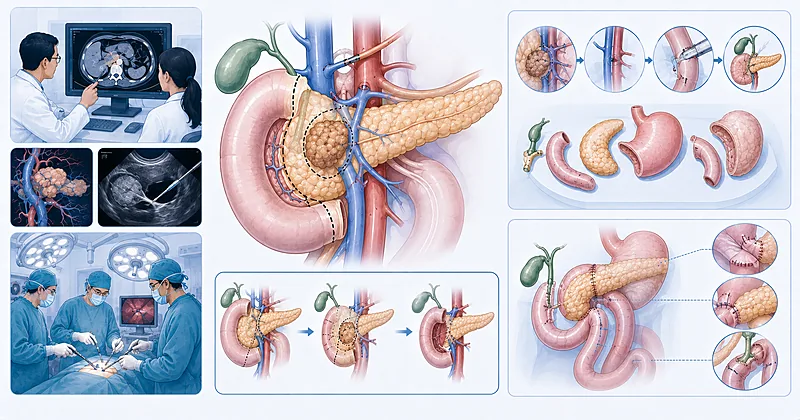
For tumours of the pancreatic head, uncinate process, and periampullary region, the pancreaticoduodenectomy — the Whipple — remains the definitive operation in pancreatic cancer surgery. It removes the pancreatic head, duodenum, distal bile duct, gallbladder, and a variable portion of stomach, then reconstructs pancreatic, biliary, and gastric continuity.
Refer pancreaticoduodenectomy to a high-volume centre and surgeon. Operative mortality falls substantially as institutional case volume rises, making centralisation one of the clearest levers on outcome in pancreatic cancer surgery.
Strong Rec High Evidence ASCO 2017Perform en-bloc venous resection and reconstruction when tumour abuts the portal or superior mesenteric vein but the vessel is reconstructable. Plan this preoperatively rather than discovering it at the table.
Moderate Rec Moderate Evidence NCCN 2024Do not attempt arterial resection of the SMA or coeliac axis as a routine manoeuvre to clear encasement. Outside specialised protocols, the morbidity outweighs any oncologic benefit.
Against Low Evidence NCCN 2024Ensure a complete regional lymphadenectomy and submit the SMA (uncinate) margin separately for pathology. Margin-negative status is the dominant modifiable determinant of survival after resection.
Strong Rec Moderate Evidence NCCN 2024What the Whipple Removes and Rebuilds
| Surgical Step | Structure Involved | Why It Matters | Practical Watch-Point |
|---|---|---|---|
| Resect | Pancreatic head & uncinate | Carries the primary tumour | Uncinate margin abuts the SMA — the commonest positive margin |
| Resect | Duodenum & distal bile duct | Shared blood supply with the head | Anatomy mandates en-bloc removal |
| Rebuild | Pancreatic anastomosis | Restores enzyme drainage | The highest-risk join — source of pancreatic fistula |
| Rebuild | Biliary anastomosis | Restores bile flow | Bile leak presents later than fistula |
| Rebuild | Gastric/duodenal anastomosis | Restores GI continuity | Pylorus-preserving variants alter gastric emptying |
Pylorus-Preserving Versus Classic Resection
Two reconstruction variants dominate practice: the pylorus-preserving operation, which retains the stomach and proximal duodenum, and the classic version, which includes a distal gastrectomy. Long-term oncologic outcomes are broadly comparable between the two, so the choice usually rests on tumour location relative to the pylorus and individual surgeon preference rather than a survival argument. Where the tumour encroaches on the first part of the duodenum or the periampullary nodes are bulky, the classic resection gives a wider clearance.
Evaluate physiological reserve with a structured frailty assessment, not chronological age alone, before offering resection to older adults. A fit patient in their eighties may tolerate the operation better than a deconditioned patient two decades younger, and prehabilitation can convert a marginal candidate into an operable one.
Moderate Rec Moderate Evidence ASCO 2017Counsel patients explicitly that the operation is one component of a longer treatment course, not a standalone cure. Setting realistic expectations about adjuvant therapy, recovery time, and recurrence risk improves shared decision-making and downstream adherence to chemotherapy.
Strong Rec Low Evidence ASCO 2017Clinical Decision Pathway
A question-based route through the surgical decision in pancreatic malignancy. Work through the questions in order before booking an operation.
Monitoring and Follow-Up
The early postoperative course after the Whipple is dominated by two complications, and the medium-term course by surveillance for recurrence and management of exocrine and endocrine insufficiency. Recovery is rarely linear: many patients tolerate the operation itself well but stumble in the second postoperative week, when fistula, delayed emptying, or a herald bleed tend to declare themselves. Vigilance during this window, rather than at the moment of discharge from theatre, is what separates a smooth recovery from a readmission.
| What to Watch | When | The Warning Sign | Common Pitfall |
|---|---|---|---|
| Postoperative pancreatic fistula | Drain output, days 3–5 | High drain amylase, rising fever | Pulling drains too early before output is characterised |
| Delayed gastric emptying | From day 5 onward | Persistent nausea, intolerance of oral intake | Assuming obstruction before excluding a leak driving it |
| Post-pancreatectomy haemorrhage | Any time, often late | A herald bleed from drain or NG tube | Ignoring a small sentinel bleed — it precedes catastrophe |
| Exocrine insufficiency | Weeks to months | Steatorrhoea, weight loss | Under-dosing pancreatic enzyme replacement |
| Recurrence surveillance | Every 3–6 months | Rising CA 19-9, new symptoms | Surveillance lapsing once adjuvant therapy ends |
Initiate adjuvant combination chemotherapy once the patient has recovered, ideally within the early postoperative window. Modern multi-agent regimens deliver the largest survival gain of any step after resection.
Strong Rec High Evidence PRODIGE 24 2018Prescribe pancreatic enzyme replacement therapy for steatorrhoea or weight loss after resection, and titrate to symptoms. Under-treatment is a frequent, correctable cause of poor recovery.
Moderate Rec Low Evidence NCCN 2024Evidence in Context
What the trials show, where the major frameworks converge, and where genuine uncertainty remains in surgical decision-making.
Where NCCN and ASCO Converge
Both frameworks anchor decisions on the resectable / borderline / locally advanced triad, insist on multidisciplinary staging, prioritise margin-negative resection, and support adjuvant chemotherapy for all fit patients after surgery.
Neoadjuvant Therapy: What the Trials Show
The PREOPANC programme found that delivering chemoradiotherapy before surgery improved margin-negative resection rates and long-term survival in resectable and borderline disease compared with upfront surgery, strengthening the case for a systemic-first approach in borderline tumours.
Adjuvant Chemotherapy: The Survival Gain
The PRODIGE 24 trial showed that a modern multi-agent adjuvant regimen meaningfully extended both disease-free and overall survival relative to single-agent therapy in patients fit enough to tolerate it, reshaping the postoperative standard of care.
Where Uncertainty Remains
The optimal neoadjuvant regimen for resectable (not just borderline) disease, the precise role of arterial-divestment techniques, and the value of routine staging laparoscopy all remain areas of active debate without uniform consensus.
References
- 1.Tempero MA, Malafa MP, Al-Hawary M, et al. Pancreatic Adenocarcinoma, Version 2.2021, NCCN Clinical Practice Guidelines in Oncology. J Natl Compr Canc Netw. 2021;19(4):439–457. doi:10.6004/jnccn.2021.0017
- 2.Khorana AA, Mangu PB, Berlin J, et al. Potentially Curable Pancreatic Cancer: ASCO Clinical Practice Guideline Update. J Clin Oncol. 2017;35(20):2324–2328. doi:10.1200/JCO.2017.72.4948
- 3.Conroy T, Hammel P, Hebbar M, et al. FOLFIRINOX or Gemcitabine as Adjuvant Therapy for Pancreatic Cancer. N Engl J Med. 2018;379(25):2395–2406. doi:10.1056/NEJMoa1809775
- 4.Versteijne E, Suker M, Groothuis K, et al. Preoperative Chemoradiotherapy Versus Immediate Surgery for Resectable and Borderline Resectable Pancreatic Cancer: Results of the Dutch Randomized Phase III PREOPANC Trial. J Clin Oncol. 2020;38(16):1763–1773. doi:10.1200/JCO.19.02274
How to Read the Evidence Tags
Each recommendation carries a strength tag and an evidence-quality tag — Medaptly’s own simplified interpretations, not a reproduction of any guideline body’s classification system.
Recommendation Strength
| Tag | What It Means |
|---|---|
| Strong Rec | High-quality evidence broadly supports this action. |
| Moderate Rec | The weight of evidence favours this action. |
| Conditional Rec | The benefit is less certain — individualise. |
| Against | Evidence shows no benefit or potential harm. |
Evidence Quality
| Tag | What It Means |
|---|---|
| High Evidence | Multiple well-designed RCTs or high-quality meta-analyses. |
| Moderate Evidence | Single RCT or large observational studies. |
| Low Evidence | Expert consensus or small studies. |