
Pilonidal Disease: 8 Proven Surgical Rules
Clinical Practice Update — Acute Abscess, Conservative Measures, Pit Picking, and Cleft-Lift Procedures
This is an original clinical education article informed by current guidelines and evidence. See References below for source documents.
- Clinical Focus
- Evidence-based acute and elective management of pilonidal disease in adolescents and adults
- Target Audience
- General surgeons, colorectal surgeons, emergency physicians, primary care physicians, wound nurses
- Setting
- Emergency department, primary care, outpatient minor-procedure clinic, operating theatre
- Source Evidence
- •ASCRS Clinical Practice Guidelines for Treatment of Pilonidal Disease (2019)
- •Cochrane Review on Surgical Management of Pilonidal Sinus Disease
- •German S3 Guidelines on Pilonidal Sinus Disease
- •Bascom and Bascom — Cleft Lift Procedure Series (Arch Surg / Dis Colon Rectum)
- •Meta-analyses of Karydakis Flap and EPSiT (Endoscopic Pilonidal Sinus Treatment)
Key Clinical Takeaways
Effective pilonidal disease management is built on three decisions: drain the abscess promptly, commit to hair removal and hygiene for the long run, and choose a definitive procedure that flattens or shifts the natal cleft away from the midline. The rules below distil the evidence into bedside choices.
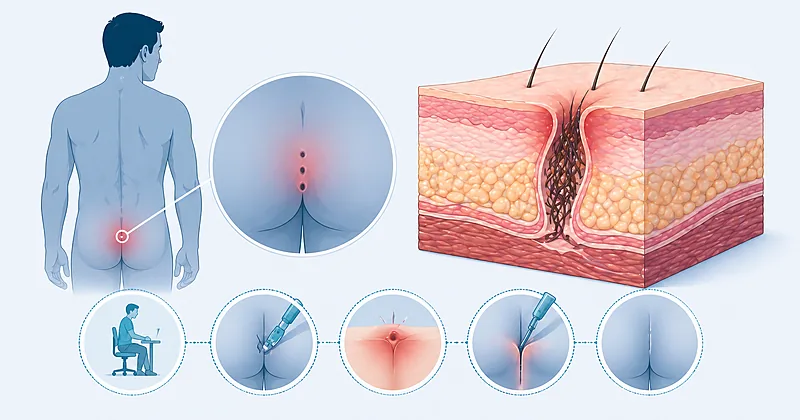
- 1Treat an acute pilonidal abscess with incision and drainage under local anaesthesia — do not wait for antibiotics to clear it → Acute Abscess
- 2Incise off-midline (typically 2–3 cm lateral) — a midline scar in the cleft is a setup for recurrence → Technique
- 3Offer laser hair removal as first-line adjunctive therapy — recurrence falls substantially when hair in the cleft is eliminated → Conservative
- 4Consider pit picking (Bascom I / Gips) for limited disease — day case, low morbidity, high patient satisfaction → Minor Procedures
- 5Reserve wide midline excision for selected patients — recurrence is higher and healing is longer than off-midline closure → Excision
- 6Use a cleft-lift procedure (Bascom II or Karydakis) for complex, recurrent, or unhealed disease — it eliminates the natal cleft → Cleft Lift
- 7Avoid routine antibiotics for uncomplicated abscess — drainage alone is curative in the healthy host → Antibiotics
- 8Counsel patients on weight management and workplace sitting breaks — these reduce both initial disease and recurrence → Prevention
Recognising Pilonidal Disease
Pilonidal disease is a disorder of the natal cleft driven by hair burrowing into the skin, chronic local inflammation, and a deep gluteal crease. It typically presents in young adults — men more often than women — with one of three patterns: acute abscess, chronic discharging sinus, or recurrent disease after prior surgery.
Diagnose pilonidal disease clinically on the basis of characteristic midline pits, intermittent discharge, or a tender fluctuant swelling over the sacrococcygeal region — imaging is rarely required.
Strong Rec High Evidence ASCRS 2019Document the number and location of midline pits, the extent and laterality of any sinus tracts, and the presence of prior surgical scars — these findings shape procedural choice.
Strong Rec Moderate Evidence ASCRS 2019Consider alternative diagnoses — perianal Crohn’s disease, hidradenitis suppurativa, sacrococcygeal teratoma in children, and fistula-in-ano — particularly when presentation is atypical or disease is recalcitrant.
Moderate Rec Low Evidence ASCRS 2019Managing Acute Pilonidal Abscess
An acute pilonidal abscess is a surgical emergency in miniature — drainage buys relief within minutes. The decisions that matter are whether to drain under local or general anaesthesia, where to place the incision, and how to manage the wound afterward.
Perform incision and drainage of an acute pilonidal abscess under local anaesthesia as soon as it is diagnosed, using an off-midline (typically 2–3 cm lateral) incision oriented along the long axis of the cleft.
Strong Rec High Evidence ASCRS 2019 German S3Do not incise in the midline for abscess drainage when an off-midline approach is feasible — a scar in the cleft itself is a durable cause of recurrence.
Against Moderate Evidence ASCRS 2019Avoid routine antibiotics after incision and drainage in a healthy adult — drainage alone is curative for the acute episode and antibiotics do not reduce recurrence.
Against Moderate Evidence ASCRS 2019 CochraneConsider adding antibiotics only in patients with significant surrounding cellulitis, immunocompromise, diabetes, or systemic sepsis — a short oral course covering skin flora suffices.
Conditional Rec Low Evidence ASCRS 2019Arrange outpatient review at 4–6 weeks after drainage to assess wound healing and plan definitive management of persistent sinuses.
Strong Rec Low Evidence ASCRS 2019Conservative Management of Pilonidal Disease
Hair in the cleft is the engine of pilonidal disease. Removing it, keeping the area clean and dry, and managing obesity reduce both initial occurrence and recurrence after any procedure. Conservative measures are not an alternative to definitive surgery in established disease, but they multiply the benefit of surgery when applied consistently.
Offer laser hair removal as the preferred modality for long-term depilation in pilonidal disease — multiple cohort studies show reduced recurrence compared with shaving alone.
Moderate Rec Moderate Evidence ASCRS 2019Counsel patients on regular shaving, depilatory creams, or trimming of the cleft hair in the immediate postoperative period and during the first year — this bridges the time before definitive laser therapy and keeps the fresh wound clean.
Strong Rec Moderate Evidence ASCRS 2019Advise patients on cleft hygiene — daily showering, thorough drying, loose breathable clothing, and avoidance of prolonged immobilised sitting when feasible.
Moderate Rec Low Evidence ASCRS 2019Address weight, diet, and physical activity in overweight patients — a deeper cleft increases disease burden and recurrence rate after any procedure.
Moderate Rec Low Evidence ASCRS 2019Surgical Options for Pilonidal Disease: Techniques Compared
The modern approach to pilonidal disease favours the least invasive procedure that reliably controls the sinuses, supplemented by hair removal. Pit picking is preferred for limited disease; cleft-lift procedures (Bascom II or Karydakis) are the durable answer to complex, recurrent, or unhealed cases.
Offer pit picking (Bascom I / Gips procedure) as a first-line minimally invasive option for limited pilonidal disease — office-based, low morbidity, and preserves tissue for later surgery if required.
Moderate Rec Moderate Evidence ASCRS 2019 CochraneConsider endoscopic pilonidal sinus treatment (EPSiT) where expertise and equipment are available — short-term outcomes match pit picking with high patient satisfaction.
Conditional Rec Moderate Evidence ASCRS 2019Do not close a wide midline excision wound in the midline — midline closure is associated with substantially higher recurrence and wound breakdown than off-midline techniques.
Against High Evidence ASCRS 2019 CochraneOffer a cleft-lift procedure (Bascom II or Karydakis flap) for complex pilonidal disease, previously operated patients, unhealed wounds after excision, or patients with a deep natal cleft — these operations remove the cleft and close off-midline.
Strong Rec High Evidence ASCRS 2019 CochraneReserve rhomboid (Limberg) or gluteal rotation flaps for extensive disease or cases where a cleft lift has failed — these are durable but morbid and should not be first-line.
Moderate Rec Moderate Evidence ASCRS 2019Consider fibrin glue or phenol instillation as adjuncts in selected patients with limited chronic disease — evidence is modest and mostly observational, but morbidity is very low.
Conditional Rec Low Evidence ASCRS 2019Comparing Techniques by Disease Pattern
| Disease Pattern | Preferred Procedure | Expected Recurrence | Practical Tips |
|---|---|---|---|
| Acute abscess, first presentation | Off-midline incision and drainage | 40–60% need second procedure | Local anaesthesia; schedule 4–6 week review |
| Limited chronic sinus (1–2 pits) | Pit picking (Bascom I / Gips) | 10–15% at 1 year | Office-based; return to work within days |
| Chronic disease, multiple pits, prior surgery | Bascom II or Karydakis cleft lift | 5–10% at 1 year | Off-midline closure; early mobilisation |
| Extensive, bilateral, or failed cleft lift | Rhomboid / Limberg flap | 5–10% but higher morbidity | Admit overnight; early drain removal |
| Minimal symptoms in a sedentary patient | Hair removal + hygiene + observation | Depends on adherence | Revisit if new abscess or ongoing discharge |
Cleft-Lift Procedures in Pilonidal Disease: Bascom II and Karydakis
The central idea of a cleft-lift procedure is mechanical: flatten the natal cleft and close the wound off-midline. Bascom II (cleft lift proper) and the Karydakis flap achieve this in slightly different ways. Both deliver low recurrence when executed well.
Consider the Bascom procedure (Bascom II cleft lift) as the default flap operation for chronic or recurrent pilonidal disease — it preserves tissue, flattens the cleft, and closes off-midline without a transposed flap.
Moderate Rec Moderate Evidence ASCRS 2019Consider the Karydakis flap as an alternative to Bascom II, particularly for patients with a larger volume of diseased tissue — it excises a teardrop-shaped fascial block and closes off-midline using a medially advanced flap.
Moderate Rec Moderate Evidence ASCRS 2019 CochraneUse a closed suction drain after cleft-lift procedures to reduce the incidence of seroma and wound breakdown — remove the drain when output falls below 30 mL per 24 hours.
Moderate Rec Moderate Evidence ASCRS 2019Mobilise the patient early after cleft-lift surgery — prolonged bed rest does not improve wound outcomes and increases venous thromboembolism risk.
Strong Rec Moderate Evidence ASCRS 2019Recurrence Prevention After Surgery
Every pilonidal operation has a recurrence rate, and the biggest driver of that rate is whether the patient keeps the cleft free of hair afterward. A structured follow-up pathway with hair removal embedded in it changes outcomes across the board.
Schedule structured wound care and follow-up at 2 weeks, 6 weeks, and 3 months after any pilonidal procedure — catching early breakdown or persistent sinus is easier than salvaging a late recurrence.
Strong Rec Low Evidence ASCRS 2019Start a formal hair-removal plan before hair regrowth occurs — ideally within 4–6 weeks of surgery, and continue until recurrence risk is low (typically 1–2 years).
Strong Rec Moderate Evidence ASCRS 2019Reassess any non-healing wound at 3 months — persistent drainage or failure to close suggests residual sinus or a reconstructive problem that needs operative revision.
Strong Rec Moderate Evidence ASCRS 2019Advise patients to return promptly with any new pit, discharge, or discomfort — early recurrence is more easily managed with pit picking than with a second flap operation.
Moderate Rec Low Evidence ASCRS 2019Clinical Decision Pathway
A practical, question-based approach to the patient with pilonidal disease. Work through the questions in order.
Monitoring and Follow-Up
| Parameter | When to Check | Action Threshold | Common Pitfalls |
|---|---|---|---|
| Wound healing | 2 weeks, 6 weeks, 3 months | Persistent drainage at 3 months → reassess for residual sinus | Discharging patient too early after cleft lift |
| Hair regrowth in cleft | Every follow-up visit in first year | Visible hair → start/continue depilation | Assuming hair removal is the patient’s problem alone |
| Pit formation | Annually for 2 years | New pit or drainage → early pit picking | Waiting for abscess to form before acting |
| BMI and lifestyle | At each outpatient review | BMI >30 → offer structured weight programme | Treating weight as an unrelated issue |
| Return to work / activity | 2–4 weeks post-op | Confirm return to normal sitting and exercise | Unclear back-to-work advice prolongs absence |
Evidence in Context
What the trials and systematic reviews show, where the major guidelines agree, and where honest evidence gaps remain.
Where ASCRS and European Guidelines Agree
ASCRS, the German S3 document, and the Cochrane review consistently support: off-midline incision for abscess drainage, off-midline closure for elective disease, the use of pit picking for limited disease, cleft-lift procedures for complex or recurrent disease, and the central role of hair removal in prevention.
Midline vs Off-Midline Closure: What the Cochrane Data Show
Systematic reviews of randomised trials comparing midline with off-midline closure after pilonidal excision consistently favour off-midline techniques on every important outcome: lower recurrence, faster healing, fewer wound complications. This is among the most robust findings in the literature and is why midline closure has largely fallen out of favour.
Pit Picking and Minimally Invasive Options
Pit picking — as described by Bascom and popularised by Gips — has accumulated a substantial cohort evidence base showing acceptable short-term recurrence with very low morbidity. It has become the first-line elective approach for limited disease in many centres.
EPSiT is the newest addition: early data suggest outcomes comparable to pit picking with some ergonomic advantages for the surgeon. Long-term data are still accumulating.
Hair Removal: Laser vs Razor
Cohort and comparative studies suggest that laser depilation reduces recurrence more than razor shaving alone, presumably because laser more reliably eliminates the hair follicles that drive the disease. This is a durable finding despite the absence of a single definitive RCT.
Evidence Gaps We Still Face
There are no head-to-head randomised comparisons of Bascom II with Karydakis with long follow-up. Adjunctive techniques such as fibrin glue, phenol, and EPSiT have promising early data but would benefit from larger pragmatic trials with consistent outcome definitions. Paediatric and adolescent pathways remain underrepresented in the literature.
References
- 1. Johnson EK, Vogel JD, Cowan ML, et al. The American Society of Colon and Rectal Surgeons’ Clinical Practice Guidelines for the Management of Pilonidal Disease. Dis Colon Rectum. 2019;62(2):146–157. doi:10.1097/DCR.0000000000001237
- 2. Al-Khamis A, McCallum I, King PM, Bruce J. Healing by primary versus secondary intention after surgical treatment for pilonidal sinus. Cochrane Database Syst Rev. 2010;(1):CD006213. doi:10.1002/14651858.CD006213.pub3
- 3. Iesalnieks I, Ommer A, Petersen S, Doll D, Herold A. German national guideline on the management of pilonidal disease. Langenbecks Arch Surg. 2016;401(5):599–609. doi:10.1007/s00423-016-1463-7
- 4. Bascom J, Bascom T. Utility of the cleft lift procedure in refractory pilonidal disease. Am J Surg. 2007;193(5):606–609. doi:10.1016/j.amjsurg.2007.01.008
- 5. Meinero P, Mori L, Gasloli G. Endoscopic pilonidal sinus treatment (E.P.Si.T.). Tech Coloproctol. 2014;18(4):389–392. doi:10.1007/s10151-013-1016-9
How to Read the Evidence Tags
Every recommendation in this article carries two tags — recommendation strength and evidence quality. These are Medaptly’s simplified interpretations, designed for bedside use.
Recommendation Strength
| Tag | What It Means |
|---|---|
| Strong Rec | High-quality evidence broadly supports this action. |
| Moderate Rec | Evidence favours this action for most patients. |
| Conditional Rec | Benefit is less certain — individualise based on patient factors. |
| Against | Evidence shows no benefit or potential harm. |
Evidence Quality
| Tag | What It Means |
|---|---|
| High Evidence | Multiple well-designed RCTs or high-quality meta-analyses. |
| Moderate Evidence | Single RCT or large observational studies. |
| Low Evidence | Expert consensus or small studies. |