
Allergic Rhinitis Treatment: Intranasal Steroids vs Antihistamines
What four decades of randomised trials reveal about which drug class controls the runny, blocked nose — and the one symptom where the two draw even.
One-Minute Takeaway
- For allergic rhinitis treatment, strong and consistent evidence Verified shows intranasal corticosteroids relieve nasal symptoms more than oral antihistamines — five meta-analyses spanning 1998 to 2024 agree.
- The 2024 review found a total nasal symptom score difference of MD −0.86 (95% CI −1.21 to −0.51); the 2,267-patient 1998 review found SMD −0.42 (95% CI −0.53 to −0.32).
- Quality of life also favoured intranasal corticosteroids (RQLQ MD −0.88, 95% CI −1.15 to −0.61).
- The exception: for ocular symptoms the two classes were comparable in the classic analyses (SMD −0.08, non-significant).
- Guidelines (ARIA 2020; US practice parameter 2020) name intranasal corticosteroids as preferred first-line monotherapy.
Why Allergic Rhinitis Treatment Matters
Allergic rhinitis affects a large share of the primary-care population and drives sneezing, congestion, rhinorrhoea, and disturbed sleep. It also lowers work and school performance and clusters with asthma, sinusitis, and conjunctivitis.
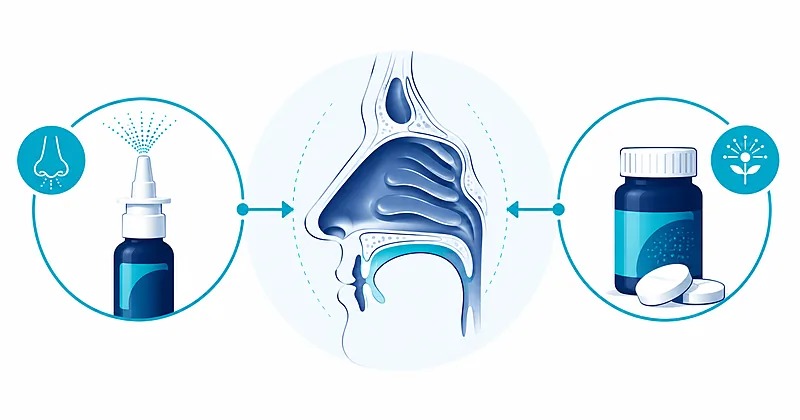
Two drug classes dominate the pharmacy shelf: intranasal corticosteroid nasal sprays and oral antihistamine tablets. Both outperform placebo, and both are widely used. The practical question is not whether either works, but which should lead when a clinician can only recommend one.
That choice is often made by habit rather than evidence. Yet the comparative literature is unusually mature — direct head-to-head randomised trials have been pooled repeatedly since the 1990s, giving a clearer answer than exists for many everyday decisions.
This review compares four core pharmacologic approaches — intranasal corticosteroids, oral antihistamines, intranasal antihistamines, and oral leukotriene receptor antagonists — using only effect sizes confirmed against their primary sources.
The Allergic Rhinitis Treatment Options Compared
The strongest comparative evidence comes from systematic reviews that pool double-blind randomised trials. Five are summarised below, ordered from newest to oldest. Each reports a standardised mean difference (SMD) or mean difference (MD) in symptom score, where a negative value favours the first-named treatment.
| Source | Design | N | Comparison | Key result (95% CI) | Tier |
|---|---|---|---|---|---|
| Torres 2024 (J Allergy Clin Immunol Pract) | SR + meta-analysis | 35 RCTs, ages ≥12 | Intranasal corticosteroid vs oral antihistamine | TNSS MD −0.86 (−1.21 to −0.51); ocular MD −0.36 (−0.56 to −0.17); RQLQ MD −0.88 (−1.15 to −0.61) | V |
| Torres 2024 (J Allergy Clin Immunol Pract) | SR + meta-analysis | subset of 35 RCTs | Intranasal antihistamine vs oral antihistamine; and INCS vs oral leukotriene antagonist | Intranasal-AH TNSS MD −0.47 (−0.81 to −0.14); INCS vs LTRA TNSS MD −1.05 (−1.33 to −0.77) | V |
| Juel-Berg 2017 (Am J Rhinol Allergy) | SR + meta-analysis | 5 RCTs, n=990 | Intranasal corticosteroid vs oral antihistamine | TNSS SMD −0.70 (−0.93 to −0.47); quality of life MD −0.90 (−1.18 to −0.62); ocular SMD −0.08 (−0.23 to 0.08, ns) | V |
| Weiner 1998 (BMJ) | SR + meta-analysis | 16 RCTs, n=2,267 | Intranasal corticosteroid vs oral antihistamine | Total nasal symptoms SMD −0.42 (−0.53 to −0.32); nasal blockage SMD −0.63 (−0.73 to −0.53); eye symptoms non-significant | V |
| Yáñez 2002 (Ann Allergy Asthma Immunol) | SR + meta-analysis | 9 RCTs, n=648 | Intranasal corticosteroid vs topical (intranasal) antihistamine | TNSS SMD −0.36 (−0.57 to −0.14); nasal blockage SMD −0.86 (−1.07 to −0.64); ocular −0.07 (ns) | V |
| Sousa-Pinto 2024 (J Allergy Clin Immunol) | SR + meta-analysis (medication ranking) | vs placebo | Individual intranasal medications | Fluticasone furoate, fluticasone propionate and azelastine–fluticasone ranked highest for nasal symptom and quality-of-life gain; GRADE certainty high in 6 of 46 analyses, moderate in 23 | V |
Read together, these analyses point one way. For the blocked, running, sneezing nose, intranasal corticosteroids beat oral antihistamines; intranasal antihistamines also beat oral antihistamines; and intranasal corticosteroids beat oral leukotriene antagonists.
Nasal Symptom Relief — How They Differ
Nasal symptoms are where the two classes separate most clearly. In the 2024 review of 35 trials, intranasal corticosteroids reduced the total nasal symptom score more than oral antihistamines, with a mean difference of −0.86 (95% CI −1.21 to −0.51).
The direction has held for a quarter-century. The 1998 BMJ review of 2,267 patients found intranasal corticosteroids produced greater relief of total nasal symptoms (SMD −0.42, 95% CI −0.53 to −0.32), with the largest single-symptom advantage for nasal blockage (SMD −0.63).
The 2017 review reproduced this in 990 patients (TNSS SMD −0.70, 95% CI −0.93 to −0.47), with significant advantages for obstruction, itching, and sneezing. Congestion is the symptom oral antihistamines address least well, which helps explain the gap.
The hierarchy extends beyond the two headline classes. Intranasal antihistamines also outperformed oral antihistamines on nasal symptoms in 2024 (MD −0.47, 95% CI −0.81 to −0.14). Intranasal corticosteroids outperformed oral leukotriene antagonists by a wide margin (MD −1.05, 95% CI −1.33 to −0.77).
Intranasal corticosteroids even edged intranasal antihistamines for nasal blockage in the 2002 review (SMD −0.86, 95% CI −1.07 to −0.64). The consistent pattern places the intranasal steroid at the top of the nasal-symptom ranking.
Clinical pearl. The advantage of intranasal corticosteroids is greatest for congestion — the symptom patients most often describe as “nothing is working.” When a blocked nose dominates the picture, the nasal spray is the higher-yield first choice.
Ocular Symptoms — How They Differ
The eyes tell a different and more nuanced story. In the classic analyses, intranasal corticosteroids and antihistamines were statistically indistinguishable for ocular symptoms.
The 2017 review found no significant difference (SMD −0.08, 95% CI −0.23 to 0.08). The 1998 review reported no significant advantage for eye symptoms. The 2002 review reached the same conclusion against topical antihistamines (SMD −0.07, 95% CI −0.27 to 0.12).
The largest and most recent review complicates this. In 2024, intranasal corticosteroids improved the total ocular symptom score more than oral antihistamines (MD −0.36, 95% CI −0.56 to −0.17), a modest but statistically significant advantage.
So the honest reading is that intranasal corticosteroids are, at worst, comparable to antihistamines for the eyes, and the newest pooled data suggest a small edge. This tempers the old teaching that antihistamines “win the eyes,” though ocular symptoms remain the weakest part of the steroid case.
Quality of Life — How They Differ
Symptom scores matter only if patients feel the difference. On the Rhinoconjunctivitis Quality of Life Questionnaire, intranasal corticosteroids outperformed oral antihistamines in both reviews that measured it.
The 2024 review found a mean difference of −0.88 (95% CI −1.15 to −0.61), with no measurable heterogeneity across trials. The 2017 review found a closely matching −0.90 (95% CI −1.18 to −0.62).
Two independent analyses landing within 0.02 of each other is a reassuring signal of consistency. The 2024 authors judged most of these differences to reach clinically meaningful thresholds, not merely statistical ones.
Subgroups That Change the Choice
Superiority on average does not settle every case. Several situations legitimately narrow or reverse the advantage.
Ocular-predominant disease
When itchy, watering eyes are the main complaint, the nasal-symptom advantage of the spray is less relevant. An antihistamine — oral or intranasal — remains a reasonable lead, and a topical ocular antihistamine can be added regardless of nasal choice.
Need for rapid, as-needed relief
Oral antihistamines act quickly and suit intermittent, predictable exposure. Intranasal corticosteroids build effect over days and reward regular daily use, so a spray used only occasionally underperforms its trial data.
Adherence and device tolerance
A tablet is easier to take consistently than a spray some patients dislike. Local irritation, taste, or technique can undermine a corticosteroid that is pharmacologically superior on paper. Matching the drug to what a patient will actually use is part of the decision.
Combination therapy
Adding an oral antihistamine to an intranasal corticosteroid adds little. A 2016 review found the combination roughly equivalent to the corticosteroid alone, and guidelines recommend the corticosteroid by itself over that pairing. A fixed intranasal corticosteroid–antihistamine spray (azelastine–fluticasone) is a different matter and ranked among the most effective options in 2024.
Quality and Consistency of the Evidence
The comparison rests on repeated pooling of double-blind randomised trials over more than 25 years, which is a strong foundation. Confidence still varies by outcome.
- Nasal-symptom superiority of intranasal corticosteroids over oral antihistamines — moderate to high. Five analyses across four decades agree in direction and rough magnitude; the 2024 review graded certainty as moderate or high for most comparisons.
- Quality-of-life benefit — moderate. Two reviews produced near-identical mean differences with no measurable heterogeneity.
- Ocular-symptom comparison — low to moderate and mixed. Older reviews found no difference; the largest recent review found a small steroid advantage. The signal is unsettled.
- Distinctions between individual sprays — variable. In the 2024 medication-ranking meta-analysis, GRADE certainty was high in only 6 of 46 analyses and low or very low in 17, so head-to-head claims between specific products should stay cautious.
- Long-term comparative safety — insufficient. Most trials ran only 6 to 8 weeks, so durable differences between classes are not established here.
What the Evidence Does Not Show
The data establish a nasal-symptom and quality-of-life advantage for intranasal corticosteroids. They do not support several broader claims.
They do not show that intranasal corticosteroids beat antihistamines for ocular symptoms in a settled way. Most pooled analyses found the classes comparable, and the one recent advantage is modest and awaits confirmation.
They do not deliver a clean onset-of-action ranking. Guidelines describe intranasal treatments as faster-acting, but the head-to-head symptom-score reviews were not designed to quantify onset, and oral antihistamines act quickly for many patients.
They do not establish long-term comparative safety. The trials were short, so differences in growth effects, mucosal change, or rare harms over years cannot be read from them.
They do not support adding an oral antihistamine to an intranasal corticosteroid for extra symptom control, since that combination performed no better than the corticosteroid alone.
Practical Implications
For most patients with troublesome nasal symptoms, the evidence supports an intranasal corticosteroid as the first-line choice, used regularly rather than as needed. The advantage is largest for congestion.
Oral or intranasal antihistamines remain sensible where ocular symptoms dominate, where rapid as-needed cover is the goal, or where a patient will take a tablet more reliably than they will use a spray. Second-generation, non-sedating agents are preferred within that class.
Adding an oral antihistamine on top of a corticosteroid is hard to justify for symptom control alone. Where a single spray is not enough, a fixed intranasal corticosteroid–antihistamine combination is better supported than layering a tablet on top.
Safety is reassuring for both classes over the studied horizon. Intranasal corticosteroid side effects are usually mild and local, such as nasal irritation and occasional epistaxis; septal perforation is rare. First-generation oral antihistamines carry sedation and anticholinergic burden that second-generation agents largely avoid.
Evidence Grade and Bottom Line
Overall grade: Moderate to High- Strong, consistent evidence supports intranasal corticosteroids over oral antihistamines for nasal symptoms and quality of life in allergic rhinitis.
- The classes are broadly comparable for ocular symptoms; a small recent advantage for corticosteroids is not yet settled.
- Antihistamines keep a defined role: ocular-predominant disease, rapid as-needed relief, and adherence-limited patients.
- Combining an oral antihistamine with a corticosteroid adds little; a fixed intranasal steroid–antihistamine spray is the stronger step-up.
- Major guidelines converge on intranasal corticosteroids as preferred first-line monotherapy.
Article Information and References
Evidence base: five systematic reviews and meta-analyses of randomised controlled trials, plus four current clinical guidelines. All statistics and DOIs were verified against primary sources during preparation.
- Torres MI, Gil-Mata S, Bognanni A, et al. Intranasal versus oral treatments for allergic rhinitis: a systematic review with meta-analysis. J Allergy Clin Immunol Pract. 2024;12(12):3404-3418. DOI: https://doi.org/10.1016/j.jaip.2024.09.001
- Juel-Berg N, Darling P, Bolvig J, et al. Intranasal corticosteroids compared with oral antihistamines in allergic rhinitis: a systematic review and meta-analysis. Am J Rhinol Allergy. 2017;31(1):19-28. DOI: https://doi.org/10.2500/ajra.2016.30.4397
- Weiner JM, Abramson MJ, Puy RM. Intranasal corticosteroids versus oral H1 receptor antagonists in allergic rhinitis: systematic review of randomised controlled trials. BMJ. 1998;317(7173):1624-1629. DOI: https://doi.org/10.1136/bmj.317.7173.1624
- Yáñez A, Rodrigo GJ. Intranasal corticosteroids versus topical H1 receptor antagonists for the treatment of allergic rhinitis: a systematic review with meta-analysis. Ann Allergy Asthma Immunol. 2002;89(5):479-484. DOI: https://doi.org/10.1016/S1081-1206(10)62085-6
- Sousa-Pinto B, Vieira RJ, Brozek J, et al. Intranasal antihistamines and corticosteroids in allergic rhinitis: a systematic review and meta-analysis. J Allergy Clin Immunol. 2024;154(2):340-354. DOI: https://doi.org/10.1016/j.jaci.2024.04.016
- Zhang K, Li AR, Miglani A, Nguyen SA, Schlosser RJ. Effect of medical therapy in allergic rhinitis: a systematic review and meta-analysis. Am J Rhinol Allergy. 2022;36(2):269-280. DOI: https://doi.org/10.1177/19458924211041438
- Feng S, Fan Y, Liang Z, Ma R, Cao W. Concomitant corticosteroid nasal spray plus antihistamine (oral or local spray) for the symptomatic management of allergic rhinitis. Eur Arch Otorhinolaryngol. 2016;273(11):3477-3486. DOI: https://doi.org/10.1007/s00405-015-3832-1
- Bousquet J, Schünemann HJ, Togias A, et al. Next-generation Allergic Rhinitis and Its Impact on Asthma (ARIA) guidelines for allergic rhinitis based on GRADE and real-world evidence. J Allergy Clin Immunol. 2020;145(1):70-80.e3. DOI: https://doi.org/10.1016/j.jaci.2019.06.049
- Dykewicz MS, Wallace DV, Amrol DJ, et al. Rhinitis 2020: a practice parameter update. J Allergy Clin Immunol. 2020;146(4):721-767. DOI: https://doi.org/10.1016/j.jaci.2020.07.007
- Dykewicz MS, Wallace DV, Baroody F, et al. Treatment of seasonal allergic rhinitis: an evidence-based focused 2017 guideline update. Ann Allergy Asthma Immunol. 2017;119(6):489-511.e41. DOI: https://doi.org/10.1016/j.anai.2017.08.012
- Brożek JL, Bousquet J, Agache I, et al. Allergic Rhinitis and its Impact on Asthma (ARIA) guidelines—2016 revision. J Allergy Clin Immunol. 2017;140(4):950-958. DOI: https://doi.org/10.1016/j.jaci.2017.03.050