
CGM in Type 2 Diabetes: Practical Findings in 4 Subgroups
Mapping the randomized-trial evidence onto the non-insulin and basal-insulin patients most often managed in primary care.
One-Minute Takeaway
- CGM in type 2 diabetes lowers HbA1c for many adults who do not use prandial insulin: a meta-analysis of 8 randomized trials in non-insulin-treated patients (n=541) found a 0.37% greater HbA1c reduction versus finger-stick monitoring (95% CI 0.24–0.49).
- In the MOBILE randomized trial of basal-insulin-only patients (n=175), CGM lowered HbA1c by 0.4 percentage points more than blood-glucose meters (95% CI 0.1–0.8) and added about 15 percentage points of time in range.
- Pooled data suggest the HbA1c benefit is similar whether or not patients use insulin, but the size is modest — roughly 0.2% to 0.4%.
- Benefit is largest when baseline HbA1c is high, and it shrinks against structured finger-stick testing plus education, which matched CGM in the GLiMPSE trial.
- The ADA now supports considering CGM in non-insulin type 2 diabetes, with 2026 guidance recommending it for patients on agents that can cause hypoglycaemia.
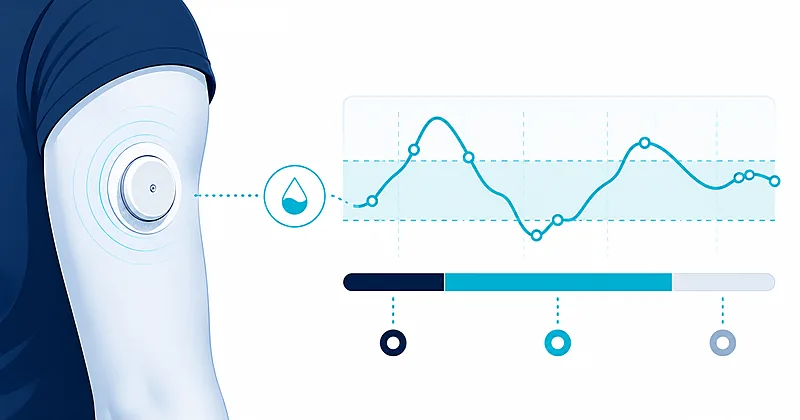
Why CGM in Type 2 Diabetes Matters
Most adults with type 2 diabetes are not managed with prandial insulin, and a large share use no insulin at all. For years, continuous glucose monitoring was reserved almost entirely for insulin users, while everyone else relied on periodic finger-stick testing.
That default is being reconsidered. Structured self-monitoring of blood glucose has shown limited and inconsistent value in non-insulin type 2 diabetes, yet these patients still struggle to reach targets. New randomized trials and a guideline shift have widened the group of people for whom sensor data may help.
This question sits squarely in primary care, where the majority of these patients are seen and where monitoring decisions are made alongside oral agents, GLP-1 receptor agonists, and basal insulin. The clinical task is no longer whether CGM works only for insulin users, but which non-insulin patients gain enough to justify it.
A Practical Taxonomy of CGM in Type 2 Diabetes
The comparative table below summarises the interventional evidence base most relevant to non-intensively-treated patients, drawing on systematic reviews first and then the landmark randomized trials. Every figure was confirmed against a primary source, and each reference resolves to the cited paper.
| Study / Source | Design | N | Population | Key result | Tier |
|---|---|---|---|---|---|
| Aronson 2025 (Diabetes Obes Metab) | Systematic review & meta-analysis | 541 (8 RCTs) | Non-insulin-treated T2D | HbA1c −0.37% (95% CI −0.49 to −0.24) | [V] |
| Jancev 2024 (Diabetologia) | Systematic review & meta-analysis | 1,248 (12 RCTs) | T2D (insulin and non-insulin) | HbA1c −0.31%; effect comparable across regimens | [V] |
| Seidu 2024 (Diabetes Care) | Systematic review & meta-analysis | 2,783 (26 RCTs) | T2D (mixed regimens) | CGM HbA1c −0.19% (95% CI −0.34 to −0.04) | [V] |
| Lian 2026 (Front Endocrinol) | Systematic review & meta-analysis | 789 (11 RCTs) | T2D, real-time CGM vs SMBG | HbA1c −0.20%; time in range +7.4% | [V] |
| MOBILE / Martens 2021 (JAMA) | Randomized controlled trial | 175 | Basal insulin without prandial insulin | HbA1c −0.4% (95% CI −0.8 to −0.1); time in range +15 pts | [V] |
| IMMEDIATE / Aronson 2023 (Diabetes Obes Metab) | Randomized controlled trial | 116 | Non-insulin therapies, HbA1c ≥7.5% | Time in range significantly higher (primary); HbA1c ~0.3% lower | [V] |
| Wada 2020 (BMJ Open Diab Res Care) | Randomized controlled trial | 100 | Non-insulin-treated T2D (flash) | HbA1c −0.29% at 24 weeks (p=0.022) | [V] |
| Lau 2024 (Diabetes Res Clin Pract) | Randomized controlled trial | 105 | Non-insulin, HbA1c >7% + telemonitoring | HbA1c 0.65% greater reduction (95% CI 0.17 to 1.12) | [V] |
Four candidate groups recur across this evidence, and this review examines each in turn: adults on basal insulin without prandial insulin; adults on non-insulin agents alone; poorly controlled patients with a high baseline HbA1c; and patients at risk of hypoglycaemia. These profiles overlap in practice, but each is a distinct way clinicians decide whether a sensor is worth offering.
Basal-Insulin Users Without Prandial Insulin
This group has the strongest randomized evidence. In the MOBILE trial, 175 adults with poorly controlled type 2 diabetes on basal insulin alone were randomized in primary care to real-time CGM or a blood-glucose meter. Over eight months, CGM reduced HbA1c from 9.1% to 8.0%, versus 9.0% to 8.4% with the meter.
The adjusted between-group difference was 0.4 percentage points (95% CI −0.8 to −0.1), and CGM added roughly 15 percentage points of time in range (95% CI 8 to 23). Because MOBILE was a randomized trial, these results support a causal effect of the sensor rather than a mere association.
A prespecified subgroup analysis found the effect was not uniform. The time-in-range benefit was present across baseline control but concentrated in the worst-controlled patients, reaching a 32% greater increase among those starting at an HbA1c of 10% or higher. A companion analysis reported that discontinuing CGM after eight months trended toward loss of the gains, which points to sustained use rather than a one-time trial.
Non-Insulin Users on Oral or Injectable Agents
Evidence in patients using no insulin at all is newer and more mixed, but several randomized trials now point in a consistent direction. In IMMEDIATE, 116 adults on non-insulin therapies with an HbA1c of 7.5% or higher were randomized to intermittently scanned CGM plus education or education alone. The sensor group achieved significantly greater time in range, the primary outcome, with an HbA1c roughly 0.3% lower.
Wada and colleagues randomized 100 non-insulin-treated adults to flash monitoring or finger-stick testing. There was no HbA1c separation at 12 weeks, but by 24 weeks the flash group held a 0.29% advantage (p=0.022), alongside better time in range and glucose variability. A separate trial paired a short six-week CGM window with virtual educator visits and reported a 0.65% greater HbA1c reduction than enhanced usual care (95% CI 0.17 to 1.12).
The counterweight is GLiMPSE. When the comparator was structured finger-stick testing rather than casual monitoring, and both arms received diabetes self-management education, intermittently scanned CGM produced no added benefit. Both approaches improved glycaemia and weight over 24 weeks, sustained to one year. Evidence suggests CGM helps this group, but the margin depends heavily on how good the comparison monitoring is.
Poorly Controlled Patients With High Baseline HbA1c
Across both insulin and non-insulin trials, the size of the benefit tracks with how far above target a patient starts. This is the most reliable predictor of who gains, and it cuts across treatment regimen.
The MOBILE subgroup data make the pattern concrete: the time-in-range advantage rose from about 14 percentage points at a baseline HbA1c of 8.5% to 32 percentage points at 10% or higher. Meta-analytic summaries echo the theme, with larger reductions expected when baseline HbA1c is elevated. For a primary-care panel, this argues for prioritising sensors in the least-controlled patients rather than spreading them thinly.
Clinical pearl
Baseline glycaemia is a more dependable guide to CGM yield than treatment regimen. An above-target patient on metformin plus a GLP-1 receptor agonist may gain as much visible benefit as a basal-insulin user, whereas a patient already near target has little room to improve on HbA1c and may value the sensor mainly for pattern detection.
Patients at Risk of Hypoglycaemia
Sulfonylureas and glinides can cause hypoglycaemia even without insulin, and this is the group the newest guidance singles out. The ADA’s 2026 Standards of Care moved beyond simply considering CGM to recommending it for adults on non-insulin therapies that can cause hypoglycaemia.
The direct trial support here is thinner than the guideline language implies. Hypoglycaemia was infrequent in the non-insulin CGM trials, so few studies were powered to show a reduction in low-glucose events specifically among sulfonylurea users. Preliminary evidence suggests alerts and trend data could help these patients avoid lows, but this rests more on mechanism and expert consensus than on randomized outcomes. It is a reasonable, guideline-endorsed use rather than a firmly proven one.
Comparative Analysis
Weighing the four groups together, three patterns stand out. First, the average HbA1c effect is modest and fairly consistent — roughly 0.2% to 0.4% across meta-analyses — and pooled analyses find it comparable whether or not a patient uses insulin. Second, the effect is comparator-dependent: measured against structured monitoring plus education, the marginal gain can disappear, as in GLiMPSE.
Third, device type matters less than expected for glycaemia. In the Seidu meta-analysis, both real-time and intermittently scanned CGM reduced HbA1c, while intermittently scanned devices added a satisfaction advantage. Adverse events were largely minor skin and sensor issues, with a modestly increased relative risk (about 1.2). Much of the benefit appears to come from the education and behaviour change the data enable, not from the sensor in isolation, which is why several trials embedded structured feedback.
Quality and Consistency of the Evidence
The strength of evidence varies sharply by outcome, so it is worth grading each rather than the technology as a whole.
- HbA1c reduction regardless of insulin use — consistent direction across multiple RCTs and meta-analyses, though the size is small. Moderate to high consistency.
- Time-in-range improvement — reproduced in randomized trials and pooled estimates. Moderate consistency.
- Magnitude of benefit — heterogeneous and comparator-dependent, with wide variation between trials. Moderate.
- Hypoglycaemia reduction in non-insulin patients — plausible but under-powered; events were rare in the trials. Low.
- Durability after discontinuation — limited data suggesting gains may fade. Low.
- Complications and mortality — no randomized evidence in non-insulin type 2 diabetes. Very low.
Several caveats apply throughout. Most trials were open-label, which is hard to avoid with a visible device but can inflate behavioural effects. Durations were short, typically 12 to 32 weeks, and samples were often small. Device manufacturers funded or supplied materials for many studies, including MOBILE, IMMEDIATE, Wada, and GLiMPSE, which warrants cautious interpretation.
What the Evidence Does Not Show
Specific gaps
- No randomized trial has shown that CGM reduces microvascular or macrovascular complications or mortality in non-insulin type 2 diabetes.
- Whether CGM outperforms structured finger-stick testing plus education is unresolved; GLiMPSE found the two equivalent.
- The optimal wear pattern — continuous, intermittent, or brief professional (blinded) use — has not been settled for non-insulin patients.
- Durability of HbA1c gains after the sensor is removed is largely unproven.
- Cost-effectiveness in non-insulin populations remains uncertain, and insurance access is frequently restricted.
- A hypoglycaemia benefit specific to sulfonylurea or glinide users has not been confirmed in a powered randomized trial.
Practical Implications
For a primary-care clinician, the evidence supports offering CGM selectively rather than universally. The highest-yield candidates are above-target patients — on basal insulin or on non-insulin agents — and especially those starting from a high HbA1c, where the demonstrated benefit is largest.
Sensor data appear to work best when paired with education and a concrete plan to act on the readings, since the behavioural response, not the device alone, drives much of the effect. Where cost or access is a barrier, brief professional or intermittent CGM can still surface postprandial spikes and fasting patterns that a meter misses. Clinicians should set expectations for a modest HbA1c change and treat much of the value as diagnostic and motivational.
CGM complements rather than replaces therapy intensification; a sensor does not substitute for adding or titrating an effective glucose-lowering agent. Current ADA guidance provides support for these uses, but coverage rules often lag the evidence, so documentation of glycaemic need is frequently necessary.
Evidence Grade and Bottom Line
Bottom line
- Strong, reproducible evidence supports a modest HbA1c reduction with CGM in type 2 diabetes, and this benefit extends beyond insulin users to patients on basal insulin and on non-insulin agents.
- The effect is small on average (about 0.2% to 0.4%) and largest in the least-controlled patients; it narrows when the alternative is structured monitoring with education.
- Evidence for durability after discontinuation is low, and there is no randomized evidence for reduced complications or mortality in this population.
- Guidelines now endorse considering CGM in non-insulin type 2 diabetes, with particular support for those on agents that can cause hypoglycaemia.
Article Information and References
- Aronson R, Brown RE, Chu L, et al. Continuous glucose monitoring in noninsulin-treated type 2 diabetes: a critical review of reported trials with an updated systematic review and meta-analysis of randomised controlled trials. Diabetes Obes Metab. 2025. DOI: https://doi.org/10.1111/dom.70008
- Jancev M, Vissers TACM, Visseren FLJ, et al. Continuous glucose monitoring in adults with type 2 diabetes: a systematic review and meta-analysis. Diabetologia. 2024. DOI: https://doi.org/10.1007/s00125-024-06107-6
- Seidu S, Kunutsor SK, Ajjan RA, Choudhary P. Efficacy and safety of continuous glucose monitoring and intermittently scanned continuous glucose monitoring in patients with type 2 diabetes: a systematic review and meta-analysis of interventional evidence. Diabetes Care. 2024;47(1):169–179. DOI: https://doi.org/10.2337/dc23-1520
- Uhl S, Choure A, Rouse B, Loblack A, Reaven P. Effectiveness of continuous glucose monitoring on metrics of glycemic control in type 2 diabetes mellitus: a systematic review and meta-analysis of randomized controlled trials. J Clin Endocrinol Metab. 2024;109(4):1119–1131. DOI: https://doi.org/10.1210/clinem/dgad652
- Lian X, Cheng LJ, Teo CJY, et al. Impact of real-time continuous glucose monitoring on glycaemic control in adults with type 2 diabetes: systematic review and meta-analysis. Front Endocrinol. 2026. DOI: https://doi.org/10.3389/fendo.2025.1761579
- Ferreira ROM, Trevisan T, Pasqualotto E, et al. Continuous glucose monitoring systems in noninsulin-treated people with type 2 diabetes: a systematic review and meta-analysis of randomized controlled trials. Diabetes Technol Ther. 2024. DOI: https://doi.org/10.1089/dia.2023.0390
- Martens T, Beck RW, Bailey R, et al; MOBILE Study Group. Effect of continuous glucose monitoring on glycemic control in patients with type 2 diabetes treated with basal insulin: a randomized clinical trial. JAMA. 2021;325(22):2262–2272. DOI: https://doi.org/10.1001/jama.2021.7444
- Davis GM, Bailey R, Calhoun P, Price DA, Beck RW. Magnitude of glycemic improvement in patients with type 2 diabetes treated with basal insulin: subgroup analyses from the MOBILE study. Diabetes Technol Ther. 2022;24(5):324–331. DOI: https://doi.org/10.1089/dia.2021.0489
- Aronson R, Brown RE, Chu L, et al. IMpact of flash glucose Monitoring in pEople with type 2 Diabetes Inadequately controlled with non-insulin Antihyperglycaemic ThErapy (IMMEDIATE): a randomized controlled trial. Diabetes Obes Metab. 2023;25(4):1024–1031. DOI: https://doi.org/10.1111/dom.14949
- Wada E, Onoue T, Kobayashi T, et al. Flash glucose monitoring helps achieve better glycemic control than conventional self-monitoring of blood glucose in non-insulin-treated type 2 diabetes: a randomized controlled trial. BMJ Open Diabetes Res Care. 2020;8(1):e001115. DOI: https://doi.org/10.1136/bmjdrc-2019-001115
- Lau D, Manca DP, Singh P, et al. The effectiveness of continuous glucose monitoring with remote telemonitoring-enabled virtual educator visits in adults with non-insulin dependent type 2 diabetes: a randomized trial. Diabetes Res Clin Pract. 2024;217:111899. DOI: https://doi.org/10.1016/j.diabres.2024.111899
- Rama Chandran S, Rahman N, Gandhi M, et al. Intermittently scanned continuous glucose monitoring provides no benefit over structured self-monitoring of blood glucose in type 2 diabetes not on prandial insulin, in the context of diabetes self-management education: Glucose Monitoring Programme Singapore (GLiMPSE). Diabetes Res Clin Pract. 2024;211:111678. DOI: https://doi.org/10.1016/j.diabres.2024.111678
- American Diabetes Association Professional Practice Committee. 7. Diabetes Technology: Standards of Care in Diabetes—2025. Diabetes Care. 2025;48(Suppl 1):S146–S166. DOI: https://doi.org/10.2337/dc25-S007