
Colorectal Cancer Screening: Blood Test vs FIT vs Colonoscopy
How three average-risk options weigh accuracy, mortality evidence, uptake, and burden in primary care.
One-Minute Takeaway
- Colorectal cancer screening for average-risk adults rests on strong randomized evidence for colonoscopy and FIT, plus prospective validation data for a newer cell-free DNA blood test.
- In the NordICC trial, invitation to colonoscopy lowered 10-year colorectal cancer incidence by 18% (RR 0.82, 95% CI 0.70–0.93); the cancer-specific mortality reduction was not statistically significant.
- FIT detects most cancers (pooled sensitivity ~79%, specificity ~94%) but only about a quarter of advanced precancerous lesions.
- The blood test in the ECLIPSE study detected 83% of cancers with 90% specificity, yet just 13% of advanced precancerous lesions.
- In COLONPREV, invitation to biennial FIT was non-inferior to one-time colonoscopy for 10-year colorectal cancer mortality.
Why Colorectal Cancer Screening Matters
Colorectal cancer is a leading cause of cancer death, and most of that burden is preventable through detection of early cancers and removal of precancerous polyps. The central problem in practice is not a shortage of options but incomplete uptake: a large share of eligible adults are not up to date.
The clinical landscape widened in 2021, when the US Preventive Services Task Force lowered the starting age to 45. Screening now carries a Grade A recommendation for adults aged 50 to 75 and a Grade B recommendation for adults aged 45 to 49, with individualized screening advised from 76 to 85.
That change added millions of newly eligible adults, many of whom have never been screened. A test that a patient will actually complete often matters more than small differences in laboratory accuracy, which is why the three approaches below are best compared on real-world outcomes as well as head-to-head performance.
The Options Compared
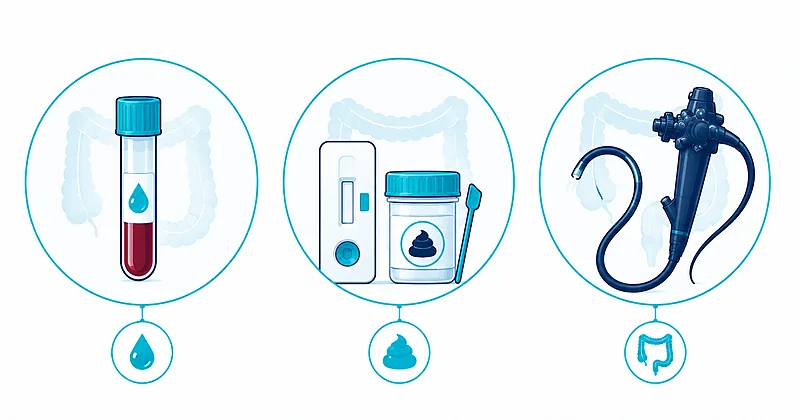
Three strategies dominate average-risk screening. Colonoscopy is a structural examination that both detects and removes lesions in one session. FIT is a stool test for occult haemoglobin, repeated at regular intervals. The cell-free DNA blood test is the newest entrant, approved by the FDA in July 2024 as a primary screening option and later added to National Comprehensive Cancer Network and American Cancer Society screening guidance, in both cases as an option for patients who decline stool testing or colonoscopy.
The table below draws only on studies confirmed against their primary sources. It deliberately mixes test-accuracy studies with pragmatic randomized trials, because accuracy and population effectiveness answer different questions.
| Study (year) | Design | N | Population | Test(s) | Key result |
|---|---|---|---|---|---|
| ECLIPSE (2024) | Prospective validation vs colonoscopy | 7,861 | Average-risk, 45–84 y | cfDNA blood test | Sensitivity 83% for cancer; specificity 90% for advanced neoplasia; 13% sensitivity for advanced precancerous lesions |
| Lee meta-analysis (2014) | Systematic review / meta-analysis (19 studies) | — | Asymptomatic average-risk | FIT | Pooled sensitivity 0.79 (95% CI 0.69–0.86); specificity 0.94 (0.92–0.95) |
| BLUE-C (2024) | Prospective vs colonoscopy | 20,176 | Average-risk, ≥40 y | FIT (comparator arm) | FIT sensitivity 67.3% (57.1–76.5) for cancer; 23.3% (21.5–25.2) for advanced precancerous lesions |
| NordICC (2022) | Pragmatic RCT vs no screening | 84,585 | Age 55–64 y | Colonoscopy invitation | 10-yr cancer incidence RR 0.82 (0.70–0.93); cancer-death RR 0.90 (0.64–1.16); NNI 455 to prevent one cancer |
| COLONPREV (2025) | Pragmatic RCT, non-inferiority | ~53,000 invited | Age 50–69 y | FIT vs colonoscopy | Intention-to-screen cancer-death RR 0.92 (0.64–1.32), FIT non-inferior; per-protocol incidence favored colonoscopy, RR 0.67 (0.47–0.95) |
| SCREESCO (2022) | Pragmatic RCT | 31,140 colo / 60,300 FIT | Age 60 y | FIT vs colonoscopy | Cancer detected 0.16% vs 0.20% (RR 0.78, 0.56–1.09); participation 35% (colonoscopy) vs 55% (FIT) |
Read together, these studies show a consistent pattern. Colonoscopy and FIT carry mature outcome evidence, the blood test carries strong accuracy data but no outcome data yet, and the three tests separate most sharply on precancer detection and on how many people complete them.
Cancer and Precancer Detection — How They Differ
All three tests find most existing cancers, but they diverge on precancerous lesions, and that divergence drives much of the clinical argument.
Colonoscopy
Colonoscopy is the reference examination against which the other tests are measured, because it visualizes the mucosa directly and allows polypectomy in the same procedure. Its performance is operator-dependent, varying with adenoma detection rate, withdrawal time, and bowel preparation, so quality metrics matter as much as the modality itself.
The FIT stool test
Across 19 studies, the Lee meta-analysis found FIT pooled sensitivity of 0.79 (95% CI 0.69–0.86) and specificity of 0.94 (0.92–0.95) for colorectal cancer. Its weakness is precancer: in the prospective DeeP-C and BLUE-C studies, FIT detected only 23.8% and 23.3% of advanced precancerous lesions, respectively. A single FIT is therefore better at catching cancer than at interrupting the adenoma-to-carcinoma sequence.
The cell-free DNA blood test
In the ECLIPSE study, the blood test detected 83% of cancers, with 90% specificity for advanced neoplasia. Its sensitivity for advanced precancerous lesions was 13%, the lowest of the three approaches, and its false-positive rate was about 10%. The test performs well for established cancer but is weak for the precursors that prevention-focused screening aims to remove.
Sensitivity for advanced precancerous lesions falls in a clear order — colonoscopy (detect and remove) > FIT (~23–24%) > blood test (13%). A screening program aimed at preventing cancer, not only detecting it early, weights this difference heavily.
Mortality Evidence Across Colorectal Cancer Screening Tests
Accuracy is a surrogate; the outcomes that matter are cancer incidence and death. Here the evidence base is uneven across the three tests.
Colonoscopy
NordICC randomized 84,585 adults to an invitation for one-time colonoscopy or to no invitation. On intention-to-screen analysis, invitation lowered 10-year cancer incidence by 18% (RR 0.82, 95% CI 0.70–0.93). The reduction in cancer death did not reach significance (RR 0.90, 95% CI 0.64–1.16), a result shaped by 42% screening uptake and a 10-year horizon that may be short for a mortality signal.
FIT versus colonoscopy, head to head
COLONPREV is the first randomized trial to compare cancer death between the two most common strategies. Invitation to biennial FIT was non-inferior to one-time colonoscopy: intention-to-screen cancer mortality was 0.24% with FIT and 0.22% with colonoscopy (RR 0.92, 95% CI 0.64–1.32). Among participants who completed their assigned test, the per-protocol analysis favored colonoscopy for cancer incidence (RR 0.67, 95% CI 0.47–0.95).
That split is the core message. As programs offered to whole populations, FIT and colonoscopy performed comparably, because FIT’s higher uptake offsets colonoscopy’s higher per-test yield. Among people who actually complete the test, colonoscopy detected and prevented more disease.
The blood test
No randomized trial has yet measured the blood test’s effect on cancer incidence or death. Its evidence is limited to test-accuracy validation against colonoscopy, and the pivotal study was industry-funded. Claims about mortality benefit for blood-based screening are, at present, extrapolations rather than trial findings.
Uptake is not a footnote to effectiveness — it is part of it. In COLONPREV, SCREESCO, and the earlier Spanish comparison, more people completed FIT than colonoscopy, which is why a less sensitive test can match a more sensitive one at the population level.
Uptake, Harms, and Trade-offs
Beyond accuracy, the three tests differ in who completes them, what they cost the patient in time and preparation, and how they can cause harm.
Participation
Non-invasive tests are consistently completed more often than colonoscopy when both are offered. Participation reached 39.9% for FIT versus 31.8% for colonoscopy in COLONPREV, and 55% versus 35% in SCREESCO. The blood test’s main proposed advantage is convenience — it can be drawn at any routine visit — which may help reach people who decline stool tests and colonoscopy, though this uptake benefit has not been confirmed in an outcomes trial.
Harms
Colonoscopy carries procedural risk. In NordICC, 15 participants had major bleeding after polypectomy, with no perforations and no screening-related deaths within 30 days; SCREESCO reported 2 perforations and 15 major bleeds in its colonoscopy arm. For FIT and the blood test, the direct harms are minimal, but false positives generate follow-up colonoscopies and their attendant risks, while false negatives can create false reassurance.
Every positive stool or blood test requires a diagnostic colonoscopy to complete the pathway. Non-invasive screening reduces, but does not eliminate, the need for colonoscopy — and its benefit depends on patients returning for that follow-up.
Interval and repetition
The tests are not interchangeable on schedule. Standard intervals are colonoscopy every 10 years and FIT annually; a single FIT captures only part of its lifetime benefit, which accrues through repeated rounds. The optimal interval for the blood test is not defined by the USPSTF, though NCCN guidance recommends repeating it every three years, and adherence to any repeat-testing schedule is a recognized weak point outside organized programs.
Subgroups That Change the Choice
The best test is not identical for every patient. Several factors shift the balance.
Newly eligible adults aged 45 to 49. This cohort has low screening rates, and any completed test is a gain. Convenience-first options may have their greatest value here, provided a positive result leads to colonoscopy.
Adherence pattern. FIT’s effectiveness depends on annual repetition; a patient unlikely to return each year may derive more durable benefit from colonoscopy’s 10-year interval. Conversely, a patient who declines colonoscopy is better served by a completed stool or blood test than by no screening.
Lesion location. Stool testing has been reported to be less sensitive for right-sided lesions, a pattern that appears in observational data and warrants caution rather than firm conclusions.
Risk status. These comparisons apply to average-risk adults. A personal or strong family history, prior adenomas, or inflammatory bowel disease moves a patient outside this evidence and typically toward colonoscopy.
Quality and Consistency of the Evidence
Strength of evidence varies markedly by test and by outcome.
- High certainty — FIT diagnostic accuracy for cancer, supported by a large multi-study meta-analysis with consistent pooled estimates.
- High certainty — Colonoscopy reduces cancer incidence, demonstrated in a large pragmatic randomized trial with a significant incidence reduction.
- Moderate certainty — FIT and colonoscopy are comparable as population programs for cancer mortality, from one non-inferiority trial limited by modest uptake and varying FIT thresholds.
- Moderate certainty — Colonoscopy’s effect on cancer death, where trial estimates are consistent in direction but not yet statistically significant at 10 years.
- Low certainty — Blood-test clinical benefit, where evidence is confined to industry-funded accuracy validation with no incidence or mortality outcomes.
What the Evidence Does Not Show
The current literature leaves several concrete questions unanswered.
No outcome trial of blood-based screening. There is no randomized evidence that the blood test lowers cancer incidence or death; its approval rests on accuracy relative to colonoscopy.
Pending head-to-head mortality data. The US CONFIRM trial comparing colonoscopy and FIT remains active, with completion estimated for 2028, and longer-term COLONPREV and SCREESCO mortality results are still to come.
Undefined blood-test interval. How often blood testing should be repeated, and how a low precancer sensitivity interacts with a longer interval, has not been settled.
Substitution effects. Whether offering a less sensitive blood test helps by reaching the unscreened or harms by displacing more effective tests is a modeling question, not yet resolved by direct evidence.
Practical Implications
The evidence supports, rather than dictates, a small number of practical positions.
Screening should be offered to average-risk adults from 45 to 75, and completing any recommended test is the priority. Colonoscopy and FIT are the best-evidenced choices and can be offered as co-equal first-line options within organized or shared-decision approaches.
The blood test is a reasonable option for patients who decline colonoscopy and stool testing, framed honestly as a way to detect existing cancer rather than as an equal substitute for prevention. Any positive stool or blood test should be followed by diagnostic colonoscopy.
Because FIT’s benefit accrues through repetition, its value in practice depends on reliable annual re-testing, which favors organized recall systems. Choice of test is well suited to shared decision-making that weighs accuracy, burden, interval, and the individual patient’s likelihood of following through.
Evidence Grade and Bottom Line
The comparative evidence is strong where it counts most — the two established tests — and immature for the newest one.
Bottom line for practice:
Colonoscopy and FIT are supported by randomized outcome data, and as population programs they perform comparably because FIT’s higher uptake offsets colonoscopy’s higher yield. Among patients who complete testing, colonoscopy detects and prevents more disease.
The blood test is convenient and FDA-approved but is validated only on accuracy, with low sensitivity for precancer and no incidence or mortality data. It is best positioned as an option for those who would otherwise go unscreened, not as a replacement for the better-evidenced tests. Across all three, the completed test outperforms the theoretically superior test that is never done.
Article Information and References
- Lee JK, Liles EG, Bent S, Levin TR, Corley DA. Accuracy of fecal immunochemical tests for colorectal cancer: systematic review and meta-analysis. Ann Intern Med. 2014;160(3):171–181. DOI: https://doi.org/10.7326/M13-1484
- Bretthauer M, Løberg M, Wieszczy P, et al. Effect of colonoscopy screening on risks of colorectal cancer and related death. N Engl J Med. 2022;387(17):1547–1556. DOI: https://doi.org/10.1056/NEJMoa2208375
- Castells A, Quintero E, Bujanda L, et al. Effect of invitation to colonoscopy versus faecal immunochemical test screening on colorectal cancer mortality (COLONPREV): a pragmatic, randomised, controlled, non-inferiority trial. Lancet. 2025;405(10486):1231–1239. DOI: https://doi.org/10.1016/S0140-6736(25)00145-X
- Forsberg A, Westerberg M, Metcalfe C, et al. Once-only colonoscopy or two rounds of faecal immunochemical testing 2 years apart for colorectal cancer screening (SCREESCO): preliminary report of a randomised controlled trial. Lancet Gastroenterol Hepatol. 2022;7(6):513–521. DOI: https://doi.org/10.1016/S2468-1253(21)00473-8
- Chung DC, Gray DM II, Singh H, et al. A cell-free DNA blood-based test for colorectal cancer screening. N Engl J Med. 2024;390(11):973–983. DOI: https://doi.org/10.1056/NEJMoa2304714
- Imperiale TF, Ransohoff DF, Itzkowitz SH, et al. Multitarget stool DNA testing for colorectal-cancer screening. N Engl J Med. 2014;370(14):1287–1297. DOI: https://doi.org/10.1056/NEJMoa1311194
- Imperiale TF, Porter K, Zella J, et al. Next-generation multitarget stool DNA test for colorectal cancer screening. N Engl J Med. 2024;390(11):984–993. DOI: https://doi.org/10.1056/NEJMoa2310336
- Quintero E, Castells A, Bujanda L, et al. Colonoscopy versus fecal immunochemical testing in colorectal-cancer screening. N Engl J Med. 2012;366(8):697–706. DOI: https://doi.org/10.1056/NEJMoa1108895
- US Preventive Services Task Force. Screening for colorectal cancer: US Preventive Services Task Force recommendation statement. JAMA. 2021;325(19):1965–1977. DOI: https://doi.org/10.1001/jama.2021.6238