
LARC Contraception: Practical Findings in 3 Subgroups
An evidence synthesis of long-acting reversible contraception — IUDs and the etonogestrel implant — covering same-day initiation, immediate postpartum placement, adolescent and special-population considerations, and the 2024 CDC US MEC update for family medicine practice.
One-Minute Takeaway on LARC Contraception
One-Minute Takeaway
- LARC contraception (IUDs and the etonogestrel subdermal implant) provides Tier-1 effectiveness with typical-use failure rates under 1% per year — approximately 20-fold lower than oral contraceptives or the patch in real-world data from the Contraceptive CHOICE Project.
- The 2024 CDC US Medical Eligibility Criteria expand and refine recommendations for postpartum, anticoagulant, sickle cell, transplant, and chronic kidney disease populations, supporting individualized LARC selection through shared decision-making.
- Same-day “Quick Start” initiation is supported by the 2024 CDC Selected Practice Recommendations when reasonable certainty of non-pregnancy can be established at the visit, with appropriate STI screening when clinically indicated.
- Immediate postpartum LARC placement before hospital discharge is endorsed by ACOG; expulsion rates are higher than interval insertion but offset by substantially higher continuation and reduced gaps in coverage.
- LARC contraception is recommended as first-line by AAP and ACOG for adolescents desiring contraception, with both groups explicitly endorsing IUD and implant placement in nulliparous patients including teenagers.
Why LARC Contraception Demands a Practical Primary Care Framework
Approximately half of pregnancies in the United States remain unintended, and family physicians remain a primary point of contraceptive counseling for millions of patients annually. Method effectiveness in real-world use varies substantially across the available options, and LARC contraception consistently outperforms shorter-acting methods.
The Contraceptive CHOICE Project followed 9,256 women provided no-cost contraception of their choice and demonstrated dramatic real-world differences. Pregnancy rates among LARC contraception users were approximately 0.27 per 100 woman-years compared with 4.55 per 100 for oral contraceptive, patch, and ring users — a roughly 20-fold difference attributable largely to user-independent dosing.
The August 2024 update to the CDC US Medical Eligibility Criteria refines recommendations across many medical conditions and adds new guidance for chronic kidney disease and antiphospholipid syndrome. The companion 2024 Selected Practice Recommendations support same-day initiation, simplified screening, and removal of unnecessary barriers — making LARC contraception more accessible in primary care than at any prior point.
What Evidence Was Reviewed
This synthesis of LARC contraception evidence draws on the 2024 CDC US Medical Eligibility Criteria and Selected Practice Recommendations, the seminal Contraceptive CHOICE Project, large randomized trials of immediate postpartum IUD placement, ACOG and AAP committee opinions on LARC use in adolescents, systematic reviews of postpartum and post-abortion IUD placement, and observational studies of long-term continuation and extended-use efficacy.
| Study (Year) | Design | Population | n | Intervention / Comparator | Key Outcomes |
|---|---|---|---|---|---|
| Curtis US MEC (2024) | Evidence-based clinical recommendations | All contraceptive candidates | Systematic review | Method-by-condition eligibility classifications | Updated categories for CKD, postpartum, anticoagulation, transplant |
| Nguyen US SPR (2024) | Evidence-based clinical recommendations | All contraceptive candidates | Systematic review | Practical contraceptive provision guidance | Same-day initiation, simplified screening, IUD pain management |
| Winner CHOICE (2012) | Prospective cohort | Women seeking contraception, St. Louis | 9,256 | LARC vs short-acting reversible contraception | Pregnancy 0.27 vs 4.55/100 woman-years |
| Trussell (2011) | Failure-rate review | US contraceptive users | — | All methods compared, typical vs perfect use | LARC <1% vs OCP/patch/ring 7–9% typical-use failure |
| AAP Committee on Adolescence (2014) | Clinical policy statement | Adolescents | — | LARC vs short-acting methods | LARC recommended first-line for adolescent contraception |
| ACOG Committee Opinion 735 (2018) | Committee opinion | Adolescents | — | LARC use in adolescents and nulliparous patients | First-line; nulliparity not a contraindication |
| Whiteman (2018) postpartum IUD SR | Systematic review & meta-analysis | Postpartum women | 48 studies | Immediate vs interval IUD placement | Higher expulsion at 6 months but higher continuation overall |
| Goldthwaite (2015) | Narrative review | Postpartum LARC candidates | — | Immediate postpartum LARC placement | Endorses immediate placement for many populations |
| Steenland post-abortion SR (2011) | Systematic review | Post-abortion women | 13 studies | Immediate vs delayed IUD placement | Immediate placement safe; lower expulsion than postpartum |
| McNicholas extended use (2015) | Prospective cohort | LNG-IUD and implant users beyond approved duration | 237 + 263 | Use beyond FDA-approved duration | Pregnancy rates remain very low at extended duration |
| Diedrich continuation (2015) | Prospective cohort | CHOICE participants long-term | 4,219 | LARC continuation by method and age | High continuation across populations including adolescents |
| Bryant immediate postpartum RCT (2017) | Pragmatic RCT | Postpartum women | 96 | Immediate postpartum vs interval IUD | Higher 6-month continuation in immediate arm |
Key Findings From the LARC Contraception Evidence Base
All LARC Methods Provide Tier-1 Effectiveness Across Populations
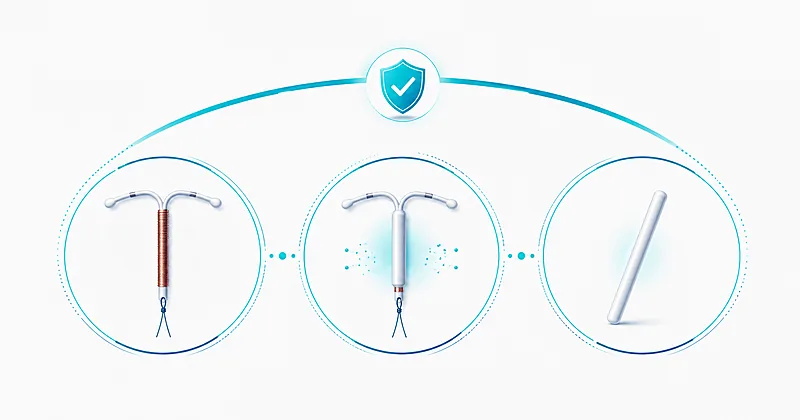
LARC contraception methods cluster together at the highest tier of effectiveness. The 52 mg levonorgestrel IUDs (Mirena, Liletta) have failure rates around 0.1–0.4 per 100 woman-years, the copper T380A IUD around 0.6–0.8, and the etonogestrel subdermal implant around 0.05. By contrast, typical-use failure rates for combined oral contraceptives, patch, and vaginal ring are 7–9 per 100 woman-years.
This effectiveness gap is driven almost entirely by user-independence. CHOICE Project data demonstrated that even when adherence support is comprehensive and methods are provided free of charge, short-acting reversible contraception fails substantially more often than LARC contraception. Continuation rates also favor LARC contraception, with first-year continuation typically 80–86% versus 50–55% for shorter-acting methods.
Method Selection — Hormonal IUDs, Copper IUD, and Etonogestrel Implant
Method selection within LARC contraception is shaped by patient preference, bleeding pattern goals, hormonal acceptability, and condition-specific eligibility under the 2024 US MEC. The 52 mg LNG-IUDs are FDA-approved for 8 years and reduce menstrual blood loss substantially, making them a frequent first choice for patients with menorrhagia or dysmenorrhea.
Lower-dose LNG-IUDs (Kyleena 19.5 mg, Skyla 13.5 mg) are smaller, may suit nulliparous anatomy, and are approved for 5 and 3 years respectively. The copper T380A IUD is hormone-free, FDA-approved for 10 years (with strong observational data supporting longer use), and serves as the most effective form of emergency contraception when placed within five days of unprotected intercourse.
The etonogestrel subdermal implant offers the lowest typical-use LARC contraception failure rate, requires no procedure-related pelvic discomfort, and is FDA-approved for 3 years (with extended-use data supporting effectiveness through year 5). Bleeding pattern unpredictability is the main reason for early discontinuation.
Subgroup 1 — Same-Day Initiation in the General Population
The 2024 CDC Selected Practice Recommendations support same-day “Quick Start” initiation of LARC contraception when reasonable certainty of non-pregnancy can be established at the visit. Reasonable certainty rests on conventional criteria (last menstrual period, contraceptive history, recent pregnancy test, sexual history, and breastfeeding status) rather than mandatory waiting until next menses.
STI screening should not delay LARC contraception placement in asymptomatic patients; specimens may be collected at the time of insertion. Clinically indicated treatment can occur with the device in place if positive results emerge subsequently. This change removes a long-standing barrier to same-visit initiation in busy primary care.
Subgroup 2 — Immediate Postpartum LARC Placement
ACOG endorses immediate postpartum LARC contraception placement (within 10 minutes after placental delivery for IUDs, or before hospital discharge for the implant) as a strategy to reduce gaps in coverage and short-interval pregnancies. Cluster-randomized and pragmatic trial data demonstrate substantially higher 6-month continuation rates with immediate placement compared with interval placement at the postpartum visit.
The principal trade-off in immediate postpartum LARC contraception is higher IUD expulsion. The Whiteman 2018 systematic review found expulsion rates at 6 months of approximately 10–27% with immediate postpartum placement compared with 1–4% with interval placement, but the benefit of avoided unintended pregnancy in the substantial subset who would otherwise not return for delayed insertion offsets this risk in many populations.
The 2024 US MEC clarifies that immediate postpartum IUD placement is acceptable for most patients including those who are breastfeeding. Implant LARC contraception placement is acceptable at any time postpartum and does not affect breastfeeding outcomes in randomized data.
Subgroup 3 — Adolescents and Patients With Complex Medical Conditions
Both AAP (2014) and ACOG (Committee Opinion 735, 2018) explicitly recommend LARC contraception as first-line for adolescents desiring contraception. For LARC contraception in this group, nulliparity is not a contraindication, age is not a contraindication, and observed continuation rates among adolescents are comparable to or higher than those in adult cohorts in CHOICE Project follow-up.
For patients with complex medical conditions, the 2024 US MEC offers nuanced guidance. Patients with sickle cell disease, systemic lupus erythematosus, anticoagulation, antiphospholipid syndrome, solid organ transplantation, and chronic kidney disease have specific category assignments. In general, LNG-IUDs and the etonogestrel implant are category 1 or 2 across most of these conditions, while the copper IUD is also typically acceptable.
Combined hormonal contraceptives, by contrast, carry substantial restrictions in many of these populations, making LARC contraception the practical first-line option in patients with complex comorbidities. Specialist co-management is appropriate where warranted, but family physicians can place LARC for these patients within the standard scope of primary care.
Clinical Pearl. The single most consequential change in LARC contraception practice over the past decade has been the dismantling of unnecessary barriers — including same-day insertion, no requirement for routine cervical screening before placement, no STI screening delay in asymptomatic patients, and no required pregnancy test on day 1 of menses. The 2024 CDC SPR formalizes most of these changes.
Quality and Consistency of the Evidence
The LARC contraception evidence base is unusually consistent across multiple study designs. Randomized trials, large prospective LARC contraception cohorts (CHOICE), administrative data analyses, and systematic reviews underpinning the CDC US MEC and US SPR converge on similar effectiveness, safety, and continuation conclusions.
What the Evidence Does Not Show
Specific Gaps in the LARC Contraception Evidence Base
- Optimal pain management strategies for IUD insertion in LARC contraception remain incompletely characterized; no single regimen has demonstrated consistent superiority across multiple high-quality trials, although the 2024 SPR addresses several options.
- Comparative effectiveness data for the lower-dose LNG-IUDs (Kyleena, Skyla) versus the 52 mg formulations on bleeding pattern outcomes and continuation in nulliparous and adolescent populations remain limited.
- Long-term effectiveness data for IUDs and implant beyond the longest currently approved durations rely on observational extension data rather than randomized comparisons.
- Outcomes specific to immediate postpartum LARC placement after cesarean delivery — including expulsion and continuation — remain less well-characterized than after vaginal delivery.
- Evidence for LARC use in adolescents with complex psychiatric or developmental conditions is sparse and largely observational.
- Implementation evidence on how to operationalize same-day LARC contraception in the typical 15- to 20-minute primary care visit is limited to small program-evaluation studies.
Closing these gaps will require head-to-head trials of pain regimens for IUD insertion, comparative effectiveness studies of lower-dose LNG-IUDs in adolescent and nulliparous populations, and pragmatic implementation trials to support same-day initiation in primary care.
Practical Implications for LARC Contraception in Family Medicine
Based on the current evidence, the family physician’s task is to translate the CHOICE Project effectiveness data and the 2024 CDC framework into accessible, patient-centered LARC contraception counseling and placement. The four cards below describe what evidence supports rather than directive prescribing rules.
Evidence Supports LARC as First-Line for Most Patients
For patients without contraindications who desire effective contraception, LARC contraception has the strongest effectiveness and continuation data. ACOG and AAP both endorse LARC as first-line for adolescents and nulliparous patients.
Same-Day Initiation Is Supported and Reduces Barriers
Evidence supports same-visit “Quick Start” placement when reasonable certainty of non-pregnancy is established. STI screening should not delay placement in asymptomatic patients; specimens can be collected at insertion.
Immediate Postpartum Placement Is Endorsed
ACOG endorses immediate postpartum IUD or implant placement before discharge. Higher 6-month continuation offsets higher expulsion rates, particularly for patients at risk of not returning for an interval visit.
2024 US MEC Guides Selection in Complex Patients
Evidence supports use of the 2024 US MEC for condition-specific eligibility decisions in CKD, transplant, anticoagulation, sickle cell disease, SLE, and antiphospholipid syndrome — most of which favor LARC over combined hormonal options.
The 2024 CDC framework supports a streamlined approach in family medicine:
- Counsel. Discuss method effectiveness using the tier framework, reversibility, side-effect profile, and bleeding pattern expectations. Anchor on patient priorities rather than method preference.
- Establish reasonable certainty of non-pregnancy. Use the standard criteria (LMP, contraceptive history, sexual history, breastfeeding status, recent pregnancy test) rather than mandating wait until menses.
- Screen as indicated, but do not delay placement. STI screening can occur at insertion in asymptomatic patients; cervical cancer screening should not be required before LARC.
- Place same-visit when feasible. Prepare staff and supply chain for same-day insertion; “ask, offer, place” protocols substantially increase uptake.
- Plan follow-up. Routine post-insertion check is no longer required for asymptomatic patients; offer return access for any concerns and standard preventive care visits.
Practical method-selection talking points:
- 52 mg LNG-IUDs (Mirena, Liletta). 8 years of FDA-approved use; substantial reduction in menstrual blood loss; commonly preferred when menorrhagia or dysmenorrhea coexists.
- Lower-dose LNG-IUDs (Kyleena 19.5 mg, Skyla 13.5 mg). Smaller frame; 5 and 3 years respectively; sometimes preferred for nulliparous anatomy or patients who prefer lower hormonal exposure.
- Copper T380A IUD (Paragard). Hormone-free; 10+ years of approved use; most effective form of emergency contraception when placed within five days of unprotected intercourse; expect heavier menses, particularly in first 3–6 months.
- Etonogestrel implant (Nexplanon). Lowest typical-use failure rate of any reversible method; 3 years of FDA-approved use with extended-use evidence to year 5; bleeding pattern unpredictability is the main reason for discontinuation.
The 2024 US MEC offers refined guidance for several conditions commonly encountered in primary care:
- Postpartum. Immediate postpartum LARC contraception placement is acceptable in most patients; counseling on higher expulsion balanced against avoided unintended pregnancy supports shared decision-making.
- Anticoagulation. LNG-IUDs and the etonogestrel implant are category 1–2; LNG-IUDs may help reduce bleeding burden in anticoagulated patients.
- Sickle cell disease. LNG-IUDs, copper IUD, and the implant are acceptable; combined hormonal contraceptives carry restrictions due to thrombotic risk.
- SLE and antiphospholipid syndrome. LNG-IUDs and copper IUD are category 1; antiphospholipid syndrome makes combined hormonal contraceptives category 4.
- Solid organ transplantation. Updated 2024 evidence supports LNG-IUDs and copper IUD in stable transplant recipients; no longer associated with concerning pelvic infection signal.
- Chronic kidney disease. New 2024 recommendations: LNG-IUDs and the implant are category 2 in CKD with nephrotic syndrome or on dialysis; combined hormonal contraceptives are category 4 in this population.
Evidence Grade and Bottom Line
Evidence Grade — Strong (effectiveness and continuation across populations); Strong (CDC US MEC and US SPR 2024 framework, anchored on systematic reviews); Moderate (immediate postpartum placement, extended-use beyond approved duration); Limited (specific high-complexity medical-condition subgroups). The convergence of randomized, prospective cohort, and systematic-review evidence on LARC contraception is one of the most consistent recommendation hierarchies in primary care reproductive health.
Bottom Line
- Both IUDs and the etonogestrel implant — the two LARC contraception families — deliver Tier-1 effectiveness with typical-use failure rates under 1%, dramatically outperforming pills, patch, and ring in real-world data from the Contraceptive CHOICE Project.
- The 2024 CDC US Medical Eligibility Criteria and US Selected Practice Recommendations provide updated, actionable guidance — including new chronic kidney disease and antiphospholipid syndrome recommendations — that clarifies LARC contraception decisions in complex patients.
- Same-day “Quick Start” LARC contraception initiation is endorsed when reasonable certainty of non-pregnancy is established; STI screening, cervical cancer screening, and routine follow-up should not delay placement in asymptomatic patients.
- Immediate postpartum LARC placement is endorsed by ACOG; higher 6-month continuation offsets higher expulsion rates, particularly for patients at risk of not returning for an interval visit.
- LARC is recommended as first-line by AAP and ACOG for adolescents desiring contraception; nulliparity and age are not contraindications, and continuation in adolescents matches or exceeds that in adult cohorts.
Article Information and References
For Educational Purposes Only. This is an original evidence synthesis informed by the studies listed below. It does not replace clinical judgement. Drug dosages should be verified against current prescribing information.
References
- Curtis KM, Nguyen AT, Tepper NK, et al. U.S. Medical Eligibility Criteria for Contraceptive Use, 2024. MMWR Recomm Rep. 2024;73(4):1–126. DOI: 10.15585/mmwr.rr7304a1
- Nguyen AT, Curtis KM, Tepper NK, et al. U.S. Selected Practice Recommendations for Contraceptive Use, 2024. MMWR Recomm Rep. 2024;73(3):1–77. DOI: 10.15585/mmwr.rr7303a1
- Winner B, Peipert JF, Zhao Q, et al. Effectiveness of long-acting reversible contraception. N Engl J Med. 2012;366(21):1998–2007. (Contraceptive CHOICE Project). DOI: 10.1056/NEJMoa1110855
- Trussell J. Contraceptive failure in the United States. Contraception. 2011;83(5):397–404. DOI: 10.1016/j.contraception.2011.01.021
- Committee on Adolescence. Contraception for adolescents. Pediatrics. 2014;134(4):e1244–e1256. DOI: 10.1542/peds.2014-2299
- American College of Obstetricians and Gynecologists Committee on Adolescent Health Care. ACOG Committee Opinion No. 735: Adolescents and Long-Acting Reversible Contraception: Implants and Intrauterine Devices. Obstet Gynecol. 2018;131(5):e130–e139. DOI: 10.1097/AOG.0000000000002632
- Whiteman MK, Cox S, Tepper NK, et al. Postpartum intrauterine device expulsion by 6 months: a systematic review and meta-analysis. Am J Obstet Gynecol. 2018;219(1):26.e1–26.e22. DOI: 10.1016/j.ajog.2018.03.022
- Goldthwaite LM, Shaw KA. Immediate postpartum provision of long-acting reversible contraception. Curr Opin Obstet Gynecol. 2015;27(6):460–464. DOI: 10.1097/GCO.0000000000000220
- Steenland MW, Tepper NK, Curtis KM, Kapp N. Intrauterine contraceptive insertion postabortion: a systematic review. Contraception. 2011;84(5):447–464. DOI: 10.1016/j.contraception.2011.03.007
- McNicholas C, Maddipati R, Zhao Q, Swor E, Peipert JF. Use of the etonogestrel implant and levonorgestrel intrauterine device beyond the U.S. Food and Drug Administration-approved duration. Obstet Gynecol. 2015;125(3):599–604. DOI: 10.1097/AOG.0000000000000690
- Diedrich JT, Madden T, Zhao Q, Peipert JF. Long-term utilization and continuation of intrauterine devices. Am J Obstet Gynecol. 2015;213(6):822.e1–822.e8. DOI: 10.1016/j.ajog.2015.08.077
- Bryant AG, Kamanga G, Stuart GS, Haddad LB, Meguid T, Mhango C. Immediate postpartum versus 6-week postpartum intrauterine device insertion: A feasibility study of a randomized controlled trial. Afr J Reprod Health. 2017;21(1):36–42. DOI: 10.29063/ajrh2017/v21i1.3
- Nguyen AT, Curtis KM, Tepper NK, et al. Using updated clinical recommendations to support contraceptive decision-making: U.S. medical eligibility criteria for contraceptive use, 2024. Contraception. 2024. DOI: 10.1016/j.contraception.2024.110614
- American College of Obstetricians and Gynecologists. ACOG Committee Opinion No. 670: Immediate postpartum long-acting reversible contraception. Obstet Gynecol. 2016;128(2):e32–e37. DOI: 10.1097/AOG.0000000000001587