
Point-of-Care Ultrasound for MSK Complaints: What the Evidence Shows for Family Medicine
Synthesis of 11 studies — including systematic reviews, diagnostic accuracy studies, and a 2025 scoping review — evaluating POCUS diagnostic yield for musculoskeletal presentations in primary care and generalist settings. Moderate evidence base, through 2025.
This is an original evidence synthesis. See References for source studies.
One-Minute Takeaway
One-Minute Takeaway
- Moderate evidence supports point-of-care ultrasound for MSK complaints in family medicine, with high diagnostic accuracy for specific targets — particularly full-thickness rotator cuff tears (sensitivity 88–94%, specificity 93–94%) and joint effusions — where POCUS performance approaches MRI.
- A 2025 scoping review of 100 outpatient studies found that POCUS changed medical management in 97% of studies reporting this outcome, including MSK applications for tendon pathology, effusions, and guided injections.
- Adding POCUS to standard history and physical examination was associated with a 49% change in initial diagnoses and a 51% modification of management plans in one primary care study, with an 89% increase in diagnostic confidence.
- Key limitations include operator dependence with steep learning curves, substantially lower accuracy for partial-thickness tears and subscapularis pathology, and a near-complete absence of RCTs measuring patient-centred outcomes such as pain, function, and healthcare utilisation in primary care MSK populations.
Why POCUS for MSK Complaints Matters in Family Medicine
Musculoskeletal complaints are among the most common reasons for primary care visits, accounting for approximately 15–20% of all family medicine encounters. Shoulder pain alone generates over 4.5 million physician visits annually in the United States, with rotator cuff disorders responsible for up to 70% of these presentations. The traditional diagnostic pathway — clinical examination followed by referral for formal imaging or specialist consultation — introduces delays of days to weeks, during which clinical uncertainty persists and empiric treatment may prove misdirected.
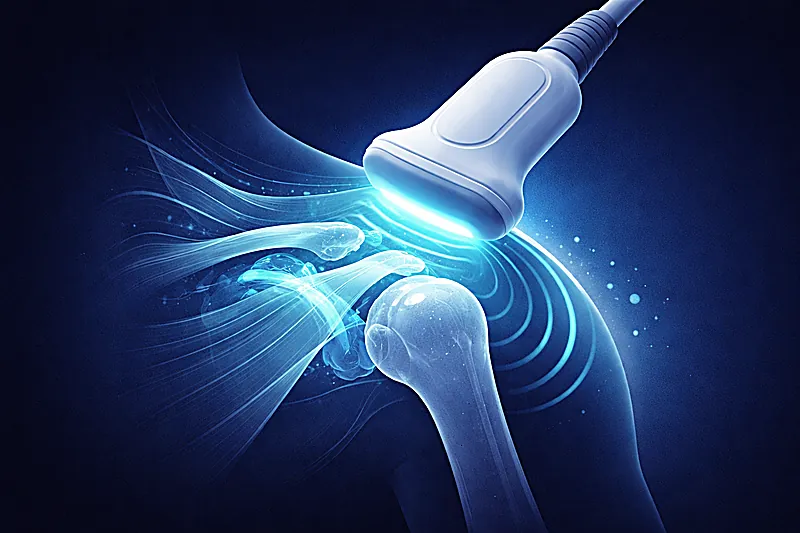
The convergence of three factors has made this question newly urgent. First, the ACGME introduced POCUS training requirements for family medicine residencies effective 2023, making ultrasound competency a mandated component of training. Second, handheld ultrasound devices now cost a fraction of traditional machines, removing the financial barrier that previously limited office-based adoption. Third, the WONCA Europe 2024 position paper formally endorsed POCUS for primary care use across a range of indications including MSK assessment. The clinical question is no longer whether family physicians can use POCUS, but what its real diagnostic yield is for the MSK presentations they encounter most often.
What Evidence Was Reviewed
This synthesis draws on 11 studies that span the available evidence from systematic reviews of generalist-performed POCUS, MSK-specific diagnostic accuracy studies (primarily comparing ultrasound to MRI or arthroscopy), and recent scoping reviews of outpatient POCUS applications. The evidence base is predominantly composed of diagnostic accuracy studies; RCTs measuring patient outcomes are notably absent for primary care MSK ultrasound.
| Study | Design | n | Population | Key Finding | Quality |
|---|---|---|---|---|---|
| Andersen 2019 (Ann Fam Med) | SR (51 studies) | NR | GP-performed POCUS | Satisfactory diagnostic accuracy across MSK, abdominal, obstetric; focused scans highest accuracy | High |
| Sorensen 2019 (Ultrasound J) | SR (26 MAs + 168 studies) | NR | Generalist-performed POCUS | MSK US: high specificity for tendon trauma, fractures, joint fluid; mixed sensitivity for ligament injury | High |
| Pratte 2025 (Eur J Int Med) | Scoping review (100 studies) | NR | Outpatient POCUS (internal med) | 9 MSK studies; management changed in 97% of studies reporting; POCUS feasible in 100% | Moderate |
| Poppleton/WONCA 2024 | Position paper | NR | Primary care POCUS globally | Endorsed POCUS for MSK, soft tissue, vascular; increased diagnostic accuracy and reduced referrals | Moderate |
| Roy 2021 (AJSM) | SR/MA of 23 studies | NR | Rotator cuff US vs arthroscopy | Full-thickness tears: sensitivity 0.88, specificity 0.93; equivalent to MRI (0.94/0.94 head-to-head) | High |
| Abadi 2020 | Diagnostic accuracy | 48 | Shoulder pain (US vs MRI) | Full-thickness tears: sensitivity 93.7%, specificity 100%; tendinopathy: sensitivity 90% | Moderate |
| Azzoni 2016 | Diagnostic accuracy | NR | MSK sonographer vs general US | MSK sonographer: 97% accuracy vs 91% for general sonographer for rotator cuff tears | Moderate |
| Doughton 2025 (Springer) | Clinical review | NR | Primary care POCUS implementation | MSK assessments and guided injections identified as highest-yield primary care POCUS applications | Moderate |
| Nathanson 2022 / Butterfly | Observational / case study | 282 | Family medicine POCUS practice | 49% diagnosis change, 89% confidence increase, 51% management change with POCUS | Low |
| Fraleigh 2022 | Clinical review | NR | NP/primary care POCUS | POCUS improved MSK diagnostic accuracy; reduced misdiagnosis for joint and soft-tissue injuries | Low |
| ACGME 2023 | Programme requirements | NR | FM residency programmes | POCUS clinical experience now required for all FM residents; MSK listed as core application | N/A |
Key Findings on POCUS Diagnostic Yield for MSK Complaints
Diagnostic Accuracy Is High for Specific MSK Targets, but Operator-Dependent
The strongest diagnostic accuracy data come from rotator cuff assessment. The Roy 2021 systematic review and meta-analysis of 23 studies found that ultrasound achieved median sensitivity of 0.88 and specificity of 0.93 for full-thickness supraspinatus tears when performed by experienced operators. In the five studies that directly compared US and MRI using arthroscopy as the reference standard, the two modalities performed equivalently: median sensitivity and specificity were 0.94 and 0.94 for US versus 0.94 and 0.89 for MRI for full-thickness tears. This equivalence is a key finding for primary care, as it suggests that office-based ultrasound can provide diagnostic information comparable to MRI for the most clinically consequential rotator cuff pathology.
However, accuracy drops substantially for partial-thickness tears and non-supraspinatus pathology. The same meta-analysis found lower sensitivity for partial-thickness tears (median 0.67) and notably poor sensitivity for subscapularis tears (0.30), despite high specificity. This pattern — strong for ruling in full-thickness tears, weaker for detecting subtler pathology — is critical for family physicians to understand when counselling patients about the scope and limitations of an office-based scan.
POCUS Changes Clinical Management in a Substantial Proportion of Encounters
While diagnostic accuracy is the most studied outcome, the more practice-relevant question is whether POCUS changes what clinicians actually do. The 2025 scoping review by Pratte et al., which evaluated 100 outpatient POCUS studies (including 9 on MSK applications), found that POCUS was associated with changes in medical management in 97% of studies reporting this outcome. One family medicine practice case study found that integrating POCUS into standard encounters was associated with a 49% change in initial diagnosis, a 51% modification of management plans, and an 89% increase in diagnostic confidence across all applications.
For MSK presentations specifically, the management changes include redirecting patients from empiric treatment to targeted therapy (e.g., identifying a full-thickness tear requiring surgical referral versus tendinopathy amenable to rehabilitation), guiding injection accuracy for joint and bursa procedures, and reducing unnecessary advanced imaging referrals. The Sorensen 2019 systematic review noted that POCUS in generalist settings showed both faster time to diagnosis and change in management across multiple organ systems including MSK.
Shoulder pain is the single highest-yield MSK POCUS application in family medicine. The evidence consistently demonstrates that ultrasound can reliably detect full-thickness rotator cuff tears with sensitivity exceeding 88% and specificity above 93% when performed by experienced operators. POCUS can also identify subacromial bursitis, biceps tendon pathology (specificity 0.99), and joint effusions with high accuracy. For adhesive capsulitis, coracohumeral ligament thickening measured by ultrasound shows sensitivity of 77–95% and specificity of 88–99% against MRI. The main limitation remains partial-thickness tears, where sensitivity drops to approximately 67%. Family physicians performing shoulder POCUS should recognise that a normal-appearing scan does not exclude a partial tear, and clinical correlation remains essential.
Joint effusion detection is arguably the most straightforward and immediately impactful MSK POCUS application for family medicine. Ultrasound can reliably detect even small effusions in the knee, shoulder, hip, and ankle — often invisible on physical examination alone. Beyond diagnosis, the real clinical value lies in ultrasound-guided aspiration and injection. Studies consistently show improved accuracy of needle placement under ultrasound guidance compared with landmark-based techniques, particularly for deeper joints (hip, posterior shoulder) and in obese patients where anatomical landmarks are obscured. The STFM POCUS curriculum specifically identifies joint effusion assessment and guided injection as core competencies for family medicine residents.
The Sorensen 2019 systematic review identified tendon trauma detection as a high-accuracy POCUS application in generalist settings. Achilles tendon assessment — both for acute rupture and chronic tendinopathy — is well-suited to office ultrasound given the tendon’s superficial location and the high specificity of ultrasound findings. Elbow and wrist tendon assessment are increasingly reported in the POCUS literature, though with smaller evidence bases. The Pratte 2025 scoping review noted growing publications on MSK POCUS applications (3.5-fold increase in the past decade), suggesting an expanding evidence base for tendon assessment beyond the shoulder. However, most validation studies still use specialist operators, and generalisability to family physicians with limited MSK ultrasound training remains a limitation.
POCUS for fracture detection in primary care is an emerging application with mixed evidence. The Sorensen 2019 review found studies demonstrating utility for cortical disruption in long bones, with high specificity but sensitivity dependent on fracture location and operator experience. Rib fractures, metacarpal fractures, and distal radius fractures have the most supporting data. For soft-tissue assessment, POCUS can reliably differentiate abscess from cellulitis — a distinction that requires different treatment approaches and is often clinically uncertain. One study found that ultrasound identified two-thirds of soft-tissue foreign bodies with 97% specificity, comparable to X-ray (sensitivity 58%, specificity 90%). These applications are particularly relevant for family physicians in urgent care or rural settings where radiology access is limited.
Institutional Momentum Is Building, but Standardisation Lags Behind
The endorsement landscape has shifted rapidly. The ACGME now requires POCUS clinical experience for all family medicine residents. The AAFP, ACP, and WONCA Europe all formally support POCUS integration into primary care. The STFM has developed dedicated training modules covering MSK ultrasound, including normal anatomy identification, effusion detection, and guided injection techniques. Yet standardisation of competency assessment, quality assurance protocols, and scope-of-practice boundaries for MSK POCUS in the office setting remain underdeveloped. The 2025 Pratte scoping review noted that standardised POCUS scanning protocols and reporting frameworks are needed to enhance methodological rigour and clinical integration.
Quality & Consistency of Evidence
What the Evidence Does Not Show
Despite growing institutional support, the evidence base for MSK POCUS in family medicine has critical gaps that must be acknowledged.
No RCTs in primary care MSK populations. The Pratte 2025 scoping review explicitly called for randomised controlled trials with standardised protocols. Currently, there is no trial comparing a POCUS-augmented MSK assessment pathway to standard care in family medicine for outcomes including diagnostic accuracy, time to treatment, patient-reported outcomes, or cost-effectiveness.
Minimum competency thresholds for family physicians performing MSK POCUS. Training requirements range from 2 to 320 hours across published studies. No validated assessment tool or minimum scan volume has been established for family physicians performing office-based MSK ultrasound. The ACGME requires “experience” but does not specify competency benchmarks for individual MSK applications.
Diagnostic accuracy in realistic primary care conditions. Most diagnostic accuracy studies use specialist MSK sonographers or radiologists with years of dedicated training. Whether family physicians — who perform MSK scans intermittently among many other clinical tasks — achieve comparable accuracy is largely untested. The steep learning curve and operator dependence of MSK ultrasound make this gap particularly important.
Harms of false positives and incidental findings. None of the reviewed studies systematically assessed the downstream consequences of false-positive findings — including unnecessary MRI referrals, anxiety, or inappropriate surgical consultations — when POCUS is performed by less-experienced operators in an unselected primary care population.
Practical Implications
Based on the current evidence, the following considerations may guide the integration of MSK POCUS into family medicine office practice. These reflect synthesised findings and current guideline positions — they are not directive recommendations.
Evidence Grade & Bottom Line
Overall Evidence Grade: Moderate (Diagnostic Accuracy) / Insufficient (Patient Outcomes)
The diagnostic accuracy of MSK ultrasound for specific targets (full-thickness rotator cuff tears, effusions, tendon rupture) is well-established by multiple systematic reviews. However, nearly all data come from specialist operators, and the translation to family medicine office settings is supported primarily by observational data, position papers, and expert consensus. Evidence that POCUS-augmented MSK assessment improves patient-centred outcomes in primary care does not yet exist.
A “moderate” diagnostic accuracy grade means family physicians can be reasonably confident that POCUS will provide clinically useful information for selected MSK presentations — particularly shoulder pathology, joint effusions, and guided procedures. The “insufficient” patient outcome grade means the downstream value of this diagnostic information — whether it actually leads to better, faster, or more cost-effective care — has not been demonstrated in primary care and should not be assumed.
- POCUS for full-thickness rotator cuff tears achieves sensitivity and specificity above 88% and 93% respectively, approaching MRI equivalence in experienced hands.
- Joint effusion detection and ultrasound-guided injection represent the most immediately actionable MSK POCUS applications for family medicine, with strong diagnostic yield and direct management impact.
- POCUS appears to change clinical management in a substantial proportion of encounters, but this finding derives from observational data without blinded comparators.
- Accuracy is highly operator-dependent, with meaningful performance differences between specialist and generalist operators — a gap that structured training can narrow but not eliminate.
- No RCT has demonstrated that MSK POCUS in primary care improves patient outcomes, reduces imaging utilisation, or is cost-effective — representing the most significant gap in the current evidence base.
Article Information
For Educational Purposes Only. This is an original evidence synthesis informed by the studies listed below. It does not replace clinical judgement. Drug dosages should be verified against current prescribing information.
References
- Andersen CA, Holden S, Vela J, Rathleff MS, Jensen MB. Point-of-care ultrasound in general practice: a systematic review. Ann Fam Med. 2019;17(1):61–69. DOI: 10.1370/afm.2330
- Sorensen B, Hunskaar S. Point-of-care ultrasound in primary care: a systematic review of generalist performed point-of-care ultrasound in unselected populations. Ultrasound J. 2019;11(1):31. DOI: 10.1186/s13089-019-0145-4
- Pratte M, Evans J, et al. Point of care ultrasound (POCUS) applications in the ambulatory internal medicine setting: a scoping review. Eur J Intern Med. 2025;141:106379. DOI: 10.1016/j.ejim.2025.06.017
- Poppleton A, Tsukagoshi S, Vinker S, et al. WONCA Europe position paper on the use of point-of-care ultrasound (POCUS) in primary care. Prim Health Care Res Dev. 2024;25:e21. DOI: 10.1017/S1463423624000112
- Roy JS, Braën C, Leblond J, et al. Diagnostic accuracy of ultrasonography for rotator cuff tears: a systematic review and meta-analysis. Am J Sports Med. 2021;49(14):NP71. DOI: 10.1177/03635465211035253
- Abadi S, Mazloom M, Hosseinzadeh H. Evaluation of diagnostic precision of ultrasound for rotator cuff disorders in patients with shoulder pain. Adv Biomed Res. 2020;9:73. DOI: 10.4103/abr.abr_196_20
- Azzoni R, Cabitza P. Not all ultrasounds are created equal: general sonography versus musculoskeletal sonography in the detection of rotator cuff tears. Shoulder Elbow. 2016;8(4):250–257. DOI: 10.1177/1758573216644560
- Doughton J. POCUS management in primary care. In: Tayal VS, et al., eds. Ultrasound Program Management. Springer; 2025. DOI: 10.1007/978-3-031-86341-7_35
- Fraleigh CD, et al. Point-of-care ultrasound: an emerging clinical tool to enhance physical assessment. Nurse Pract. 2022;47(8):14–22. DOI: 10.1097/01.NPR.0000854051.25709.46
- Accreditation Council for Graduate Medical Education. ACGME program requirements for graduate medical education in family medicine (interim revision effective July 1, 2024). ACGME; 2023.
- Carrera KG, et al. The benefits and barriers of using point-of-care ultrasound in primary healthcare in the United States. Cureus. 2022;14(8):e28373. DOI: 10.7759/cureus.28373