
PSA Screening: 5 Essential Practice Considerations
Weighing a modest mortality benefit against overdiagnosis — and how MRI-first biopsy pathways are reshaping the harm side of the conversation.
One-Minute Takeaway
- PSA screening lowers prostate-cancer mortality modestly: the randomized ERSPC trial found a 20% relative reduction at 16 years (rate ratio 0.80, 95% CI 0.72–0.89) — high-certainty evidence from a large trial.
- The absolute benefit is small and comes with overdiagnosis: at 23 years, ERSPC reported an absolute mortality reduction of 0.22% and a number-needed-to-invite of 456.
- An MRI-first pathway sharpens detection: in the PRECISION trial, MRI-targeted biopsy found clinically significant cancer in 38% of men, versus 26% with standard biopsy.
- MRI triage spares biopsies: about a quarter of men avoided biopsy in PROMIS (27%) and PRECISION (28%), with fewer insignificant cancers diagnosed.
- US guidance treats it as a shared decision — the USPSTF assigns a grade C for men aged 55–69, recommending an individualized choice after a benefit–harm discussion.
Why PSA Screening Matters
Prostate cancer is among the most common cancers in men. In the United States, the lifetime risk of a diagnosis is roughly 13%, and the lifetime risk of dying from the disease is about 2.5%. Many men diagnosed never develop symptoms from it.
PSA screening aims to catch aggressive cancer while it is still curable. The strongest support comes from the ERSPC randomized trial. It reduced prostate-cancer mortality by 20% at 16 years of follow-up.
That benefit has held up over time. At 23 years of follow-up, ERSPC reported a sustained but smaller relative reduction in prostate-cancer mortality (rate ratio 0.87, 95% CI 0.80–0.95). The absolute reduction was 0.22%.
Other trials complicate the picture. The US PLCO trial found no mortality benefit, but heavy PSA testing in its control group blurred the comparison. The UK CAP trial, using a single screening invitation, also found no significant mortality reduction at 10 years.
These mixed results explain why PSA screening is framed as a choice rather than a routine. The evidence supports a real but modest benefit that men will weigh differently. That makes an individualized, shared decision the appropriate default.
The Clinical Problem in PSA Screening
PSA is a marker of prostate activity, not a cancer-specific test. Benign enlargement, inflammation, and infection all raise it. An elevated result therefore triggers further testing that most men with a high PSA do not need for a lethal cancer.
The central harm is overdiagnosis. Screening detects many slow-growing cancers that would never have caused symptoms. In ERSPC, the cumulative incidence of prostate cancer was 30% higher in the screened group (rate ratio 1.30, 95% CI 1.26–1.33).
Diagnosis has historically meant a systematic biopsy. A standard transrectal ultrasound-guided biopsy samples 10 to 12 cores across the gland, largely blind to where cancer sits. This approach can miss significant tumours while finding indolent ones.
Biopsy itself carries risk. In the PROMIS study, serious adverse events occurred in 5.9% of men, including cases of sepsis. Each unnecessary biopsy adds cost, anxiety, and a small but real chance of harm.
Clinical Pearl. The problem is not detecting cancer — it is detecting the right cancer. A better first step would rule out men who can safely avoid biopsy and concentrate sampling on lesions that matter.
Available Approaches
Three broad strategies now compete for the space between an elevated PSA and a biopsy. They differ in how aggressively they biopsy, how well they find significant cancer, and how much overdiagnosis they generate. The evidence below is drawn only from studies confirmed against their primary sources.
| Study / Source | Design | n | Population | Comparison | Key result |
|---|---|---|---|---|---|
| PROMIS (Ahmed 2017) | Paired diagnostic validation | 576 | PSA ≤15, biopsy-naive | MP-MRI vs TRUS biopsy (template-mapping reference) | MRI sensitivity 93% (95% CI 88–96) vs TRUS 48% (42–55) for significant cancer; 27% could avoid a primary biopsy |
| PRECISION (Kasivisvanathan 2018) | Multicentre RCT | 500 | Biopsy-naive, clinical suspicion | MRI ± targeted biopsy vs standard TRUS biopsy | Significant cancer 38% vs 26% (adjusted difference 11.7%, 95% CI 3.6–19.8); insignificant 9% vs 22%; 28% avoided biopsy |
| STHLM3-MRI (Eklund 2021) | Population screening RCT | 1,532 | Screening, men 50–74, PSA ≥3 | Biparametric MRI-targeted vs systematic biopsy | Significant-cancer detection non-inferior; insignificant cancer 4% vs 12% |
| Göteborg-2 (Hugosson 2022) | Population screening RCT | 17,980 | Screening by invitation | PSA + MRI, targeted biopsy only, vs systematic | Insignificant cancer 0.6% vs 1.2% (difference −0.7 percentage points); roughly halved overdiagnosis |
| Cochrane review (Drost 2019) | Systematic review & meta-analysis | 25 studies | Biopsy-naive and prior-negative | MRI pathway vs systematic biopsy | Significant-cancer detection ratio 1.05 (95% CI 0.95–1.16) biopsy-naive; insignificant detection ratio 0.63 (0.54–0.74) |
The systematic-biopsy pathway
For decades, an elevated PSA led directly to systematic TRUS-guided biopsy. It remains widely used and needs no imaging infrastructure. Its weakness is accuracy: in PROMIS, systematic biopsy identified only 48% of clinically significant cancers (95% CI 42–55) against a template-mapping reference.
Because sampling is not lesion-directed, the pathway both misses aggressive anterior tumours and detects insignificant cancers that drive overtreatment.
The MRI-first pathway with targeted biopsy
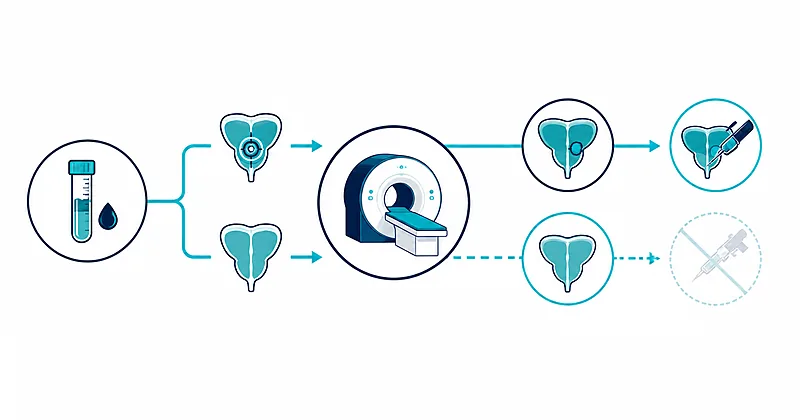
An MRI-first pathway performs multiparametric or biparametric MRI before any biopsy. Men with no suspicious lesion may avoid biopsy; those with a lesion receive targeted sampling. The PRECISION randomized trial tested this directly in biopsy-naive men.
MRI-targeted biopsy detected clinically significant cancer in 38% of men, compared with 26% using standard biopsy. Fewer insignificant cancers were found with the MRI-first approach (9% versus 22%).
Roughly a quarter of men avoided biopsy entirely — 28% in PRECISION and 27% in PROMIS had no suspicious MRI.
Risk-stratified and biopsy-avoidance strategies
Screening populations differ from referral populations, and two large Swedish trials tested MRI-first there. In STHLM3-MRI, an MRI-targeted pathway matched systematic biopsy for significant-cancer detection while cutting insignificant-cancer diagnoses from 12% to 4%.
Göteborg-2 pushed further, offering targeted biopsy only when MRI was positive. It roughly halved overdiagnosis, with clinically insignificant cancer detected in 0.6% versus 1.2% of screened men.
Risk tools can refine who reaches MRI. Blood-based scores and PSA density help select higher-risk men, reducing scans and biopsies without materially lowering significant-cancer detection.
Comparative Analysis
Across these studies a consistent pattern emerges. An MRI-first pathway detects at least as much clinically significant cancer as systematic biopsy, and often more, while substantially reducing the detection of indolent disease.
The Cochrane review quantified this. Pooled against systematic biopsy, the MRI pathway had a significant-cancer detection ratio of 1.05 in biopsy-naive men (95% CI 0.95–1.16). In men with a prior negative biopsy the advantage was larger (detection ratio 1.44, 95% CI 1.19–1.75).
The reduction in overdiagnosis is the more consistent finding. The same review reported an insignificant-cancer detection ratio of 0.63 in biopsy-naive men (95% CI 0.54–0.74).
The advantage is not unlimited. MRI misses some significant cancers — pooled sensitivity against template biopsy was 0.72 (95% CI 0.60–0.82) — so a negative scan lowers risk without eliminating it.
Quality and Consistency of the Evidence
Strength of evidence varies with the question being asked.
- High — Reduced overdiagnosis with an MRI-first pathway. Multiple randomized trials and a Cochrane review agree it detects fewer clinically insignificant cancers than systematic biopsy.
- High — Fewer unnecessary biopsies. Around a quarter of men avoid biopsy after a non-suspicious MRI, replicated across PROMIS, PRECISION, and screening trials.
- Moderate — Improved significant-cancer detection. Randomized and pooled data favour the MRI pathway, though the size of the gain varies by population and MRI quality.
- High — A modest mortality benefit from PSA screening. The ERSPC trial shows a sustained reduction in prostate-cancer mortality over long follow-up.
- Low — Effect of an MRI-first pathway on mortality. No randomized trial has yet measured whether the pathway changes prostate-cancer deaths rather than detection.
What the Evidence Does Not Show
Specific gaps remain. The following questions are not answered by current evidence and should temper how firmly the pathway is presented.
- No mortality endpoint for MRI-first pathways. Trials measured cancer detection, not prostate-cancer deaths; whether better detection translates into fewer deaths is untested.
- Uncertain long-term safety of biopsy avoidance. The course of men sent home after a negative MRI is not fully characterised, and a small number of significant cancers are missed.
- Limited data in higher-risk groups. Black men and men with a strong family history face higher risk, yet the major trials enrolled predominantly European, largely white populations.
- Real-world performance may lag trials. MRI accuracy depends on scanner quality, reader expertise, and standardised reporting, which vary widely outside expert centres.
- Optimal thresholds are unsettled. The best PSA level, screening interval, and starting age — and whether to obtain a baseline PSA in younger men — remain undefined.
Practical Implications
For a family physician, the evidence supports a small set of concrete practices.
- Treat screening as a shared decision. The USPSTF assigns a grade C for men aged 55 to 69, meaning the choice should be individualized after a discussion of benefits and harms. Offer the conversation rather than the test by default.
- Individualize by risk and life expectancy. Benefit accrues over 10 to 15 years, so screening favours men with longer life expectancy. Higher-risk men — including Black men and those with a family history — may weigh a small average benefit more heavily.
- Use an MRI-first pathway to limit harm. Where available, MRI before biopsy reduces unnecessary biopsies and the overdiagnosis of indolent cancer without sacrificing detection of significant disease. This shifts the harm side of the ledger that most worries patients.
- Interpret a negative MRI carefully. A non-suspicious scan lowers the probability of significant cancer but does not exclude it. Keep a safety net — PSA density, informed follow-up, or biopsy when clinical suspicion is high.
- Match the pathway to local capability. The trial results assume high-quality MRI and experienced readers. Counsel patients on what your system can reliably deliver, and refer when local imaging quality is uncertain.
Evidence Grade and Bottom Line
Overall, the evidence supporting an MRI-first diagnostic pathway is moderate to high for its diagnostic advantages and low for any effect on mortality. The evidence that PSA screening yields a small mortality benefit is high, though the absolute effect is modest.
- PSA screening offers a real but small reduction in prostate-cancer mortality, offset by overdiagnosis and biopsy-related harm.
- An MRI-first pathway improves the benefit-to-harm balance: it detects at least as much significant cancer while reducing unnecessary biopsies and indolent-cancer diagnoses.
- No trial has shown that MRI-first screening lowers prostate-cancer deaths; the case rests on better detection and fewer harms.
- The appropriate default remains an individualized, shared decision, now informed by a more accurate diagnostic route.
Article Information and References
- Drost FH, Osses DF, Nieboer D, et al. Prostate MRI, with or without MRI-targeted biopsy, and systematic biopsy for detecting prostate cancer. Cochrane Database Syst Rev. 2019;4:CD012663. DOI: https://doi.org/10.1002/14651858.CD012663.pub2
- Fenton JJ, Weyrich MS, Durbin S, et al. Prostate-specific antigen–based screening for prostate cancer: evidence report and systematic review for the US Preventive Services Task Force. JAMA. 2018;319(18):1914–1931. DOI: https://doi.org/10.1001/jama.2018.3712
- US Preventive Services Task Force; Grossman DC, Curry SJ, Owens DK, et al. Screening for prostate cancer: US Preventive Services Task Force recommendation statement. JAMA. 2018;319(18):1901–1913. DOI: https://doi.org/10.1001/jama.2018.3710
- Kasivisvanathan V, Rannikko AS, Borghi M, et al. MRI-targeted or standard biopsy for prostate-cancer diagnosis. N Engl J Med. 2018;378(19):1767–1777. DOI: https://doi.org/10.1056/NEJMoa1801993
- Ahmed HU, El-Shater Bosaily A, Brown LC, et al. Diagnostic accuracy of multi-parametric MRI and TRUS biopsy in prostate cancer (PROMIS): a paired validating confirmatory study. Lancet. 2017;389(10071):815–822. DOI: https://doi.org/10.1016/S0140-6736(16)32401-1
- Eklund M, Jäderling F, Discacciati A, et al. MRI-targeted or standard biopsy in prostate cancer screening. N Engl J Med. 2021;385(10):908–920. DOI: https://doi.org/10.1056/NEJMoa2100852
- Hugosson J, Månsson M, Wallström J, et al. Prostate cancer screening with PSA and MRI followed by targeted biopsy only. N Engl J Med. 2022;387(23):2126–2137. DOI: https://doi.org/10.1056/NEJMoa2209454
- Hugosson J, Roobol MJ, Månsson M, et al. A 16-yr follow-up of the European Randomized study of Screening for Prostate Cancer. Eur Urol. 2019;76(1):43–51. DOI: https://doi.org/10.1016/j.eururo.2019.02.009
- European Randomized Study of Screening for Prostate Cancer (ERSPC) Investigators. European study of prostate cancer screening — 23-year follow-up. N Engl J Med. 2025. DOI: https://doi.org/10.1056/NEJMoa2503223
- Andriole GL, Crawford ED, Grubb RL III, et al. Mortality results from a randomized prostate-cancer screening trial. N Engl J Med. 2009;360(13):1310–1319. DOI: https://doi.org/10.1056/NEJMoa0810696
- Martin RM, Donovan JL, Turner EL, et al. Effect of a low-intensity PSA-based screening intervention on prostate cancer mortality: the CAP randomized clinical trial. JAMA. 2018;319(9):883–895. DOI: https://doi.org/10.1001/jama.2018.0154