
Rotator Cuff Tear Treatment: Surgery Versus Exercise
What placebo-controlled shoulder-surgery trials mean for choosing tendon repair or structured rehabilitation.
One-Minute Takeaway
- For degenerative rotator cuff tear care, Level I randomized trials and a Cochrane systematic review find surgical repair and structured exercise deliver broadly similar short-term pain and function.
- In the Cochrane synthesis, repair improved 12-month function by 6 of 100 points (95% CI 2.4 to 9.5) — a difference below the level most patients would notice.
- Placebo-controlled trials (CSAW, FIMPACT) found subacromial decompression worked no better than sham surgery for impingement, reframing enthusiasm for shoulder operations — though neither tested tendon repair.
- Surgery’s clearest advantage is structural: repaired tendons heal, unrepaired tears may enlarge over years, and a minority of exercise-first patients later choose surgery.
- Traumatic tears, larger tears, and younger active patients more often favour repair; older degenerative tears usually warrant an exercise-first trial.
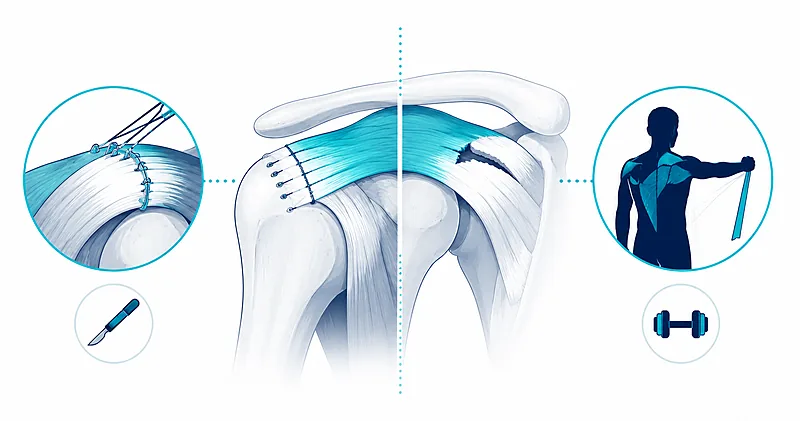
Why Rotator Cuff Tear Treatment Matters
Shoulder pain drives roughly 4.5 million clinician visits a year in the United States, and rotator cuff disease is its most common cause. Most patients first present in primary care, where the decision is rarely whether to treat but how.
For decades, a symptomatic tear on imaging pointed many patients toward the operating room. Rotator cuff repair and subacromial surgery became among the most frequently performed orthopaedic procedures in high-income countries.
Then a series of rigorous trials unsettled that logic. Placebo-controlled surgical studies asked a question few had tested directly: does the operation outperform a convincing sham?
The landmark sham-surgery trials studied subacromial decompression for impingement in shoulders with an intact cuff — not repair of a torn tendon. Their findings reshaped scepticism about shoulder surgery generally, but they do not directly test cuff repair. Keeping these two operations separate is essential to reading the evidence honestly.
In the CSAW trial, arthroscopic decompression produced Oxford Shoulder Scores no better than arthroscopy alone, the placebo (mean difference -1.3 points, 95% CI -3.9 to 1.3). Both surgical arms beat no treatment only by a margin the authors judged not clinically important.
The independent Finnish FIMPACT trial reached the same conclusion, and added a third arm: structured exercise. Decompression, placebo surgery, and exercise all converged, with no between-group difference exceeding the clinically important threshold at two or five years.
These results forced a reasonable question for the tear itself. If removing bone spurs adds nothing over placebo, how much does repairing the tendon add over rehabilitation? That is the comparison this review examines.
The Options Compared
“Surgery” here means arthroscopic or mini-open rotator cuff repair, reattaching the torn tendon to bone, often with subacromial decompression. “Exercise” means a structured, progressive physiotherapy programme, sometimes combined with a corticosteroid injection.
Both aim at the same targets: less pain, better function, and a return to daily activity. They diverge on one biological point — only surgery restores tendon-to-bone continuity, while exercise treats the symptoms of a tear that remains anatomically present.
The randomized evidence falls into two groups. Trials of repair versus exercise address the tear directly; the placebo-surgery trials address impingement and set the sceptical backdrop. The table below keeps them clearly separated.
| Study / Source | Design | N | Population | Comparison | Key result | Tier |
|---|---|---|---|---|---|---|
| Rotator cuff tear: repair versus exercise | ||||||
| Karjalainen 2019 (Cochrane) | Systematic review / meta-analysis | 9 RCTs, 1007 (primary comparison 3 RCTs, 339) | Full-thickness tears, mostly small degenerative supraspinatus | Repair ± decompression vs exercise ± injection | At 12 months, function 6/100 better (95% CI 2.4 to 9.5) and pain 0.87/10 better (95% CI 0.43 to 1.30) with surgery — both below clinical importance; global success RR 1.08 (0.96 to 1.22); low-to-moderate certainty | V |
| Kukkonen 2015 | RCT, Level I (3 arms) | 180 shoulders (167 analysed) | Nontraumatic supraspinatus tears, older patients | Physiotherapy vs acromioplasty + physio vs repair + acromioplasty | Mean Constant gain 18.4 (95% CI 14.2 to 22.6) with physiotherapy vs 22.6 (18.4 to 26.8) with repair; no significant difference (p=0.38); tears enlarged more without repair | V |
| Moosmayer 2014 / 2019 / 2024 (5- to 15-year) | RCT | 103 | Small-to-medium tears (≤3 cm) | Primary tendon repair vs physiotherapy (with optional secondary repair) | Comparable at 2 years; repair modestly superior on Constant and ASES scores from 5 years, with the gap widening at 10 and 15 years; 14 of 51 physiotherapy patients crossed to secondary repair | V |
| Lambers Heerspink 2015 | RCT | 56 | Degenerative full-thickness tears | Rotator cuff repair vs conservative treatment | No significant Constant-Murley difference at 1 year; visual-analogue pain lower after repair | V |
| Schemitsch 2019 | Systematic review / meta-analysis | 6 RCTs | Chronic / degenerative tears, older patients | Repair vs conservative or decompression alone | Pooled Constant-Murley advantage for repair of ~6.2 points vs conservative (p=0.002) and ~5.8 vs decompression (p=0.0004); authors judge the difference small and conservative success high; 11.9% of conservative patients crossed to surgery | V |
| Placebo-controlled context (impingement, intact cuff — not tear repair) | ||||||
| Beard 2018 (CSAW) | Placebo-controlled RCT | 313 | Subacromial pain, intact cuff (impingement) | Decompression vs arthroscopy-only (placebo) vs no treatment | Oxford Shoulder Score 32.7 with decompression vs 34.2 with placebo; mean difference -1.3 (95% CI -3.9 to 1.3); surgery beat no treatment by fewer than 5 points, below clinical importance | V |
| Paavola 2018 / 2020 (FIMPACT) | Placebo-controlled RCT | 210 | Shoulder impingement, intact cuff | Decompression vs diagnostic arthroscopy (placebo) vs exercise therapy | No between-group difference exceeding clinical importance at 2 or 5 years; e.g. decompression vs exercise, pain on activity, mean difference -3.9 (95% CI -12.8 to 5.1) at 5 years | V |
Tier key: V = verified against the primary source retrieved during preparation. ASES = American Shoulder and Elbow Surgeons score; RR = risk ratio; CI = confidence interval.
Pain Relief — How Surgery and Exercise Differ
On pain, the two approaches sit closer than many patients expect. The Cochrane review found repair reduced 12-month pain by 0.87 points on a 0-to-10 scale (95% CI 0.43 to 1.30), an improvement that falls short of what patients typically register as meaningful.
Kukkonen’s three-arm trial saw no significant pain difference across physiotherapy, decompression, and repair. Both surgical strategies caused improvement, but not beyond what exercise alone achieved.
Lambers Heerspink offers the counterpoint. In degenerative tears, repaired patients reported significantly lower pain scores at one year than those treated conservatively, even though function did not differ.
A statistically significant pain difference is not always a clinically important one. Across these trials, the pooled advantage for surgery is real but small, and non-operative patients still report substantial pain relief. That combination is why guidelines endorse either path for the right patient.
Shoulder Function — How Surgery and Exercise Differ
Function tells a similar story with a longer tail. In the Cochrane analysis, repair improved 12-month function by 6 of 100 points (95% CI 2.4 to 9.5) — statistically detectable, but under the threshold most consider clinically important.
Kukkonen’s Constant-score gains landed at 18.4 points with physiotherapy and 22.6 with repair, a spread that did not reach significance (p=0.38). Conservative care produced most of the functional recovery that surgery delivered.
Meta-analysis complicates a tidy “no difference” message. Pooling six trials, Schemitsch reported a Constant-Murley advantage for repair of about 6 points over conservative care (p=0.002) — yet the authors themselves called the magnitude small and the success of conservative treatment high.
Moosmayer’s cohort adds the time dimension. Repair and physiotherapy performed comparably at two years, but the repaired group pulled modestly ahead from five years onward, with the difference widening through ten and fifteen years of follow-up.
Tendon Healing and Rotator Cuff Tear Progression — How They Differ
Here the two approaches genuinely part ways. Surgery restores the tendon; exercise does not. Kukkonen documented this directly: mean tear size stayed near 11 mm in the non-repaired arms but shrank to about 4 mm where the tendon was fixed.
Left unrepaired, degenerative tears tend to progress. The AAOS 2025 guideline notes with strong-rated evidence that tear size, muscle atrophy, and fatty infiltration may advance over five to ten years under non-operative management.
That structural drift has a clinical echo. In Moosmayer’s cohort, tears that stayed unrepaired throughout the study enlarged substantially, and the associated shoulder scores declined — a plausible mechanism for the late functional gap favouring repair.
Symptoms and structure do not move in lockstep. Many people function well for years with an unrepaired tear, while some healed repairs still disappoint. Structural healing is a genuine advantage of surgery, but it predicts outcome imperfectly — which is why a non-operative trial rarely forecloses later repair.
Crossover captures the practical balance. Across trials, a consistent minority of exercise-first patients — roughly 12% in the pooled meta-analysis, and about a quarter of Moosmayer’s physiotherapy arm over the long term — eventually elected surgery. Most did not.
Subgroups That Change the Choice
The trial evidence applies to a specific population, and its limits define where surgery moves back up the list.
Degenerative versus traumatic tears
Nearly all randomized data come from chronic, degenerative tears in older adults. The Cochrane authors caution that their conclusions may not extend to acute traumatic tears, which are commonly repaired, particularly in younger patients.
Tear size and location
The trials studied mostly small-to-medium supraspinatus tears and generally excluded large tears involving the subscapularis. Larger or multi-tendon tears were not represented, so equivalence claims should not be extended to them.
Age and activity demands
Older, lower-demand patients did well with exercise across the trials. Younger, active patients and those with high occupational shoulder loads sit outside the trial populations, and repair is more often considered for them.
Acute traumatic tears; large or subscapularis-involving tears; younger, active or high-demand patients; and tears showing progression on serial imaging. Where the picture is a small degenerative tear in an older adult, an exercise-first trial is well supported.
Quality and Consistency of the Evidence
The body of evidence is unusually strong for a surgical question — multiple Level I trials and independent meta-analyses — but it carries real limitations.
- Moderate — short-term pain and function (repair vs exercise). Consistent across trials and pooled analyses, but the Cochrane review downgraded certainty for risk of bias, since no cuff-repair trial could blind participants.
- Low — long-term superiority of repair. Driven largely by a single well-conducted cohort (Moosmayer) and heterogeneous meta-analytic pooling; the direction is consistent but the effect size is uncertain.
- High — placebo-controlled decompression findings. Two independent, blinded trials (CSAW, FIMPACT) agree that decompression adds nothing over sham for impingement — though this addresses a different operation than tendon repair.
- Moderate — structural progression without repair. Imaging data and guideline consensus agree that unrepaired degenerative tears may enlarge over years, but the link to symptoms is inconsistent.
One structural gap dominates: no trial has ever compared cuff repair against placebo surgery. Every repair-versus-exercise estimate is therefore unblinded, leaving room for expectation effects that the decompression trials showed can be substantial.
What the Evidence Does Not Show
The current evidence cannot answer several questions that matter at the bedside.
It does not show whether repair outperforms a placebo operation for a tear, because no such trial exists. The unblinded design of every repair-versus-exercise study is its central weakness.
It does not establish the best treatment for acute traumatic tears, large or subscapularis tears, or younger high-demand patients, who were largely excluded from the randomized trials.
It does not resolve whether early repair prevents long-term arthritic change, since the trials did not follow structural joint outcomes far enough to judge. It also cannot identify, in advance, which exercise-first patients will later need surgery.
Finally, it does not tell us the optimal exercise protocol. Programmes varied across trials, and no head-to-head comparison defines the most effective rehabilitation for a torn cuff.
Practical Implications
The evidence supports framing the choice as genuinely shared rather than default-surgical. For a small-to-medium degenerative tear in an older adult, a structured exercise trial is a well-founded first step that most patients will not need to escalate.
The AAOS 2025 guideline reflects this balance, endorsing either physical therapy or repair for symptomatic small-to-medium full-thickness tears, since both produce meaningful improvement in patient-reported outcomes.
Counselling can be concrete. Exercise offers substantial symptom relief without operative risk, but leaves the tendon torn and open to slow enlargement. Repair adds structural healing and a modest long-term functional edge, at the cost of surgery, recovery time, and a retear rate.
For degenerative tears, an exercise-first trial with a defined review point is well supported; serial imaging or persistent decline can prompt reconsideration. For traumatic, large, or high-demand tears, earlier surgical referral is appropriate. The decision belongs to the informed patient.
Because these are educational syntheses rather than individual advice, treatment should follow clinical assessment. Drug dosages, injection decisions, and surgical timing rest on the judgement of the treating clinician.
Evidence Grade and Bottom Line
Bottom line
- For degenerative rotator cuff tears, repair and structured exercise produce similar short-term pain and function; differences favouring surgery are real but small.
- Placebo-controlled trials undercut symptom-based rationales for subacromial decompression, though they do not test tendon repair itself.
- Surgery’s clearest benefit is structural healing and a modest long-term functional edge; exercise avoids operative risk and suits most older degenerative tears.
- Traumatic, large, or high-demand tears fall outside the trial populations and more often warrant repair.
The grade reflects several converging Level I trials and meta-analyses, tempered by unavoidable lack of blinding, heterogeneity in long-term data, and the absence of any placebo-surgery comparison for cuff repair.
Article Information and References
- Karjalainen TV, Jain NB, Heikkinen J, Johnston RV, Page CM, Buchbinder R. Surgery for rotator cuff tears. Cochrane Database Syst Rev. 2019;12(12):CD013502. DOI: https://doi.org/10.1002/14651858.CD013502
- Schemitsch C, Chahal J, Vicente M, Nowak L, Flurin PH, Lambers Heerspink F, Henry P, Nauth A. Surgical repair versus conservative treatment and subacromial decompression for the treatment of rotator cuff tears: a meta-analysis of randomized trials. Bone Joint J. 2019;101-B(9):1100-1106. DOI: https://doi.org/10.1302/0301-620X.101B9.BJJ-2018-1591.R1
- Ryösä A, Laimi K, Äärimaa V, Lehtimäki K, Kukkonen J, Saltychev M. Surgery or conservative treatment for rotator cuff tear: a meta-analysis. Disabil Rehabil. 2017;39(14):1357-1363. DOI: https://doi.org/10.1080/09638288.2016.1198431
- Karjalainen TV, Jain NB, Page CM, Lähdeoja TA, Johnston RV, Salamh P, Kavaja L, Ardern CL, Agarwal A, Vandvik PO, Buchbinder R. Subacromial decompression surgery for rotator cuff disease. Cochrane Database Syst Rev. 2019;1(1):CD005619. DOI: https://doi.org/10.1002/14651858.CD005619.pub3
- Kukkonen J, Joukainen A, Lehtinen J, Mattila KT, Tuominen EKJ, Kauko T, Äärimaa V. Treatment of nontraumatic rotator cuff tears: a randomized controlled trial with two years of clinical and imaging follow-up. J Bone Joint Surg Am. 2015;97(21):1729-1737. DOI: https://doi.org/10.2106/JBJS.N.01051
- Moosmayer S, Lund G, Seljom US, Haldorsen B, Svege IC, Hennig T, Pripp AH, Smith HJ. Tendon repair compared with physiotherapy in the treatment of rotator cuff tears: a randomized controlled study in 103 cases with a five-year follow-up. J Bone Joint Surg Am. 2014;96(18):1504-1514. DOI: https://doi.org/10.2106/JBJS.M.01393
- Moosmayer S, Lund G, Seljom U, Svege I, Hennig T, Tariq R, Smith HJ. Comparison between surgery and physiotherapy in the treatment of small and medium-sized tears of the rotator cuff: a randomised controlled study of 103 patients with one-year follow-up. J Bone Joint Surg Br. 2010;92(1):83-91. DOI: https://doi.org/10.1302/0301-620X.92B1.22609
- Moosmayer S, Lund G, Seljom US, Haldorsen B, Svege IC, Hennig T, Pripp AH, Smith HJ. At a 10-year follow-up, tendon repair is superior to physiotherapy in the treatment of small and medium-sized rotator cuff tears. J Bone Joint Surg Am. 2019;101(12):1050-1060. DOI: https://doi.org/10.2106/JBJS.18.01373
- Moosmayer S, Lund G, Seljom US, Haldorsen B, Svege IC, Hennig T, Pripp AH, Smith HJ. Fifteen-year results of a comparative analysis of tendon repair versus physiotherapy for small-to-medium-sized rotator cuff tears: a concise follow-up of previous reports. J Bone Joint Surg Am. 2024;106(19):1785-1796. DOI: https://doi.org/10.2106/JBJS.24.00065
- Lambers Heerspink FO, van Raay JJAM, Koorevaar RCT, van Eerden PJM, Westerbeek RE, van ‘t Riet E, van den Akker-Scheek I, Diercks RL. Comparing surgical repair with conservative treatment for degenerative rotator cuff tears: a randomized controlled trial. J Shoulder Elbow Surg. 2015;24(8):1274-1281. DOI: https://doi.org/10.1016/j.jse.2015.05.040
- Beard DJ, Rees JL, Cook JA, Rombach I, Cooper C, Merritt N, et al; CSAW Study Group. Arthroscopic subacromial decompression for subacromial shoulder pain (CSAW): a multicentre, pragmatic, parallel group, placebo-controlled, three-group, randomised surgical trial. Lancet. 2018;391(10118):329-338. DOI: https://doi.org/10.1016/S0140-6736(17)32457-1
- Paavola M, Malmivaara A, Taimela S, Kanto K, Inkinen J, Kalske J, et al; FIMPACT Investigators. Subacromial decompression versus diagnostic arthroscopy for shoulder impingement: randomised, placebo surgery controlled clinical trial. BMJ. 2018;362:k2860. DOI: https://doi.org/10.1136/bmj.k2860
- Paavola M, Kanto K, Ranstam J, Malmivaara A, Inkinen J, Kalske J, et al; FIMPACT Investigators. Subacromial decompression versus diagnostic arthroscopy for shoulder impingement: a 5-year follow-up of a randomised, placebo surgery controlled clinical trial. Br J Sports Med. 2021;55(2):99-107. DOI: https://doi.org/10.1136/bjsports-2020-102216
- American Academy of Orthopaedic Surgeons. Management of Rotator Cuff Injuries: Evidence-Based Clinical Practice Guideline. Published 2025. Available at: https://www.aaos.org/rccpg2025