
C Difficile Treatment: Pivotal 40% Recurrence Reduction
An evidence synthesis on fidaxomicin as first-line per the IDSA/SHEA focused update, bezlotoxumab as recurrence prophylaxis, and the modern role of FMT and the FDA-approved live biotherapeutics Rebyota and Vowst.
One-Minute Takeaway on C Difficile Treatment
One-Minute Takeaway
- Modern C difficile treatment positions fidaxomicin as first-line for both initial and recurrent episodes per the IDSA/SHEA 2021 focused update; pooled trial data show approximately a 40% relative reduction in recurrence versus oral vancomycin.
- Oral vancomycin remains an appropriate alternative when fidaxomicin is unavailable; metronidazole is no longer first-line and is reserved for non-severe episodes only when neither fidaxomicin nor vancomycin can be used.
- Bezlotoxumab, a monoclonal antibody against toxin B, reduces recurrence by approximately 38% at 12 weeks when added to standard antibiotic therapy in patients at high recurrence risk (Wilcox 2017 MODIFY I and II).
- Faecal microbiota transplantation cures roughly 80–90% of recurrent CDI in randomised and observational data; the FDA-approved live biotherapeutics Rebyota and Vowst now offer standardised alternatives following antibiotic-treated recurrent disease.
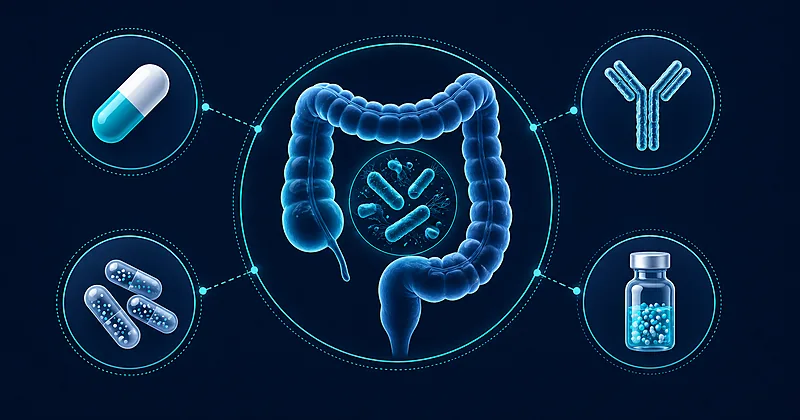
Why C Difficile Treatment Matters
Clostridioides difficile remains one of the most common healthcare-associated infections, with US incidence in the hundreds of thousands of cases annually. Recurrence is the central clinical challenge: roughly 25% of patients recur after a first episode, with each subsequent recurrence raising the probability of further episodes.
The therapeutic landscape has shifted substantially in the past decade. Fidaxomicin trials repositioned the first-line agent. Bezlotoxumab introduced targeted recurrence prophylaxis. FMT moved from research curiosity to recommended therapy for recurrent disease. Two FDA-approved live biotherapeutics — Rebyota in 2022 and Vowst in 2023 — now provide standardised microbiome-restoration options.
Three forces drive the evidence base. First, randomised data consistently show fidaxomicin reduces recurrence versus vancomycin while matching initial cure. Second, MODIFY I and II established bezlotoxumab as adjunct prophylaxis for high-risk patients. Third, the FMT and live-biotherapeutic literature reframes recurrent CDI as a microbiome-restoration problem rather than a purely antibiotic one.
This C difficile treatment synthesis maps the modern evidence onto the practical decisions internists make: which antibiotic to start, whether to add an antibody, when to escalate to microbiome-based therapy, and how to choose between FMT and live biotherapeutics.
Evidence Reviewed for C Difficile Treatment
This C difficile treatment synthesis draws on ten major sources, including the two pivotal fidaxomicin trials (Louie 2011, Cornely 2012), the MODIFY I and II bezlotoxumab trials (Wilcox 2017), the first randomised FMT trial (van Nood 2013), the Phase 3 PUNCH CD3 and ECOSPOR III trials of the FDA-approved live biotherapeutics, and the IDSA/SHEA 2021 focused update.
Studies were chosen to span every clinically meaningful decision point: initial-episode antibiotic selection, recurrence prophylaxis, microbiome restoration after recurrence, and guideline-level integration of the components into a coherent C difficile treatment pathway.
| Study / Source | Year | Design | n | Primary Outcome | Key Result |
|---|---|---|---|---|---|
| Johnson (IDSA/SHEA focused update) | 2021 | Consensus guideline | NR | Recommendations | Fidaxomicin recommended first-line for initial and recurrent episodes; metronidazole downgraded |
| Kelly (ACG guidelines) | 2021 | Consensus guideline | NR | Recommendations | Fidaxomicin or vancomycin first-line; FMT recommended for second or later recurrence |
| van Prehn (ESCMID 2021) | 2021 | European guideline | NR | Recommendations | Fidaxomicin first-line; standardised FMT/microbiome therapy for recurrent disease |
| Louie (fidaxomicin pivotal) | 2011 | Multicentre RCT | 629 evaluable | Initial cure and recurrence at 4 weeks | Initial cure non-inferior; recurrence 15.4% (fidaxomicin) vs 25.3% (vancomycin) |
| Cornely (fidaxomicin EU/CAN/US) | 2012 | Double-blind non-inferiority RCT | 535 evaluable | Sustained clinical response | Sustained response 76.6% (fidaxomicin) vs 63.4% (vancomycin); recurrence reduction confirmed |
| Wilcox (MODIFY I and II) | 2017 | Two parallel multicentre RCTs | 2,655 | Recurrence at 12 weeks | Bezlotoxumab 17.4% vs placebo 27.6%; ~38% relative recurrence reduction |
| van Nood (FMT) | 2013 | Open-label RCT (early stopped) | 43 randomised | Resolution of CDI without recurrence at 10 weeks | FMT 81% (single infusion) vs vancomycin alone 31% |
| Khanna (PUNCH CD3 — Rebyota) | 2022 | Phase 3 RCT (Bayesian primary) | 262 modelled | Treatment success at 8 weeks | Rebyota 70.6% vs placebo 57.5% in Bayesian model; FDA-approved 2022 |
| Feuerstadt (ECOSPOR III — Vowst/SER-109) | 2022 | Phase 3 RCT | 182 | Recurrence at 8 weeks | SER-109 12% vs placebo 40% recurrence; sustained 88% vs 60%; FDA-approved 2023 |
| Crook (fidaxomicin meta-analysis) | 2012 | Pooled analysis of pivotal trials | 1,164 | Recurrence and sustained response | Approximately 40% relative reduction in recurrence with fidaxomicin vs vancomycin |
Key Findings: How C Difficile Treatment Has Evolved
Fidaxomicin Replaces Vancomycin as First-Line in C Difficile Treatment
Two pivotal multicentre randomised trials established the modern C difficile treatment hierarchy. Louie 2011 randomised 629 evaluable patients in North America to fidaxomicin or oral vancomycin; initial cure was non-inferior, and recurrence at 4 weeks was 15.4% with fidaxomicin versus 25.3% with vancomycin.
Cornely 2012 replicated these findings in 535 European, Canadian, and US patients, with sustained clinical response of 76.6% (fidaxomicin) versus 63.4% (vancomycin). The Crook 2012 pooled analysis confirmed approximately a 40% relative reduction in recurrence with fidaxomicin versus vancomycin without compromising initial cure.
The IDSA/SHEA 2021 focused update therefore recommends fidaxomicin as first-line for both initial and recurrent episodes. Vancomycin remains an acceptable alternative; metronidazole is downgraded and reserved for non-severe episodes when neither fidaxomicin nor vancomycin is available.
Bezlotoxumab Adds Targeted Recurrence Prophylaxis to C Difficile Treatment
Bezlotoxumab is a fully human monoclonal antibody against C difficile toxin B. The MODIFY I and II trials (Wilcox 2017) randomised 2,655 patients receiving standard-of-care C difficile treatment to a single bezlotoxumab infusion or placebo; recurrence at 12 weeks was 17.4% versus 27.6%, an approximately 38% relative reduction.
Bezlotoxumab does not treat the active episode; it adds protection against recurrence. The greatest absolute benefit is observed in patients with multiple recurrence-risk factors: age ≥ 65, prior CDI, immunocompromise, severe disease, and known epidemic strain (e.g., ribotype 027). Cardiovascular safety in patients with heart failure deserves attention given a small numerical signal in MODIFY trials.
FMT Establishes Microbiome Restoration in C Difficile Treatment
The van Nood 2013 randomised trial was stopped early after duodenal-infusion FMT cured 81% of patients with recurrent CDI versus 31% with vancomycin alone. Subsequent open-label series, registries, and small randomised trials have repeatedly reproduced cure rates of approximately 80–90% across delivery routes (colonoscopy, upper-GI infusion, capsule).
FMT now occupies a defined position in C difficile treatment guidelines for recurrent disease after at least one prior recurrence on appropriate antibiotic therapy. Procedural and donor-screening complexity, plus an FDA safety alert about transmission of multidrug-resistant organisms, drove development of standardised, regulated alternatives within the broader C difficile treatment pathway.
Live Biotherapeutics Enter the C Difficile Treatment Pathway
Rebyota (faecal microbiota live-jslm; previously RBX2660) was FDA-approved in 2022 based on the PUNCH CD3 Phase 3 trial. The Bayesian primary analysis combining PUNCH CD2 and CD3 estimated treatment success at 70.6% with Rebyota versus 57.5% with placebo at 8 weeks following completion of antibiotic therapy.
Vowst (SER-109) is an oral capsule of purified Firmicutes spores. The ECOSPOR III trial (Feuerstadt 2022) randomised 182 patients to SER-109 or placebo after antibiotic-treated recurrence; recurrence at 8 weeks was 12% with SER-109 versus 40% with placebo, supporting FDA approval in 2023.
Both products are positioned for prevention of recurrence after a course of standard CDI antibiotics in patients with one or more prior recurrences. They do not replace antibiotic therapy for the active episode.
How the Modern C Difficile Treatment Pathway Integrates
The modern C difficile treatment pathway is sequential. First, treat the active episode with fidaxomicin (preferred) or vancomycin. Second, consider bezlotoxumab for high-risk patients during the antibiotic course. Third, for recurrent disease after antibiotic therapy, choose between FMT, Rebyota, or Vowst based on local availability, patient preference, and route tolerance.
The IDSA/SHEA 2021 focused update prefers fidaxomicin for initial CDI based on the recurrence-reduction signal. Practical considerations that may favour vancomycin:
- Cost and formulary access — fidaxomicin remains substantially more expensive in most settings.
- Severe or fulminant disease — both are appropriate; vancomycin (with adjunctive IV metronidazole and consideration of rectal vancomycin in ileus) has more accumulated experience.
- Inability to tolerate twice-daily oral dosing — vancomycin is dosed four times daily but well-tolerated.
For recurrent disease, fidaxomicin (standard or extended-pulse regimen) is preferred over a vancomycin taper-and-pulse in the IDSA/SHEA focused update.
The greatest absolute benefit in MODIFY I and II was observed in patients with one or more of:
- Age ≥ 65 years.
- Prior CDI episode within 6 months.
- Immunocompromise (haematologic malignancy, solid-organ transplant, chemotherapy).
- Severe CDI episode.
- Known epidemic strain (ribotype 027 or other hypervirulent).
Bezlotoxumab is given as a single infusion during the antibiotic course. Caution is warranted in patients with heart failure given a small numerical safety signal; the decision should be individualised.
The three options share the same therapeutic intent (microbiome restoration) but differ operationally:
- FMT — Highest reported efficacy (~80–90%) in randomised and observational data; requires donor screening, processing, and a delivery procedure (colonoscopy, capsule, or enema). FDA enforcement-discretion framework rather than full approval.
- Rebyota — Standardised rectal product; Phase 3 PUNCH CD3 used a Bayesian analysis combining trials. Treatment success ~71% vs ~58% placebo at 8 weeks.
- Vowst — Oral capsule; ECOSPOR III recurrence 12% vs 40% placebo at 8 weeks; preceded by bowel preparation. Most patient-friendly delivery route.
Choice depends on local availability, cost coverage, route tolerance, and clinician familiarity. None replaces antibiotic therapy for the active episode.
Synthesis pearl: The strongest C difficile treatment evidence supports fidaxomicin as first-line, bezlotoxumab as targeted recurrence prophylaxis in high-risk patients, and microbiome restoration (FMT, Rebyota, or Vowst) for recurrent disease. The modern pathway is sequential and complementary rather than competitive.
C Difficile Treatment Evidence Quality and Consistency
Evidence strength varies meaningfully across the four pillars of modern C difficile treatment. The labeled list below maps each component to the design and consistency of the underlying studies.
What the C Difficile Treatment Evidence Does Not Show
Specific Gaps in the C Difficile Treatment Evidence Base
- No head-to-head FMT vs Rebyota vs Vowst trials. Comparative effectiveness rests on observational and indirect data. Choice in practice is driven by availability, cost, and route preference.
- Optimal patient selection for bezlotoxumab. Risk-factor models (age, prior CDI, immunocompromise, severe disease, ribotype 027) identify high-risk groups, but the threshold at which absolute benefit justifies the cost is unsettled.
- Severe and fulminant CDI. Most trials excluded fulminant disease; the role of fidaxomicin versus combination therapy with intravenous metronidazole and rectal vancomycin in ileus has limited randomised support.
- Pediatric C difficile treatment. Adult trial data do not transfer cleanly to children; pediatric-specific guidelines exist but with weaker evidentiary support.
- Long-term microbiome and oncologic outcomes. Whether FMT or live biotherapeutics influence subsequent infection susceptibility, IBD risk, or oncologic outcomes is incompletely characterised.
- Cost-effectiveness across health systems. Most economic analyses are US-based; pathways in single-payer or resource-limited systems remain less well modelled.
- Asymptomatic carriage management. Treatment of asymptomatic colonisation in hospital-roommate or transplant settings is not supported by randomised evidence.
These gaps explain why C difficile treatment guidelines emphasise individualised decisions within the four-pillar framework and why pathway operationalisation differs across institutions despite broad consensus on the components.
Practical Implications for C Difficile Treatment
Based on the current evidence, the C difficile treatment implications below describe what the data support — not categorical recommendations. Clinical judgement, formulary access, and patient preferences remain decisive at the bedside.
Evidence Supports Fidaxomicin Over Vancomycin for Initial Episodes
Pooled trial data show approximately a 40% relative recurrence reduction without compromising initial cure. Vancomycin remains an acceptable alternative when fidaxomicin is not available.
Bezlotoxumab Reduces Recurrence in High-Risk Patients
A single infusion during antibiotic therapy reduces 12-week recurrence by ~38% in MODIFY I and II. Greatest absolute benefit in patients with multiple recurrence-risk factors; cardiovascular caution in heart failure.
FMT Has the Strongest Recurrence-Prevention Signal
Cure rates of 80–90% across delivery routes, supported by randomised and observational data. Operational complexity and donor screening drive use of regulated alternatives where available.
Rebyota and Vowst Offer FDA-Approved Live Biotherapeutic Alternatives
Phase 3 data support both products for recurrence prevention after antibiotic-treated recurrent CDI. Choice between rectal Rebyota and oral Vowst depends on local availability, route tolerance, and cost.
Two operational themes unify these C difficile treatment implications. First, the pathway is sequential — antibiotic for the active episode, antibody for high recurrence risk, microbiome restoration after recurrence — and substitutions across these tiers lose efficacy. Second, the four pillars complement rather than compete with one another.
C Difficile Treatment Evidence Grade and Bottom Line
Overall Evidence Grade: Strong — Fidaxomicin first-line, bezlotoxumab adjunct, and FMT for recurrent disease all rest on randomised pivotal trials. The live biotherapeutics carry Phase 3 RCT support and FDA approval. Comparative effectiveness across the microbiome-restoration options is the principal outstanding question, alongside performance in severely immunocompromised populations.
Bottom Line
- Fidaxomicin is now first-line for initial and recurrent CDI per the IDSA/SHEA 2021 focused update; vancomycin remains an acceptable alternative.
- Metronidazole is no longer first-line and is reserved for non-severe episodes when neither fidaxomicin nor vancomycin can be used.
- Bezlotoxumab adds an approximately 38% relative recurrence reduction in high-risk patients during the antibiotic course; cardiovascular caution in heart failure.
- FMT cures roughly 80–90% of recurrent CDI; FDA-approved Rebyota and Vowst now offer standardised microbiome-restoration alternatives.
- The modern pathway is sequential and complementary, with antibiotic, antibody, and microbiome-restoration steps each addressing a distinct mechanism of recurrence.
Article Information and References
For Educational Purposes Only. This is an original evidence synthesis informed by the studies listed below. It does not replace clinical judgement. Drug dosages should be verified against current prescribing information.
References
- Johnson S, Lavergne V, Skinner AM, et al. Clinical Practice Guideline by the Infectious Diseases Society of America (IDSA) and Society for Healthcare Epidemiology of America (SHEA): 2021 Focused Update Guidelines on Management of Clostridioides difficile Infection in Adults. Clin Infect Dis. 2021;73(5):e1029–e1044. DOI: 10.1093/cid/ciab549
- Kelly CR, Fischer M, Allegretti JR, et al. ACG Clinical Guidelines: Prevention, Diagnosis, and Treatment of Clostridioides difficile Infections. Am J Gastroenterol. 2021;116(6):1124–1147. DOI: 10.14309/ajg.0000000000001278
- van Prehn J, Reigadas E, Vogelzang EH, et al. European Society of Clinical Microbiology and Infectious Diseases: 2021 Update on the Treatment Guidance Document for Clostridioides difficile Infection in Adults. Clin Microbiol Infect. 2021;27 Suppl 2:S1–S21. DOI: 10.1016/j.cmi.2021.09.038
- Louie TJ, Miller MA, Mullane KM, et al. Fidaxomicin versus Vancomycin for Clostridium difficile Infection. N Engl J Med. 2011;364(5):422–431. DOI: 10.1056/NEJMoa0910812
- Cornely OA, Crook DW, Esposito R, et al. Fidaxomicin Versus Vancomycin for Infection with Clostridium difficile in Europe, Canada, and the USA: A Double-Blind, Non-Inferiority, Randomised Controlled Trial. Lancet Infect Dis. 2012;12(4):281–289. DOI: 10.1016/S1473-3099(11)70374-7
- Wilcox MH, Gerding DN, Poxton IR, et al. Bezlotoxumab for Prevention of Recurrent Clostridium difficile Infection. N Engl J Med. 2017;376(4):305–317. DOI: 10.1056/NEJMoa1602615
- van Nood E, Vrieze A, Nieuwdorp M, et al. Duodenal Infusion of Donor Feces for Recurrent Clostridium difficile. N Engl J Med. 2013;368(5):407–415. DOI: 10.1056/NEJMoa1205037
- Khanna S, Assi M, Lee C, et al. Efficacy and Safety of RBX2660 in PUNCH CD3, a Phase III, Randomized, Double-Blind, Placebo-Controlled Trial with a Bayesian Primary Analysis for the Prevention of Recurrent Clostridioides difficile Infection. Drugs. 2022;82(15):1527–1538. DOI: 10.1007/s40265-022-01797-x
- Feuerstadt P, Louie TJ, Lashner B, et al. SER-109, an Oral Microbiome Therapy for Recurrent Clostridioides difficile Infection. N Engl J Med. 2022;386(3):220–229. DOI: 10.1056/NEJMoa2106516
- Cammarota G, Ianiro G, Tilg H, et al. European Consensus Conference on Faecal Microbiota Transplantation in Clinical Practice. Gut. 2017;66(4):569–580. DOI: 10.1136/gutjnl-2016-313017
- Crook DW, Walker AS, Kean Y, et al. Fidaxomicin Versus Vancomycin for Clostridium difficile Infection: Meta-Analysis of Pivotal Randomized Controlled Trials. Clin Infect Dis. 2012;55 Suppl 2:S93–S103. DOI: 10.1093/cid/cis499
- McDonald LC, Gerding DN, Johnson S, et al. Clinical Practice Guidelines for Clostridium difficile Infection in Adults and Children: 2017 Update by the Infectious Diseases Society of America (IDSA) and Society for Healthcare Epidemiology of America (SHEA). Clin Infect Dis. 2018;66(7):e1–e48. DOI: 10.1093/cid/cix1085
- Sims MD, Khanna S, Feuerstadt P, et al. Safety and Tolerability of SER-109 as an Investigational Microbiome Therapeutic in Adults With Recurrent Clostridioides difficile Infection: A Phase 3, Open-Label, Single-Arm Trial. JAMA Netw Open. 2023;6(2):e2255758. DOI: 10.1001/jamanetworkopen.2022.55758