
Gout Treatment: Robust Effects on 4 Outcomes
An evidence synthesis of treat-to-target urate-lowering therapy with allopurinol, the febuxostat cardiovascular safety signal, and the role of pegloticase for refractory tophaceous gout in adults.
One-Minute Takeaway on Gout Treatment
One-Minute Takeaway
- Modern gout treatment is a treat-to-target strategy: urate-lowering therapy titrated to a serum urate below 6 mg/dL (or below 5 mg/dL for tophaceous disease), which the 2020 ACR guideline strongly recommends for patients with frequent flares, tophi, radiographic damage, or stage 3 or higher CKD.
- Allopurinol is first-line, started at ≤ 100 mg/day (≤ 50 mg/day in CKD stage 4 or worse) and titrated every 2–5 weeks; doses up to 800–900 mg/day are required in some patients to achieve the urate target safely (Stamp 2017).
- The CARES trial (White 2018) reported a higher cardiovascular and all-cause mortality signal for febuxostat versus allopurinol; the FAST trial (Mackenzie 2020) did not reproduce this finding, leaving the safety question only partially resolved.
- Pegloticase reaches a complete urate-lowering response in about 42% of refractory tophaceous cases at six months (Sundy 2011); immunogenicity and infusion reactions limit its use to selected patients.
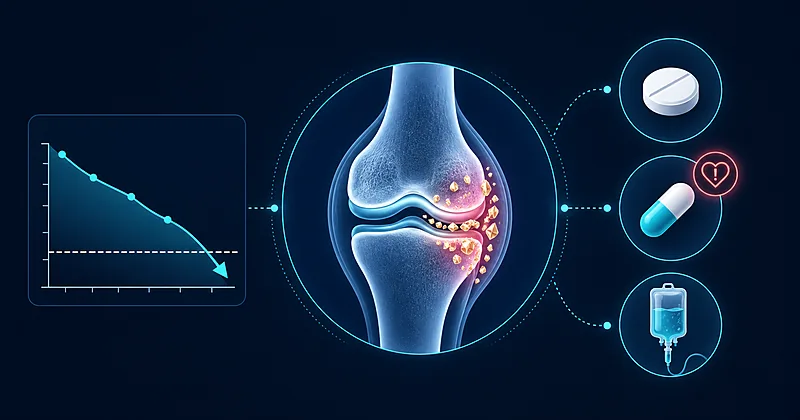
Why Gout Treatment Matters
Gout is the most common inflammatory arthritis in adults, with prevalence around 4% in the United States and rising globally with increasing rates of obesity, metabolic syndrome, and CKD. Untreated, it is a chronic crystal-deposition disease that produces flares, tophi, joint damage, and contributes to cardiovascular and renal morbidity.
Despite well-defined pathophysiology and effective therapy, real-world gout treatment remains undertreated. Population studies consistently show that only one-third to half of patients prescribed urate-lowering therapy achieve the target serum urate, and adherence drops below 50% within the first year. The gap between guideline recommendation and bedside execution is the central problem in modern gout treatment.
Three forces shape the modern evidence base. First, the 2020 ACR guideline endorsed treat-to-target as the dominant strategy after years of strategy-versus-fixed-dose debate. Second, the CARES cardiovascular signal in 2018 reframed febuxostat positioning relative to allopurinol. Third, pegloticase emerged for the small but clinically intense refractory population.
This gout treatment synthesis maps the evidence onto four clinically actionable outcomes: serum urate target attainment, acute flare frequency, tophi reduction, and cardiovascular safety. Each section frames findings by the strength of the underlying study design rather than enthusiasm for any single agent.
Evidence Reviewed for Gout Treatment
This gout treatment synthesis draws on ten major sources, including the two anchor cardiovascular safety trials (CARES, FAST), randomised studies of allopurinol dose-escalation strategy (Stamp 2017), the pegloticase pivotal trials (Sundy 2011), the nurse-led NORM-T treat-to-target trial (Doherty 2018), and the consensus 2020 ACR guideline.
Studies were chosen to span each clinically meaningful outcome: urate target attainment (NORM-T, Stamp 2017), flare reduction (NORM-T, FACT, CARES), tophi reduction (Sundy 2011, Becker FACT extension), and cardiovascular safety (CARES, FAST). Pharmacogenomic context comes from Hung 2005 on the HLA-B*5801 association with allopurinol hypersensitivity.
| Study / Source | Year | Design | n | Primary Outcome | Key Result |
|---|---|---|---|---|---|
| FitzGerald (ACR 2020 guideline) | 2020 | Consensus guideline | NR | Recommendations | Strongly recommends treat-to-target serum urate < 6 mg/dL with allopurinol as first-line ULT |
| Richette (EULAR 2016) | 2017 | Consensus guideline | NR | European recommendations | Treat-to-target with allopurinol first-line; xanthine oxidase inhibitor switch if target unmet |
| White (CARES) | 2018 | Multicentre RCT | 6,190 | CV death and primary CV composite | Febuxostat vs allopurinol non-inferior for primary CV composite; HR 1.34 (95% CI 1.03–1.73) for CV death |
| Mackenzie (FAST) | 2020 | Multicentre RCT (UK/EU) | 6,128 | Hospitalisation for non-fatal MI/biomarker-positive ACS, non-fatal stroke, CV death | Febuxostat non-inferior to allopurinol for primary CV composite; HR 0.85 (95% CI 0.70–1.03) |
| Stamp (allopurinol dose escalation) | 2017 | RCT | 183 | Serum urate target attainment | Dose escalation above creatinine-based limits achieved target in 69% with no excess hypersensitivity |
| Becker (FACT) | 2005 | Multicentre RCT | 762 | Serum urate < 6.0 mg/dL at 3 months | Febuxostat 80 mg outperformed allopurinol 300 mg (53% vs 21% target attainment in this dose comparison) |
| Sundy (pegloticase trials) | 2011 | Replicate Phase 3 RCTs | 225 (combined) | Plasma urate < 6 mg/dL ≥ 80% of months 3 and 6 | Biweekly pegloticase achieved primary endpoint in 42% vs 0% placebo; tophi reduction in responders |
| Doherty (NORM-T) | 2018 | Pragmatic RCT | 517 | Serum urate < 6 mg/dL at 2 years | Nurse-led treat-to-target achieved target in 95% vs 30% with usual care; flare frequency lower in intervention |
| Hung (HLA-B*5801) | 2005 | Genetic case-control | 51 cases / 228 controls | Risk allele association | HLA-B*5801 strongly associated with severe cutaneous adverse reactions to allopurinol in Han Chinese |
| Stamp (starting-dose risk) | 2012 | Case-control | 54 cases / 157 controls | Allopurinol hypersensitivity syndrome | Starting dose normalised to renal function reduced AHS risk; supports low-and-slow titration |
Key Findings: Gout Treatment Effects on Four Outcomes
Outcome 1 — Serum Urate Target Attainment
Treat-to-target gout treatment is the most reproducible finding in the modern evidence base. The NORM-T pragmatic trial (Doherty 2018) randomised 517 patients to nurse-led treat-to-target gout treatment versus usual primary care; at two years, 95% of intervention patients achieved serum urate below 6 mg/dL versus 30% with usual care.
The Stamp 2017 dose-escalation RCT showed that allopurinol could be safely titrated above the creatinine-clearance-based limit historically applied to CKD patients, with 69% achieving target and no excess in hypersensitivity reactions when the low-and-slow start was preserved. Together, these trials anchor the operational message in gout treatment: target attainment depends on titration discipline, not drug choice.
Outcome 2 — Acute Flare Frequency
Sustained urate lowering reduces flare frequency over time, but flares often increase in the first 3–6 months of therapy as crystal deposits mobilise. The 2020 ACR guideline strongly recommends concomitant prophylaxis (colchicine, low-dose NSAID, or low-dose corticosteroid) for at least 3–6 months when initiating urate-lowering therapy.
In the NORM-T trial, the gout treatment intervention group reported lower flare frequency by year two despite the early prophylaxis-period flares. Across observational cohorts, sustained urate below 6 mg/dL is associated with substantial flare-free intervals; sustained urate below 5 mg/dL accelerates this benefit in tophaceous disease.
Outcome 3 — Tophi Reduction
Tophi resolution is a slow process that depends on cumulative urate gradient below the saturation threshold. The Sundy 2011 pegloticase pivotal trials reported tophi reduction in responders, with the magnitude proportional to the depth of urate suppression.
For non-pegloticase regimens within standard gout treatment, tophi typically shrink over 12–24 months when serum urate is held below 5 mg/dL, with small or recently-formed tophi resolving fastest. Larger, calcified, or long-standing tophi may not regress fully even with sustained low urate, supporting earlier and more aggressive gout treatment in patients with tophaceous disease at presentation.
Outcome 4 — Cardiovascular Safety Profile
The CARES trial (White 2018) randomised 6,190 patients with gout and known cardiovascular disease to febuxostat or allopurinol. The primary CV composite was non-inferior between agents, but cardiovascular death (HR 1.34, 95% CI 1.03–1.73) and all-cause death were higher with febuxostat — a finding that prompted FDA labelling and reshaped prescribing.
The FAST trial (Mackenzie 2020), a UK/European pragmatic RCT of 6,128 patients, did not reproduce the CARES signal. Febuxostat was non-inferior to allopurinol for the primary cardiovascular composite (HR 0.85, 95% CI 0.70–1.03), with no excess in cardiovascular or all-cause mortality.
The discordance is most plausibly explained by differences in CV-disease prevalence at baseline, allopurinol dosing approach, and patient retention. Most clinicians now treat febuxostat in gout treatment pathways as a reasonable second-line option after allopurinol failure, intolerance, or HLA-B*5801 positivity, rather than a routine first-line agent.
How the Four Gout Treatment Outcomes Connect
The four gout treatment outcomes are sequential rather than parallel. Achieving the urate target (Outcome 1) drives flare reduction (Outcome 2), which drives tophi resolution (Outcome 3) over time. Cardiovascular safety (Outcome 4) is a comparative property of the agent chosen and does not change the treat-to-target principle of gout treatment itself.
The Stamp 2017 RCT supports allopurinol dose escalation above creatinine-clearance-based limits when the start is low and titration is slow. A pragmatic algorithm:
- Start at 100 mg/day (50 mg/day in CKD stage 4 or worse, or in older Asian patients pre-HLA-B*5801 testing).
- Increase by 50–100 mg every 2–5 weeks until serum urate is < 6 mg/dL (or < 5 mg/dL for tophaceous disease).
- Recheck serum urate, creatinine, and ALT/AST with each titration step in early phases.
- Doses up to 800–900 mg/day are appropriate for some patients to reach target; the older 300 mg/day cap is no longer evidence-based.
Co-prescribe colchicine 0.5–0.6 mg once or twice daily (renal-adjusted) for flare prophylaxis during the first 3–6 months of titration, switching to low-dose NSAID or corticosteroid if colchicine is not tolerated.
Allopurinol hypersensitivity syndrome (Stevens–Johnson syndrome / toxic epidermal necrolysis spectrum) carries a mortality of 20–25% in severe cases. The HLA-B*5801 allele is strongly associated with this reaction, particularly in Han Chinese, Korean, and Thai populations where allele frequency reaches 5–8%.
The 2020 ACR guideline conditionally recommends HLA-B*5801 screening before initiating allopurinol in:
- Patients of Han Chinese, Korean, or Thai descent regardless of CKD status.
- Patients of African American descent (allele frequency lower but still meaningful).
For HLA-B*5801-positive patients, alternative gout treatment options include febuxostat (with appropriate cardiovascular risk discussion) or uricosuric agents (probenecid where available; lesinurad combinations were withdrawn from many markets).
Three differences plausibly explain the divergent CV findings:
- CARES enrolled patients with established cardiovascular disease; FAST enrolled patients with at least one CV risk factor but lower overall baseline CV risk.
- CARES had a high discontinuation rate (~57%), introducing informative censoring; FAST had lower attrition.
- Allopurinol dosing in CARES was generally up to 600 mg/day; FAST permitted titration to target consistent with European practice.
Pragmatically, most rheumatology and internal medicine bodies now position febuxostat as a second-line agent for patients who fail or cannot tolerate allopurinol, with an explicit cardiovascular risk discussion in those with established CVD.
Synthesis pearl: The strongest gout treatment evidence supports treat-to-target with allopurinol as first-line, slow titration with prophylaxis, and reservation of febuxostat and pegloticase for specific second- and third-line indications. Urate target attainment is the unifying mechanism behind all four downstream outcomes.
Gout Treatment Evidence Quality and Consistency
Evidence strength varies meaningfully across the four gout treatment outcomes. The labeled list below maps each component to the design and consistency of the underlying studies.
What the Gout Treatment Evidence Does Not Show
Specific Gaps in the Gout Treatment Evidence Base
- Definitive resolution of the febuxostat CV signal. CARES and FAST diverge; no further trial of comparable size is planned. The clinical answer rests on weighing trial-design differences rather than fresh evidence.
- Optimal urate target in non-tophaceous disease. ACR 2020 endorses < 6 mg/dL but does not require < 5 mg/dL outside tophaceous disease; randomised comparison of target depths in non-tophaceous gout is limited.
- Long-term prophylaxis duration. The 3–6 month minimum is supported, but optimal duration in patients with persistent low-level inflammation, tophaceous disease, or rapid initial titration is uncertain.
- Asymptomatic hyperuricaemia treatment. No randomised data support routine ULT in the absence of clinical disease, despite epidemiologic associations.
- Direct head-to-head comparison of pegloticase plus methotrexate vs pegloticase alone. Anti-drug antibody prevention with methotrexate looks promising in MIRROR-RCT but extended-duration data and renal-impairment subgroups remain limited.
- Cardiovascular benefit of urate lowering itself. Whether sustained low urate reduces hard CV events independently of the agent used is observational at present; randomised mortality benefit has not been demonstrated.
- Best ULT in advanced CKD. Allopurinol titration is supported by Stamp 2017 in CKD up to stage 3; data in CKD stage 4–5 and dialysis populations are sparser.
These gaps explain why guidelines emphasise individualised gout treatment within the treat-to-target framework, and why febuxostat positioning differs subtly between US and European recommendations.
Practical Implications for Gout Treatment
Based on the current evidence, the gout treatment implications below describe what the data support — not categorical recommendations. Clinical judgement, comorbidity profile, and patient preferences remain decisive at the bedside.
Evidence Supports Treat-to-Target with Allopurinol as First-Line
Pragmatic randomised data (NORM-T) and dose-escalation trials (Stamp 2017) consistently favour structured titration to a serum urate below 6 mg/dL. Nurse- or pharmacist-led pathways outperform usual primary-care management in target attainment.
Slow Allopurinol Initiation Reduces Hypersensitivity Risk
Starting at ≤ 100 mg/day (≤ 50 mg/day in advanced CKD) with renal-adjusted dosing reduces the risk of allopurinol hypersensitivity syndrome without sacrificing eventual target attainment.
Febuxostat Shows Comparable Urate Lowering with Cardiovascular Caveats
The CARES signal is not reproduced in FAST, but most current guidelines position febuxostat as a second-line option after allopurinol failure or intolerance, with an explicit CV-risk discussion in patients with established CVD.
Pegloticase Has a Defined Role in Refractory Tophaceous Disease
For patients who cannot achieve target on oral therapy and have tophaceous burden, biweekly pegloticase achieves durable response in ~42%, with co-administered methotrexate showing promise for response durability.
Two operational themes unify these gout treatment implications. First, target attainment depends on titration discipline more than on drug choice — most failures are under-titration, not under-potency. Second, comorbidities (CKD, established CVD, ancestry-related HLA-B*5801 risk) drive agent selection more than urate level alone.
Gout Treatment Evidence Grade and Bottom Line
Overall Evidence Grade: Strong — The treat-to-target framework, allopurinol dose escalation, and pegloticase efficacy in refractory disease rest on randomised trials and concordant guideline support. The febuxostat cardiovascular safety question is a notable Moderate-strength island within an otherwise Strong evidence base.
Bottom Line
- Treat-to-target with serum urate below 6 mg/dL is the unifying principle, supported by randomised and pragmatic trials and endorsed by ACR 2020 and EULAR 2016.
- Allopurinol remains first-line; titrate from a low starting dose to target with co-prescribed prophylaxis for the first 3–6 months.
- Febuxostat is a reasonable second-line option after allopurinol failure or intolerance, with an explicit cardiovascular risk discussion for patients with established CVD given the unresolved CARES versus FAST data.
- Pegloticase is reserved for refractory tophaceous disease and reaches a complete response in approximately 42% of patients at six months; co-administered methotrexate is increasingly used to extend response.
- HLA-B*5801 screening is supported in Han Chinese, Korean, Thai, and African American populations before initiating allopurinol; alternative agents apply when positive.
Article Information and References
For Educational Purposes Only. This is an original evidence synthesis informed by the studies listed below. It does not replace clinical judgement. Drug dosages should be verified against current prescribing information.
References
- FitzGerald JD, Dalbeth N, Mikuls T, et al. 2020 American College of Rheumatology Guideline for the Management of Gout. Arthritis Care Res. 2020;72(6):744–760. DOI: 10.1002/acr.24180
- Richette P, Doherty M, Pascual E, et al. 2016 Updated EULAR Evidence-Based Recommendations for the Management of Gout. Ann Rheum Dis. 2017;76(1):29–42. DOI: 10.1136/annrheumdis-2016-209707
- White WB, Saag KG, Becker MA, et al. Cardiovascular Safety of Febuxostat or Allopurinol in Patients with Gout (CARES). N Engl J Med. 2018;378(13):1200–1210. DOI: 10.1056/NEJMoa1710895
- Mackenzie IS, Ford I, Nuki G, et al. Long-Term Cardiovascular Safety of Febuxostat Compared with Allopurinol in Patients with Gout (FAST): A Multicentre, Prospective, Randomised, Open-Label, Non-Inferiority Trial. Lancet. 2020;396(10264):1745–1757. DOI: 10.1016/S0140-6736(20)32234-0
- Stamp LK, Chapman PT, Barclay ML, et al. A Randomised Controlled Trial of the Efficacy and Safety of Allopurinol Dose Escalation to Achieve Target Serum Urate. Ann Rheum Dis. 2017;76(9):1522–1528. DOI: 10.1136/annrheumdis-2016-210872
- Becker MA, Schumacher HR Jr, Wortmann RL, et al. Febuxostat Compared with Allopurinol in Patients with Hyperuricemia and Gout (FACT). N Engl J Med. 2005;353(23):2450–2461. DOI: 10.1056/NEJMoa050373
- Sundy JS, Baraf HSB, Yood RA, et al. Efficacy and Tolerability of Pegloticase for the Treatment of Chronic Gout in Patients Refractory to Conventional Treatment: Two Randomized Controlled Trials. JAMA. 2011;306(7):711–720. DOI: 10.1001/jama.2011.1169
- Doherty M, Jenkins W, Richardson H, et al. Efficacy and Cost-Effectiveness of Nurse-Led Care Involving Education and Engagement of Patients and a Treat-to-Target Urate-Lowering Strategy Versus Usual Care for Gout (NORM-T). Lancet. 2018;392(10156):1403–1412. DOI: 10.1016/S0140-6736(18)32158-5
- Hung SI, Chung WH, Liou LB, et al. HLA-B*5801 Allele as a Genetic Marker for Severe Cutaneous Adverse Reactions Caused by Allopurinol. Proc Natl Acad Sci USA. 2005;102(11):4134–4139. DOI: 10.1073/pnas.0409500102
- Stamp LK, Taylor WJ, Jones PB, et al. Starting Dose Is a Risk Factor for Allopurinol Hypersensitivity Syndrome: A Proposed Safe Starting Dose of Allopurinol. Arthritis Rheum. 2012;64(8):2529–2536. DOI: 10.1002/art.34488
- Khanna D, Khanna PP, FitzGerald JD, et al. 2012 American College of Rheumatology Guidelines for Management of Gout: Therapy and Antiinflammatory Prophylaxis of Acute Gouty Arthritis. Arthritis Care Res. 2012;64(10):1447–1461. DOI: 10.1002/acr.21773
- Saag KG, Whelton A, Becker MA, et al. Impact of Febuxostat on Renal Function in Gout Patients with Moderate-to-Severe Renal Impairment. Arthritis Rheumatol. 2016;68(8):2035–2043. DOI: 10.1002/art.39654
- Botson JK, Tesser JRP, Bennett R, et al. Pegloticase in Combination with Methotrexate in Patients with Uncontrolled Gout: A Multicenter, Open-Label Study (MIRROR). J Rheumatol. 2021;48(5):767–774. DOI: 10.3899/jrheum.200460