
ICS Withdrawal COPD: Critical Findings in 3 Subgroups
A synthesis of withdrawal trial evidence to guide ICS de-escalation in stable COPD, stratified by blood eosinophil count and exacerbation history.
One-Minute Takeaway on ICS Withdrawal COPD
What the withdrawal evidence shows
- Blood eosinophils drive the decision: ICS withdrawal COPD outcomes diverge sharply between patients with eosinophils <300 cells/µL (largely safe) and ≥300 cells/µL (excess exacerbation risk).
- Major RCTs are concordant: WISDOM and SUNSET both demonstrated neutral overall exacerbation rates but consistent harm signals in eosinophilic subgroups after stepwise ICS removal from triple therapy.
- Lung function dips modestly: A 20–40 mL FEV1 decrement accompanies withdrawal across studies, generally without symptomatic deterioration in non-eosinophilic patients.
- Frequent exacerbators were largely excluded: The withdrawal literature applies to relatively stable patients with at most one exacerbation in the prior year; data in frequent exacerbators remain limited.
- Guideline alignment: Current GOLD guidance supports ICS de-escalation when eosinophils are sustained <300 cells/µL and exacerbation history is unremarkable.
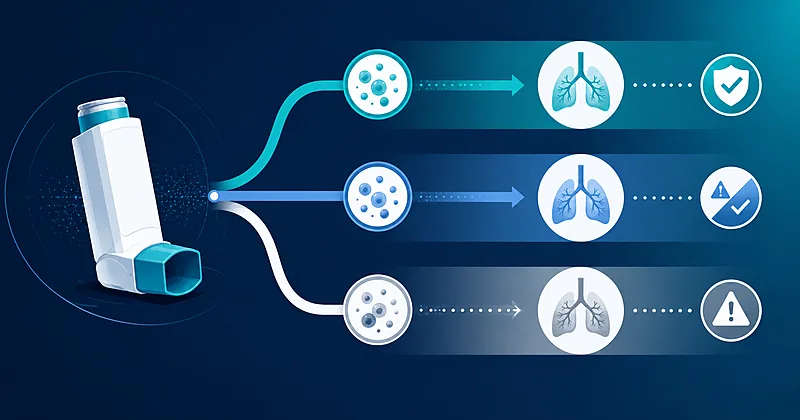
Why ICS Withdrawal COPD Decisions Matter
Inhaled corticosteroids remain widely prescribed in COPD, frequently as part of fixed-dose triple inhaler regimens. Real-world prescribing audits suggest a substantial proportion of patients receive ICS without a clear evidence-based indication, particularly those without frequent exacerbations or eosinophilic inflammation.
ICS exposure is not benign. Cumulative trial and observational data link long-term ICS use to increased pneumonia incidence, oropharyngeal candidiasis, dose-related dermatologic effects, and modest bone-density reductions in older adults. The pneumonia signal has been the most consistent and clinically important adverse effect.
ICS withdrawal COPD decisions therefore sit at the intersection of efficacy and safety. For patients who have been stable on triple therapy without recent exacerbations, the question is whether continued ICS exposure provides meaningful benefit or simply accumulates risk without offsetting gain.
Over the past decade, several pivotal randomised trials have addressed this clinical question directly. Their results have refined guideline recommendations on ICS withdrawal COPD strategy and now support a phenotype-driven approach, with blood eosinophil count and exacerbation history as the central decision criteria.
Evidence Reviewed
This ICS withdrawal COPD synthesis draws on four pivotal randomised withdrawal trials, a key eosinophil-stratified post-hoc analysis, a Cochrane systematic review, and a topic-specific meta-analysis. Together they cover more than 5,000 randomised patients spanning mild-to-severe COPD populations.
The table below summarises the comparative design and primary findings. Across studies, the most informative analyses are those that stratify outcomes by blood eosinophil count and prior exacerbation frequency.
| Study / Year | Design | Population (n) | Intervention | Primary Result |
|---|---|---|---|---|
| WISDOM (Magnussen 2014) | Double-blind RCT | 2,485 severe COPD, ≥1 exacerbation prior year | Stepwise fluticasone withdrawal vs continuation on tiotropium + salmeterol over 12 weeks | Non-inferior for time to first moderate/severe exacerbation; HR 1.06 (95% CI 0.94–1.19); FEV1 −38 mL at 18 weeks |
| WISDOM post-hoc (Watz 2016) | Pre-specified subgroup analysis | Eosinophil-stratified subset | Same withdrawal protocol, stratified by blood eosinophil count | HR 1.86 (95% CI 1.06–3.29) for moderate/severe exacerbations in patients with eosinophils ≥4% or ≥300 cells/µL |
| SUNSET (Chapman 2018) | Double-blind RCT | 1,053 non-frequent exacerbators on triple therapy | Switch to indacaterol/glycopyrronium vs continued triple therapy (52 weeks) | Exacerbation rate ratio 1.08 (95% CI 0.83–1.40); FEV1 −26 mL; eosinophil ≥300 subgroup rate ratio 1.86 |
| INSTEAD (Rossi 2014) | Double-blind RCT | 581 moderate COPD without recent exacerbations | Switch from salmeterol/fluticasone to indacaterol monotherapy | Non-inferior FEV1 and symptom outcomes; no exacerbation increase over 26 weeks |
| COSMIC (van der Valk 2002) | Double-blind RCT | 373 patients on fluticasone/salmeterol | Fluticasone withdrawal vs continuation | Increased rate of mild exacerbations after withdrawal; FEV1 decline more pronounced in withdrawal arm |
| Calzetta meta-analysis (2017) | Systematic review and meta-analysis | ~5,000 pooled across 5 RCTs | Pooled ICS withdrawal data | No overall increase in exacerbations; modest pooled FEV1 reduction of approximately 40 mL |
| Cochrane review (Yang 2017) | Systematic review | ICS-in-COPD trials | Pooled evidence on ICS effects including discontinuation | Low-to-moderate certainty for neutral overall exacerbation outcomes; signal of harm in higher-risk subgroups |
| Bafadhel post-hoc (2018) | Post-hoc analysis of three RCTs | ~12,000 across initiation trials | Eosinophil-stratified ICS response (initiation context) | Consistent threshold effect of blood eosinophils on ICS benefit, supporting reverse application to withdrawal decisions |
A few features of the ICS withdrawal COPD evidence base merit emphasis. Most randomised trials enrolled stable patients without frequent exacerbations, used 12 months or less of follow-up, and tested either stepwise reduction (WISDOM) or direct switch (SUNSET, INSTEAD) protocols.
Key Findings by Theme
Across the ICS withdrawal COPD literature, five themes recur. Each is supported by concordant findings across multiple trials, with consistent direction of effect and converging effect-size estimates.
Exacerbation risk varies sharply by phenotype
In aggregate, the four major withdrawal RCTs showed neutral exacerbation outcomes when populations were analysed as a whole. WISDOM met its non-inferiority margin for time to first moderate or severe exacerbation. SUNSET demonstrated a similarly neutral overall rate ratio of 1.08.
The picture changed when patients were stratified by blood eosinophil count. The WISDOM post-hoc analysis showed that withdrawal nearly doubled the risk of moderate-to-severe exacerbations in patients with eosinophils at or above 4% or 300 cells/µL.
SUNSET reproduced this phenotype-specific signal. The eosinophil-high subgroup experienced a rate ratio of approximately 1.86 versus continuation, while the eosinophil-low subgroup showed no detectable increase. These results align with the type-2 inflammation pathway and the corticosteroid-responsive component of COPD.
Eosinophil thresholds emerge consistently
Two thresholds recur across the literature: 100 cells/µL and 300 cells/µL. Below 100 cells/µL, no clear ICS benefit has been demonstrated in either initiation or withdrawal contexts. Between 100 and 300 cells/µL, evidence is intermediate and clinical judgement applies.
At or above 300 cells/µL, both initiation and ICS withdrawal COPD trials show concordant signals: these patients gain meaningful ICS benefit and tend to lose it when ICS is removed. The Bafadhel post-hoc analysis demonstrated the same threshold effect across three large initiation RCTs, providing complementary evidence.
Clinical pearl. The 300 cells/µL threshold is not a hard biological cliff but a clinically useful inflection point. Sustained values consistently above this level identify patients in whom ICS withdrawal carries meaningful exacerbation risk regardless of recent exacerbation history.
Lung function declines modestly after withdrawal
A consistent finding across the ICS withdrawal COPD trials is a small FEV1 decrement following ICS removal. WISDOM reported a 38 mL difference at 18 weeks. SUNSET reported a 26 mL difference at 52 weeks. INSTEAD found no significant FEV1 difference over 26 weeks.
The Calzetta meta-analysis pooled an aggregate FEV1 effect of approximately 40 mL, with wide confidence intervals reflecting between-study heterogeneity. The magnitude is well below the minimum clinically important difference (~100 mL) and rarely translates to symptomatic deterioration in non-eosinophilic patients.
Time course favours early detection
Where harm signals appeared, they emerged within the first six months of withdrawal. WISDOM detected divergence between treatment arms by approximately week 18, with the strongest signal in the final stepwise reduction. SUNSET observed the bulk of excess events within the first six months.
This time course supports structured follow-up after de-escalation: review at 4–8 weeks, again at 3–6 months, and a low threshold for ICS reintroduction if exacerbations or symptomatic deterioration emerge in the first half-year.
Frequent exacerbators were largely excluded from trials
A critical caveat across the ICS withdrawal COPD literature is that major trials enrolled relatively stable populations. WISDOM required only one exacerbation in the prior year. SUNSET deliberately excluded frequent exacerbators, defined as ≥2 moderate-to-severe events in the prior year.
No high-quality randomised data therefore exist on withdrawing ICS from patients with frequent exacerbations on background triple therapy. Observational data and clinical reasoning suggest withdrawal in this group carries higher risk; current guidance is to continue ICS unless eosinophils are sustained well below 100 cells/µL.
Quality and Consistency of Evidence
The ICS withdrawal COPD evidence base is anchored by several large, well-conducted, double-blind randomised trials, complemented by post-hoc subgroup analyses and a Cochrane systematic review. Quality varies across themes and outcomes.
Knowledge Gaps
Despite a strong randomised core, several clinically important ICS withdrawal COPD questions remain unresolved. The most important gaps are summarised below.
What the evidence does not show
- Long-term outcomes. Mortality, hospitalisation, and lung-function trajectory beyond 12 months after withdrawal are not well characterised in randomised cohorts.
- Frequent exacerbators. No high-quality RCT has addressed withdrawal in patients with ≥2 moderate exacerbations or any severe exacerbation in the prior year.
- Optimal eosinophil cutoff. The 300 cells/µL threshold derives largely from post-hoc analyses; prospective head-to-head comparisons of cutoffs (200 vs 300 vs 400) are lacking.
- Stepwise versus abrupt withdrawal. WISDOM tested a 12-week stepwise protocol; SUNSET used a direct switch. Comparative effectiveness of approaches has not been formally evaluated.
- Stability of eosinophil counts. Single-measurement decisions may misclassify patients with fluctuating counts; minimum measurement frequency and time-averaging strategies remain underspecified.
- Mild COPD populations. INSTEAD addressed switch in moderate disease; randomised evidence in GOLD A and B groups already taking triple therapy is limited.
Practical Implications for ICS Withdrawal COPD
The following implications synthesise current randomised evidence with GOLD guidance on ICS withdrawal COPD strategy. They are framed as evidence-based considerations rather than directive recommendations and remain subject to individual clinical judgement.
For patients with sustained eosinophils below 300 cells/µL and at most one moderate exacerbation in the prior year, randomised evidence indicates ICS removal from triple therapy is not associated with excess exacerbations.
Concordant subgroup findings from WISDOM and SUNSET indicate substantially elevated exacerbation risk after withdrawal in patients above this threshold, particularly when the count is sustained on repeat measurement.
Excess events in withdrawal trials emerged within the first six months. Evidence supports review at 4–8 weeks, repeat assessment at 3–6 months, and a low threshold for ICS reintroduction if exacerbations recur.
Most ICS withdrawal COPD trials followed patients for 12 months or less. Durable effects on lung-function trajectory, hospitalisation, and mortality remain incompletely defined; continued monitoring is reasonable.
Documentation supporting ICS withdrawal COPD decisions
Where ICS de-escalation is undertaken on the basis of current evidence, the clinical record can usefully document the original indication for ICS, the blood eosinophil count and exacerbation history at the decision point, the withdrawal protocol used, and a defined follow-up schedule for symptom and lung function review.
This documentation supports continuity of care and provides a clear basis for re-evaluation if exacerbations recur or eosinophils rise above threshold on subsequent measurement. It also aids communication with patients about the rationale for de-escalation and the indicators that would prompt ICS reintroduction.
Evidence Grade and Bottom Line
Overall evidence grade: Moderate
The core ICS withdrawal COPD conclusion — that withdrawal is generally safe in low-risk, low-eosinophil patients but carries excess exacerbation risk in eosinophilic patients — rests on consistent findings from multiple double-blind RCTs and is unlikely to be reversed by future research. Granular questions about long-term outcomes, frequent exacerbators, and the optimal eosinophil cutoff warrant additional study.
Bottom Line
- Blood eosinophil count is the central decision-maker; sustained values below 300 cells per microlitre identify patients in whom withdrawal carries minimal exacerbation penalty.
- Major randomised trials show neutral overall outcomes but concordant harm signals in eosinophilic subgroups, supporting a phenotype-driven approach to de-escalation.
- A small FEV1 decrement is expected after withdrawal but falls well below the clinically important threshold in non-eosinophilic patients.
- Frequent exacerbators were largely excluded from withdrawal trials; ICS continuation remains the default in this group unless eosinophils are persistently very low.
- Structured follow-up across the first six months reduces the risk of late detection of post-withdrawal deterioration and supports timely ICS reintroduction when needed.
Article Information and References
For Educational Purposes Only. This is an original evidence synthesis informed by the studies listed below. It does not replace clinical judgement. Drug dosages should be verified against current prescribing information.
References
- Magnussen H, Disse B, Rodriguez-Roisin R, et al. Withdrawal of inhaled glucocorticoids and exacerbations of COPD. N Engl J Med. 2014;371(14):1285–1294. DOI: 10.1056/NEJMoa1407154
- Watz H, Tetzlaff K, Wouters EFM, et al. Blood eosinophil count and exacerbations in severe COPD after withdrawal of inhaled corticosteroids: a post-hoc analysis of the WISDOM trial. Lancet Respir Med. 2016;4(5):390–398. DOI: 10.1016/S2213-2600(16)00100-4
- Chapman KR, Hurst JR, Frent S-M, et al. Long-term triple therapy de-escalation to indacaterol/glycopyrronium in patients with COPD (SUNSET): a randomized, double-blind, triple-dummy clinical trial. Am J Respir Crit Care Med. 2018;198(3):329–339. DOI: 10.1164/rccm.201803-0405OC
- Rossi A, van der Molen T, del Olmo R, et al. INSTEAD: a randomised switch trial of indacaterol versus salmeterol/fluticasone in moderate COPD. Eur Respir J. 2014;44(6):1548–1556. DOI: 10.1183/09031936.00126814
- van der Valk P, Monninkhof E, van der Palen J, Zielhuis G, van Herwaarden C. Effect of discontinuation of inhaled corticosteroids in patients with COPD: the COSMIC (COPD and Seretide: a Multi-Center Intervention and Characterization) study. Am J Respir Crit Care Med. 2002;166(10):1358–1363. DOI: 10.1164/rccm.200206-512OC
- Calzetta L, Matera MG, Braido F, et al. Withdrawal of inhaled corticosteroids in COPD: a meta-analysis. Pulm Pharmacol Ther. 2017;45:148–158. DOI: 10.1016/j.pupt.2017.06.002
- Yang IA, Clarke MS, Sim EHA, Fong KM. Inhaled corticosteroids for stable chronic obstructive pulmonary disease. Cochrane Database Syst Rev. 2012;(7):CD002991. DOI: 10.1002/14651858.CD002991.pub3
- Bafadhel M, Peterson S, De Blas MA, et al. Predictors of exacerbation risk and response to budesonide in patients with chronic obstructive pulmonary disease: a post-hoc analysis of three randomised trials. Lancet Respir Med. 2018;6(2):117–126. DOI: 10.1016/S2213-2600(18)30006-7
- Pascoe S, Locantore N, Dransfield MT, Barnes NC, Pavord ID. Blood eosinophil counts, exacerbations, and response to the addition of inhaled fluticasone furoate to vilanterol in patients with COPD: a secondary analysis of data from two parallel randomised controlled trials. Lancet Respir Med. 2015;3(6):435–442. DOI: 10.1016/S2213-2600(15)00106-X
- Lipson DA, Barnhart F, Brealey N, et al. Once-daily single-inhaler triple versus dual therapy in patients with COPD (IMPACT). N Engl J Med. 2018;378(18):1671–1680. DOI: 10.1056/NEJMoa1713901
- Crim C, Calverley PMA, Anderson JA, et al. Pneumonia risk in COPD patients receiving inhaled corticosteroids alone or in combination: TORCH study results. Eur Respir J. 2009;34(3):641–647. DOI: 10.1183/09031936.00193908
- Global Initiative for Chronic Obstructive Lung Disease (GOLD). Global Strategy for the Diagnosis, Management, and Prevention of COPD: 2024 Report. Available at: goldcopd.org/2024-gold-report