
Iron Deficiency in Heart Failure: 6 Key Clinical Insights
Intravenous iron reliably reduces hospitalizations, yet a clear survival benefit has stayed out of reach across every major randomized outcome trial.
One-Minute Takeaway
- Iron deficiency affects roughly half of people with heart failure, and randomized-trial evidence supports correcting it with intravenous iron to ease symptoms and cut hospitalizations — but not to prolong survival.
- Four large outcome trials — AFFIRM-AHF, IRONMAN, HEART-FID and FAIR-HF2 — each narrowly missed its primary endpoint, while all pointed the same direction.
- Pooled randomized data reduce the composite of heart-failure hospitalization and cardiovascular death (RR 0.72, 95% CI 0.55–0.89 at 12 months), driven mainly by fewer hospitalizations.
- All-cause mortality is not significantly changed (HR 0.92, 95% CI 0.80–1.07), and cardiovascular death shows only a non-significant trend.
- Benefit is clearest in HFrEF; evidence in HFpEF is minimal, and the best formulation, dose and patient definition remain unsettled.
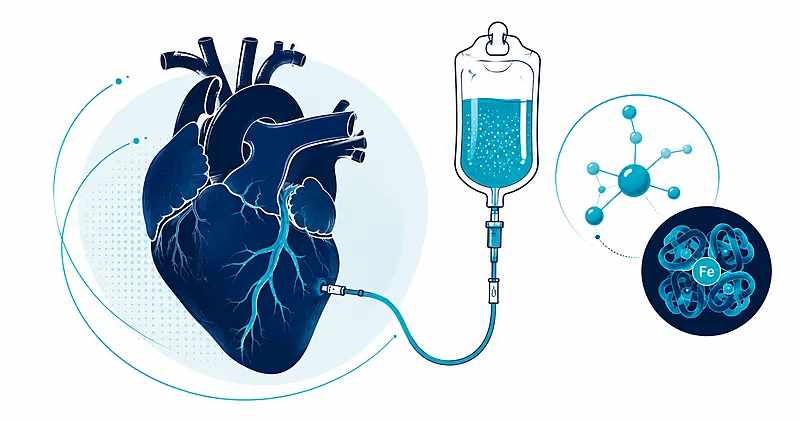
Why Iron Deficiency in Heart Failure Matters
Iron deficiency is one of the most common comorbidities in heart failure, present in roughly half of patients across the ejection-fraction spectrum. It occurs with or without anemia, and standard iron indices frequently miss it.
The deficiency is not a bystander. In observational cohorts, low iron status is associated with worse symptoms, reduced exercise capacity, more frequent hospitalization, and higher mortality. These associations describe risk, not proven causation.
Iron sits at the center of cardiac and skeletal-muscle energetics. It supports oxygen transport, mitochondrial electron transport, and enzymatic function in cardiomyocytes. When iron is scarce, aerobic performance and cellular efficiency decline even before anemia appears.
Two forms are recognized. Absolute deficiency reflects depleted stores; functional deficiency reflects iron that is present but unavailable for use. Trials define both using serum ferritin below 100 ng/mL, or ferritin 100–299 ng/mL with transferrin saturation under 20%.
Clinically, this creates an appealing target. A simple, inexpensive blood panel identifies a treatable deficiency, and the therapeutic question narrows to a single practical choice: does repleting iron change outcomes that patients feel and clinicians measure?
Clinical PearlThe route matters. Oral iron did not improve exercise capacity in the IRONOUT-HF trial, likely because inflammation and hepcidin limit gut absorption in heart failure. The evidence base for outcomes is built almost entirely on the intravenous route.
Current State of Knowledge on Iron Deficiency
The evidence has moved through three phases. Early functional trials asked whether patients felt and moved better. Later outcome trials asked whether events fell. Meta-analyses then pooled the signal that no single trial could confirm alone.
FAIR-HF and CONFIRM-HF established the functional case, improving symptoms, New York Heart Association class, and six-minute walk distance. AFFIRM-AHF, IRONMAN, HEART-FID and FAIR-HF2 then tested hard endpoints — hospitalization and death — as their primary target.
The pattern that emerged is unusually consistent and unusually frustrating. Each large outcome trial produced a point estimate favoring iron, and each fell just short of statistical significance for its own primary endpoint. The table below sets the trials side by side.
| Study (Year) | Design | N | Population / setting | Key result on the stated endpoint | Tier |
|---|---|---|---|---|---|
| Nature Medicine meta-analysis (2025) | Bayesian individual-patient meta-analysis, 6 trials | 7,175 | HFrEF and acute HF, iron deficient | Recurrent HF hospitalization + CV death RR 0.72 (95% CI 0.55–0.89) at 12 mo; all-cause mortality HR 0.92 (0.80–1.07) | [V] |
| Graham meta-analysis (2021) | Meta-analysis of RCTs, 7 trials | 2,166 | HF with iron deficiency | First HF hospitalization + CV death OR 0.73 (0.59–0.90); CV mortality alone OR 0.89 (0.66–1.21) | [V] |
| HEART-FID (2023) | RCT, double-blind, placebo-controlled | 3,065 | Ambulatory HFrEF (LVEF ≤40%) | Hierarchical composite (death, HF hospitalization, 6MWD) win ratio 1.10 (0.99–1.23), p=0.019 vs prespecified threshold p<0.01 → not significant | [V] |
| IRONMAN (2022) | RCT, open-label, blinded-endpoint | 1,137 | HFrEF (LVEF ≤45%), median 2.7 y | Recurrent HF hospitalization + CV death RR 0.82 (0.66–1.02), p=0.070; COVID-adjusted RR 0.76 (0.58–1.00) | [V] |
| AFFIRM-AHF (2020) | RCT, double-blind, placebo-controlled | 1,132 | LVEF <50%, stabilized after acute HF | Total HF hospitalization + CV death RR 0.79 (0.62–1.01), p=0.059; total HF hospitalization RR 0.74 (0.58–0.94) | [V] |
| CONFIRM-HF (2015) | RCT, double-blind, placebo-controlled | 304 | Symptomatic HFrEF, iron deficient | Six-minute walk distance +33 m at 24 wk (p=0.002); functional endpoint, not powered for mortality | [S] |
| FAIR-HF (2009) | RCT, double-blind, placebo-controlled | 459 | Symptomatic HFrEF, iron deficient | Improved patient global assessment and NYHA class; 6MWD ~+35 m; functional endpoint | [S] |
Two independent meta-analyses reconcile these near-misses. When trials are pooled, the composite of hospitalization and cardiovascular death falls to a significant degree, and the effect is driven predominantly by hospitalizations rather than deaths.
FAIR-HF2, published in 2025, tested a higher maintenance dose to address possible underdosing. Its first primary endpoint, cardiovascular death or first heart-failure hospitalization, occurred in 16.7% versus 21.9% with placebo. That result missed its prespecified threshold, echoing the earlier trials.
What We Know
Three findings sit on firm ground. They separate cleanly by endpoint type, and keeping them distinct is the key to counseling patients honestly.
Symptoms and function improve. FAIR-HF and CONFIRM-HF showed better six-minute walk distance, NYHA class, and quality-of-life scores with intravenous ferric carboxymaltose. These functional gains are the most reproducible effect of iron repletion in heart failure.
Heart-failure hospitalizations fall. AFFIRM-AHF reduced total heart-failure hospitalizations (RR 0.74, 95% CI 0.58–0.94). Pooled analyses agree, with the composite of hospitalization and cardiovascular death consistently favoring iron.
The therapy is well tolerated. Across trials, intravenous iron carried an acceptable safety profile. IRONMAN reported fewer cardiac serious adverse events with ferric derisomaltose than with usual care, and pooled data showed no excess of infections.
Taken together, the established message is coherent. For iron-deficient patients with reduced ejection fraction, repletion helps people feel better and stay out of hospital, and it does so without a clear safety penalty.
What Remains Uncertain
The unresolved questions are not peripheral. They shape whether a clinician expects a modest, symptom-focused benefit or something larger, and they explain why trials keep landing on the border of significance.
Biological and mechanistic gaps
How intravenous iron helps the failing heart is incompletely mapped. Whether the benefit is systemic, through improved oxygen delivery, or local, through myocardial iron uptake, is not settled. Small imaging studies suggest infused iron reaches myocardium and may persist in a labile form.
That persistence raises a competing hypothesis. If repeated dosing loads the myocardium with reactive iron, any functional gain could be offset over time. This concern is preliminary and hypothesis-generating, drawn from very small studies, and it has not been shown to cause harm in the large trials.
Trial-design and methodological gaps
Every outcome trial missed its primary endpoint, and the reasons cluster. AFFIRM-AHF and IRONMAN reached significance only in prespecified analyses censoring pandemic-era events. IRONMAN used an open-label design, which can inflate apparent hospitalization benefit.
Dose is a live suspect. In several trials, maintenance iron after initial repletion fell below 500 mg per year, plausibly too little to sustain an effect. FAIR-HF2 tested a higher dose to probe this and still did not cross its threshold.
Population gaps
Nearly all robust data come from reduced ejection fraction. In preserved ejection fraction, evidence is minimal: the FAIR-HFpEF trial stopped early after enrolling 39 of a planned 200 patients, leaving the question effectively open.
The definition of deficiency is itself contested. Ferritin-based and transferrin-saturation-based criteria identify overlapping but different groups, and whether current biomarkers capture true tissue iron deficiency — and therefore the patients most likely to respond — remains unresolved.
Comparative and dosing gaps
No adequately powered trial has compared ferric carboxymaltose head-to-head with ferric derisomaltose for clinical outcomes. The optimal cumulative dose, re-dosing interval, and monitoring strategy are extrapolated rather than established, and ferric carboxymaltose can cause transient hypophosphatemia.
The central tensionIndividual trials say “not proven”; pooled trials say “beneficial for hospitalization.” Both statements are correct, because significance in this field lives in the aggregate rather than in any single study. That is a fragile place for a treatment claim to rest.
Research Priorities
The open questions translate into a concrete agenda. A short list would resolve most of the current ambiguity and tell clinicians which patients gain the most.
- Dosing strategy. Prospective comparison of higher, sustained maintenance dosing against the low-dose regimens used in earlier trials, powered for hospitalization and death.
- Better patient selection. Validation of biomarkers that reflect tissue iron status, so treatment targets responders rather than everyone meeting a ferritin cutoff.
- Preserved ejection fraction. An adequately powered HFpEF trial, since the largest existing effort halted early and the population is expanding.
- Formulation comparison. Direct outcome comparison of ferric carboxymaltose and ferric derisomaltose, including hypophosphatemia and re-dosing burden.
- Mortality resolution. Continued pooled and individual-patient analyses to determine whether a survival signal exists or can be excluded with confidence.
Quality and Consistency of the Evidence
Evidence strength varies sharply by outcome. Reading the field as a single verdict overstates the mortality data and understates the functional data.
- Functional capacity and quality of life — strong, consistent. Multiple double-blind randomized trials agree, and the effect underpins current guideline recommendations.
- Heart-failure hospitalization — moderate to strong. The direction is consistent across trials and confirmed in pooled analyses, though partly reliant on composite and pandemic-adjusted endpoints.
- Composite of hospitalization and cardiovascular death — moderate. Significant when pooled, but each individual trial fell short of its own primary threshold.
- Cardiovascular death — weak. Point estimates trend favorable, yet confidence intervals cross unity in both major meta-analyses.
- All-cause mortality — insufficient. No trial and no meta-analysis has shown a significant survival benefit.
- Preserved ejection fraction and optimal dosing — insufficient. Data are sparse, early-terminated, or extrapolated.
What the Evidence Does Not Show
Guarding against overstatement is as important as reporting benefit. The following claims are not supported by the current evidence base.
- It does not show an all-cause mortality benefit; survival was unchanged in every trial and in pooled analysis.
- It does not show a clear reduction in cardiovascular death, only a non-significant favorable trend.
- It does not establish benefit in heart failure with preserved ejection fraction.
- It does not support oral iron as a substitute; oral repletion failed to improve exercise capacity in IRONOUT-HF.
- It does not identify the optimal formulation, cumulative dose, or the best biomarker for selecting patients.
- No individual outcome trial, on its own, met its primary endpoint — the positive signal is a pooled-analysis finding.
Practical Implications
The evidence supports a defined, modest role rather than a sweeping one. Framed around what patients can expect, the implications are clear.
Screen routinely. Measure ferritin and transferrin saturation in heart failure, since deficiency is common, symptomatic, and treatable, and standard blood counts miss it.
Follow guideline direction, with its nuance. The 2023 focused update of the European Society of Cardiology heart-failure guidelines gives intravenous ferric carboxymaltose or ferric derisomaltose a Class I recommendation to relieve symptoms and improve quality of life in symptomatic HFrEF or HFmrEF with iron deficiency. It adds a Class IIa recommendation to reduce heart-failure hospitalization.
Timing tempers this. That update incorporated evidence through March 2023 and therefore predates the neutral HEART-FID primary result. HEART-FID does not overturn the pooled hospitalization signal, but it argues against promising more than symptom and hospitalization benefit.
United States guidance aligns. The 2022 AHA/ACC/HFSA guideline gives a Class 2a recommendation that intravenous iron replacement is reasonable to improve functional status and quality of life in HFrEF with iron deficiency.
Counsel honestly. Tell patients that iron repletion may help them feel better and reduce hospital stays, and that it has not been shown to help them live longer. That framing matches the evidence and sets realistic expectations.
Individualize by phenotype. Reduced and mildly reduced ejection fraction with iron deficiency is the evidence-supported setting. In preserved ejection fraction, treatment is a case-by-case decision given thin data. Use the intravenous route and re-check iron indices to guide re-dosing.
Evidence Grade and Bottom Line
Overall grade: Moderate for symptom and hospitalization benefit in HFrEF; Low for any mortality effect. The functional case is well supported; the survival case is unproven.
- On current evidence, intravenous iron is a symptom-and-hospitalization therapy, not a survival therapy.
- Every large outcome trial missed its primary endpoint; the benefit reaches significance chiefly when trials are pooled.
- The reduction in heart-failure hospitalization is the most consistent and clinically actionable finding.
- All-cause mortality is unchanged, so longevity should not be promised to patients.
- Reduced and mildly reduced ejection fraction with iron deficiency is the population with the strongest support; preserved ejection fraction is not.
- Formulation, dose, and patient-selection biomarkers remain open questions that the next generation of trials should resolve.
Article Information and References
- Anker SD, Karakas M, Mentz RJ, et al. Systematic review and meta-analysis of intravenous iron therapy for patients with heart failure and iron deficiency. Nat Med. 2025;31:2640–2646. DOI: https://doi.org/10.1038/s41591-025-03671-1
- Graham FJ, Pellicori P, Ford I, et al. Intravenous iron for heart failure with evidence of iron deficiency: a meta-analysis of randomised trials. Clin Res Cardiol. 2021;110(9):1299–1307. DOI: https://doi.org/10.1007/s00392-021-01837-8
- Mentz RJ, Garg J, Rockhold FW, et al. Ferric carboxymaltose in heart failure with iron deficiency. N Engl J Med. 2023;389(11):975–986. DOI: https://doi.org/10.1056/NEJMoa2304968
- Kalra PR, Cleland JGF, Petrie MC, et al. Intravenous ferric derisomaltose in patients with heart failure and iron deficiency in the UK (IRONMAN): an investigator-initiated, prospective, randomised, open-label, blinded-endpoint trial. Lancet. 2022;400(10369):2199–2209. DOI: https://doi.org/10.1016/S0140-6736(22)02083-9
- Ponikowski P, Kirwan BA, Anker SD, et al. Ferric carboxymaltose for iron deficiency at discharge after acute heart failure: a multicentre, double-blind, randomised, controlled trial. Lancet. 2020;396(10266):1895–1904. DOI: https://doi.org/10.1016/S0140-6736(20)32339-4
- Ponikowski P, van Veldhuisen DJ, Comin-Colet J, et al. Beneficial effects of long-term intravenous iron therapy with ferric carboxymaltose in patients with symptomatic heart failure and iron deficiency (CONFIRM-HF). Eur Heart J. 2015;36(11):657–668. DOI: https://doi.org/10.1093/eurheartj/ehu385
- Anker SD, Comin Colet J, Filippatos G, et al. Ferric carboxymaltose in patients with heart failure and iron deficiency (FAIR-HF). N Engl J Med. 2009;361(25):2436–2448. DOI: https://doi.org/10.1056/NEJMoa0908355
- von Haehling S, Doehner W, Evertz R, et al. Ferric carboxymaltose and exercise capacity in heart failure with preserved ejection fraction and iron deficiency: the FAIR-HFpEF trial. Eur Heart J. 2024;45(37):3789–3800. DOI: https://doi.org/10.1093/eurheartj/ehae479
- Heidenreich PA, Bozkurt B, Aguilar D, et al. 2022 AHA/ACC/HFSA guideline for the management of heart failure. Circulation. 2022;145(18):e895–e1032. DOI: https://doi.org/10.1161/CIR.0000000000001063
- Beavers CJ, Ambrosy AP, Butler J, et al. Iron deficiency in heart failure: a scientific statement from the Heart Failure Society of America. J Card Fail. 2023;29(7):1059–1077. DOI: https://doi.org/10.1016/j.cardfail.2023.03.025