
Obstructive Sleep Apnea: 3 Core Approaches Compared
How airway splinting, incretin-based weight loss, and behavioural weight loss stack up for adults with obesity-related disease — and where each one earns its place.
One-Minute Takeaway
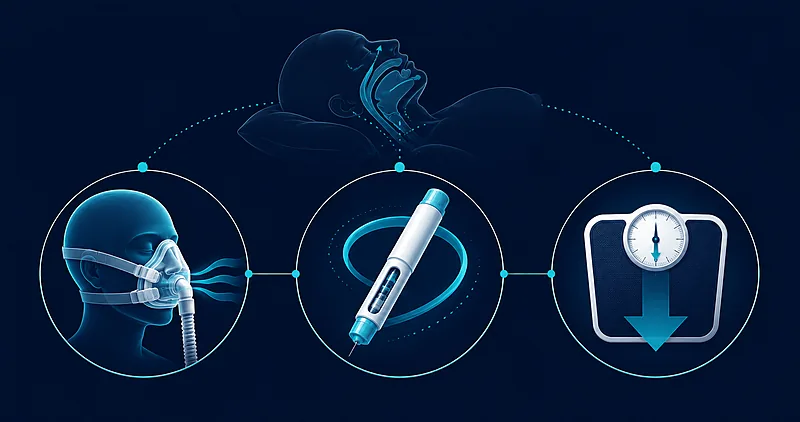
- For obstructive sleep apnea with obesity, strong randomised evidence now supports three distinct strategies — airway splinting, incretin pharmacotherapy, and behavioural weight loss — each targeting a different driver of disease.
- CPAP normalises the apnea–hypopnea index (AHI) while it is worn: on-treatment AHI fell to roughly 4 events/hour from about 29 untreated in the SAVE trial, yet that trial found no reduction in cardiovascular events, and average use was only about 3.3 hours per night.
- Tirzepatide, in the SURMOUNT-OSA trials, lowered the AHI by roughly 20 events/hour beyond placebo in people not using CPAP and about 24 events/hour in CPAP users, with 43–52% reaching disease resolution; it became the first drug approved for this use in December 2024.
- Behavioural weight loss (Sleep AHEAD) cut the AHI by about 10 events/hour versus control at one year, in proportion to the weight lost.
- These approaches are complementary, not mutually exclusive: incretin therapy was tested successfully both instead of and layered on top of CPAP.
The Clinical Problem in Obstructive Sleep Apnea
Obstructive sleep apnea is one of the most common chronic conditions in adult medicine, with population estimates reaching roughly a billion adults worldwide. Excess adiposity is the dominant modifiable risk factor, which places much of the disease squarely in the internist’s clinic.
Untreated disease is associated with hypertension, incident cardiovascular disease, stroke, impaired quality of life, and daytime injury risk. It also tends to progress: in Sleep AHEAD, weight-stable control participants saw their AHI drift upward by about 4 events/hour over a single year.
The central tension in management is now sharper than it has been for decades. The long-standing standard, continuous positive airway pressure, corrects the mechanical problem but only while it is worn, and it does not treat the underlying obesity. Incretin-based drugs treat the obesity directly, but they are newer, costlier, and not yet tested against hard clinical endpoints in this population. The practical question for a clinician facing an adult with obesity-related disease is where incretins fit against CPAP.
Available Approaches
Three strategies carry randomised support in adults with obesity-related disease. They differ less in whether they work than in how they work, in whom, and for how long. The table summarises the pivotal trials and the pooled signal for the drug class; every figure below was verified against a primary source.
| Study / Source | Design | N | Population | Comparison | Key result (95% CI) | Tier |
|---|---|---|---|---|---|---|
| SURMOUNT-OSA, trial 1 (Malhotra 2024) | Phase 3 RCT, 52 wk | 234 | Moderate–severe OSA + obesity, not using PAP | Tirzepatide 10/15 mg weekly vs placebo | AHI −20.0 events/h vs placebo (−25.8 to −14.2) | V |
| SURMOUNT-OSA, trial 2 (Malhotra 2024) | Phase 3 RCT, 52 wk | 235 | Moderate–severe OSA + obesity, established on PAP | Tirzepatide + PAP vs placebo + PAP | AHI −23.8 events/h vs placebo (−29.6 to −17.9) | V |
| SAVE (McEvoy 2016) | RCT, mean 3.7 yr | 2,717 | Moderate–severe OSA + established cardiovascular disease | CPAP + usual care vs usual care | Primary CV composite HR 1.10 (0.91–1.32); on-CPAP AHI 3.7 | V |
| CPAP blood-pressure meta-analysis (Benning 2025) | Systematic review, 75 RCTs | 10,025 | OSA, mixed severity | CPAP vs inactive control | Office SBP −2.5 mmHg (−3.8 to −1.2); nocturnal SBP −3.5 (−4.4 to −2.5) | V |
| Sleep AHEAD (Foster 2009) | RCT, 1 yr | 264 | OSA + type 2 diabetes, overweight/obesity | Intensive lifestyle weight loss vs diabetes education | AHI −9.7 events/h vs control (−13.6 to −5.7) | V |
| GLP-1 receptor agonist pooled analysis (2025) | Systematic review, 3 RCTs | ~803 | Moderate–severe OSA, mostly obesity | GLP-1 agonist / tirzepatide vs placebo | AHI −16.6 events/h (−27.4 to −5.7); high heterogeneity | S |
Positive Airway Pressure (CPAP)
CPAP is a pneumatic splint. Delivered through a mask, it holds the upper airway open and abolishes obstructive events for as long as it is worn. When adherence is adequate it is the most physiologically complete correction available: in SAVE the residual on-treatment AHI fell to about 4 events/hour, from roughly 29 untreated. The American Academy of Sleep Medicine’s clinical practice guideline recommends CPAP or auto-adjusting PAP for ongoing treatment of the condition in adults.
The consistent benefits are symptomatic and physiological: CPAP improves daytime sleepiness, reduces snoring, and improves quality of life, and a large meta-analysis shows a modest blood-pressure reduction that is greatest overnight. The consistent limitation is adherence. In SAVE, average use was about 3.3 hours per night, and that trial — conducted in a minimally sleepy population with established cardiovascular disease — did not show a reduction in cardiovascular events. CPAP also leaves the underlying obesity untouched.
Incretin Therapy (Tirzepatide)
Tirzepatide is a once-weekly injectable GIP and GLP-1 receptor co-agonist. It reduces the AHI indirectly, by driving substantial weight loss and thereby addressing an etiologic root of airway collapse. The SURMOUNT-OSA programme comprised two phase 3 randomised trials in 469 adults with moderate-to-severe disease and obesity, run over 52 weeks — one in people not using CPAP, one in established CPAP users.
Across the two trials, tirzepatide reduced the AHI, body weight, hypoxic burden, C-reactive protein, and systolic blood pressure, and improved patient-reported sleep outcomes. Between 43% and 52% of participants on the higher dose met predefined criteria for disease resolution. On the strength of these results, tirzepatide became the first medication approved for moderate-to-severe disease in adults with obesity, in December 2024, to be used alongside a reduced-calorie diet and increased physical activity. Adverse effects were predominantly gastrointestinal and generally mild to moderate.
An important caveat sits behind the drug class as a whole. The convincing evidence is specific to tirzepatide. Pooled analyses of glucagon-like peptide-1 receptor agonists in this condition rest on only a handful of small trials, with wide confidence intervals and high statistical heterogeneity; reported AHI reductions across these syntheses range roughly from 8 to 17 events/hour. Semaglutide and liraglutide do not yet have a dedicated large trial or a regulatory indication for this use.
Behavioural Weight Loss
Because obesity drives much obstructive disease, weight loss achieved through diet and activity has long been a foundational recommendation. Sleep AHEAD, the largest randomised trial of lifestyle weight loss for the condition, compared an intensive lifestyle intervention with diabetes education in 264 adults with type 2 diabetes.
The lifestyle group lost about 11 kg versus under 1 kg in controls, and the AHI fell in proportion to weight lost — those losing 10 kg or more saw the largest reductions. The benefit is real but conditional. Longer follow-up of the same cohort shows the effect attenuates as weight is regained, which is the recurring weakness of behavioural weight loss and a reason the durable, higher-magnitude weight loss seen with incretin drugs is clinically interesting.
Clinical pearl
The three approaches act at different points. CPAP removes the obstruction mechanically but only while worn; weight loss — behavioural or drug-induced — shrinks the anatomical load that causes the obstruction. That distinction, rather than headline AHI numbers alone, is what should guide selection for an individual patient.
Comparative Analysis for Obstructive Sleep Apnea
Set side by side, the three approaches answer different clinical questions, and the honest comparison turns on mechanism, magnitude, durability, and the endpoints each has actually been tested against.
Mechanism and durability
CPAP is symptomatic and mechanical. It works the night it is used and stops working the night it is not, so its real-world value is capped by adherence and is independent of body weight — which is why it remains applicable to non-obese, anatomically driven disease. Incretin therapy is disease-modifying through weight loss: its effect persists between weekly doses, but it requires continued use, and weight regain after stopping would be expected to reverse the gain. Behavioural weight loss works through the same anatomical pathway as incretins but achieves less weight loss and is harder to sustain.
Magnitude of effect
The magnitudes are not directly comparable because they are measured differently, but the pattern is instructive. Tirzepatide produced large AHI reductions — on the order of 20 events/hour beyond placebo — several times greater than behavioural weight loss achieved, reflecting greater weight loss. CPAP, when actually worn, produces a larger physiological correction still, driving the residual AHI close to normal. The comparison therefore hinges on a single practical variable: whether the patient will use the mask.
Effect on hard outcomes
This is where both stories are incomplete. CPAP did not reduce cardiovascular events in SAVE, though low adherence and a minimally sleepy population limit how far that null result generalises. The incretin trials, for their part, were 52 weeks long and measured the AHI and related surrogates, not cardiovascular events or mortality. Broader cardiovascular benefit has been shown for these drugs in obesity and diabetes populations, but that has not been demonstrated within a sleep-apnea trial, so applying it here is extrapolation rather than evidence.
Where incretins fit
The trials point away from an either/or framing. SURMOUNT-OSA’s second study added tirzepatide on top of established CPAP and still showed benefit, so the drug can augment the device. And because roughly half of treated participants reached disease resolution, some patients may eventually reduce or stop CPAP — a step that calls for repeat testing to confirm the response first. Positioned honestly, incretins are a disease-modifying option for the obese phenotype: an adjunct to CPAP, or an alternative when CPAP fails or is declined, rather than a wholesale replacement.
Access and burden
The practical trade-offs differ. CPAP is inexpensive over time and durable, but adherence-limited. Incretin therapy is effective and generally well tolerated, but costly, needs indefinite use, is subject to supply and coverage constraints, and carries gastrointestinal side effects. Behavioural weight loss is low-cost and broadly beneficial but demands sustained effort and tends to fade.
Quality and Consistency of the Evidence
Certainty varies markedly by outcome. Where trials converge the signal is strong; where they are few, small, or absent, the confidence drops accordingly.
- High — CPAP normalises the AHI while worn. Consistent across randomised trials; the residual on-treatment AHI near 4 events/hour in a trial of over 2,700 patients is representative.
- High — tirzepatide reduces the AHI in obese disease. Two concordant phase 3 randomised trials with large, precisely estimated effects and aligned secondary outcomes.
- Moderate — behavioural weight loss reduces the AHI. Supported by randomised data with a clear weight–response gradient, but of smaller magnitude and prone to attenuation with regain.
- Moderate — CPAP modestly lowers blood pressure. A 75-trial synthesis shows a consistent but small effect; heterogeneity is high and GRADE certainty was rated low.
- Low — class effect of incretins beyond tirzepatide. Pooled estimates rest on few small trials with wide confidence intervals and high heterogeneity.
- Insufficient — hard cardiovascular benefit of drug therapy for this condition. No sleep-apnea trial has tested it, and CPAP did not reduce cardiovascular events in the one large outcome trial.
What the Evidence Does Not Show
Several questions that matter for day-to-day decisions remain genuinely open. Naming them is more useful than papering over them.
Specific evidence gaps
- No head-to-head trial. Incretins have not been compared directly with CPAP on the AHI or on clinical outcomes; the comparison here is drawn across separate trials.
- No hard-outcome data for drug therapy. The incretin trials measured the AHI and surrogates over 52 weeks; none was powered for cardiovascular events or mortality in a sleep-apnea population.
- Durability after stopping. Whether AHI benefit is maintained after incretin discontinuation is uncharacterised; behavioural data suggest weight regain reverses much of the gain.
- Non-obese disease. Incretin evidence does not apply to anatomically driven, non-obese disease, since the trials required a body-mass index of at least 30.
- Other agents. Semaglutide and other agonists lack a dedicated large trial or an approved indication for this condition.
- Safely de-escalating CPAP. Whether drug-induced resolution reliably permits stopping CPAP over the long term needs prospective confirmation.
Practical Implications
The evidence supports a few reasonable positions, framed as what the data show rather than as directives.
CPAP remains the standard for prompt control of obstruction and applies regardless of body weight, so it stays first-line for rapid symptom relief and for anatomically driven disease. Adherence support is decisive, because the therapy delivers only what the patient actually uses.
For adults with obesity-related disease, incretin therapy is now an evidence-based option — reasonable as an adjunct that augments CPAP, or as an alternative when CPAP fails or is declined. Where a drug produces apparent resolution, repeat testing to confirm the response is prudent before reducing device therapy.
Behavioural weight loss remains foundational and complements both, particularly given the weight–response relationship seen in randomised data. In practice, selection turns on phenotype, adherence, comorbidity, and access rather than on a single treatment being categorically superior.
Evidence Grade and Bottom Line
Overall certainty: Moderate–to–high for AHI reduction; low for comparative hard outcomesEach of the three approaches has moderate-to-high certainty evidence that it lowers the AHI in the populations studied. What is missing is comparative outcome data: no trial has pitted these strategies against each other, and none has shown that treating this condition with drugs changes cardiovascular endpoints.
Bottom line
- Incretins do not replace CPAP across the board; they add a disease-modifying tool for the obese phenotype.
- CPAP, when actually worn, still delivers the most complete physiological correction of the airway.
- The approaches were shown to work in combination as well as alone, so sequencing and layering are reasonable strategies.
- Head-to-head comparisons and hard-outcome trials for drug therapy are the decisive missing pieces.
Article Information and References
- Malhotra A, Grunstein RR, Fietze I, et al. Tirzepatide for the treatment of obstructive sleep apnea and obesity. N Engl J Med. 2024;391(13). DOI: https://doi.org/10.1056/NEJMoa2404881
- McEvoy RD, Antic NA, Heeley E, et al. CPAP for prevention of cardiovascular events in obstructive sleep apnea. N Engl J Med. 2016;375(10):919–931. DOI: https://doi.org/10.1056/NEJMoa1606599
- Benning L, et al. Effects of CPAP on blood pressure parameters across different severities of obstructive sleep apnoea: a meta-analysis. J Sleep Res. 2025. DOI: https://doi.org/10.1111/jsr.70072
- Kow CS, Ramachandram DS, Hasan SS, Thiruchelvam K. Efficacy and safety of GLP-1 receptor agonists in the management of obstructive sleep apnea in individuals without diabetes: a systematic review and meta-analysis of randomized, placebo-controlled trials. Sleep Med. 2025;129:40–44. DOI: https://doi.org/10.1016/j.sleep.2025.02.010
- Yang Y-T, Hou X-Z, Zhang X-R, Zhang Z-P, Wang S-H. Comparative effectiveness and safety of novel antidiabetic agents in the management of obstructive sleep apnea: a systematic review, meta-analysis, and network meta-analysis. Respir Med. 2026;253:108671. DOI: https://doi.org/10.1016/j.rmed.2026.108671
- Safety and efficacy of glucagon-like peptide-1 receptor agonists in patients with obstructive sleep apnea: a systematic review and meta-analysis of randomized controlled trials. ERJ Open Res. 2025. DOI: https://doi.org/10.1080/20018525.2025.2484048
- Aljazeeri J, Carvalhal De Almeida Cordeiro G, Peralta-Jiménez GA, et al. GLP-1 receptor agonists for obstructive sleep apnea: a meta-analysis of randomized controlled trials [abstract]. Am J Respir Crit Care Med. 2025;211(Suppl):A2901. DOI: https://doi.org/10.1164/ajrccm.2025.211.Abstracts.A2901
- Foster GD, Borradaile KE, Sanders MH, et al. A randomized study on the effect of weight loss on obstructive sleep apnea among obese patients with type 2 diabetes: the Sleep AHEAD study. Arch Intern Med. 2009;169(17):1619–1626. DOI: https://doi.org/10.1001/archinternmed.2009.266
- Patil SP, Ayappa IA, Caples SM, Kimoff RJ, Patel SR, Harrod CG. Treatment of adult obstructive sleep apnea with positive airway pressure: an American Academy of Sleep Medicine clinical practice guideline. J Clin Sleep Med. 2019;15(2):335–343. DOI: https://doi.org/10.5664/jcsm.7640