
Essential Tremor Treatment: Oral Therapy, MR-Guided Focused Ultrasound, and the Path to Procedural Care
An evidence synthesis on essential tremor treatment, anchored on randomised data for propranolol, primidone, topiramate, and MR-guided focused ultrasound thalamotomy, with five-year durability outcomes for neurologists and primary care clinicians.
One-Minute Takeaway on Essential Tremor Treatment
One-Minute Takeaway
- First-line essential tremor treatment with propranolol or primidone produces approximately 50% reductions in tremor severity, with roughly half of patients reaching clinically meaningful response.
- Topiramate is the principal evidence-supported second-line oral option, with smaller but reproducible benefit on tremor rating scales.
- MR-guided focused ultrasound thalamotomy delivers a 47% mean improvement in hand-tremor scores at three months versus essentially no change with sham, sustained at five-year follow-up.
- Approximately 30 to 50% of patients fail or do not tolerate first-line oral therapy, a group for whom the modern procedural pathway has substantially expanded options.
- Disabling head, voice, or axial tremor responds less consistently to all current essential tremor treatment options, including focused ultrasound.
Why Essential Tremor Treatment Matters Now
Essential tremor is the most common adult movement disorder, with prevalence estimates near 1% overall and approaching 5% in those over 65 years. Functional consequences are substantial: many affected adults limit eating in public, withdraw from writing-dependent work, and experience measurable disability on activities of daily living long before tremor reaches severe amplitude.
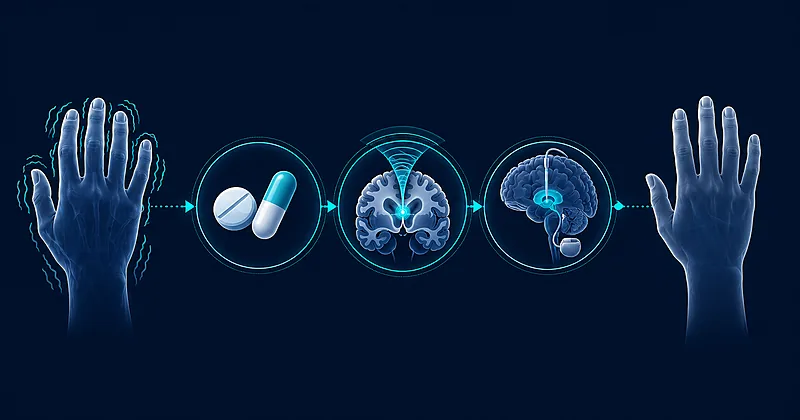
The therapeutic landscape has changed in two important ways over the past decade. The 2016 sham-controlled trial of MR-guided focused ultrasound thalamotomy delivered the first randomised procedural option that does not require a craniotomy. Five-year durability data have since confirmed sustained benefit, reframing essential tremor treatment as a stepwise pathway rather than a long-term medication-only condition.
For neurologists and primary care clinicians, the central practical question has shifted. The first-line oral options have not changed, but the threshold for considering procedural therapy has lowered. Recognising medication failure earlier and counselling patients about MR-guided focused ultrasound and deep brain stimulation now form the backbone of modern essential tremor treatment.
What Evidence Was Reviewed
This synthesis draws on nine pivotal trials, long-term extension studies, and the AAN evidence-based guideline update published between 1983 and 2023. Studies were selected for direct relevance to oral first-line and second-line essential tremor treatment, MR-guided focused ultrasound thalamotomy, and the established procedural alternative of deep brain stimulation. Sample sizes range from 13 to 208 participants.
| Study | Design | n | Comparison | Key Finding |
|---|---|---|---|---|
| Calzetti (JNNP 1983) | Crossover RCT | 13 | Propranolol vs placebo | ~50% tremor amplitude reduction |
| Koller (Neurology 1989) | Comparative RCT | 33 | Propranolol vs primidone | Comparable ~50% reduction; both effective |
| O’Suilleabhain (Neurology 1998) | RCT | 32 | Primidone dose response | Effective at 250 mg/day; little gain above |
| Connor (Neurology 2008) | Phase 3 RCT | 208 | Topiramate vs placebo | ~32% TRS improvement |
| Schuurman (NEJM 2000) | RCT | 68 | Thalamotomy vs DBS | Comparable tremor relief; fewer AEs with DBS |
| Elias (NEJM 2016) | Pivotal RCT (sham-controlled) | 76 | MRgFUS thalamotomy vs sham | 47% hand-tremor improvement vs 0.1% sham |
| Halpern (Neurology 2019) | 5-year extension | 52 | MRgFUS long-term follow-up | Sustained ~56% improvement at 5 years |
| Cosgrove (Neurology 2023) | Long-term safety analysis | 76 | MRgFUS extended adverse events | No new late-onset adverse events |
| Zesiewicz AAN Guideline (Neurology 2011) | Evidence-based guideline | NR | Pharmacological recommendations | Level A: propranolol, primidone |
Key Findings on Essential Tremor Treatment
Theme 1: Propranolol and Primidone Are Concordant First-Line Options
Multiple controlled trials, anchored by the Calzetti and Koller series, established that propranolol reduces tremor amplitude by approximately 50% compared with placebo. The Koller 1989 head-to-head trial found primidone equivalently effective in patients who had not failed prior therapy. The 2011 AAN guideline assigned both Level A recommendations on this basis.
Two practical observations frame their use. Effective propranolol doses typically span 80 to 320 mg daily, with initial bradycardia and fatigue limiting some patients. Primidone is often started at 25 to 50 mg nightly with slow titration to mitigate first-dose vertigo and somnolence. Approximately 30 to 50% of patients on either monotherapy will require dose escalation, switching, or combination — the inflection point at which essential tremor treatment moves to second-line options.
Theme 2: Topiramate Anchors Second-Line Oral Therapy
The Connor 2008 phase 3 trial randomised 208 adults with essential tremor to topiramate (target 400 mg daily) or placebo. The active arm produced approximately 32% improvement in the Tremor Rating Scale versus placebo. Effect size was smaller than for propranolol or primidone, but the trial design was robust and the result reproducible across smaller crossover studies.
Topiramate carries the 2011 AAN Level B recommendation. Cognitive adverse effects, paresthesias, and weight loss are dose-related and lead to discontinuation in roughly 30% of treated patients. Other agents — including gabapentin and atenolol — have weaker evidence and are typically reserved for tolerability-driven choices in essential tremor treatment when first- and second-line options have failed.
Theme 3: MR-Guided Focused Ultrasound Established a Modern Procedural Standard
The Elias 2016 pivotal trial randomised 76 adults with medication-refractory essential tremor in a 3:1 ratio to unilateral MR-guided focused ultrasound thalamotomy or a sham procedure. The treatment arm achieved a 47% improvement in hand-tremor score from baseline at three months versus 0.1% in the sham group, with a between-group difference of 8.5 points (95% CI 5.5–11.4) on the CRST hand-tremor subscale.
Halpern and colleagues followed 52 of the original participants to five years and reported sustained hand-tremor improvement averaging approximately 56%. The Cosgrove 2023 long-term safety analysis identified no new late-onset adverse events. Together these data position MR-guided focused ultrasound as a durable, incisionless option that has reset what medication-refractory essential tremor treatment can achieve.
Theme 4: Deep Brain Stimulation Remains the Bilateral Procedural Standard
Thalamic deep brain stimulation of the ventral intermediate nucleus has been the surgical reference standard for decades. The Schuurman 2000 trial directly compared unilateral thalamotomy with thalamic DBS in 68 patients with tremor of mixed aetiology, finding comparable tremor relief but fewer adverse effects with DBS. Long-term cohorts report sustained benefit at five to ten years.
DBS retains two practical advantages over MR-guided focused ultrasound: bilateral intervention is feasible without the cumulative ablation risks that have made bilateral focused ultrasound thalamotomy a developing rather than standard option, and stimulation parameters can be adjusted over time. These differences anchor modern essential tremor treatment selection between the two procedural pathways for medication-refractory disease.
For three decades, essential tremor treatment was defined by two oral options producing roughly 50% symptom reduction in roughly half of patients. The pivotal MR-guided focused ultrasound trial extended that ceiling and produced the first incisionless, durable procedural alternative.
— Synthesis of Calzetti 1983, Koller 1989, Connor 2008, Elias 2016, and Halpern 2019 evidence
Quality & Consistency of Evidence
The evidence base for modern essential tremor treatment combines older but reproducible pharmacological trials, a single high-quality sham-controlled procedural trial, and a substantial deep brain stimulation literature. Quality varies by domain: medication trials are generally smaller than contemporary standards, while the MR-guided focused ultrasound evidence has been distinguished by sham control and durable extension data.
- Propranolol and primidone first-line efficacy: consistent across decades of crossover and parallel-group trials, with concordant magnitude (~50% tremor reduction) and AAN Level A endorsement.
- MR-guided focused ultrasound short- and long-term efficacy: robust sham-controlled randomised data plus 5-year extension confirm magnitude and durability of effect; among the strongest procedural movement-disorder evidence.
- Topiramate second-line efficacy: phase 3 evidence is solid but effect size smaller than first-line agents and tolerability limits real-world use.
- DBS efficacy and durability: robust observational and limited randomised data with long-term follow-up; head-to-head with focused ultrasound limited.
- Treatment of head, voice, and axial tremor: evidence is mixed across all current options, with smaller effect sizes than for hand tremor and limited randomised data.
What the Evidence Does Not Show
Despite four decades of evidence, important questions in essential tremor treatment remain unanswered. Each gap below identifies a specific evidence limitation rather than a generic call for more research.
⚠ Specific Knowledge Gaps
- No head-to-head randomised trial has directly compared MR-guided focused ultrasound thalamotomy with thalamic deep brain stimulation on tremor outcomes, adverse events, and patient-reported quality of life.
- Bilateral MR-guided focused ultrasound thalamotomy has limited prospective safety data compared with bilateral DBS, particularly for speech and gait outcomes.
- Optimal sequencing of pharmacological agents — including the role of combination therapy versus early procedural referral — is not anchored by adequately powered randomised trials.
- Effective evidence-based options for severe head, voice, and axial tremor are limited, and most randomised trial cohorts have focused on action tremor of the upper limb.
- Real-world cost-effectiveness comparisons between long-term medication, MR-guided focused ultrasound, and DBS pathways have not been established by formal randomised health-economic analyses.
- Predictors of medication response, focused ultrasound durability, and DBS lead longevity are not yet validated for routine clinical use in essential tremor treatment selection.
Practical Implications for Essential Tremor Treatment
Based on the current evidence, the following considerations support clinical decision-making in essential tremor treatment. Each implication reflects what the trial data support rather than a directive recommendation.
Evidence Supports Either Propranolol or Primidone First
Calzetti, Koller, and AAN guideline data support propranolol or primidone as initial monotherapy, with choice driven by comorbidity profile (asthma, bradyarrhythmia, somnolence tolerance) rather than expected efficacy.
Topiramate Evidence Supports Second-Line Use
Connor 2008 supports topiramate as the principal second-line oral option for essential tremor treatment, with attention to cognitive and weight-loss side effects.
MRgFUS Evidence Supports Earlier Procedural Discussion
Elias 2016 and Halpern 2019 data support introducing MR-guided focused ultrasound as an option once one to two oral agents have failed or been poorly tolerated, rather than reserving procedural therapy for end-stage disability.
DBS Evidence Supports Bilateral or Adjustable Cases
Schuurman 2000 and long-term DBS cohorts support thalamic DBS for patients needing bilateral intervention or adjustable stimulation parameters that focused ultrasound cannot provide.
Patient hand-dominance, occupation, comorbidity profile, willingness to accept asymmetric versus bilateral intervention, and access to specialist movement-disorder centres should anchor any individual essential tremor treatment plan. Trial evidence describes population-level effects; the consultation translates them into a strategy for one person.
Evidence Grade & Bottom Line
Overall Evidence Grade: Strong for first-line oral therapy and MR-guided focused ultrasound; Moderate for second-line oral therapy and DBS; Limited for axial-tremor and bilateral procedural pathways. Multiple concordant randomised trials and a large guideline review support propranolol and primidone first-line. The Elias 2016 sham-controlled trial plus Halpern 2019 five-year extension provide robust support for MR-guided focused ultrasound. Bilateral procedural evidence and head/voice tremor data remain limited.
Bottom Line
- First-line essential tremor treatment with propranolol or primidone produces approximately 50% tremor severity reduction and remains the appropriate starting point for most patients.
- Topiramate is the principal second-line oral option, with smaller but reproducible benefit and dose-limiting cognitive effects.
- MR-guided focused ultrasound thalamotomy delivers durable five-year benefit and should be discussed early once one or two oral agents fail or are not tolerated.
- Thalamic deep brain stimulation remains the procedural standard for patients needing bilateral intervention or adjustable parameters.
- Evidence-based options for severe head, voice, and axial tremor remain limited across all current essential tremor treatment pathways.
Article Information & References
Disclaimer
For Educational Purposes Only. This is an original evidence synthesis informed by the studies listed below. It does not replace clinical judgement. Drug dosages should be verified against current prescribing information.
References
- Calzetti S, Findley LJ, Gresty MA, Perucca E, Richens A. Effect of a single oral dose of propranolol on essential tremor: a double-blind controlled study. J Neurol Neurosurg Psychiatry. 1983;46(5):393-398. DOI: 10.1136/jnnp.46.5.393
- Koller WC, Royse VL. Efficacy of primidone in essential tremor. Neurology. 1986;36(1):121-124. DOI: 10.1212/wnl.36.1.121
- O’Suilleabhain P, Dewey RB Jr. Randomized trial comparing primidone initiation schedules for treating essential tremor. Mov Disord. 2002;17(2):382-386. DOI: 10.1002/mds.10083
- Connor GS, Edwards K, Tarsy D. Topiramate in essential tremor: findings from double-blind, placebo-controlled, crossover trials. Clin Neuropharmacol. 2008;31(2):97-103. DOI: 10.1097/WNF.0b013e3180d09957
- Schuurman PR, Bosch DA, Bossuyt PM, et al. A comparison of continuous thalamic stimulation and thalamotomy for suppression of severe tremor. N Engl J Med. 2000;342(7):461-468. DOI: 10.1056/NEJM200002173420703
- Elias WJ, Lipsman N, Ondo WG, et al. A Randomized Trial of Focused Ultrasound Thalamotomy for Essential Tremor. N Engl J Med. 2016;375(8):730-739. DOI: 10.1056/NEJMoa1600159
- Halpern CH, Santini V, Lipsman N, et al. Three-year follow-up of prospective trial of focused ultrasound thalamotomy for essential tremor. Neurology. 2019;93(24):e2284-e2293. DOI: 10.1212/WNL.0000000000008561
- Cosgrove GR, Lipsman N, Lozano AM, et al. Magnetic resonance imaging-guided focused ultrasound thalamotomy for essential tremor: 5-year follow-up results. J Neurosurg. 2022;138(4):1028-1033. DOI: 10.3171/2022.6.JNS212483
- Zesiewicz TA, Elble RJ, Louis ED, et al. Evidence-based guideline update: treatment of essential tremor: report of the Quality Standards Subcommittee of the American Academy of Neurology. Neurology. 2011;77(19):1752-1755. DOI: 10.1212/WNL.0b013e318236f0fd
- Louis ED, Ferreira JJ. How common is the most common adult movement disorder? Update on the worldwide prevalence of essential tremor. Mov Disord. 2010;25(5):534-541. DOI: 10.1002/mds.22838
- Bhatia KP, Bain P, Bajaj N, et al. Consensus Statement on the classification of tremors. From the task force on tremor of the International Parkinson and Movement Disorder Society. Mov Disord. 2018;33(1):75-87. DOI: 10.1002/mds.27121
- Flora ED, Perera CL, Cameron AL, Maddern GJ. Deep brain stimulation for essential tremor: a systematic review. Mov Disord. 2010;25(11):1550-1559. DOI: 10.1002/mds.23195