
Parkinson Disease Treatment: Levodopa, MAO-B, and Device Therapy Approaches
An evidence synthesis on three major Parkinson disease treatment strategies — early oral therapy, MAO-B inhibitors, and device-aided options — drawing on landmark randomised trials and pragmatic comparative data.
One-Minute Takeaway on Parkinson Disease Treatment
One-Minute Takeaway
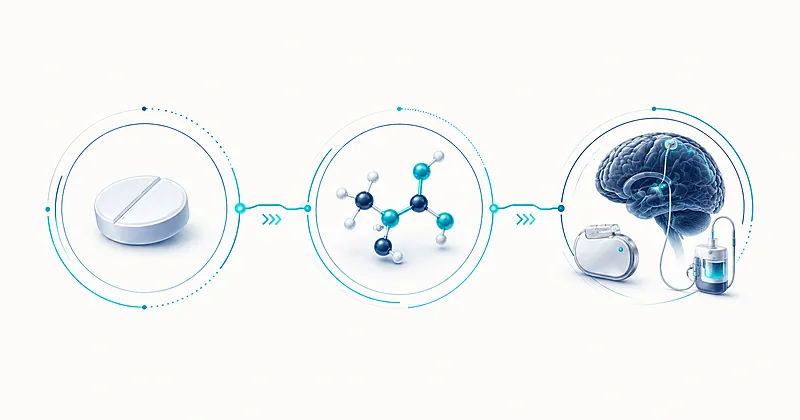
- Modern Parkinson disease treatment rests on three pillars: oral dopaminergic therapy, MAO-B inhibitors, and device-aided options including deep brain stimulation and intestinal levodopa-carbidopa gel.
- The LEAP randomised trial showed that early levodopa initiation neither slows nor accelerates disease progression at 80 weeks, removing a longstanding rationale for delay.
- The pragmatic PD MED trial found small but durable patient-rated mobility advantages for levodopa-first strategies versus MAO-B inhibitors or dopamine agonists as initial monotherapy.
- EARLYSTIM established that subthalamic deep brain stimulation in patients with early motor complications improves quality of life by approximately 26% versus best medical therapy alone.
- Levodopa-carbidopa intestinal gel reduces daily off time by roughly 1.9 hours in advanced disease but device complications and patient selection remain critical considerations.
Why Parkinson Disease Treatment Matters Now
Parkinson disease affects an estimated 8.5 million people worldwide, with prevalence projected to double by 2040 driven by population ageing. Yet the field has reached an inflection point: long-held assumptions about delaying levodopa, sequencing dopamine agonists first, and reserving device therapy for end-stage disease have all been challenged by randomised data over the past decade.
Three landmark trials reframed Parkinson disease treatment in the 2010s. The LEAP delayed-start trial settled the question of whether early levodopa modifies disease course. The pragmatic PD MED trial directly compared the three principal first-line options on patient-rated quality of life over seven years. EARLYSTIM showed that deep brain stimulation in younger patients with early motor fluctuations outperforms continued medication adjustment.
For clinicians, the practical question is no longer “which therapy delays disease progression?” — none reliably does — but rather “which sequencing of Parkinson disease treatment maximises function, minimises motor complications, and matches the patient’s life stage?” This review synthesises the randomised evidence anchoring those decisions.
What Evidence Was Reviewed
This synthesis draws on ten major randomised trials and one pragmatic comparative effectiveness study published between 2004 and 2019. Studies were selected for direct relevance to first-line Parkinson disease treatment decisions, comparison of dopaminergic strategies, or evaluation of device-aided therapies in advanced disease. Sample sizes range from 71 to 1,620 participants.
| Study | Design | n | Comparison | Key Finding |
|---|---|---|---|---|
| LEAP (Verschuur 2019) | Delayed-start RCT | 445 | Early vs delayed levodopa | No UPDRS difference at 80 weeks |
| ELLDOPA (Fahn 2004) | Dose-ranging RCT | 361 | Levodopa vs placebo | Dose-dependent symptomatic benefit |
| ADAGIO (Olanow 2009) | Delayed-start RCT | 1,176 | Rasagiline vs placebo | 1 mg met endpoints; 2 mg did not |
| PD MED (Gray 2014) | Pragmatic open-label RCT | 1,620 | Levodopa vs MAO-BI vs DA | Levodopa: small QoL advantage |
| EARLYSTIM (Schuepbach 2013) | RCT | 251 | STN-DBS + meds vs meds alone | 26% QoL improvement with DBS |
| PD SURG (Williams 2010) | RCT | 366 | DBS vs best medical therapy | PDQ-39 improved by 5.0 points |
| NSTAPS (Odekerken 2013) | RCT | 128 | STN-DBS vs GPi-DBS | STN: greater medication reduction |
| LCIG trial (Olanow 2014) | Double-blind RCT | 71 | LCIG vs oral immediate-release | Off time reduced by 1.91 hours |
| TOLEDO (Katzenschlager 2018) | RCT | 107 | Apomorphine infusion vs placebo | Off time reduced by 1.89 hours |
| STRIDE-PD (Stocchi 2010) | RCT | 747 | Levodopa+entacapone vs levodopa | Earlier dyskinesia with entacapone |
Key Findings on Parkinson Disease Treatment
Theme 1: Early Levodopa Is Safe and Symptomatically Effective
The LEAP trial directly addressed whether early levodopa accelerates motor complications or modifies disease course. In 445 patients with early Parkinson disease randomised to immediate levodopa 100/25 mg three times daily versus delayed start at 40 weeks, the between-group difference in total UPDRS at 80 weeks was 0.7 points — neither clinically meaningful nor statistically significant.
This neutral finding has positive implications for Parkinson disease treatment timing. Earlier ELLDOPA data established a dose-dependent symptomatic benefit at 40 weeks, with 600 mg daily producing the greatest UPDRS improvement. Together these trials indicate that levodopa can be initiated when symptoms warrant treatment rather than withheld over disease-modification concerns.
Theme 2: First-Line Choice Affects Patient-Rated Quality of Life
PD MED randomised 1,620 patients with newly diagnosed Parkinson disease to initial levodopa, MAO-B inhibitor, or dopamine agonist monotherapy and followed them pragmatically over seven years. Patient-rated mobility scores on the PDQ-39 favoured levodopa by 1.8 points (95% CI 0.5–3.0) versus MAO-B inhibitors and by 1.4 points (95% CI 0.5–2.4) versus dopamine agonists.
The effect size is small but durable. Discontinuation rates differed substantially: 28% of dopamine-agonist starters and 23% of MAO-B starters switched therapy versus 2% of levodopa starters, driven by side effects and inadequate symptom control. These differences make initial Parkinson disease treatment selection a matter of tolerability and trajectory rather than disease modification.
Theme 3: MAO-B Inhibitor Disease-Modification Claims Remain Unsupported
The ADAGIO delayed-start trial tested whether rasagiline modifies disease course in 1,176 patients with very early Parkinson disease. The 1 mg dose met all three primary endpoints but the 2 mg dose did not — an inconsistency incompatible with a true disease-modifying effect. Regulatory bodies declined to grant a disease-modification indication on this basis.
As symptomatic monotherapy in early disease, MAO-B inhibitors produce modest UPDRS improvements of approximately 3–5 points and delay the need for levodopa by a median of 9–12 months. This positions them as a reasonable bridging option for patients with mild disability, particularly those wishing to defer levodopa dosing.
Theme 4: Deep Brain Stimulation Benefits Younger Patients With Motor Complications
EARLYSTIM challenged the long-standing rule that deep brain stimulation should be reserved for end-stage disease. In 251 patients younger than 61 with motor complications of less than three years’ duration, subthalamic stimulation plus medical therapy improved PDQ-39 quality-of-life scores by 7.8 points more than medical therapy alone over two years.
PD SURG corroborated this in a broader, older population, showing a 5.0-point PDQ-39 advantage for surgery. The NSTAPS trial directly compared subthalamic versus pallidal targets, finding similar motor and quality-of-life outcomes but greater medication reduction with subthalamic stimulation. Target selection remains an individualised decision balancing dyskinesia, mood, and cognition.
Theme 5: Device-Aided Therapy Reduces Off Time in Advanced Disease
Two device-aided pumps have randomised support. Levodopa-carbidopa intestinal gel delivered via percutaneous endoscopic gastrostomy reduced daily off time by 1.91 hours versus oral immediate-release levodopa in the Olanow 2014 trial. Subcutaneous apomorphine infusion produced an almost identical 1.89-hour off-time reduction in TOLEDO.
Cross-trial comparison is constrained by differing patient populations and adverse-event profiles, but both options provide a non-surgical alternative to deep brain stimulation for advanced motor fluctuations. Stoma complications, device infections, and the practical demands of pump care drive selection in real-world Parkinson disease treatment.
Across the evidence base, no Parkinson disease treatment has been shown to reliably modify the underlying neurodegenerative process — yet patient function, complication burden, and life quality differ substantially by sequencing strategy.
— Synthesis of the LEAP, ADAGIO, PD MED, and EARLYSTIM evidence
Quality & Consistency of Evidence
The evidence base supporting modern Parkinson disease treatment draws on adequately powered randomised trials with mixed but generally moderate-to-strong methodological quality. Key strengths include direct comparisons, patient-rated outcomes, and pragmatic long-term follow-up. Weaknesses cluster around blinding limitations and heterogeneous outcome definitions.
- Symptomatic effect of levodopa: consistent across ELLDOPA, LEAP, PD MED, and decades of practice — a robust, dose-dependent reduction in UPDRS scores in early to moderate disease.
- DBS quality-of-life benefit in selected patients: EARLYSTIM and PD SURG concordantly demonstrate a 5–8 point PDQ-39 advantage with low between-trial heterogeneity.
- Off-time reduction with device-aided therapy: evidence base is moderate — small RCTs (n=71 LCIG, n=107 TOLEDO) with consistent direction but limited size.
- Disease modification by any agent: evidence is mixed at best — ADAGIO inconsistencies and LEAP neutrality argue against disease-modifying claims for current Parkinson disease treatment.
- Optimal DBS target: NSTAPS and prior comparative data show similar motor outcomes between subthalamic and pallidal stimulation, with secondary outcome differences that complicate consensus.
What the Evidence Does Not Show
Despite the breadth of randomised data, several questions central to Parkinson disease treatment remain unanswered. Identifying these gaps prevents overinterpretation of available evidence and frames future research priorities.
⚠ Specific Knowledge Gaps
- No randomised trial has demonstrated that any current Parkinson disease treatment slows underlying neurodegeneration as measured by validated biomarkers.
- Direct head-to-head comparisons of deep brain stimulation versus levodopa-carbidopa intestinal gel in advanced disease are limited to observational data with substantial confounding.
- Optimal patient selection criteria for DBS in patients aged 70 years and older are not defined by adequately powered trials, despite this group representing a substantial real-world population.
- The role of MAO-B inhibitors as adjuncts to levodopa for motor fluctuation control versus alternative add-ons (COMT inhibitors, amantadine) lacks definitive comparative trials.
- Long-term outcomes (10+ years) of device-aided therapies including pump complications, stoma maintenance, and quality-of-life trajectories remain incompletely characterised.
- No randomised data guide management of dopa-responsive non-motor symptoms — orthostatic hypotension, sleep, and apathy — within an integrated Parkinson disease treatment framework.
Practical Implications for Parkinson Disease Treatment
Based on the current evidence, the following considerations support clinical decision-making in Parkinson disease treatment. Each implication reflects what the trial data support rather than a directive recommendation.
Evidence Supports Levodopa When Function Is Affected
LEAP and ELLDOPA data support initiating levodopa whenever symptoms interfere with function, without concern that early use accelerates motor complications independent of cumulative dose.
MAO-B Inhibitors Show Bridging Utility in Mild Disease
In early Parkinson disease treatment with mild disability, MAO-B inhibitor monotherapy provides modest symptomatic benefit and may delay levodopa need by 9–12 months in motivated patients.
DBS Evidence Supports Earlier Referral in Selected Patients
EARLYSTIM data support DBS evaluation in patients younger than 61 with early motor complications, rather than delaying referral until end-stage disease.
Device Pumps Offer an Alternative Path
For patients with advanced motor fluctuations who decline or are not candidates for DBS, levodopa-carbidopa intestinal gel and apomorphine infusion show comparable off-time reductions of approximately 1.9 hours.
Patient preference, cognitive status, comorbidity burden, and access to specialised movement-disorder care should anchor any individual Parkinson disease treatment plan. The trial evidence describes population-level effects; the consultation translates them into a strategy for one person.
Evidence Grade & Bottom Line
Overall Evidence Grade: Moderate to Strong — Multiple adequately powered randomised trials with concordant findings support the symptomatic role of levodopa, the quality-of-life benefit of deep brain stimulation in selected patients, and the off-time reduction with device-aided pumps. Disease-modification claims for any current Parkinson disease treatment remain unsupported.
Bottom Line
- Levodopa remains the cornerstone of symptomatic Parkinson disease treatment and can be initiated when symptoms warrant without fear of accelerating disease.
- First-line choice between levodopa, MAO-B inhibitors, and dopamine agonists modestly affects patient-rated mobility, with levodopa showing small advantages and lower discontinuation rates.
- Subthalamic deep brain stimulation improves quality of life in younger patients with early motor complications and should be considered before disease becomes advanced.
- Levodopa-carbidopa intestinal gel and apomorphine infusion are evidence-supported options for advanced motor fluctuations when surgery is unsuitable or declined.
- No current Parkinson disease treatment alters the underlying neurodegenerative process; clinical decisions should focus on function, complication burden, and patient-defined goals rather than disease modification.
Article Information & References
Disclaimer
For Educational Purposes Only. This is an original evidence synthesis informed by the studies listed below. It does not replace clinical judgement. Drug dosages should be verified against current prescribing information.
References
- Verschuur CVM, Suwijn SR, Boel JA, et al. Randomized Delayed-Start Trial of Levodopa in Parkinson’s Disease. N Engl J Med. 2019;380(4):315-324. DOI: 10.1056/NEJMoa1809983
- Fahn S, Oakes D, Shoulson I, et al. Levodopa and the progression of Parkinson’s disease. N Engl J Med. 2004;351(24):2498-2508. DOI: 10.1056/NEJMoa033447
- Olanow CW, Rascol O, Hauser R, et al. A double-blind, delayed-start trial of rasagiline in Parkinson’s disease. N Engl J Med. 2009;361(13):1268-1278. DOI: 10.1056/NEJMoa0809335
- Gray R, Ives N, Rick C, et al. Long-term effectiveness of dopamine agonists and monoamine oxidase B inhibitors compared with levodopa as initial treatment for Parkinson’s disease (PD MED): a large, open-label, pragmatic randomised trial. Lancet. 2014;384(9949):1196-1205. DOI: 10.1016/S0140-6736(14)60683-8
- Schuepbach WMM, Rau J, Knudsen K, et al. Neurostimulation for Parkinson’s disease with early motor complications. N Engl J Med. 2013;368(7):610-622. DOI: 10.1056/NEJMoa1205158
- Williams A, Gill S, Varma T, et al. Deep brain stimulation plus best medical therapy versus best medical therapy alone for advanced Parkinson’s disease (PD SURG trial): a randomised, open-label trial. Lancet Neurol. 2010;9(6):581-591. DOI: 10.1016/S1474-4422(10)70093-4
- Odekerken VJJ, van Laar T, Staal MJ, et al. Subthalamic nucleus versus globus pallidus bilateral deep brain stimulation for advanced Parkinson’s disease (NSTAPS study): a randomised controlled trial. Lancet Neurol. 2013;12(1):37-44. DOI: 10.1016/S1474-4422(12)70264-8
- Olanow CW, Kieburtz K, Odin P, et al. Continuous intrajejunal infusion of levodopa-carbidopa intestinal gel for patients with advanced Parkinson’s disease: a randomised, controlled, double-blind, double-dummy study. Lancet Neurol. 2014;13(2):141-149. DOI: 10.1016/S1474-4422(13)70293-X
- Katzenschlager R, Poewe W, Rascol O, et al. Apomorphine subcutaneous infusion in patients with Parkinson’s disease with persistent motor fluctuations (TOLEDO): a multicentre, double-blind, randomised, placebo-controlled trial. Lancet Neurol. 2018;17(9):749-759. DOI: 10.1016/S1474-4422(18)30239-4
- Stocchi F, Rascol O, Kieburtz K, et al. Initiating levodopa/carbidopa therapy with and without entacapone in early Parkinson disease: the STRIDE-PD study. Ann Neurol. 2010;68(1):18-27. DOI: 10.1002/ana.22060
- Dorsey ER, Sherer T, Okun MS, Bloem BR. The Emerging Evidence of the Parkinson Pandemic. J Parkinsons Dis. 2018;8(s1):S3-S8. DOI: 10.3233/JPD-181474
- Armstrong MJ, Okun MS. Diagnosis and Treatment of Parkinson Disease: A Review. JAMA. 2020;323(6):548-560. DOI: 10.1001/jama.2019.22360