
PFO Closure Cryptogenic Stroke: 5 Key Clinical Insights
Evidence synthesis on percutaneous PFO closure after cryptogenic stroke — CLOSE, RESPECT, and REDUCE trial data, RoPE score patient selection, and long-term recurrence outcomes.
One-Minute Takeaway on PFO Closure Cryptogenic Stroke
One-Minute Takeaway
- Strong evidence supports PFO closure cryptogenic stroke prevention in selected patients aged 18–60 with high-risk anatomic features, with hazard ratios for recurrent stroke ranging from 0.23 to 0.55 in pivotal trials.
- The CLOSE, RESPECT, and REDUCE trials converge on superiority of device closure plus antiplatelets over antiplatelet therapy alone, with the largest benefit in patients with atrial septal aneurysm or large interatrial shunt.
- The RoPE score helps estimate the probability that a discovered PFO is causally related to the index stroke and supports shared decision-making.
- Procedural atrial fibrillation occurs in roughly 4–6% of patients and is usually transient, while serious procedural complications remain uncommon.
- Evidence specific to patients above age 60 and to those with low-risk anatomy remains insufficient and represents a key area of clinical uncertainty.
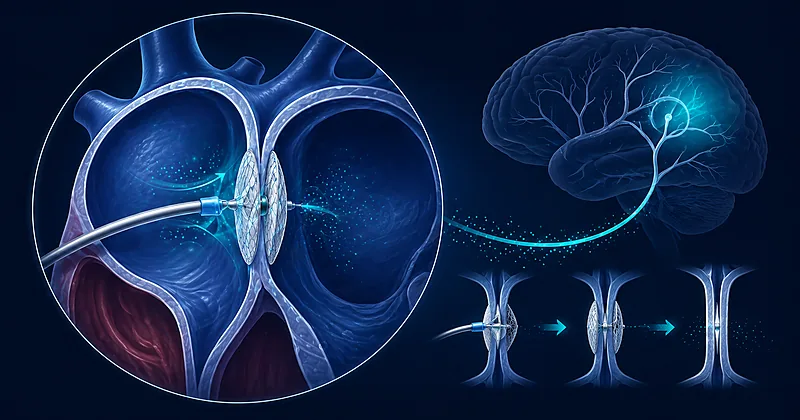
Why This Topic Matters
Cryptogenic stroke accounts for roughly one in four ischemic strokes overall and a higher proportion in younger adults. A patent foramen ovale is found in approximately 25% of the general population but is identified in 40–60% of patients under 55 years presenting with cryptogenic ischemic stroke.
For two decades, the question of whether percutaneous PFO closure was superior to medical therapy alone in this population remained unsettled. Early closure trials were underpowered or used now-obsolete devices, and meta-analyses produced conflicting interpretations. The 2017 publication of CLOSE, RESPECT extended follow-up, and REDUCE in the same NEJM issue resolved much of that uncertainty.
Today, PFO closure for cryptogenic stroke prevention is a recognized option in current AHA/ASA and AAN guidance for selected patients. The remaining clinical challenge is patient selection — identifying who truly has a PFO-related stroke versus an incidental shunt — and weighing the modest absolute risk reduction against procedural risks.
Decisions in this space are inherently shared: closure offers a one-time, durable intervention but carries an upfront procedural risk, while medical therapy avoids the procedure but requires lifelong antiplatelet exposure. For neurologists, framing the trade-off transparently is essential to good practice in PFO closure cryptogenic stroke management.
Beyond stroke recurrence, the discussion has implications for migraine, decompression illness in divers, and platypnea-orthodeoxia syndrome. The evidence base for these other indications is weaker than for stroke prevention, but they often surface in the same clinical conversation.
What Evidence Was Reviewed
This evidence synthesis on PFO closure draws on the three pivotal 2017 randomized trials, an additional high-risk-anatomy trial from 2018, the foundational RoPE score derivation cohort, the major pooled analyses, and two practice guidelines. All PFO closure trials enrolled adults aged 18–60 with imaging-confirmed cryptogenic ischemic stroke and a documented PFO.
Primary outcomes across PFO closure trials were recurrent ischemic stroke or composite recurrent stroke and TIA. Median follow-up ranged from 3.2 to 5.9 years. All trials compared transcatheter device closure plus antiplatelet therapy against antiplatelet therapy alone, with one trial offering anticoagulation as a third arm.
| Source | Type | n | Population | Headline finding |
|---|---|---|---|---|
| CLOSE (Mas et al., NEJM 2017) | RCT | 663 | PFO + atrial septal aneurysm or large shunt; ages 16–60 | Zero recurrent strokes in closure arm vs 14 in antiplatelet arm; HR essentially 0 |
| RESPECT extended (Saver et al., NEJM 2017) | RCT (extended follow-up) | 980 | Any PFO with cryptogenic stroke; mean age 46 | HR 0.55 (95% CI 0.31–0.999) for recurrent ischemic stroke at 5.9 years |
| REDUCE (Søndergaard et al., NEJM 2017) | RCT | 664 | Any PFO with cryptogenic stroke; ages 18–59 | HR 0.23 (95% CI 0.09–0.62) for clinical recurrent ischemic stroke |
| DEFENSE-PFO (Lee et al., JACC 2018) | RCT | 120 | High-risk anatomy: ASA, hypermobile septum, or large shunt | Zero strokes in closure vs 6 in medical arm at 2 years |
| CLOSURE I (Furlan et al., NEJM 2012) | RCT | 909 | Cryptogenic stroke or TIA with PFO; STARFlex device | No significant benefit; older device with higher AF and thrombus rates |
| RESPECT initial (Carroll et al., NEJM 2013) | RCT (initial report) | 980 | Cryptogenic stroke with PFO | Intention-to-treat trend favored closure; reached significance with longer follow-up |
| Kent 2013 (RoPE score derivation) | Pooled cohort | 3,023 | Patients with cryptogenic stroke and PFO assessment | Validated 10-point score predicting probability that a PFO is stroke-related |
| Saver 2018 (NEJM topical review/meta-analysis) | Pooled trial analysis | ~3,440 | All major closure RCTs | Significant overall reduction in recurrent stroke favoring closure |
| Mir 2018 (BMJ Open network meta-analysis) | Network meta-analysis | 5 RCTs | Cryptogenic stroke with PFO | Closure superior to antiplatelets; closure vs anticoagulation comparison less certain |
| AAN 2020 Practice Advisory (Messé et al.) | Guideline | — | Adults 18–60 with non-lacunar cryptogenic stroke and PFO | Recommends offering closure in selected patients after specialist evaluation |
Key Findings on PFO Closure Cryptogenic Stroke
Theme 1: Three landmark trials converge on closure superiority in selected patients
CLOSE, RESPECT extended follow-up, and REDUCE — all reported in 2017 — independently demonstrated that PFO closure plus antiplatelet therapy reduces recurrent ischemic stroke compared with antiplatelet therapy alone. Hazard ratios were approximately 0 in CLOSE (high-risk anatomy only), 0.55 in RESPECT, and 0.23 in REDUCE.
This convergence across three independently designed trials, using different devices and slightly different inclusion criteria, substantially strengthens confidence that the effect is real and not a chance finding from a single trial. The earlier negative CLOSURE I trial used the now-obsolete STARFlex device, which was associated with higher rates of atrial fibrillation and device thrombus and likely diluted any benefit signal.
Theme 2: High-risk anatomy drives the magnitude of benefit
CLOSE enrolled only patients with an atrial septal aneurysm or a large interatrial shunt and reported the largest effect size — zero recurrent strokes in the closure arm. DEFENSE-PFO similarly restricted enrollment to high-risk anatomic features and replicated this near-complete benefit.
Subgroup analyses in RESPECT and REDUCE consistently show larger effect sizes in patients with atrial septal aneurysm or large shunt size compared with those with small, simple PFOs. This pattern aligns with the biological plausibility that anatomically high-risk shunts mediate paradoxical embolism more readily.
Theme 3: The RoPE score informs causal attribution
The Risk of Paradoxical Embolism (RoPE) score is a 10-point clinical tool derived from a pooled cohort of more than 3,000 patients with cryptogenic stroke and known PFO status. Higher scores indicate younger age and absence of competing vascular risk factors, which together raise the probability that a discovered PFO is causally relevant.
Although RoPE was derived to estimate causal attribution rather than to predict response to closure, its components closely overlap with patient profiles that benefited most in the trials. In current practice, RoPE supplements anatomic assessment in the multidisciplinary discussion preceding PFO closure cryptogenic stroke decisions.
Theme 4: Procedural atrial fibrillation is the most common adverse event
Across the three pivotal trials, periprocedural atrial fibrillation occurred in approximately 4–6% of closure recipients, compared with about 1% in medical-therapy arms. Most events were detected within 45 days of the procedure and resolved spontaneously or with short-term rhythm management.
Whether transient post-procedural atrial fibrillation predicts long-term arrhythmic risk is uncertain. The absolute increase in clinically significant atrial fibrillation appears small but is non-zero, and patients should be counseled about this trade-off as part of informed consent for closure.
Theme 5: Long-term durability of benefit appears favorable
RESPECT extended follow-up to a median of 5.9 years and showed the benefit of PFO closure cryptogenic stroke prevention persisted and indeed reached statistical significance only with longer follow-up. CLOSE followed patients for a mean of 5.3 years with sustained absence of recurrent strokes in the closure arm.
Annualized recurrent stroke rates after closure are approximately 0.4–0.6%, compared with 1.0–1.5% on antiplatelet therapy alone. Over a 10–20 year horizon, the absolute risk reduction compounds — a key consideration when counseling younger patients with multiple decades of remaining stroke-risk exposure.
Theme 6: Closure versus anticoagulation is less well characterized
The CLOSE trial included an anticoagulation arm but was not powered for direct PFO closure versus anticoagulation comparison. Network meta-analyses suggest closure may be modestly superior to anticoagulation for stroke prevention, but with overlapping confidence intervals.
Anticoagulation may be preferable when an alternative indication exists — for example, deep venous thrombosis with a transient provoking factor — or when procedural risk is judged unacceptable. Otherwise, the contemporary evidence base predominantly compares closure with antiplatelets, and that is the comparison most relevant to PFO closure cryptogenic stroke decisions in everyday practice.
Clinical pearl. In a young patient (under 60) with a non-lacunar cryptogenic stroke and a PFO with atrial septal aneurysm or large shunt, the trial evidence consistently favors closure. In an older patient with multiple competing vascular risk factors and a small simple PFO, that same evidence does not reliably extend, and medical therapy alone is usually appropriate.
Quality & Consistency of Evidence
The evidence base for PFO closure in cryptogenic stroke is among the strongest in stroke prevention, anchored by three concordant 2017 RCTs and reinforced by pooled analyses and a fourth high-risk-anatomy trial. Nevertheless, applicability of PFO closure beyond the enrolled population requires care.
What the Evidence Does Not Show
Despite three concordant pivotal PFO closure trials, several questions central to everyday practice remain unanswered. Recognizing these gaps prevents over-extrapolation of trial findings to populations and decisions they were not designed to address.
Specific Gaps in the Evidence Base
- Patients over age 60. All three pivotal trials capped enrollment at 60. Whether the same magnitude of benefit applies to older adults — who carry more competing stroke etiologies — is unknown.
- TIA-only presentations. Trials enrolled mostly imaging-confirmed strokes; the benefit of closure after pure TIA with PFO is less clearly characterized.
- Closure versus direct oral anticoagulants. No adequately powered head-to-head trial compares closure with DOACs specifically.
- Optimal duration and intensity of post-closure antithrombotic therapy. Antiplatelet regimens varied across trials and are not standardized.
- Long-term procedural durability beyond 10 years. Device-related events such as erosion, thrombus, and residual shunt over decades remain incompletely characterized.
- Migraine and other non-stroke endpoints. Although closure is sometimes performed for migraine with aura, randomized evidence does not support routine closure for that indication.
These gaps justify a multidisciplinary, individualized approach. Cardiology and neurology partnership is essential to translate trial findings to patients who fall outside the inclusion criteria of the pivotal studies.
Practical Implications
Based on the current evidence, several considerations emerge for managing PFO closure cryptogenic stroke decisions. They reframe what trial data support — not what individual clinicians must do — and require shared decision-making.
Evidence Supports PFO Closure in Selected Younger Patients
For non-lacunar cryptogenic stroke in patients aged 18–60 with a PFO, particularly with atrial septal aneurysm or large shunt, three concordant RCTs support offering PFO closure plus antiplatelet therapy.
RoPE Score Aids Causal Attribution
A high RoPE score increases the probability that a discovered PFO is causally relevant rather than incidental and supports proceeding with multidisciplinary discussion of PFO closure.
Anatomic Features Refine Selection
Atrial septal aneurysm and large interatrial shunt by bubble-contrast or transesophageal echocardiography concentrate the absolute benefit of PFO closure based on subgroup data.
Counsel on Procedural Atrial Fibrillation
A small but real risk of new-onset atrial fibrillation — typically transient and within 45 days — should be discussed during informed consent for PFO closure.
Implementation Considerations
A complete cryptogenic stroke workup remains essential before considering closure: prolonged cardiac monitoring for occult atrial fibrillation, transesophageal echocardiography for left atrial appendage and aortic atheroma, vascular imaging for proximal large-artery sources, and hypercoagulability assessment when clinically indicated. Closure addresses a single proposed mechanism; missing an alternative source — such as paroxysmal atrial fibrillation — exposes the patient to ongoing risk that closure cannot mitigate.
Current guidelines and the CRYSTAL-AF and EMBRACE trials support extended ambulatory monitoring of at least 30 days, with implantable loop recorders identifying occult atrial fibrillation in additional patients over 6–12 months. Identifying paroxysmal atrial fibrillation reframes the etiology and shifts management from PFO closure to anticoagulation.
Trial protocols varied: dual antiplatelet therapy for 1–6 months followed by single-agent antiplatelet was common. Most contemporary practice uses aspirin plus clopidogrel for 1–6 months, then aspirin alone indefinitely. Specific durations are not strongly evidence-based and are typically guided by device manufacturer recommendations and operator preference.
Randomized trials of PFO closure for migraine — including MIST and PREMIUM — did not meet primary efficacy endpoints, although some secondary signals were observed. Current evidence does not support routine PFO closure cryptogenic stroke decisions being extended to pure migraine indications. PFO closure for migraine remains investigational.
Anticoagulation may be preferred when a concurrent indication exists — recent unprovoked deep venous thrombosis, hypercoagulable state, or strong suspicion of paradoxical embolism with persistent venous source. The CLOSE trial’s anticoagulation arm and several network meta-analyses suggest comparable, though less certain, efficacy versus PFO closure in selected scenarios.
Evidence Grade & Bottom Line
Evidence Grade: Strong (for selected younger adults with high-risk anatomy) / Moderate (for general PFO and cryptogenic stroke population aged 18–60). Three concordant RCTs and a confirmatory high-risk anatomy trial support closure superiority in well-selected patients. Evidence weakens substantially for older adults, low-risk anatomy, and TIA-only presentations.
Bottom Line
- For non-lacunar cryptogenic stroke in adults aged 18–60 with a PFO, percutaneous PFO closure plus antiplatelet therapy is supported by three concordant randomized trials.
- High-risk anatomic features — atrial septal aneurysm, large interatrial shunt — concentrate the absolute benefit and should drive selection.
- The RoPE score complements anatomic assessment by estimating the probability that a discovered PFO is causally relevant to the index stroke.
- Periprocedural atrial fibrillation occurs in roughly 4–6% of patients and is usually transient, but should be disclosed during shared decision-making.
- Evidence is insufficient for patients over age 60, for low-risk PFO anatomy, and for routine PFO closure in pure migraine indications.
Article Information & References
For Educational Purposes Only. This is an original evidence synthesis informed by the studies listed below. It does not replace clinical judgement. Drug dosages should be verified against current prescribing information.
References
- Mas JL, Derumeaux G, Guillon B, et al. Patent Foramen Ovale Closure or Anticoagulation vs. Antiplatelets after Stroke. New England Journal of Medicine. 2017;377(11):1011-1021. DOI: 10.1056/NEJMoa1705915
- Saver JL, Carroll JD, Thaler DE, et al. Long-Term Outcomes of Patent Foramen Ovale Closure or Medical Therapy after Stroke. New England Journal of Medicine. 2017;377(11):1022-1032. DOI: 10.1056/NEJMoa1610057
- Søndergaard L, Kasner SE, Rhodes JF, et al. Patent Foramen Ovale Closure or Antiplatelet Therapy for Cryptogenic Stroke. New England Journal of Medicine. 2017;377(11):1033-1042. DOI: 10.1056/NEJMoa1707404
- Lee PH, Song JK, Kim JS, et al. Cryptogenic Stroke and High-Risk Patent Foramen Ovale: The DEFENSE-PFO Trial. Journal of the American College of Cardiology. 2018;71(20):2335-2342. DOI: 10.1016/j.jacc.2018.02.046
- Furlan AJ, Reisman M, Massaro J, et al. Closure or Medical Therapy for Cryptogenic Stroke with Patent Foramen Ovale. New England Journal of Medicine. 2012;366(11):991-999. DOI: 10.1056/NEJMoa1009639
- Carroll JD, Saver JL, Thaler DE, et al. Closure of Patent Foramen Ovale versus Medical Therapy after Cryptogenic Stroke. New England Journal of Medicine. 2013;368(12):1092-1100. DOI: 10.1056/NEJMoa1301440
- Kent DM, Ruthazer R, Weimar C, et al. An Index to Identify Stroke-Related vs Incidental Patent Foramen Ovale in Cryptogenic Stroke. Neurology. 2013;81(7):619-625. DOI: 10.1212/WNL.0b013e3182a08d59
- Saver JL, Mattle HP, Thaler D. Patent Foramen Ovale Closure Versus Medical Therapy for Cryptogenic Ischemic Stroke: A Topical Review. Stroke. 2018;49(6):1541-1548. DOI: 10.1161/STROKEAHA.117.018153
- Mir H, Siemieniuk RAC, Ge LC, et al. Patent foramen ovale closure, antiplatelet therapy or anticoagulation in patients with patent foramen ovale and cryptogenic stroke: a systematic review and network meta-analysis. BMJ Open. 2018;8(7):e023761. DOI: 10.1136/bmjopen-2018-023761
- Kleindorfer DO, Towfighi A, Chaturvedi S, et al. 2021 Guideline for the Prevention of Stroke in Patients With Stroke and Transient Ischemic Attack: A Guideline From the American Heart Association/American Stroke Association. Stroke. 2021;52(7):e364-e467. DOI: 10.1161/STR.0000000000000375
- Messé SR, Gronseth GS, Kent DM, et al. Practice advisory update summary: Patent foramen ovale and secondary stroke prevention. Neurology. 2020;94(20):876-885. DOI: 10.1212/WNL.0000000000009443
- Mojadidi MK, Zaman MO, Elgendy IY, et al. Cryptogenic Stroke and Patent Foramen Ovale. Journal of the American College of Cardiology. 2018;71(9):1035-1043. DOI: 10.1016/j.jacc.2017.12.059
- Kent DM, Dahabreh IJ, Ruthazer R, et al. Device Closure of Patent Foramen Ovale After Stroke: Pooled Analysis of Completed Randomized Trials. Journal of the American College of Cardiology. 2016;67(8):907-917. DOI: 10.1016/j.jacc.2015.12.023