
Plasmapheresis Guillain-Barre: 6 Critical Clinical Insights
Synthesising trial evidence on plasma exchange versus IVIG, combination therapy outcomes, and severity-based selection in acute inflammatory demyelinating polyneuropathy.
One-Minute Takeaway on Plasmapheresis Guillain-Barre
Key takeaways from the plasmapheresis Guillain-Barre evidence base:
- Plasmapheresis Guillain-Barre treatment accelerates motor recovery compared with supportive care alone, with the strongest benefit observed when initiated within the first two weeks of symptom onset.
- Head-to-head randomised trials show plasma exchange and intravenous immunoglobulin produce equivalent functional outcomes in severe disease, making the choice largely driven by logistics and contraindications rather than expected efficacy.
- Combining plasma exchange with IVIG offers no consistent advantage over either monotherapy in the largest direct comparison trial conducted to date.
- Severity-based selection remains the primary clinical driver — patients unable to walk unaided benefit most, while mild ambulant cases have less convincing supporting evidence for either treatment.
- Treatment delays beyond four weeks substantially attenuate benefit, making early recognition and intervention central to outcomes.
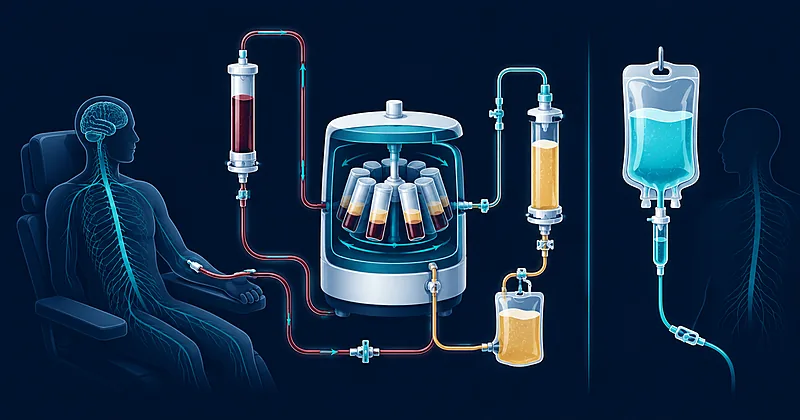
Why Plasmapheresis Guillain-Barre Decisions Matter
Guillain-Barre syndrome affects approximately one to two per 100,000 people annually worldwide and is the leading cause of acute flaccid paralysis since polio eradication. Around 20% to 30% of patients require mechanical ventilation during the nadir of weakness, and mortality remains 3% to 7% even with modern intensive supportive care.
The plasmapheresis Guillain-Barre evidence base shaped one of the earliest immunomodulatory protocols in neurology. The North American and French cooperative trials in the mid-1980s established efficacy at a time when supportive care alone had previously been the standard of management.
Intravenous immunoglobulin entered clinical use in the early 1990s and has since become the more commonly chosen first-line agent in many centres. Logistics largely favour IVIG: peripheral administration, no specialised equipment, no central venous access requirement, and broader operator familiarity.
Yet plasma exchange retains specific advantages worth weighing. It removes circulating autoantibodies and inflammatory mediators rather than supplementing immunoglobulins, a mechanism distinct from IVIG. In IVIG contraindications, primary treatment failure, or resource-limited settings, plasmapheresis Guillain-Barre treatment may be the preferred or only available option.
For clinicians managing newly diagnosed severe disease, knowing precisely which evidence supports plasma exchange — and where that evidence falls short — underpins both shared decision-making with patients and rational use of scarce intensive care resources.
Evidence Reviewed
The plasmapheresis Guillain-Barre literature spans four decades. It is anchored by two foundational placebo-controlled trials from the mid-1980s, a definitive 1997 three-arm randomised trial comparing plasma exchange against IVIG and against the combination, dose-response data from the French Cooperative Group, modern Cochrane systematic reviews for both modalities, and a contemporary placebo-controlled trial of intensified IVIG in poor-prognosis patients.
The table below summarises the eight most influential studies informing current decision-making. Sample sizes range from under 100 to nearly 1,500 participants, and across the higher-quality trials enrollment was consistently restricted to severe disease defined by inability to walk unaided.
| Study / Year | Design | Population (n) | Comparison | Primary Outcome | Key Finding |
|---|---|---|---|---|---|
| North American GBS Study Group, 1985 | RCT | 245 severe adults | PE vs supportive care | Time to recover walking | PE shortened time to walk by approximately 50% |
| French Cooperative Group, 1987 | RCT | 220 severe adults | PE vs supportive care | Median days to walk unaided | Reduced from 85 to 53 days |
| Plasma Exchange/Sandoglobulin Trial, 1997 | RCT, 3 arms | 379 severe adults | PE vs IVIG vs PE+IVIG | Disability grade improvement at 4 weeks | No significant difference among the three arms |
| French Cooperative Group, 1997 (dose-response) | RCT | 556 adults stratified by severity | 2 vs 4 vs 6 PE sessions | Time to recover walking | Severity-tailored dose-response benefit |
| Hughes IVIG Cochrane, 2014 | SR/MA | ~600 PE-vs-IVIG patients | IVIG vs PE | Disability grade improvement | IVIG equivalent to PE in severe disease |
| Chevret PE Cochrane, 2017 | SR/MA | 6 RCTs, 649 patients | PE vs supportive care | Disability improvement and recovery | PE consistently accelerates recovery |
| SID-GBS (Walgaard), 2021 | RCT, placebo-controlled | 93 poor-prognosis patients | Second IVIG dose vs placebo | Disability at 4 weeks | No benefit; more thromboembolism |
| IGOS regional analysis (Doets), 2018 | Prospective cohort | ~1,500 patients globally | Observational treatment patterns | Geographic treatment variation | Wide regional differences in PE/IVIG use |
Three of these trials — the 1985 North American, the 1987 French, and the 1997 Plasma Exchange/Sandoglobulin trial — form the backbone of evidence for plasma exchange efficacy and its comparison with IVIG. Two Cochrane reviews provide the highest-quality syntheses, and the 2021 SID-GBS trial addresses the contemporary question of treatment intensification in poor responders.
Key Findings in Plasmapheresis Guillain-Barre Trials
Thematic synthesis of the plasmapheresis Guillain-Barre evidence yields six clinical insights, organised by the question each trial generation addressed: efficacy against supportive care, head-to-head comparison with IVIG, the role of combination therapy, severity-based dosing, treatment timing, and considerations in special subpopulations.
Plasma Exchange Versus Supportive Care: The Foundation
The first generation of plasmapheresis Guillain-Barre trials compared plasma exchange against best supportive care alone. The North American Guillain-Barre Syndrome Study Group enrolled 245 adults within 30 days of symptom onset and demonstrated that plasma exchange shortened median time to recover walking by approximately one month.
The French Cooperative Group on Plasma Exchange in Guillain-Barre Syndrome corroborated these findings in 220 severe patients, reducing median time to walk unaided from 85 days to 53 days. The 2017 Chevret Cochrane review of six RCTs and 649 patients reinforced this conclusion: plasmapheresis Guillain-Barre treatment is more effective than supportive care for accelerating motor recovery in severe disease.
These foundational trials shared design features that anchor modern interpretation. Enrollment was restricted to within four weeks of onset, focused on inability to walk unaided, and used disability grade improvement as the primary outcome. The consistency of benefit across two independent multicentre trials and confirmation in meta-analysis supports a strong evidence rating.
Head-to-Head: Plasmapheresis Versus IVIG
The landmark 1997 Plasma Exchange/Sandoglobulin Guillain-Barre Syndrome Trial randomised 379 severe patients to plasma exchange alone, IVIG alone, or both treatments combined. After four weeks, mean disability grade improvements were 0.9, 0.8, and 1.1 respectively — numerical differences that did not reach statistical significance.
The 2014 Hughes IVIG Cochrane review synthesised five trials directly comparing IVIG to plasma exchange in over 500 severe patients. Outcomes including time to recover walking, disability grade improvement at four weeks, and mortality were statistically indistinguishable between the two modalities.
The plasmapheresis Guillain-Barre versus IVIG question therefore has a remarkably consistent answer across high-quality direct evidence: equivalent efficacy in severe demyelinating disease. Choice between the two should be driven by logistics, comorbidities, and resource availability rather than expected efficacy differences.
Combination Therapy: Evidence Against Routine Use
The 1997 trial’s combination arm received plasma exchange followed by IVIG. Although the numerical mean disability improvement was modestly higher than either monotherapy (1.1 vs 0.9 and 0.8), the difference was not statistically significant. Combination treatment doubled total treatment duration, cost, and adverse event exposure.
The 2021 SID-GBS trial by Walgaard and colleagues tested a closely related question in 93 patients with poor predicted prognosis: would a second IVIG course improve outcomes? The placebo-controlled trial showed no functional benefit on disability at four weeks and reported a higher incidence of thromboembolic events in the active arm.
Read together, these two trials argue against routine intensification of plasmapheresis Guillain-Barre regimens. Combination or repeated treatment should be reserved for clearly defined clinical scenarios with shared decision-making, not adopted as default practice in severe disease.
Severity-Based Selection and Dosing
The 1997 French Cooperative Group trial on appropriate number of plasma exchange sessions stratified 556 patients by initial severity. Mildly affected patients (still walking unaided) gained as much from two sessions as from four. Moderately affected patients (unable to walk) benefited demonstrably from four sessions over two.
Severely affected patients (mechanically ventilated) showed no additional benefit beyond four sessions, even though original protocols had often used six. This severity-stratified dose-response remains one of the few high-quality datasets directly addressing plasmapheresis Guillain-Barre dosing decisions.
The practical implication is a tailored approach: minimal two-session regimens for mild disease if treatment is offered, fuller four-session regimens for non-ambulant patients, with limited additional gain from extending beyond four sessions even in the most severely affected.
Timing of Plasmapheresis Guillain-Barre Initiation
Across all major trials, treatment initiation within two weeks of symptom onset consistently outperformed delayed initiation. The North American trial showed strongest benefit when started within seven days, with diminishing effect at later windows. The French trial similarly observed attenuated benefit beyond four weeks.
Mechanistically this aligns with the disease course. Peak immune injury occurs in the first two to four weeks of illness, after which recovery is driven by remyelination and reinnervation that immunomodulation cannot accelerate. Treatment after the plateau phase has weak supporting evidence and should be undertaken cautiously.
Clinical Pearl
Special Subpopulation Considerations
Major plasmapheresis Guillain-Barre trials predominantly enrolled adults with classical demyelinating disease. Several clinically important subpopulations rely on evidence extrapolation, registry data, or pragmatic clinical judgement.
Pediatric randomised trials are sparse. The 2014 IVIG Cochrane synthesis includes limited paediatric data showing similar efficacy patterns for both modalities, though sample sizes are inadequate for definitive conclusions. Most paediatric protocols extrapolate from adult evidence and typically favour IVIG to avoid central venous access requirements in children. Plasma exchange remains feasible in older paediatric patients with adequate vascular access and experienced paediatric apheresis services.
Pregnancy-specific safety and efficacy data remain under-reported in the formal trial literature, despite case series suggesting acceptable safety profiles for both plasma exchange and IVIG during pregnancy. Choice in pregnancy typically favours IVIG to avoid the haemodynamic shifts associated with plasma exchange, particularly in the third trimester. Plasma exchange remains an option when IVIG is contraindicated or has failed, with appropriate maternal-foetal monitoring during procedures.
Acute motor axonal neuropathy and acute motor-sensory axonal neuropathy predominate in parts of Asia and Latin America. Most landmark trials enrolled predominantly demyelinating patients, so efficacy estimates for axonal variants are largely extrapolated from mixed-cohort subgroup analyses. These analyses suggest response patterns similar to demyelinating disease but with weaker statistical confidence. Some observational data suggest slower or less complete recovery in axonal forms regardless of immunotherapy choice.
Documented anti-IgA antibodies with prior anaphylaxis, severe renal impairment with risk of osmotic injury from sucrose-stabilised preparations, hyperviscosity syndromes, and unavailability or cost barriers to IVIG all constitute clinical scenarios where plasma exchange is the rational primary choice. Conversely, acute heart failure, haemodynamic instability, sepsis, or absence of adequate vascular access favour IVIG over plasma exchange, because plasma exchange involves fluid shifts and central venous access that can destabilise critically ill patients.
Evidence Quality and Consistency
Evidence quality varies meaningfully across the clinical questions the plasmapheresis Guillain-Barre trials address. The colour-coded summary below reflects both the strength and the consistency of the supporting data for each domain.
Knowledge Gaps in Plasmapheresis Guillain-Barre Evidence
Despite four decades of plasmapheresis Guillain-Barre research, several clinically important questions remain inadequately addressed by high-quality evidence. Naming these gaps explicitly supports honest patient counselling and helps prioritise future research.
Specific Evidence Gaps
- No modern RCTs comparing plasma exchange timing windows (e.g., within seven days versus within fourteen days) in contemporary critical care environments.
- Limited efficacy data for plasma exchange in axonal variants (AMAN and AMSAN), which dominate in Asia and parts of Latin America and may have distinct underlying immunopathology.
- Pediatric plasmapheresis Guillain-Barre evidence is sparse, and most paediatric protocols extrapolate from adult trials with limited age-specific safety data.
- Pregnancy-specific safety and efficacy data remain under-reported despite suggestive case series indicating both treatments are tolerable.
- Treatment of slow or incomplete responders is not well-characterised; the SID-GBS trial in poor-prognosis patients found no benefit from a second IVIG dose.
- Long-term outcomes beyond 12 months — including residual fatigue, neuropathic pain, and quality of life — are systematically under-reported.
- Cost-effectiveness comparisons in modern healthcare systems are absent from most analyses, which complicates resource allocation decisions in middle- and lower-income settings.
Until these plasmapheresis Guillain-Barre evidence gaps are addressed by adequately powered modern trials, clinical decision-making in these subpopulations will continue to depend on individual case judgement, expert consensus, and observational data.
Practical Implications for Clinical Practice
The plasmapheresis Guillain-Barre evidence base supports several practice-relevant considerations, framed as evidence-based observations rather than as prescriptive directives. Local protocols and individual patient factors remain central to final decision-making.
Patients unable to walk unaided benefit from either plasma exchange or IVIG when initiated within the first two weeks. Logistics, comorbidities, and resource availability appropriately drive the choice rather than an evidence-based preference for one modality.
Combining plasma exchange with IVIG has not improved outcomes in randomised trials and increases cost, treatment duration, and adverse event exposure. The available data support reserving combination consideration for clinical deterioration scenarios.
The French dose-response trial supports adjusting plasma exchange sessions to baseline severity: two sessions for mildly affected patients if treating, four for non-ambulant patients, with no demonstrated additional benefit beyond four sessions for ventilated cases.
Treatment benefit is highest when started within seven to fourteen days of symptom onset, diminishes beyond two weeks, and becomes uncertain beyond four weeks. Early diagnosis and immediate transfer to a centre with treatment capability is well-supported.
These plasmapheresis Guillain-Barre considerations reflect the highest-quality evidence currently available. Individual patient factors — including IVIG contraindications, vascular access challenges, and local apheresis expertise — appropriately modify their application in practice.
Evidence Grade and Bottom Line
The plasmapheresis Guillain-Barre evidence base receives different grades for different clinical questions. The strongest evidence supports plasma exchange efficacy versus supportive care; moderate evidence supports equivalence with IVIG and the absence of routine combination benefit; evidence in subpopulations is limited.
Evidence Grade: Strong (plasma exchange vs supportive care) · Moderate (PE–IVIG equivalence; combination question) · Limited (axonal variants, mild ambulant disease, paediatrics, pregnancy)
Bottom Line
- Plasma exchange and IVIG provide equivalent functional outcomes in severe Guillain-Barre syndrome based on direct head-to-head randomised trials and the supporting Cochrane meta-analyses.
- The choice between the two should be driven by patient comorbidities, treatment logistics, vascular access, and resource availability rather than an expected efficacy difference.
- Combining the two treatments has not demonstrated additional benefit in randomised trials and is not supported as a routine approach, although it remains an option in defined deterioration scenarios.
- Earlier treatment within the first two weeks of symptom onset is meaningfully more effective; benefit substantially diminishes beyond four weeks from onset.
- Evidence is strongest for severe demyelinating disease in adults. Axonal variants, mild ambulant cases, paediatric patients, pregnancy, and the choice of second-line therapy in non-responders all represent meaningful evidence gaps that require clinical judgement and local expertise.
Article Information
For Educational Purposes Only. This is an original evidence synthesis informed by the studies listed below. It does not replace clinical judgement. Drug dosages should be verified against current prescribing information.
References
- The Guillain-Barré Syndrome Study Group. Plasmapheresis and acute Guillain-Barré syndrome. Neurology. 1985;35(8):1096-1104. DOI: 10.1212/wnl.35.8.1096
- French Cooperative Group on Plasma Exchange in Guillain-Barré Syndrome. Efficiency of plasma exchange in Guillain-Barré syndrome: role of replacement fluids. Ann Neurol. 1987;22(6):753-761. DOI: 10.1002/ana.410220612
- Plasma Exchange/Sandoglobulin Guillain-Barré Syndrome Trial Group. Randomised trial of plasma exchange, intravenous immunoglobulin, and combined treatments in Guillain-Barré syndrome. Lancet. 1997;349(9047):225-230. DOI: 10.1016/s0140-6736(96)09095-2
- The French Cooperative Group on Plasma Exchange in Guillain-Barré Syndrome. Appropriate number of plasma exchanges in Guillain-Barré syndrome. Ann Neurol. 1997;41(3):298-306. DOI: 10.1002/ana.410410304
- Chevret S, Hughes RA, Annane D. Plasma exchange for Guillain-Barré syndrome. Cochrane Database Syst Rev. 2017;2(2):CD001798. DOI: 10.1002/14651858.CD001798.pub3
- Hughes RA, Swan AV, van Doorn PA. Intravenous immunoglobulin for Guillain-Barré syndrome. Cochrane Database Syst Rev. 2014;(9):CD002063. DOI: 10.1002/14651858.CD002063.pub6
- Walgaard C, Jacobs BC, Lingsma HF, et al. Second intravenous immunoglobulin dose in patients with Guillain-Barré syndrome with poor prognosis (SID-GBS): a double-blind, randomised, placebo-controlled trial. Lancet Neurol. 2021;20(4):275-283. DOI: 10.1016/S1474-4422(20)30494-4
- van den Berg B, Walgaard C, Drenthen J, Fokke C, Jacobs BC, van Doorn PA. Guillain-Barré syndrome: pathogenesis, diagnosis, treatment and prognosis. Nat Rev Neurol. 2014;10(8):469-482. DOI: 10.1038/nrneurol.2014.121
- Hughes RA, Wijdicks EF, Barohn R, et al. Practice parameter: immunotherapy for Guillain-Barré syndrome: report of the Quality Standards Subcommittee of the American Academy of Neurology. Neurology. 2003;61(6):736-740. DOI: 10.1212/wnl.61.6.736
- Verboon C, van Doorn PA, Jacobs BC. Treatment dilemmas in Guillain-Barré syndrome. J Neurol Neurosurg Psychiatry. 2017;88(4):346-352. DOI: 10.1136/jnnp-2016-314862
- Leonhard SE, Mandarakas MR, Gondim FAA, et al. Diagnosis and management of Guillain-Barré syndrome in ten steps. Nat Rev Neurol. 2019;15(11):671-683. DOI: 10.1038/s41582-019-0250-9
- Doets AY, Verboon C, van den Berg B, et al. Regional variation of Guillain-Barré syndrome. Brain. 2018;141(10):2866-2877. DOI: 10.1093/brain/awy232