
Trigeminal Neuralgia Treatment: Robust Effects on 4 Outcomes
An evidence synthesis comparing medical therapy, MRI imaging, and surgical options across pain freedom, recurrence, durability, and adverse effects.
One-Minute Takeaway on Trigeminal Neuralgia Treatment
One-Minute Takeaway
- Strong evidence supports sodium-channel blockers as first-line trigeminal neuralgia treatment, with carbamazepine and oxcarbazepine producing meaningful early reduction in paroxysmal pain in most patients.
- High-resolution 3D T2-weighted MRI with MR angiography detects neurovascular compression with reported sensitivity above 95%, and also identifies secondary causes such as tumour or demyelination.
- Microvascular decompression offers the most durable surgical relief, with roughly 70% of patients pain-free without medication a decade after surgery in the largest long-term series.
- Stereotactic radiosurgery and percutaneous procedures provide less invasive options, with higher recurrence over time but a favourable safety profile in older or higher-risk patients.
Why This Topic Matters
Trigeminal neuralgia produces sudden, electric-shock-like facial pain triggered by light touch, chewing, or speaking. The disorder affects up to roughly 27 per 100,000 people and is most common in older adults, with a female predominance reported across several cohorts.
The clinical challenge is that no single modality solves the problem for everyone. Drugs often work well at first, but a substantial share of patients lose adequate control over years. Imaging and surgery then become central to planning.
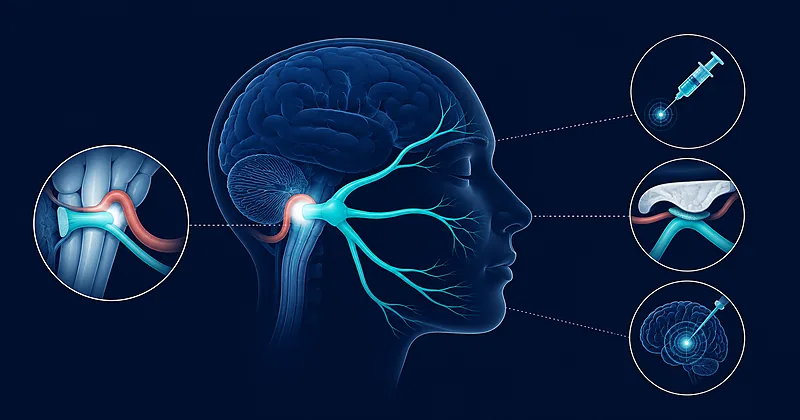
Effective trigeminal neuralgia treatment now spans three connected pillars: pharmacotherapy for rapid control, dedicated MRI to classify the disorder and map any offending vessel, and a menu of surgical procedures that trade durability against invasiveness. This review synthesises the evidence across all three.
Evidence Reviewed
The evidence base combines randomized trials of pharmacotherapy, prospective and retrospective surgical cohorts, imaging accuracy studies, and pooled analyses. The table below summarises the major sources anchoring this synthesis, spanning medical, imaging, and surgical domains.
| Source / Type | Domain | n | Key Outcome |
|---|---|---|---|
| Guo 2024 meta-analysis | Medical (carbamazepine) | 15 studies | Significant reduction in pain intensity and frequency; generally well tolerated |
| Comparative RCT (oxcarbazepine vs carbamazepine) | Medical | NR | Good response 69% vs 20%; lower mean VAS with oxcarbazepine |
| Di Stefano natural-history cohort | Medical (long-term) | 200 | Loss of adequate response over time; surgery counselling advised |
| Zhou 2012 imaging study (3D FIESTA) | Imaging | NR | Sensitivity 97.2%, specificity 100% vs surgical findings |
| Springer 2026 imaging systematic review | Imaging | Multiple | Protocol and diagnostic-accuracy synthesis for MRI in TN |
| Barker 1996 long-term cohort (NEJM) | Surgical (MVD) | 1,185 | 70% excellent result at 10 years; major complications uncommon |
| Holste 2018 meta-analysis | Surgical (MVD) | 3,987 | 76% pain freedom at mean 1.7-year follow-up |
| Danish 5-year prospective cohort 2025 | Surgical vs medical | 227 | Pain-free without medication 59% (MVD) vs 19% (medical) |
| Kondziolka 2010 radiosurgery cohort | Surgical (SRS) | 503 | Initial adequate relief 89%; BNI I–IIIa 41% at 5 years |
| MVD vs percutaneous long-term comparison | Surgical comparison | NR | 25% recurrence at 96 months (MVD) vs 12 months (percutaneous) |
These sources differ in design and risk of bias. Imaging-accuracy work and surgical series are largely observational, while pharmacological comparisons include randomized data. The synthesis below weights findings accordingly rather than treating all sources equally.
Key Findings on Trigeminal Neuralgia Treatment by Theme
Medical Therapy: First-Line and Beyond
Across guidelines and cohorts, carbamazepine and oxcarbazepine remain the consistent first-line agents. Both block voltage-gated sodium channels, reducing neuronal excitability and the paroxysmal pain characteristic of the disorder. A pooled analysis of fifteen studies found carbamazepine significantly reduced pain intensity and frequency.
Oxcarbazepine shows similar efficacy with better tolerability in comparative work. One randomized comparison reported a good response in 69% of the oxcarbazepine group versus 20% on carbamazepine. Tolerability matters because adverse drug reactions are common, and severe cutaneous reactions occur more often in carriers of the HLA-B*1502 allele.
Clinical pearl: durable control is the weak point of medical therapy. One systematic review estimated that more than half of initial carbamazepine responders eventually fail to maintain adequate relief over 5 to 10 years, which reframes drugs as effective but often time-limited.
Second-line and add-on options have a thinner evidence base. Lamotrigine added to carbamazepine has supportive controlled data, while baclofen, gabapentin, pregabalin, and botulinum toxin are used with more limited evidence. No oral agent has outperformed carbamazepine or oxcarbazepine for primary control.
Imaging: Classification and Surgical Planning
MRI serves two distinct jobs in trigeminal neuralgia treatment. First, it distinguishes secondary causes, such as cerebellopontine-angle tumours or multiple sclerosis, from primary disease. Second, it characterises any neurovascular contact at the root entry zone that may guide decompression.
The reference standard combines high-resolution 3D heavily T2-weighted sequences (CISS or FIESTA) with 3D time-of-flight MR angiography and gadolinium-enhanced T1 imaging. Using surgical findings as the comparator, one 3D FIESTA study reported sensitivity of 97.2% and specificity of 100% for the neurovascular relationship.
Imaging also informs prognosis. The most recent classification separates classical trigeminal neuralgia, defined by demonstrable vascular contact with morphological change, from idiopathic disease without it. This distinction, drawn largely from imaging, helps frame which patients are most likely to benefit from decompression.
Surgery: Durability Versus Invasiveness
Microvascular decompression is the most definitive option because it addresses the presumed cause rather than ablating the nerve. In a 1,185-patient series with median 6.2-year follow-up, 70% had excellent results without medication at 10 years. Major complications were uncommon, including operative mortality near 0.2%.
A 2025 prospective cohort directly compared modalities over five years. Pain-free status without medication reached 59% after decompression versus 19% with medical management (RR 3.03, 95% CI 1.67–5.50). A pooled analysis of 3,987 patients found 76% pain freedom at a mean 1.7 years, with arterial compression predicting success.
Less invasive options trade durability for safety. Gamma Knife radiosurgery achieved initial adequate relief in 89% of 503 patients, but significant relief fell to 41% at five years, reflecting recurrence over time. Percutaneous procedures show high initial success with earlier recurrence; in one comparison, 25% recurred at 96 months after decompression versus 12 months after percutaneous surgery.
Quality & Consistency of the Evidence
Evidence strength varies sharply by domain. The findings below are graded by the consistency and design quality of the underlying studies, with colour reflecting how settled each conclusion currently is.
The overall pattern is encouraging but uneven. The strongest claims concern first-line drugs, MRI accuracy, and decompression durability. Comparative ranking among surgical options is supported by less rigorous designs and warrants caution.
What the Evidence Does NOT Show
Knowledge Gaps
- No randomized trial establishes the optimal timing of surgery relative to drug failure, so the threshold for early referral remains a judgement based on prognostic features.
- Head-to-head randomized comparisons of decompression, radiosurgery, and percutaneous techniques are lacking, leaving relative durability inferred from observational data.
- The predictive value of MRI-detected neurovascular contact for surgical success is imperfect, since contact also occurs in asymptomatic nerves.
- Long-term comparative quality-of-life and cost data across modalities are limited beyond five to ten years.
- Evidence for most second-line and adjunctive drugs is too sparse to rank them reliably against each other.
These gaps explain why trigeminal neuralgia treatment remains individualised. Decisions weigh patient age, comorbidity, imaging findings, and preference rather than a single evidence-mandated pathway.
Practical Implications
Translating the evidence into practice means matching each pillar to the clinical situation. The cards below frame what the current evidence supports, not directive mandates.
Based on the current evidence, a staged approach is reasonable: confirm diagnosis and image early, start first-line drugs, and discuss surgery when control falters or adverse effects limit dosing. Modality choice then follows fitness, imaging, and patient priorities.
Evidence Grade & Bottom Line
Overall Evidence Grade: Moderate to Strong. First-line drug efficacy, MRI accuracy, and decompression durability rest on strong evidence. Comparative ranking among surgical options and most second-line drugs is weaker, so some recommendations may change as randomized data emerge.
Bottom Line
- Carbamazepine and oxcarbazepine provide effective early control for most patients, though many lose adequate response over years.
- Dedicated MRI with high-resolution T2 and MR angiography reliably identifies neurovascular compression and excludes secondary causes.
- Microvascular decompression delivers the most durable medication-free relief, with roughly seven in ten patients pain-free at ten years in the largest series.
- Radiosurgery and percutaneous procedures are valuable lower-risk alternatives, accepting higher recurrence in exchange for reduced invasiveness.
- The main limitation is the absence of randomized head-to-head surgical trials, so timing and modality remain individualised decisions.
Article Information & References
For Educational Purposes Only. This is an original evidence synthesis informed by the studies listed below. It does not replace clinical judgement. Drug dosages should be verified against current prescribing information.
- Guo M, Shen W, Zhou M, et al. Safety and efficacy of carbamazepine in the treatment of trigeminal neuralgia: a meta-analysis. Math Biosci Eng. 2024;21(4):5335–5359. DOI: 10.3934/mbe.2024235
- Bendtsen L, Zakrzewska JM, Abbott J, et al. European Academy of Neurology guideline on trigeminal neuralgia. Eur J Neurol. 2019;26(6):831–849. DOI: 10.1111/ene.13950
- Di Stefano G, La Cesa S, Truini A, Cruccu G. Natural history and outcome of 200 outpatients with classical trigeminal neuralgia treated with carbamazepine or oxcarbazepine. J Headache Pain. 2014;15:34. DOI: 10.1186/1129-2377-15-34
- Zhou Q, Liu ZL, Qu CC, et al. Preoperative demonstration of neurovascular relationship in trigeminal neuralgia by using 3D FIESTA sequence. Magn Reson Imaging. 2012;30(5):666–671. DOI: 10.1016/j.mri.2011.12.022
- Haller S, Etienne L, Kövari E, et al. Imaging of neurovascular compression syndromes. AJNR Am J Neuroradiol. 2016;37(8):1384–1392. DOI: 10.3174/ajnr.A4683
- Systematic review of MRI protocol and diagnostic accuracy in trigeminal neuralgia. Eur Radiol. 2026. DOI: 10.1007/s00330-025-12141-8
- Barker FG, Jannetta PJ, Bissonette DJ, et al. The long-term outcome of microvascular decompression for trigeminal neuralgia. N Engl J Med. 1996;334(17):1077–1083. DOI: 10.1056/NEJM199604253341701
- Holste K, Chan AY, Rolston JD, Englot DJ. Pain outcomes following microvascular decompression for drug-resistant trigeminal neuralgia: a systematic review and meta-analysis. Neurosurgery. 2020;86(2):182–190. DOI: 10.1093/neuros/nyz075
- Five-year prospective outcomes of medical management and microvascular decompression in trigeminal neuralgia. J Neurol. 2025. DOI: 10.1007/s00415-025-13447-9
- Kondziolka D, Zorro O, Lobato-Polo J, et al. Gamma Knife stereotactic radiosurgery for idiopathic trigeminal neuralgia. J Neurosurg. 2010;112(4):758–765. DOI: 10.3171/2009.7.JNS09694
- Comparison of first-time microvascular decompression with percutaneous surgery for trigeminal neuralgia: long-term outcomes and prognostic factors. Acta Neurochir (Wien). 2021;163(6):1623–1634. DOI: 10.1007/s00701-021-04793-4
- Cruccu G, Di Stefano G, Truini A. Trigeminal neuralgia. N Engl J Med. 2020;383(8):754–762. DOI: 10.1056/NEJMra1914484
- Outcomes of different surgical interventions for treating trigeminal neuralgia: a review. Cureus. 2024;16(8). DOI: 10.7759/cureus.67266