
Antenatal Corticosteroids: Three Approaches Compared
When the evidence supports extending fetal-lung-maturation therapy into the late preterm window — and when a second course earns its place.
One-Minute Takeaway
- Antenatal corticosteroids draw on high-certainty evidence before 34 weeks, where a single course reduces respiratory distress syndrome (RR 0.71, 95% CI 0.65–0.78) and neonatal death (RR 0.78, 95% CI 0.70–0.87).
- In the late preterm window (34 0/7–36 6/7 weeks), a course reduces the need for respiratory support (RR 0.80, 95% CI 0.66–0.97) but roughly doubles neonatal hypoglycemia (RR 1.60, 95% CI 1.37–1.87).
- A single repeat or rescue course before 34 weeks lowers RDS (pooled RR 0.82, 95% CI 0.74–0.90); regularly scheduled multiple courses add no benefit and reduce birthweight.
- Major guidelines converge on one course per window — no calendar-based schedule, rescue dosing reserved for renewed imminent risk, and regularly scheduled repeat courses are not recommended.
The Clinical Problem in Antenatal Corticosteroids
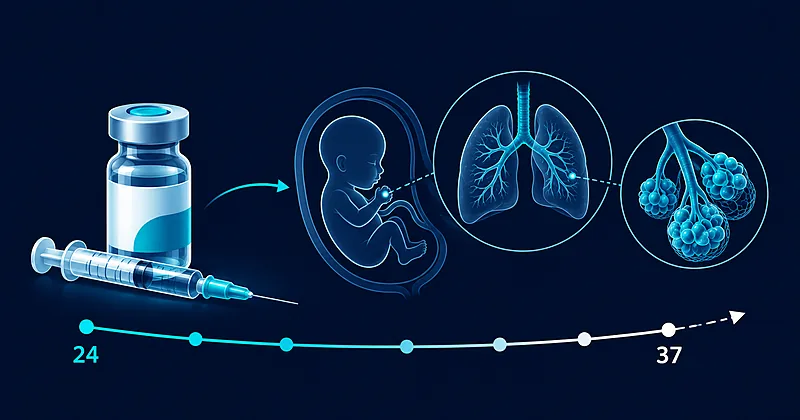
Preterm birth drives most early neonatal respiratory illness, and antenatal corticosteroids accelerate fetal lung maturation. For deliveries before 34 weeks, the question is no longer whether to treat. The unsettled decisions now sit at the edges of the intervention.
Two extension questions dominate day-to-day practice. The first is whether to give a course in the late preterm window. The second is whether a repeat course helps when a treated pregnancy does not deliver and risk returns.
Each extension offers a real but smaller benefit than the core indication, set against distinct harms. The stakes are large by volume: late preterm infants account for roughly 70% of all preterm births, so even a modest per-patient effect touches many newborns.
This review compares three antenatal corticosteroid strategies against the verified trial evidence: the established single course before 34 weeks, the late preterm course, and repeat or rescue courses. The goal is a clear read on where benefit is strong, where it narrows, and where added exposure stops paying off.
Available Approaches to Antenatal Corticosteroids
The three approaches share a mechanism but differ sharply in gestational-age window, magnitude of benefit, and side-effect profile. The comparative table below draws every figure from a source retrieved and confirmed for this review; each row was checked against the primary trial or systematic review it names.
| Study / Source | Design | N | Population | Comparison | Key result |
|---|---|---|---|---|---|
| McGoldrick 2020 (Cochrane) | SR/MA, 27 RCTs | 11,925 neonates | At risk <37 wk (mostly <34 wk) | Single course vs placebo / none | RDS RR 0.71 (0.65–0.78); neonatal death RR 0.78 (0.70–0.87) V |
| Saccone & Berghella 2016 (BMJ) | SR/MA, 6 RCTs | 5,698 | ≥34 wk, incl. term cesarean | ACS ≥34 wk vs control | RDS RR 0.74 (0.61–0.91); TTN RR 0.56 (0.37–0.86) V |
| ALPS / Gyamfi-Bannerman 2016 (NEJM) | RCT | 2,831 | 34 0/7–36 5/7 wk, singletons | Betamethasone vs placebo | Respiratory support RR 0.80 (0.66–0.97); hypoglycemia RR 1.60 (1.37–1.87) V |
| Walters 2022 (Cochrane) | SR/MA, repeat doses | 3,540 (RDS analysis) | <34 wk, ≥7 d after first course | Repeat course vs no repeat | RDS RR 0.82 (0.74–0.90); neonatal death RR 0.91 (0.62–1.34) V |
| ACTORDS / Crowther 2006 (Lancet) | RCT | 982 | <32 wk, ≥7 d after first course | Weekly repeat betamethasone vs placebo | RDS 33% vs 41%, RR 0.82 (0.71–0.95); fewer with severe lung disease V |
| MACS / Murphy 2008 (Lancet) | RCT | 1,858 | <33 wk, ongoing risk | Multiple courses every 14 d vs placebo | Composite morbidity/mortality 12.9% vs 12.5% (NS); lower birthweight, length, head circumference V |
| Garite 2009 (AJOG) | RCT | 437 | <33 wk, ≥14 d after first course | Single rescue course vs placebo | Composite morbidity <34 wk OR 0.45 (0.27–0.75) V |
The Standard Single Course Before 34 Weeks
This is the strongest indication. The most recent Cochrane synthesis pooled 27 trials and found that a single course reduces respiratory distress syndrome (RR 0.71, 95% CI 0.65–0.78) and neonatal death (RR 0.78, 95% CI 0.70–0.87), both graded high-certainty. Perinatal death also falls (RR 0.85, 95% CI 0.77–0.93).
The regimen is two 12 mg doses of betamethasone 24 hours apart, or dexamethasone in an equivalent schedule. Benefit is greatest when birth follows 24 hours to 7 days after the first dose, which frames the timing challenge that later approaches inherit.
The Late Preterm Course (34 0/7–36 6/7 Weeks)
The ALPS randomized trial reset practice at this gestational age. Among 2,831 people at risk of late preterm birth, betamethasone reduced the primary respiratory-support composite (11.6% vs 14.4%; RR 0.80, 95% CI 0.66–0.97) and severe respiratory morbidity (8.1% vs 12.1%; RR 0.67, 95% CI 0.53–0.84).
A meta-analysis of six trials at 34 weeks or later — spanning late preterm and planned term cesarean deliveries — found a consistent respiratory signal: RDS fell (RR 0.74, 95% CI 0.61–0.91) alongside transient tachypnea of the newborn (RR 0.56, 95% CI 0.37–0.86). At this window, though, the mortality benefit seen earlier does not carry over.
The trade-off is neonatal hypoglycemia, which ALPS roughly doubled (24.0% vs 15.0%; RR 1.60, 95% CI 1.37–1.87). A secondary analysis found this hypoglycemia was largely transient, mostly untreated, and resolved somewhat faster in the betamethasone group.
The late preterm benefit concentrates in newborns delivered 2 to 7 days after dosing. ALPS enrolled only those judged at high risk of imminent late preterm birth and excluded anyone who had received a prior course — so its effect size reflects a selected, delivery-likely population, not routine use at 34 to 36 weeks.
Repeat and Rescue Courses
When a treated pregnancy remains undelivered and risk returns, a single further course helps. Pooled repeat-dose data show reduced RDS (RR 0.82, 95% CI 0.74–0.90), and the ACTORDS trial recorded the same effect in 982 women (33% vs 41%; RR 0.82, 95% CI 0.71–0.95) with fewer cases of severe lung disease.
A single rescue course carries similar evidence. In Garite’s trial of 437 participants, a rescue course given at least 14 days after the first cut composite neonatal morbidity before 34 weeks (43.9% vs 63.6%; OR 0.45, 95% CI 0.27–0.75), with lower rates of RDS, ventilator support, and surfactant use.
Scheduled multiple courses are a different matter. The MACS trial gave courses every 14 days to 1,858 women and found no reduction in the composite of neonatal death or morbidity (12.9% vs 12.5%). Infants exposed to multiple courses weighed less and had smaller head circumferences.
Comparative Analysis
Read together, the three approaches form a gradient of benefit that narrows as gestational age and cumulative exposure rise. Before 34 weeks, corticosteroids move both mortality and major morbidity on high-certainty evidence. That is the anchor against which the extensions are judged.
The late preterm course delivers a respiratory benefit only — no mortality effect at this window — and it comes with a hypoglycemia cost. The benefit is real but conditional on the newborn actually being delivered within the effective window, which is difficult to predict.
For repeat dosing, the split is clean. One additional course, whether planned as a repeat or given as a rescue, reduces RDS. Serial courses on a calendar do not improve neonatal outcomes and restrict fetal growth, which is why the evidence stops the count at a single repeat.
Weighing the Harms
Two harms shape the comparison. Neonatal hypoglycemia is the near-term concern after a late preterm course; in ALPS it was common but transient. Restricted growth is the concern with repeated exposure; MACS documented lower birthweight, shorter length, and smaller head circumference after multiple courses.
A single course, by contrast, shows little or no effect on birthweight in the Cochrane synthesis. The growth signal is therefore a feature of cumulative dosing, not of corticosteroid exposure as such.
What the Longer View Shows
Long-term follow-up is reassuring for a single late preterm course. The ALPS follow-up study, reported in JAMA in 2024, found no difference in below-average general cognitive ability, assessed at age 6 years or older (adjusted RR 0.94, 95% CI 0.73–1.22). The 5-year MACS follow-up likewise found no neurodevelopmental difference between single and multiple courses.
A note of caution comes from population data. A large Finnish cohort of 670,097 children reported that corticosteroid exposure was associated with childhood mental and behavioral disorders (hazard ratio 1.33), including among children ultimately born at term. As an observational finding, it cannot establish causation, but it argues against exposing pregnancies unlikely to deliver preterm.
Quality and Consistency of the Evidence
Certainty differs markedly across the three approaches. The colored markers below rate the strength of evidence by question, from high-certainty pooled RCTs to observational signals that carry real confounding.
- High — single course before 34 weeks. Large, consistent randomized trials pooled across 27 studies; mortality and RDS effects graded high-certainty, with narrow confidence intervals and stable direction across settings.
- Moderate to high — late preterm respiratory benefit. Anchored by one large trial and a six-trial meta-analysis pointing the same way. Downgraded because the benefit is morbidity-only and paired with increased hypoglycemia.
- Moderate — single repeat or rescue course. Consistent RDS reduction across a pooled analysis and individual trials, but from smaller studies with variable RDS definitions and limited long-term data.
- Low — long-term neurodevelopment after late preterm or term exposure. Reassuring trial follow-up into the school-age years sits beside observational signals of harm; residual confounding and short horizons limit confidence.
What the Evidence Does Not Show
The trials answer the central efficacy questions but leave specific gaps that shape real decisions.
They do not define long-term neurodevelopmental safety for the late preterm and term-exposed populations beyond childhood; follow-up currently reaches only into the school-age years. Nor do they resolve whether the term-exposed group — those dosed at 34 to 36 weeks who ultimately deliver at term — face any later cost.
The evidence does not make timing precise. Because delivery within the effective 2-to-7-day window cannot be reliably predicted, a share of treated pregnancies gain little from dosing. Refined prediction of imminent delivery remains an unmet need.
Several subgroups stay uncertain. Whether to give a repeat or rescue course in preterm prelabor rupture of membranes is unresolved, with insufficient evidence for or against. The independent benefit in twins is also not established. Finally, whether a lower betamethasone dose would preserve efficacy is still under investigation and unproven.
Practical Implications
The evidence supports one course per gestational-age window, matched to a genuine likelihood of preterm birth within 7 days. Before 34 weeks, this is strongly supported and applies broadly, including with ruptured membranes and multiple gestations.
In the late preterm window, the evidence supports a course for those at high risk of delivery within 7 days who have not already received one. It does not support routine use when delivery is unlikely; specialty guidance recommends against dosing patients with a low probability of delivering. Anticipating and monitoring neonatal hypoglycemia is a reasonable accompaniment.
For a treated pregnancy that does not deliver, the evidence supports a single repeat or rescue course when risk of birth within 7 days returns and the prior course is remote in time. It does not support scheduled serial courses, given the absent benefit and the growth cost documented with repeated dosing.
Across all three, these are read as what the evidence supports rather than as directives; the individual clinical picture governs the decision.
Evidence Grade and Bottom Line
Overall grade: High before 34 weeks · Moderate for the late preterm and single-repeat extensionsThe grade tracks the gestational-age gradient. Corticosteroids before 34 weeks rest on high-certainty evidence for both survival and respiratory morbidity. The late preterm course and the single repeat or rescue course rest on moderate-certainty, morbidity-focused evidence. Scheduled multiple courses are not supported.
Bottom line
- Before 34 weeks, a single course is the highest-value obstetric intervention available for reducing neonatal death and RDS.
- In the late preterm window, one course reduces respiratory morbidity for delivery-likely patients but adds transient neonatal hypoglycemia and no mortality benefit.
- A single repeat or rescue course reduces RDS when risk returns; multiple scheduled courses do not, and they restrict fetal growth.
- Criteria, not the calendar, should govern each course — treat a real 7-day risk of birth once per window, and reserve repeat dosing for renewed imminent risk.
Article Information and References
For Educational Purposes Only. This is an original evidence synthesis informed by the studies listed below. It does not replace clinical judgement. Drug dosages should be verified against current prescribing information.
- McGoldrick E, Stewart F, Parker R, Dalziel SR. Antenatal corticosteroids for accelerating fetal lung maturation for women at risk of preterm birth. Cochrane Database Syst Rev. 2020;12(12):CD004454. DOI: https://doi.org/10.1002/14651858.CD004454.pub4
- Walters A, McKinlay C, Middleton P, Harding JE, Crowther CA. Repeat doses of prenatal corticosteroids for women at risk of preterm birth for improving neonatal health outcomes. Cochrane Database Syst Rev. 2022;4(4):CD003935. DOI: https://doi.org/10.1002/14651858.CD003935.pub5
- Saccone G, Berghella V. Antenatal corticosteroids for maturity of term or near term fetuses: systematic review and meta-analysis of randomized controlled trials. BMJ. 2016;355:i5044. DOI: https://doi.org/10.1136/bmj.i5044
- Williams MJ, Ramson JA, Brownfoot FC. Different corticosteroids and regimens for accelerating fetal lung maturation for babies at risk of preterm birth. Cochrane Database Syst Rev. 2022;8(8):CD006764. DOI: https://doi.org/10.1002/14651858.CD006764.pub4
- Gyamfi-Bannerman C, Thom EA, Blackwell SC, et al. Antenatal betamethasone for women at risk for late preterm delivery. N Engl J Med. 2016;374(14):1311–1320. DOI: https://doi.org/10.1056/NEJMoa1516783
- Crowther CA, Haslam RR, Hiller JE, Doyle LW, Robinson JS. Neonatal respiratory distress syndrome after repeat exposure to antenatal corticosteroids: a randomised controlled trial. Lancet. 2006;367(9526):1913–1919. DOI: https://doi.org/10.1016/S0140-6736(06)68846-6
- Murphy KE, Hannah ME, Willan AR, et al. Multiple courses of antenatal corticosteroids for preterm birth (MACS): a randomised controlled trial. Lancet. 2008;372(9656):2143–2151. DOI: https://doi.org/10.1016/S0140-6736(08)61929-7
- Garite TJ, Kurtzman J, Maurel K, Clark R. Impact of a ‘rescue course’ of antenatal corticosteroids: a multicenter randomized placebo-controlled trial. Am J Obstet Gynecol. 2009;200(3):248.e1–248.e9. DOI: https://doi.org/10.1016/j.ajog.2009.01.021
- Räikkönen K, Gissler M, Kajantie E. Associations between maternal antenatal corticosteroid treatment and mental and behavioral disorders in children. JAMA. 2020;323(19):1924–1933. DOI: https://doi.org/10.1001/jama.2020.3937
- El-Sayed YY, Borders AEB, Gyamfi-Bannerman C. Committee Opinion No. 713: antenatal corticosteroid therapy for fetal maturation. Obstet Gynecol. 2017;130(2):e102–e109. DOI: https://doi.org/10.1097/AOG.0000000000002237
- Reddy UM, Deshmukh U, Dude A, et al. Society for Maternal-Fetal Medicine Consult Series #58: use of antenatal corticosteroids for individuals at risk for late preterm delivery. Am J Obstet Gynecol. 2021;225(5):B36–B42. DOI: https://doi.org/10.1016/j.ajog.2021.07.023
- Kamath-Rayne BD, Rozance PJ, Goldenberg RL, Jobe AH. Antenatal corticosteroids beyond 34 weeks gestation: what do we do now? Am J Obstet Gynecol. 2016;215(4):423–430. DOI: https://doi.org/10.1016/j.ajog.2016.06.023