
Gestational Diabetes Postpartum Follow-Up: What the Evidence Shows Clinicians Are Missing
An original evidence synthesis across 10 key studies — covering the postpartum screening gap, long-term type 2 diabetes risk, prevention strategies, and why one-third of women with GDM already show abnormal glucose at their postpartum visit. Evidence level: moderate to high (guidelines, systematic reviews, cohort studies). Through 2026.
This is an original evidence synthesis. See References for source studies.
One-Minute Takeaway
One-Minute Takeaway
- Women with a history of gestational diabetes postpartum follow-up have a 40–70% lifetime risk of developing type 2 diabetes, yet postpartum glucose screening rates remain below 50% in most populations — a gap the SMFM has formally designated a healthcare quality failure (SMFM 2023, reaffirmed 2025).
- ACOG and ADA recommend a 75-g OGTT at 4–12 weeks postpartum; inpatient screening during the delivery hospitalisation has been shown to increase completion from 46% to 66% and to reduce racial disparities in screening uptake (Cape Fear Valley 2025).
- Among women who complete postpartum screening, approximately 30% show abnormal glucose metabolism — including impaired fasting glucose, impaired glucose tolerance, or overt diabetes — demonstrating that the opportunity for early intervention is real and immediate (Zhang et al. 2024).
- Intensive lifestyle interventions reduce progression from prediabetes to type 2 diabetes with a number needed to treat of 12 over 10 years; metformin is more effective still (NNT 8 over 10 years), and breastfeeding is independently associated with lower postpartum glucose levels and reduced long-term diabetes risk (ADA 2025, DPP).
- HbA1c testing in the first 6 months postpartum is less accurate due to pregnancy-related physiological changes, and positive results from early postpartum testing should be confirmed at least 6 months after delivery (WPSI 2023).
Why Gestational Diabetes Postpartum Follow-Up Matters
Gestational diabetes mellitus affects 5–13% of pregnancies, and its prevalence continues to rise globally in tandem with increasing rates of obesity and sedentary behaviour. During pregnancy, the condition rightfully commands clinical attention — glucose monitoring, dietary counselling, medication adjustments, and fetal surveillance consume considerable resources. But once the baby is delivered and maternal glucose levels normalise within hours, the clinical urgency evaporates. This is precisely where the system fails.
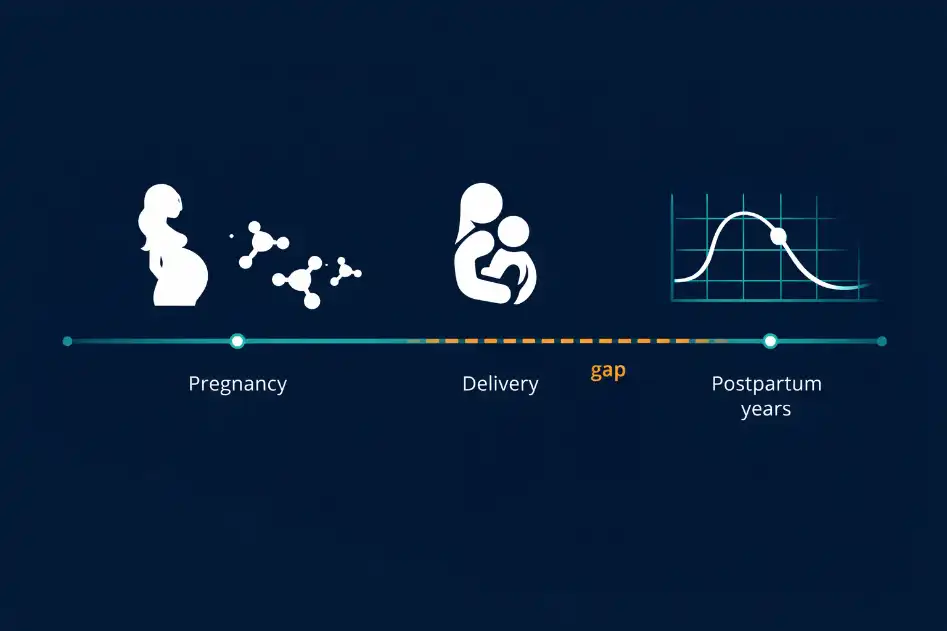
The data are stark: roughly 5% of women with GDM already have overt diabetes at the time of postpartum testing, about 60% will develop type 2 diabetes within a decade, and the lifetime progression risk ranges from 40–70%. These are not distant, theoretical risks — they represent the single strongest predictor of future diabetes in young women. Yet despite unambiguous guideline recommendations from ACOG, ADA, and SMFM, fewer than half of affected women receive the recommended postpartum glucose tolerance test.
The consequences of this gap extend far beyond metabolic disease. Women who progress undetected to type 2 diabetes face years of uncontrolled hyperglycaemia, with compounding risks for cardiovascular disease, nephropathy, neuropathy, and adverse outcomes in subsequent pregnancies. The postpartum period — when women are already engaged with the healthcare system — represents the most efficient intervention point. Missing it creates a decade-long blind spot.
What Evidence Was Reviewed
This synthesis integrates major society guidelines (ADA, ACOG, SMFM, WPSI), cohort studies evaluating postpartum screening rates and abnormal glucose yield, the Diabetes Prevention Program trial data as applied to the GDM population, meta-analyses on breastfeeding and diabetes risk, and emerging quality improvement evidence on inpatient screening strategies.
| Study | Design | n | Population | Key Finding | Quality |
|---|---|---|---|---|---|
| ADA Standards of Care 2025 (Ch. 15) | Clinical guideline | NR | Women with diabetes in pregnancy | 75-g OGTT at 4–12 weeks postpartum; ongoing screening every 1–3 years; lifestyle/metformin for prediabetes | High |
| ACOG Clinical Practice Update 2024 | Clinical guidance | NR | Women with GDM (US) | Screening window changed to 4–12 weeks; inpatient OGTT at delivery a reasonable alternative | High |
| SMFM Special Statement 2023 (reaffirmed 2025) | Quality metric proposal | NR | Women with GDM (US) | Screening rates <50% = major quality gap; proposed uniform metric for 75-g OGTT within 12 weeks | High |
| WPSI 2023 (Federal Register) | Preventive services guideline | NR | Women with GDM history (US) | Screen within 1 year, then every 3 years for ≥10 years; HbA1c less accurate in first 6 months postpartum | High |
| Zhang et al. 2024 (Maternal-Fetal Med) | Retrospective cohort | 3,047 | Women with GDM (China) | OGTT completion 47.2%; 29.9% of screened had abnormal glucose; 1.8% had suspected diabetes | Moderate |
| Cape Fear Valley 2025 (Research Square) | Pre-post implementation | 195 | Women with GDM (US) | Inpatient screening raised completion from 46% to 66%; eliminated racial disparities in screening | Moderate |
| Hartling et al. 2012 (cited in Kaiser guideline) | Systematic review | NR | Women with GDM | ~5% T2DM within 6 months; ~60% within 10 years of GDM diagnosis | Moderate |
| DPP Research Group (10-year follow-up) | RCT + long-term follow-up | 3,234 | Adults with prediabetes (including GDM subgroup) | Lifestyle NNT 12; metformin NNT 8 over 10 years; metformin most effective in women with GDM history | High |
| Breastfeeding and T2DM meta-analysis (17 studies) | MA | NR | Women with GDM history | Non-breastfeeding associated with higher blood glucose and greater T2DM risk vs. breastfeeding | Moderate |
| Clinician barriers qualitative synthesis (PMC 2021) | SR of qualitative studies (9 studies) | 187 clinicians | Hospital and community providers | Ambiguous follow-up responsibility, fragmented care, patient/provider knowledge gaps | Moderate |
Key Findings on Gestational Diabetes Postpartum Follow-Up
The Scale of the Screening Gap
Across multiple countries and healthcare systems, postpartum glucose screening after GDM consistently falls short. The SMFM — in a statement reaffirmed in 2025 — characterised screening rates below 50% as a "major healthcare quality gap." Global data confirm this pattern: systematic reviews report completion rates ranging from 23–58%, with most populations clustering around 35–50%. For comparison, antenatal GDM screening achieves rates of approximately 98%, and postnatal cervical screening reaches 94%, highlighting that the postpartum glucose testing failure is not an inherent limitation of postpartum care but a specific gap in this pathway.
A 2024 retrospective cohort from China (Zhang et al.) involving 3,047 women with GDM found a completion rate of 47.2% for the recommended 75-g OGTT at 4–12 weeks postpartum. Among those who completed testing, the yield was clinically significant: 29.9% had abnormal results, including 24.1% with impaired glucose tolerance, 1.8% with impaired fasting glucose, 2.2% with combined abnormalities, and 1.8% with suspected overt diabetes. These numbers make the business case for screening clear — nearly one in three screened women had actionable results.
Why the Gap Persists: A Three-Level Problem
A qualitative synthesis of clinician perspectives (9 studies, 187 clinicians) identified barriers at patient, provider, and system levels that interact to create the follow-up failure. At the patient level, common barriers include lack of awareness that postpartum testing is needed, the logistical difficulty of attending a fasting glucose test with a newborn, childcare challenges, loss of insurance coverage, and the psychological tendency to view GDM as resolved once the baby is delivered.
At the provider level, the most consistent finding is ambiguity about whose responsibility postpartum glucose screening is. Hospital-based obstetricians focus on pregnancy management and delivery, while primary care providers may lack awareness of the GDM history or assume the obstetrician has arranged follow-up. This handoff failure was described as the single most important structural barrier. At the system level, fragmented health records, the duration and inconvenience of the OGTT, limited laboratory hours, and — in the US — Medicaid coverage historically terminating at 60 days postpartum (though many states have now extended to 12 months) compound the problem.
Evolving Screening Strategies: When, How, and By Whom
The 2024 ACOG Clinical Practice Update introduced two important changes. First, the postpartum screening window was expanded to begin at 4 weeks rather than 6 weeks, reflecting evidence that earlier testing is feasible and may capture women before they disengage from obstetric care. Second — and more impactfully — ACOG now acknowledges that performing a 75-g OGTT during the delivery hospitalisation is "a reasonable alternative" that may increase testing rates.
Early data supporting inpatient screening are encouraging. A 2025 pre-post implementation study at a US hospital system found that introducing inpatient OGTT during the delivery stay raised screening completion from 46.2% to 65.8% (relative risk 1.43, 95% CI 1.09–1.87). The shift was driven almost entirely by inpatient testing, which accounted for 84% of completed screens in the post-implementation period. Notably, racial disparities in screening that were statistically significant before implementation were no longer detectable afterwards — suggesting that inpatient screening may reduce equity gaps by removing structural barriers like transportation, childcare, and insurance continuity.
The 75-g, 2-hour OGTT remains the gold standard for postpartum glucose assessment because it identifies both impaired fasting glucose and impaired glucose tolerance — the latter being the more common abnormality after GDM and one that fasting glucose alone misses. The ADA and ACOG recommend this test at 4–12 weeks postpartum, using non-pregnancy diagnostic thresholds (fasting ≥126 mg/dL or 2-hour ≥200 mg/dL for diabetes; fasting 100–125 mg/dL or 2-hour 140–199 mg/dL for prediabetes).
HbA1c is logistically simpler (no fasting required, single blood draw), but the WPSI 2023 guideline explicitly warns that HbA1c is less accurate in the first 6 months postpartum due to pregnancy-related changes in red blood cell turnover, blood volume, and iron status. Conditions such as anaemia, haemoglobinopathies, or recent transfusion further compromise accuracy. Importantly, a positive HbA1c in the early postpartum period should always be confirmed with repeat testing at 6 months or later. The WPSI recommends that when OGTT is not feasible, HbA1c may be considered as an alternative — acknowledging a pragmatic trade-off between test accuracy and completion likelihood.
A 2023 AAFP review noted that a 75-g OGTT performed on the second postpartum day showed comparable accuracy to testing at 4–12 weeks in a prospective cohort of 300 patients, supporting the feasibility of inpatient screening. However, some data suggest reduced sensitivity for certain glucose abnormalities when testing occurs immediately after delivery, when insulin resistance is still dropping rapidly. The clinical decision ultimately balances the imperfect sensitivity of early testing against the well-documented reality that most women never return for the recommended outpatient test.
The Diabetes Prevention Program (DPP) — the landmark RCT of over 3,200 adults with prediabetes — provides the strongest evidence for preventive intervention. Intensive lifestyle modifications (targeting 7% weight loss and 150 minutes/week of moderate activity) reduced progression to type 2 diabetes by 58% over 2.8 years compared to placebo. Metformin 850 mg twice daily reduced progression by 31%. In the 10-year follow-up, the number needed to treat was 12 for lifestyle intervention and 8 for metformin.
Critically, sub-analyses of the DPP showed that metformin was most effective in the subgroup of women with a history of GDM — making this population particularly likely to benefit from pharmacological prevention. The ADA 2025 Standards of Care explicitly recommend that individuals with overweight/obesity and a history of GDM who have prediabetes should receive intensive lifestyle interventions and/or metformin to prevent diabetes (Grade A recommendation).
Breastfeeding provides an independent protective effect. A meta-analysis of 17 studies found that women with GDM who breastfed had lower blood glucose levels and a reduced risk of developing type 2 diabetes compared to those who did not breastfeed. The ADA recommends breastfeeding for all individuals with a history of GDM, citing multiple benefits including reduced maternal diabetes risk. The mechanism is thought to involve improved insulin sensitivity associated with lactation, as well as the caloric expenditure of milk production.
A normal postpartum OGTT does not end the surveillance obligation. The WPSI 2023 guideline recommends that women with a negative initial postpartum screen should be retested at least every 3 years for a minimum of 10 years after the affected pregnancy. The ADA similarly recommends ongoing screening every 1–3 years, even with an initially normal result. This reflects the progressive nature of beta-cell decline in susceptible women — the same pathological trajectory that causes GDM can manifest as type 2 diabetes years later, particularly with intervening weight gain, ageing, or subsequent pregnancies.
The practical challenge is that long-term follow-up requires coordination between obstetric, primary care, and sometimes endocrine providers across a timeframe that far exceeds the typical obstetric care episode. Proposed solutions include national or institutional GDM registries, automated health record reminders, and — most importantly — explicit documentation of GDM history in the problem list and patient education materials so that primary care providers are aware of the risk when they assume longitudinal care. The Australian National Gestational Diabetes Register and the Saudi National Diabetes Registry represent early examples of this approach, though evidence on their impact on screening adherence is still emerging.
The risk does not diminish substantially over time. Systematic reviews indicate that approximately 60% of women with GDM will have developed type 2 diabetes by 10 years, reinforcing the need for sustained vigilance well beyond the initial postpartum period. Women should be counselled that GDM is not a transient condition but a signal of underlying metabolic vulnerability that warrants lifelong attention to glucose, weight, and cardiovascular risk.
The screening gap falls disproportionately on already-disadvantaged populations. Women with less education, lower health literacy, and those without private insurance are least likely to complete postpartum glucose testing. In the US, approximately 40% of births are covered by Medicaid, and until the recent coverage extensions, these women faced an extremely narrow window to complete testing before coverage lapsed. While the option for states to extend Medicaid postpartum coverage to 12 months has helped in many jurisdictions, implementation remains incomplete — as of 2023, 15 states had neither implemented nor announced plans for this expansion.
The inpatient screening strategy addresses equity concerns directly. By performing the OGTT during the delivery hospitalisation — when all women are already present regardless of insurance status, transportation access, or childcare availability — structural barriers are functionally bypassed. The 2025 Cape Fear Valley study demonstrated that racial disparities present in outpatient screening (p = 0.015) were eliminated after inpatient screening implementation (p = 0.836). While this is a single-institution study with limited sample size, the equity signal is striking and warrants replication.
Clinician-level disparities also exist. A survey found that while 73% of specialists recommended long-term postpartum follow-up, only 39% of primary care providers recalled women with GDM for diabetes screening. This gap in awareness underscores the need for systematic handoff protocols and education across disciplines, with particular attention to the communities where GDM prevalence is highest and follow-up infrastructure is weakest.
Quality and Consistency of the Evidence
What the Evidence Does Not Yet Show
The optimal screening strategy for maximising both test sensitivity and completion rates has not been determined. While inpatient screening during the delivery hospitalisation improves completion, it may have reduced sensitivity for some glucose abnormalities due to the rapid physiological shift from pregnancy insulin resistance. No randomised trial has compared the clinical outcomes of women screened inpatient versus those screened at 4–12 weeks.
Which system-level interventions most effectively sustain long-term postpartum screening adherence is unknown. Individual quality improvement studies report improved rates with electronic reminders, standing orders, patient navigators, and point-of-care testing, but comparative effectiveness data are lacking. The optimal design for GDM registries and how effectively they improve multi-year screening adherence remain questions without definitive answers.
No trial has evaluated whether earlier identification and treatment of postpartum dysglycaemia specifically in the GDM population reduces long-term cardiovascular events. The DPP demonstrated diabetes prevention in general prediabetic populations, but whether applying these interventions at the postpartum time point — in a younger, female population with unique physiological characteristics — produces the same magnitude of cardiovascular benefit is assumed but unproven.
Optimal contraceptive counselling integrating metabolic risk from GDM is under-studied. Hormonal contraceptive effects on glucose metabolism in women with recent GDM have not been thoroughly evaluated. Current guidance recommends contraception planning for all women with diabetes, but specific evidence guiding method selection based on GDM-related metabolic risk is limited.
Practical Implications for Clinical Practice
Based on the current evidence, the following considerations may inform clinical approach to gestational diabetes postpartum follow-up. These reflect what the evidence supports — not prescriptive directives — and should be adapted to local guidelines, resources, and individual patient context.
Performing a 75-g OGTT during the delivery hospitalisation removes structural barriers and may reduce equity gaps. ACOG now endorses this as a reasonable alternative. Early data suggest it can increase completion from ~46% to ~66% and eliminate racial disparities in testing uptake.
The DPP trial showed metformin is particularly effective in women with GDM history (NNT 8 over 10 years). Paired with intensive lifestyle modifications (NNT 12), these represent the most cost-effective diabetes prevention strategies available for this high-risk population.
Meta-analytic evidence supports a protective association between breastfeeding and lower glucose levels and T2DM risk in women with GDM history. This provides an additional motivation for breastfeeding support that extends well beyond the immediate postpartum period.
WPSI recommends screening every 3 years for at least 10 years. This requires clear documentation of GDM history and explicit communication to primary care. GDM registries and EHR-based alerts may help, but their effectiveness is still being evaluated.
Evidence Grade and Bottom Line
Overall Evidence Grade: Moderate to Strong
The long-term diabetes risk after GDM is well-established by high-quality evidence, and effective prevention strategies (lifestyle, metformin) are supported by landmark RCT data. The postpartum screening gap is consistently documented. Emerging strategies to close the gap — particularly inpatient screening — show early promise but require larger-scale validation. The evidence for breastfeeding benefit is consistent but observational.
- GDM confers a 40–70% lifetime risk of type 2 diabetes; approximately 30% of women already show abnormal glucose at postpartum screening — this is not a distant risk but an immediate clinical finding.
- Postpartum OGTT completion remains below 50%, making it one of the most significant quality gaps in obstetric care; inpatient screening during delivery shows early promise for improving rates and equity.
- Metformin (NNT 8) and intensive lifestyle modification (NNT 12) are highly effective at preventing progression to diabetes in this population — but only if dysglycaemia is identified through screening.
- Screening must continue for at least 10 years with a normal result; GDM history should be documented prominently and communicated to primary care for lifelong metabolic surveillance.
- Key limitation: no randomised trial has demonstrated that specific postpartum screening strategies improve long-term hard endpoints (cardiovascular events, diabetes complications) versus no screening, though the logic chain from screening to prevention to reduced risk is well-supported by the DPP evidence.
Article Information
For Educational Purposes Only. This is an original evidence synthesis informed by the studies listed below. It does not replace clinical judgement. Drug dosages should be verified against current prescribing information.
References
- American Diabetes Association Professional Practice Committee. 15. Management of Diabetes in Pregnancy: Standards of Care in Diabetes—2025. Diabetes Care. 2025;48(Suppl 1):S306–S320. DOI: 10.2337/dc25-S015
- ACOG Clinical Practice Update. Screening for Gestational and Pregestational Diabetes in Pregnancy and Postpartum. Obstet Gynecol. 2024;144:e20–e23. DOI: 10.1097/AOG.0000000000005612
- Bauer ST, Cate JJM, Whitsel AI, Combs CA. Society for Maternal-Fetal Medicine Special Statement: Quality metric on the rate of postpartum diabetes screening after pregnancies with gestational diabetes mellitus. Am J Obstet Gynecol. 2023;228(4):B2–B9. DOI: 10.1016/j.ajog.2022.12.009
- Women's Preventive Services Initiative (WPSI). Screening for Diabetes after Pregnancy: Updated Recommendation. Federal Register. January 5, 2023. Available from: womenspreventivehealth.org
- Zhang J, Xu T, Cao Q, Mao C, Zhou F, Wang X. Postpartum Glucose Follow-up Screening Among Women With Gestational Diabetes Mellitus: A Retrospective Cohort Study. Maternal Fetal Med. 2024;6(4):236–242. DOI: 10.1097/FM9.0000000000000252
- Diabetes Prevention Program Research Group. 10-year follow-up of diabetes incidence and weight loss in the Diabetes Prevention Program Outcomes Study. Lancet. 2009;374(9702):1677–1686. DOI: 10.1016/S0140-6736(09)61457-4
- Gante I, et al. Barriers to postpartum screening for type 2 diabetes: a qualitative synthesis of clinicians' views. Br J Gen Pract. 2021;71(706):e329–e338. DOI: 10.3399/BJGP.2020.0856
- Much D, et al. Breastfeeding and type 2 diabetes risk: meta-analysis of 17 studies. Curr Diab Rep. 2014;14(10):549.
- Hartling L, et al. Benefits and harms of treating gestational diabetes mellitus: a systematic review and meta-analysis for the U.S. Preventive Services Task Force and the National Institutes of Health. Ann Intern Med. 2013;159(2):123–129. DOI: 10.7326/0003-4819-159-2-201307160-00661
- Hernandez TL, et al. Challenging the American College of Obstetricians and Gynecologists' Clinical Practice Update on Screening for Pre-existing Diabetes and Early Gestational Diabetes. Obstet Gynecol. 2025;145(1):31–38. DOI: 10.1097/AOG.0000000000005777
- Kaiser Permanente. Gestational Diabetes Screening and Treatment Guideline. Updated June 2025. Available from: kaiserpermanente.org