
HPV Self-Collection for Cervical Screening
Where self-taken vaginal samples match clinician sampling, where they fall short, and what it takes to deliver them well.
One-Minute Takeaway
- HPV self-collection with a validated PCR-based assay detects cervical precancer about as accurately as clinician-collected sampling (relative sensitivity 0.99, 95% CI 0.97–1.02) — high-certainty evidence.
- Accuracy depends on the assay, not the swab: signal-amplification and some mRNA tests lose sensitivity on self-samples.
- Mailing kits directly to under-screened people raises participation far more than asking them to request one.
- Because most cervical cancers occur in the never- or under-screened, the biggest gain is reach and equity.
- It is not standalone: an HPV-positive self-sample still needs clinician follow-up and cannot be reflex-tested with cytology.
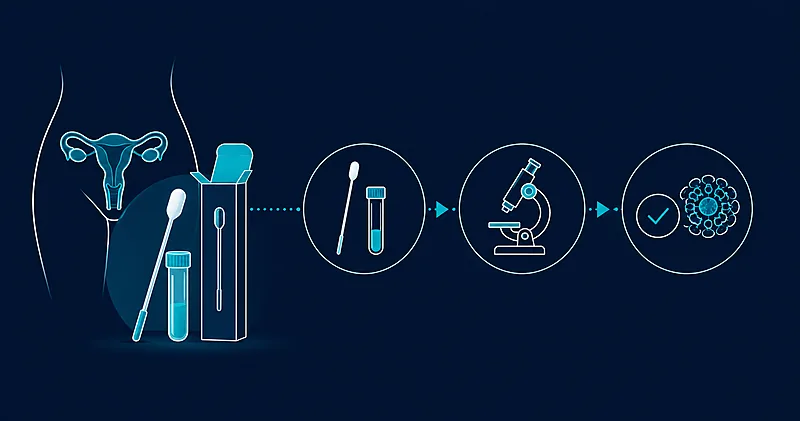
Why HPV Self-Collection Matters
Nearly all cervical cancer is caused by persistent infection with high-risk human papillomavirus (HPV). The disease remains common worldwide, and most cases arise in people who are screened rarely or never.
That pattern is the core rationale for self-collection. When a person can take their own vaginal sample, the speculum examination — a barrier for many — is removed from the first step of screening.
Coverage is the limiting factor. In several high-income settings a substantial share of eligible people are overdue, and the gap is widest among those facing access, cultural, or trauma-related barriers.
The questions that follow are practical. Is a self-taken sample accurate enough to trust? Does offering it actually bring under-screened people back? And what does a clinic need to run it safely? This review takes each in turn.
Evidence Reviewed
The evidence base spans three streams: paired diagnostic-accuracy studies comparing self-collected with clinician-collected samples, randomised trials of how kits are offered, and real-world programme data. The comparative table below draws only on sources verified against the primary literature, with resolving DOIs.
| Study / Source | Design | N | Population / focus | Key comparative result |
|---|---|---|---|---|
| Arbyn et al., 2018 (BMJ) | Meta-analysis | 56 accuracy studies | Paired self vs clinician, mostly screening | PCR-based assays: relative sensitivity for CIN2+/CIN3+ 0.99 (0.97–1.02); relative specificity 0.98 |
| Polman et al. (IMPROVE), 2019 (Lancet Oncol) | RCT, paired screen-positive | 13,925 randomised (>180,000 invited) | Routine Dutch screening programme | Self vs clinician for CIN2+: relative sensitivity 0.96 (0.90–1.03); relative specificity 1.00 (0.99–1.01) |
| Arbyn et al., 2014 (Lancet Oncol) | Meta-analysis | Accuracy studies (screening) | Self vs clinician, mixed assay chemistries | Absolute sensitivity 76% (69–82) for CIN2+; sensitivity ratio 0.88 (0.85–0.91) — shortfall confined to signal-amplification tests |
| Costa et al., 2023 (Br J Cancer) | Meta-analysis of RCTs | 33 trials | Under-screened, by invitation model | Participation difference vs usual care: mail-to-all +13.2% (11.0–15.3); community outreach +39.1% (8.4–69.9); offer at visit +28.1% (23.5–32.7) |
| Pedersen et al., 2025 (Int J Cancer) | Pragmatic RCT | 49,393 invited | Screening non-attenders (Denmark) | Direct-mail 25.2% vs opt-in 20.2% participation; adjusted OR 1.27 (1.20–1.34) |
| Sultana et al., 2026 (Lancet Public Health) | Retrospective cohort | National programme | Universal offer, Australia | Uptake rose 1.2% → 26.9%; 51.9% among those >10 years overdue; high-grade lesion and cancer detection comparable to clinician-collected |
Key Findings on HPV Self-Collection
Accuracy against the clinician-collected standard
The strongest evidence concerns accuracy. A meta-analysis of 56 paired accuracy studies examined it directly. When a PCR-based HPV assay was used, self-collected vaginal samples detected CIN2+ and CIN3+ about as often as clinician-collected samples (relative sensitivity 0.99, 95% CI 0.97–1.02). Relative specificity was similarly high, at 0.98.
A randomised trial nested in the Dutch programme reached the same conclusion in a screening population. Within a programme that invited more than 180,000 women, testing on self-collected samples was non-inferior to clinician-collected samples for CIN2+ (relative sensitivity 0.96, 95% CI 0.90–1.03) and for CIN3+.
Accuracy depends on the test, not the swab. An earlier meta-analysis found self-samples read on signal-amplification assays less sensitive than clinician samples (sensitivity ratio 0.88, 95% CI 0.85–0.91). That shortfall was traced to one hybrid-capture platform rather than to self-sampling itself. Some mRNA assays show the same reduced sensitivity on self-samples.
Clinical pearl. The collection device matters less than the assay chemistry. Brush and swab collectors perform comparably to lavage devices, but a validated PCR-based assay is what preserves sensitivity. Pair the chosen collector with an assay validated for self-samples rather than assuming platforms are interchangeable.
What raises participation
Accuracy is necessary but not sufficient; a test only helps if people use it. Here the evidence favours how kits are offered rather than the swab itself.
Mailing a kit directly to someone’s home outperforms asking them to request one. In the 2018 analysis, direct mailing more than doubled response versus invitation letters (relative participation 2.33, 95% CI 1.86–2.91). Opt-in requests, by contrast, did not clearly beat a letter (relative participation 1.22, 95% CI 0.93–1.61).
A meta-analysis of 33 randomised trials quantified the gap another way. Every self-sampling offer beat usual care, but the size depended heavily on the delivery route.
A large pragmatic trial in Denmark confirmed the direction. Among 49,393 invited non-attenders, direct mailing produced higher participation than an opt-in offer (25.2% versus 20.2%). The advantage held after adjustment (odds ratio 1.27, 95% CI 1.20–1.34).
The consistent beneficiaries are the under-screened. Self-collection reaches people who have avoided screening for years, which matters because that is where most cervical cancers arise.
From evidence to programme: uptake and workflow
Programme data now back the trials. Australia offered self-collection to every eligible person from mid-2022, and uptake climbed quickly.
In the national programme, self-collection rose from 1.2% of tests to 26.9% within roughly 18 months. Uptake was highest exactly where it was needed: 51.9% among people more than a decade overdue, and 53.9% in very remote areas.
Detection did not suffer. Among people referred to colposcopy, self-collected and clinician-collected samples showed comparable identification of high-grade lesions and cancer.
Self-collection changes the clinic workflow rather than removing the clinic. A self-sample can screen but cannot be reflex-tested with cytology, so anyone who is HPV-positive must return for a clinician-collected sample or colposcopy.
In Australia the test is still ordered and overseen by a practitioner and remains embedded in primary care. The follow-up pathway — recall, triage, and colposcopy referral — has to exist before a programme scales. Self-collection can also reduce clinician workload, a benefit the IMPROVE investigators highlighted.
Quality and Consistency of the Evidence
Strength varies by outcome. The accuracy signal is strong and consistent; the size of the participation benefit is far more variable across settings.
- High — Accuracy of PCR-based self-collection. A large meta-analysis and a screening-population randomised trial agree, with narrow confidence intervals around equivalence for CIN2+/CIN3+.
- High — Direction of the participation benefit. Across 33 randomised trials, offering kits consistently outperformed usual care.
- Moderate — Magnitude of that benefit. Between-study heterogeneity is very high, so the exact gain is setting-specific and pilots are advisable before roll-out.
- Moderate — Real-world effectiveness at scale. Programme evidence comes from large but observational cohorts, which are subject to confounding.
- Low–Moderate — Non-PCR assay performance. Signal-amplification and some mRNA assays have fewer head-to-head data on self-samples, and where measured their sensitivity is lower.
What the Evidence Does Not Show
- Cancer-incidence and mortality endpoints for self-collection specifically remain immature. Trials rely on CIN2+/CIN3+ surrogates, and programme follow-up is still short.
- A validated way to triage HPV-positive self-samples without a return visit is not yet established; reflex triage performed directly on self-samples is under study.
- Head-to-head performance of the many self-sampling devices under routine conditions is limited, and device–assay combinations vary.
- In the United States, current approval covers office-based self-collection rather than mail-to-home, so access models differ by country.
- Whether first-round uptake gains persist across later rounds, and whether follow-up adherence holds at scale, is not yet answered.
- Self-collected urine is an emerging alternative matrix still under evaluation; where studied, its sensitivity has been lower and dependent on the assay used.
Practical Implications
The evidence supports a set of operational choices rather than a directive to switch wholesale. Guidance has moved quickly toward accepting self-collection: the WHO’s 2021 screening guideline includes it, and the US FDA cleared office-based self-collection in 2024. US bodies now address it directly, with the American Cancer Society’s 2025 update accepting self-collected vaginal samples as an option and the USPSTF’s draft update endorsing it as an effective alternative.
- Choose the assay first. Use an HPV test clinically validated for self-collected samples, typically PCR-based. Do not assume platforms are interchangeable.
- Favour proactive delivery. Mailing kits to overdue people, offering at the visit, and community outreach reach non-attenders better than asking them to opt in.
- Build follow-up before scaling. HPV-positive self-collectors need recall for cytology triage (non-16/18 types) or direct colposcopy (16/18); there is no reflex cytology on the self-sample.
- Validate the whole chain in the laboratory. The specific device, transport medium, and assay must be validated together, and invalid-result rates monitored.
- Position it as a choice, not a lesser test. Several bodies still prefer clinician-collected sampling for primary screening while accepting self-collection, and its clearest value is for the under-screened.
Evidence Grade and Bottom Line
Overall grade. High for the accuracy of PCR-based self-collection against clinician-collected sampling; Moderate for the size of the participation benefit, which is real but setting-dependent; and Moderate for real-world effectiveness, which early programme data support.
- With a validated PCR-based assay, self-collection is accurate enough to serve as a primary screening option.
- Its greatest impact comes from reaching the never- and under-screened, and from proactive delivery rather than opt-in requests.
- It complements rather than replaces the clinical pathway, since positive results still require clinician follow-up.
- The main open questions are long-term outcomes, triage without a return visit, and the durability of uptake.
Article Information and References
- Arbyn M, Smith SB, Temin S, et al; Collaboration on Self-Sampling and HPV Testing. Detecting cervical precancer and reaching underscreened women by using HPV testing on self samples: updated meta-analyses. BMJ. 2018;363:k4823. DOI: https://doi.org/10.1136/bmj.k4823
- Costa S, Verberckmoes B, Castle PE, Arbyn M. Offering HPV self-sampling kits: an updated meta-analysis of the effectiveness of strategies to increase participation in cervical cancer screening. Br J Cancer. 2023;128(5):805–813. DOI: https://doi.org/10.1038/s41416-022-02094-w
- Arbyn M, Verdoodt F, Snijders PJF, et al. Accuracy of human papillomavirus testing on self-collected versus clinician-collected samples: a meta-analysis. Lancet Oncol. 2014;15(2):172–183. DOI: https://doi.org/10.1016/S1470-2045(13)70570-9
- Verdoodt F, Jentschke M, Hillemanns P, Racey CS, Snijders PJF, Arbyn M. Reaching women who do not participate in the regular cervical cancer screening programme by offering self-sampling kits: a systematic review and meta-analysis of randomised trials. Eur J Cancer. 2015;51(16):2375–2385. DOI: https://doi.org/10.1016/j.ejca.2015.07.006
- Polman NJ, Ebisch RMF, Heideman DAM, et al. Performance of human papillomavirus testing on self-collected versus clinician-collected samples for the detection of cervical intraepithelial neoplasia of grade 2 or worse: a randomised, paired screen-positive, non-inferiority trial. Lancet Oncol. 2019;20(2):229–238. DOI: https://doi.org/10.1016/S1470-2045(18)30763-0
- Pedersen BT, Sonne SB, Pedersen H, et al. Participation and relative cost of attendance by direct-mail compared to opt-in invitation strategy for HPV self-sampling targeting cervical screening non-attenders: a large-scale, randomized, pragmatic study. Int J Cancer. 2025;156(8):1594–1605. DOI: https://doi.org/10.1002/ijc.35263
- Brewer N, Bartholomew K, Grant J, et al. Acceptability of human papillomavirus (HPV) self-sampling among never- and under-screened Indigenous and other minority women: a randomised three-arm community trial in Aotearoa New Zealand. Lancet Reg Health West Pac. 2021;16:100265. DOI: https://doi.org/10.1016/j.lanwpc.2021.100265
- Sultana F, Smith M, Saville M, et al. Uptake and performance of self-collection offered through primary care to all eligible participants in a national cervical screening programme in Australia: a retrospective cohort study. Lancet Public Health. 2026. Published online January 27, 2026. DOI: https://doi.org/10.1016/S2468-2667(25)00304-4
- Wentzensen N, Massad LS, Clarke MA, et al. Self-collected vaginal specimens for HPV testing: recommendations from the Enduring Consensus Cervical Cancer Screening and Management Guidelines Committee. J Low Genit Tract Dis. 2025;29(2):144–152. DOI: https://doi.org/10.1097/LGT.0000000000000885
- Fontham ETH, Wolf AMD, Church TR, et al. Cervical cancer screening for individuals at average risk: 2020 guideline update from the American Cancer Society. CA Cancer J Clin. 2020;70(5):321–346. DOI: https://doi.org/10.3322/caac.21628