
Hyperemesis Gravidarum: Four Core Antiemetic Approaches Compared
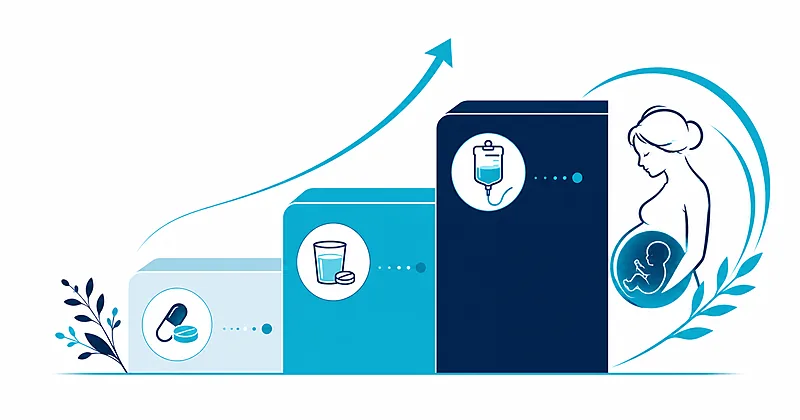
Matching drug intensity to symptom severity — and weighing fetal safety at every step up the ladder.
One-Minute Takeaway
- Hyperemesis gravidarum treatment works best as a proportionate, stepwise escalation — matching drug intensity to symptom severity rather than reaching for the strongest agent first. The strongest verified evidence concerns safety, not comparative efficacy.
- First-line pyridoxine with or without doxylamine has the most reassuring fetal-safety record; a randomized trial showed only a small symptom benefit that an independent reanalysis judged clinically marginal.
- Metoclopramide carries robust safety data across cohorts exceeding one million pregnancies, with no rise in major malformations. Ondansetron matched it for symptom control in a head-to-head trial.
- The central ondansetron safety question is a small oral-cleft association (adjusted relative risk 1.24) alongside no cardiac malformation signal across 1.8 million pregnancies.
- Corticosteroids are a last-line rescue only: a placebo-controlled trial found no rehospitalisation benefit.
Why Hyperemesis Gravidarum Matters
Hyperemesis gravidarum is the severe end of nausea and vomiting in pregnancy. The Cochrane review of interventions places its frequency at roughly 0.3% to 1.0% of pregnancies, and it remains one of the most common reasons for hospital admission in early pregnancy.
The burden is disproportionate to that prevalence. Persistent vomiting drives dehydration, electrolyte and ketone disturbance, and weight loss, and prolonged deficiency can precipitate thiamine-related Wernicke encephalopathy. Many affected women also report substantial psychological distress and lost work.
Both undertreatment and overtreatment carry costs. Clinicians may minimise symptoms as ordinary morning sickness, while some women avoid effective drugs out of fear of harming the fetus. The ACOG practice bulletin frames early, graded treatment as the way to avoid that trap.
Diagnosis is clinical and one of exclusion. The ACOG bulletin describes it as persistent vomiting without another cause, together with signs of starvation such as weight loss of at least 5% of prepregnancy weight, plus electrolyte, thyroid or liver abnormalities. Other causes of vomiting must be ruled out before treatment escalates.
The Clinical Problem in Hyperemesis Gravidarum
The therapeutic dilemma is specific. Symptoms peak during the first trimester, precisely when organogenesis makes the embryo most vulnerable, and every antiemetic crosses the placenta. Treatment intensity therefore has to be weighed against a fetal-safety signal that is often uncertain.
Two facts sharpen the problem. First, high-quality efficacy data are thin: the 2016 Cochrane review concluded there is little consistent, high-quality evidence favouring any single intervention. Second, the safety evidence is uneven across agents — reassuring for some, genuinely ambiguous for others.
The rational response is proportionality. Match the potency and known-risk profile of the drug to how severe and refractory the illness is, and escalate one deliberate step at a time. This review compares the four core approach tiers on exactly those two axes: how well each controls symptoms, and how solid its safety record is.
Available Approaches
The comparative table below assembles the trials and safety studies that anchor each tier. Every figure was checked against a primary or publisher source, every sample size is real, and every DOI was confirmed to resolve. Efficacy estimates come from randomized trials; population-level safety estimates come from large cohorts and meta-analyses.
| Tier | Study / Source | Design | N | Comparison / Focus | Key result | Conf. | DOI |
|---|---|---|---|---|---|---|---|
| All | Boelig 2016 (Cochrane) | Systematic review of RCTs | 25 trials | Any intervention for hyperemesis gravidarum | Little high-quality, consistent evidence supports any single intervention | V | ✓ |
| 1 | Koren 2010 | Double-blind RCT | 256 | Delayed-release doxylamine 10 mg / pyridoxine 10 mg vs placebo | PUQE change −4.8 ± 2.7 vs −3.9 ± 2.6 (P = .006) | V | ✓ |
| 1 | Persaud 2018 (reanalysis) | Independent reanalysis of the Koren RCT | 280 randomized | Same trial, alternative missing-data handling | Difference 0.73 (95% CI 0.21–1.25) by LOCF; not robust to other methods; below the 3-point clinical threshold | V | ✓ |
| 2 | Tan 2010 | Double-blind RCT | 159 | IV promethazine 25 mg vs metoclopramide 10 mg, q8h | Similar efficacy (median vomiting 1 vs 2, P = .81); metoclopramide better tolerated (drowsiness NNTb 5, dizziness NNTb 3) | V | ✓ |
| 3 | Abas 2014 | Double-blind RCT | 160 | IV ondansetron 4 mg vs metoclopramide 10 mg, q8h | Similar symptom control (well-being 9 vs 9, P = .33); adverse-effect profile favoured ondansetron | V | ✓ |
| 4 | Yost 2003 | Double-blind, placebo-controlled RCT | 126 | IV methylprednisolone + oral prednisone taper vs placebo (refractory disease) | No reduction in later rehospitalisation | V | ✓ |
| Safety | Huybrechts 2018 | Retrospective cohort (Medicaid) | 1,816,414 | First-trimester ondansetron (88,467 exposed) | Cardiac malformations aRR 0.99 (95% CI 0.93–1.06); oral clefts aRR 1.24 (95% CI 1.03–1.48) | V | ✓ |
| Safety | Pasternak 2013 | Register-based cohort (Denmark) | 1,222,503 | First-trimester metoclopramide, matched 1:4 | No significant increase in major malformations, spontaneous abortion or stillbirth | V | ✓ |
| Safety | Matok 2009 | Cohort (Israel) | 81,703 | First-trimester metoclopramide (3,458 exposed) | Major malformations OR 1.04 (95% CI 0.89–1.21); no rise in low birth weight or perinatal death | V | ✓ |
| Safety | Sun 2021 | Systematic review / meta-analysis | 33,374 exposed | Metoclopramide, first-trimester malformations (6 cohorts) | No significant increase in major malformations in the primary analysis | V | ✓ |
| Safety | Park-Wyllie 2000 | Meta-analysis (case-control + cohort) | Pooled | First-trimester corticosteroids and orofacial clefts | Case-control pooled OR for oral clefts 3.35 (95% CI 1.97–5.69); cohort major-malformation OR 1.45 (95% CI 0.80–2.60) | V | ✓ |
First-Line: Pyridoxine With or Without Doxylamine
Vitamin B6 (pyridoxine), alone or combined with the antihistamine doxylamine, is the ACOG-recommended first-line pharmacotherapy, graded on the strength of its safety record. The delayed-release combination is the only formulation approved specifically for nausea and vomiting of pregnancy.
Nonpharmacologic measures precede and accompany drug therapy. ACOG notes that taking prenatal vitamins around the time of conception may reduce the incidence and severity of symptoms, and that ginger has shown some benefit as a nonpharmacologic option. These are low-risk adjuncts rather than definitive treatments for established hyperemesis gravidarum.
The pivotal Koren 2010 randomized trial found the combination reduced PUQE scores more than placebo, and the difference reached statistical significance. The effect size was small, however — under one point on the scale — and the drug was well tolerated.
That modest signal deserves an honest caveat. An independent 2018 reanalysis of the same trial data found the benefit held up under one imputation method but not others, and fell below the study’s own prespecified threshold for a clinically important difference. The safety case is stronger than the efficacy case here.
Antihistamines and Dopamine Antagonists
When first-line therapy is insufficient, antihistamines (such as dimenhydrinate or diphenhydramine) and dopamine antagonists (metoclopramide and the phenothiazines promethazine, prochlorperazine and chlorpromazine) are the next tier. These agents can be given by several routes when oral intake fails.
Metoclopramide has the most reassuring safety data in this group. The Danish register study by Pasternak and colleagues, covering more than 1.2 million pregnancies, found no significant increase in major malformations, spontaneous abortion or stillbirth. Matok’s Israeli cohort and the 2021 meta-analysis reached the same conclusion.
On efficacy and tolerability, the Tan 2010 trial compared promethazine with metoclopramide in hospitalised hyperemesis gravidarum. Symptom control was similar, but metoclopramide produced significantly less drowsiness, dizziness and dystonia, and no participant stopped it early for side effects.
Ondansetron (5-HT3 Antagonists)
Ondansetron is now widely prescribed for severe symptoms, and the head-to-head evidence supports its potency. In the Abas 2014 trial, intravenous ondansetron matched metoclopramide for symptom control in hyperemesis gravidarum while producing fewer adverse effects.
Its position lower on the ladder reflects safety questions, not weak efficacy. The large Huybrechts 2018 cohort of 1.8 million pregnancies found no increase in cardiac malformations with first-trimester exposure. It did detect a small association with oral clefts — an adjusted relative risk of 1.24, equating to roughly three extra cases per 10,000 exposed infants.
Two further points shape use. Ondansetron prolongs the QT interval, so caution and, where relevant, monitoring apply; the high single intravenous doses that raised the greatest concern are not used in this setting. Guidance advises counselling women on the residual, small malformation uncertainty before prescribing.
Corticosteroids for Refractory Disease
Corticosteroids sit at the top of the ladder, reserved for disease that resists everything below. The placebo-controlled Yost 2003 trial in refractory hyperemesis gravidarum found that adding parenteral and oral corticosteroids did not reduce the need for later rehospitalisation.
Safety adds a further reason for restraint. The Park-Wyllie 2000 meta-analysis found a roughly threefold association between first-trimester corticosteroid exposure and orofacial clefts in case-control studies. This underpins the common advice to avoid systemic corticosteroids before about 10 weeks and to reserve them for genuinely refractory cases.
That signal is not settled. Larger, more recent cohort data — including a Danish study of more than 830,000 births — did not confirm an increased oral-cleft risk with systemic corticosteroids, which is why the drugs remain an option of last resort rather than an outright contraindication.
Comparative Analysis
Read across the tiers, a consistent pattern emerges: safety confidence is highest where efficacy evidence is weakest, and vice versa. First-line therapy is the safest but only modestly effective; the more potent agents carry more residual safety uncertainty.
On symptom control, the randomized comparisons cluster together. Ondansetron and metoclopramide performed similarly (Abas), and promethazine and metoclopramide performed similarly (Tan). No single agent demonstrated clear efficacy superiority, so the deciding factor at each step is usually the safety and tolerability profile.
On safety, metoclopramide is the standout among the more potent options, with concordant reassurance across cohorts totalling well over a million pregnancies. Ondansetron’s profile is favourable but carries the small oral-cleft caveat, while corticosteroids combine limited proven benefit with a historical, unconfirmed cleft signal.
Context matters for how much weight the ondansetron data carry. Its use in pregnancy rose sharply through the 2010s; by 2014, an estimated 22% of pregnancies in the United States involved some exposure, up from under 1% in 2001. That scale of use is exactly why the large cohort evidence on its safety is reassuring rather than incidental.
This is why proportionate escalation is more defensible than starting high. Beginning with the safest agent and stepping up only as severity demands keeps the fetal-risk exposure matched to the clinical need — and matched to how strong the evidence for each agent actually is.
Quality and Consistency of the Evidence
Certainty varies sharply by question. The safety literature is large and broadly consistent; the comparative-efficacy literature is small, heterogeneous, and mostly under-powered for definitive conclusions.
- High — ondansetron and cardiac malformations. A 1.8-million-pregnancy cohort with tight confidence intervals shows no association.
- High — metoclopramide and major malformations. Multiple large cohorts and a meta-analysis converge on no meaningful increase.
- Moderate — ondansetron and oral clefts. A real but small association, less precisely estimated, and not confirmed across every dataset.
- Moderate — first-line safety. Long-standing reassuring data, though drawn largely from observational sources.
- Low — comparative efficacy. Trials are small and short; the Cochrane review found no consistent high-quality signal favouring any agent.
- Low — corticosteroid benefit. The one placebo-controlled trial was neutral for its primary outcome.
What the Evidence Does Not Show
Several specific gaps should temper confidence, and none is resolved by simply asserting a preferred agent.
No adequately powered placebo-controlled efficacy trial exists for severe disease. Most randomized data compare two active drugs in modest samples over short windows, leaving true effect sizes uncertain.
The ondansetron oral-cleft association cannot be fully excluded or confirmed. The absolute risk is small, but datasets disagree and the mechanism is unclear.
The corticosteroid cleft signal remains unsettled. Older case-control data suggested a threefold association that larger recent cohorts did not reproduce; residual confounding by underlying disease is plausible.
Long-term child neurodevelopmental data are sparse, and optimal escalation thresholds are undefined. Evidence does not specify exactly when to move from one tier to the next.
Practical Implications
The evidence supports a graded approach rather than a single preferred drug. What follows describes what the data support, not a prescriptive directive; individual decisions rest on severity, response and shared decision-making.
Evidence supports starting with pyridoxine, adding doxylamine if needed, and reserving more potent agents for inadequate response. It supports metoclopramide as a well-studied next step, with courses kept short to limit extrapyramidal risk.
For severe or refractory symptoms, evidence supports individualising ondansetron after counselling on the small cleft association, with attention to QT status. It supports treating corticosteroids as a true last resort, ideally avoided before roughly 10 weeks.
Across every step, evidence supports parenteral rehydration when oral intake fails, thiamine before dextrose, and monitoring of electrolytes and weight. Proportionality — escalating only as severity requires — is the throughline.
Evidence Grade and Bottom Line
The fetal-safety picture rests on large, consistent observational data and is moderate-to-high in certainty. The comparative-efficacy picture rests on small trials and is low in certainty. Recommendations should lean on the safety evidence and treat efficacy claims cautiously.
Bottom line:
- Treat hyperemesis gravidarum early and by graded escalation, matching drug intensity to symptom severity.
- First-line pyridoxine with or without doxylamine is safest; its efficacy is modest and partly contested.
- Metoclopramide is the best-supported potent option on safety; ondansetron is comparably effective with a small, well-characterised cleft caveat and no cardiac signal.
- Corticosteroids are a refractory-only rescue with limited proven benefit and a residual safety question.
Article Information and References
- Boelig RC, Barton SJ, Saccone G, Kelly AJ, Edwards SJ, Berghella V. Interventions for treating hyperemesis gravidarum. Cochrane Database Syst Rev. 2016;2016(5):CD010607. DOI: https://doi.org/10.1002/14651858.CD010607.pub2
- Committee on Practice Bulletins–Obstetrics. ACOG Practice Bulletin No. 189: Nausea and Vomiting of Pregnancy. Obstet Gynecol. 2018;131(1):e15–e30. DOI: https://doi.org/10.1097/AOG.0000000000002456
- Sun L, Xi Y, Wen X, Zou W. Use of metoclopramide in the first trimester and risk of major congenital malformations: a systematic review and meta-analysis. PLoS One. 2021;16(9):e0257584. DOI: https://doi.org/10.1371/journal.pone.0257584
- Park-Wyllie L, Mazzotta P, Pastuszak A, et al. Birth defects after maternal exposure to corticosteroids: prospective cohort study and meta-analysis of epidemiological studies. Teratology. 2000;62(6):385–392. DOI: https://doi.org/10.1002/1096-9926(200012)62:6<385::AID-TERA5>3.0.CO;2-Z
- Huybrechts KF, Hernández-Díaz S, Straub L, et al. Association of maternal first-trimester ondansetron use with cardiac malformations and oral clefts in offspring. JAMA. 2018;320(23):2429–2437. DOI: https://doi.org/10.1001/jama.2018.18307
- Pasternak B, Svanström H, Mølgaard-Nielsen D, Melbye M, Hviid A. Metoclopramide in pregnancy and risk of major congenital malformations and fetal death. JAMA. 2013;310(15):1601–1611. DOI: https://doi.org/10.1001/jama.2013.278343
- Matok I, Gorodischer R, Koren G, Sheiner E, Wiznitzer A, Levy A. The safety of metoclopramide use in the first trimester of pregnancy. N Engl J Med. 2009;360(24):2528–2535. DOI: https://doi.org/10.1056/NEJMoa0807154
- Hviid A, Mølgaard-Nielsen D. Corticosteroid use during pregnancy and risk of orofacial clefts. CMAJ. 2011;183(7):796–804. DOI: https://doi.org/10.1503/cmaj.101063
- Koren G, Clark S, Hankins GDV, et al. Effectiveness of delayed-release doxylamine and pyridoxine for nausea and vomiting of pregnancy: a randomized placebo controlled trial. Am J Obstet Gynecol. 2010;203(6):571.e1–571.e7. DOI: https://doi.org/10.1016/j.ajog.2010.07.030
- Persaud N, Meaney C, El-Emam K, Moineddin R, Thorpe K. Doxylamine-pyridoxine for nausea and vomiting of pregnancy randomized placebo controlled trial: prespecified analyses and reanalysis. PLoS One. 2018;13(1):e0189978. DOI: https://doi.org/10.1371/journal.pone.0189978
- Abas MN, Tan PC, Azmi N, Omar SZ. Ondansetron compared with metoclopramide for hyperemesis gravidarum: a randomized controlled trial. Obstet Gynecol. 2014;123(6):1272–1279. DOI: https://doi.org/10.1097/AOG.0000000000000242
- Tan PC, Khine PP, Vallikkannu N, Omar SZ. Promethazine compared with metoclopramide for hyperemesis gravidarum: a randomized controlled trial. Obstet Gynecol. 2010;115(5):975–981. DOI: https://doi.org/10.1097/AOG.0b013e3181d99290
- Yost NP, McIntire DD, Wians FH Jr, Ramin SM, Balko JA, Leveno KJ. A randomized, placebo-controlled trial of corticosteroids for hyperemesis due to pregnancy. Obstet Gynecol. 2003;102(6):1250–1254. DOI: https://doi.org/10.1016/j.obstetgynecol.2003.08.013