
Early Cerebral Palsy Diagnosis: Detecting Risk Before Age One
Absent fidgety movements and a low Hammersmith score can flag motor risk months before walking delays appear — reshaping how high-risk newborns are followed.
One-Minute Takeaway
- Early cerebral palsy diagnosis is now feasible before age one: converging evidence shows a structured pathway can flag motor risk from around 3 months of corrected age in high-risk infants.
- Prechtl’s General Movements Assessment is the single strongest early marker — pooled sensitivity 98% (95% CI 74–100%) and specificity 91% (95% CI 83–93%) for later cerebral palsy.
- The Hammersmith Infant Neurological Examination adds a scored neurological exam; a global score of 56 or below at 3 months carries roughly 90% sensitivity and specificity for cerebral palsy.
- Combining General Movements, the Hammersmith exam, and neuroimaging reached 97.9% sensitivity and 99.2% specificity in one high-risk cohort of 441 infants.
- These figures come mainly from high-risk NICU populations; sensitivity is lower in unselected infants and for outcomes broader than cerebral palsy.
The Clinical Problem in Early Cerebral Palsy Diagnosis
Cerebral palsy is the most common physical disability of childhood. In high-income countries its prevalence sits at roughly 1.6 to 2.1 per 1000 live births, and it rises steeply with prematurity and low birthweight.
For decades the diagnosis arrived late. Most children were not formally diagnosed until after their second birthday, once delayed sitting, rolling, or walking made the motor disorder visible. Population data reflect this lag, with mean age at initial diagnosis often falling between 1.6 and 2.4 years.
Risk is not evenly spread across the nursery. Prematurity, very low birthweight, neonatal encephalopathy, and perinatal stroke sharply raise the odds of cerebral palsy. These infants form the population in which early cerebral palsy detection has been studied most, and structured surveillance concentrates on them.
That delay carries a real cost. The infant brain is most plastic in the first year, and the internationally endorsed early-intervention guideline is built on starting cerebral-palsy-specific therapy during that window to harness developing-system plasticity. A diagnosis at 24 months can miss the period when intervention may do the most.
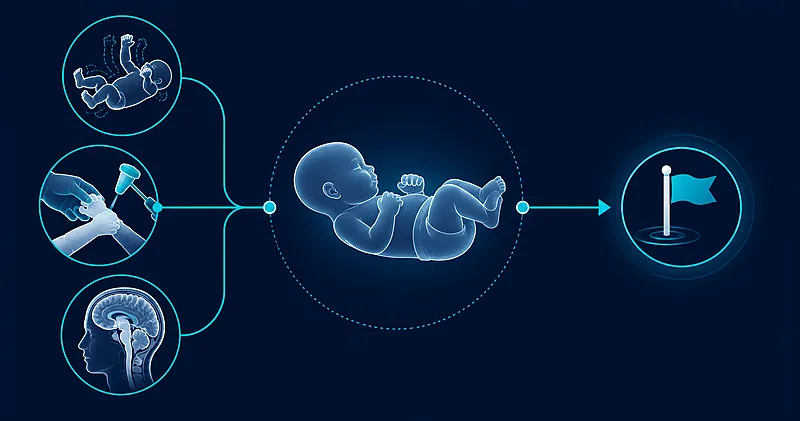
Two bedside tools have compressed this timeline. Prechtl’s General Movements Assessment and the Hammersmith Infant Neurological Examination, used alongside neuroimaging, let clinicians identify infants at high risk of cerebral palsy from as early as 3 months of corrected age. This review asks a narrow, practical question: how accurately does each approach detect cerebral palsy before age one, where does each fall short, and what does combining them achieve?
Available Approaches to Early Detection
Four assessment strategies dominate the first-year evidence: the General Movements Assessment, the Hammersmith Infant Neurological Examination, structural neuroimaging, and the combined use of all three. The table summarises the diagnostic-accuracy studies underpinning them, with real sample sizes and confidence intervals drawn from the source papers.
| Study / Source | Design | N | Population | Tool assessed | Key result (sensitivity / specificity) |
|---|---|---|---|---|---|
| Bosanquet 2013 | Systematic review + meta-analysis | 19 studies | High-risk preterm / low-birthweight, <5 y | General Movements (pooled) vs cranial ultrasound, neurological exam, MRI | GMA 98% (95% CI 74–100) / 91% (95% CI 83–93); strongest of four modalities V |
| Novak 2017 | Systematic review | Multi-study | High-risk infants, <5 mo corrected age | General Movements, HINE, term-age MRI | GMA 98% sens; HINE 90% sens; MRI 86–89% sens V |
| Morgan (Crowle) 2016 | Prospective cohort | 259 (187 at 1 y) | High-risk, Australian NICUs | General Movements, fidgety period (12–20 wk) | 98% / 94% for cerebral palsy V |
| Goyen 2020 | Prospective cohort, 2-year outcomes | ~180 (41 CP) | High-risk, Australia | General Movements, fidgety period | CP 97.6% (40/41) / 95.7%; any abnormal outcome 57.9% sens V |
| Romeo 2016 | Critical review | Multi-study | At-risk preterm and term infants | HINE global score cutoffs | Score ≤56 at 3 mo → ~90% / ~90%; <40 seen only with severe CP V |
| Morgan 2019 | Retrospective case-control | 441 | High-risk, three Italian centres | HINE + General Movements + neuroimaging | Combined 97.9% / 99.2% (PPV 98.6%); GMA alone 95% / 97% V |
General Movements Assessment GMA
The General Movements Assessment observes an infant’s spontaneous, whole-body movements rather than testing reflexes on command. During the fidgety period, from roughly 3 to 5 months of corrected age, healthy infants show continual small-amplitude movements of the neck, trunk, and limbs. These fidgety movements may be present and normal, abnormal, or absent.
Absent fidgety movements are the central red flag. Assessment is performed by visual Gestalt observation of a short video, using Prechtl’s method, and it does not require the infant to cooperate. Bosanquet’s meta-analysis found the General Movements Assessment to be the strongest single predictor of later cerebral palsy among all the tools reviewed.
Timing shapes what the assessment can do. During the earlier writhing period, from birth to about 6 weeks, sensitivity for cerebral palsy is similar at 93% (95% CI 86–96) but specificity falls to 59% (95% CI 45–71). A distinctive pattern from this period, cramped-synchronised movements, is itself an early marker of cerebral palsy.
Real-world performance has held up where raters are trained. In an Australian rater network screening high-risk infants, the assessment reached 98% sensitivity and 94% specificity for cerebral palsy, and accuracy was sustained to 2 years. A practical caveat emerges from that same follow-up: sensitivity for cerebral palsy specifically stayed near 98%, but sensitivity for detecting any abnormal neurodevelopmental outcome fell to about 58%. The tool is tuned to motor disability, not to the full range of developmental concerns.
The Hammersmith Infant Neurological Examination HINE
The Hammersmith Infant Neurological Examination is a standardised neurological exam for infants aged 2 to 24 months. It scores 26 items covering cranial nerves, posture, movement, tone, reflexes, and reactions, producing a global score from 0 to 78 alongside a separate asymmetry score. Higher scores indicate better neurological performance.
The exam is organised in three parts: a neurological section covering cranial nerves, posture, tone, and reflexes; a section on motor milestones such as head control and sitting; and a short assessment of behavioural state. The 26 neurological items feed the optimality global score used for risk stratification.
Optimality cutoffs turn the score into a risk signal. Romeo’s critical review reported that infants with global scores of 56 or below at 3 months, and 65 or below at 12 months, showed approximately 90% sensitivity and specificity for developing cerebral palsy. Extremely low scores, below 40, appeared only in association with severe cerebral palsy.
The asymmetry score matters because it can catch unilateral cerebral palsy in infants whose global score still looks acceptable. A 2024 scoring aid formalised this, recommending referral for early intervention when global scores fall below the cerebral palsy cutoff or when more than four asymmetries are present. Used alone at 3 months, though, the exam is a better rule-out than rule-in: in the 441-infant pooled study it showed high sensitivity (88%) but lower specificity (62%).
Neuroimaging — MRI and Cranial Ultrasound Imaging
Structural imaging looks for the injury behind the movement disorder rather than the movement disorder itself. Term-age magnetic resonance imaging carries a sensitivity of 86–89% in the systematic-review estimates, with individual studies ranging as high as 100%. It can reveal white matter injury, arterial stroke, and brain malformations, and it contributes information on cause and topography that the movement and exam tools cannot.
In infants born very preterm, white matter injury is the predominant lesion behind later cerebral palsy, which is one reason imaging findings track with motor outcome most closely in this group.
Cranial ultrasound is the bedside alternative. Its pooled sensitivity of 74% (95% CI 63–83) is lower than MRI, but its specificity of 92% (95% CI 81–96) is comparable, and it is readily available in the neonatal unit without transport or sedation.
Imaging is not a complete answer on its own. It is not always feasible or safe to perform early, scoring systems vary between centres, and a meaningful share of cerebral palsy has a genetic basis that can leave structural scans looking normal. Neuroimaging is best read as one input alongside the functional assessments, not as a standalone verdict.
Combined Multimodal Assessment Triad
The internationally recommended pathway does not rely on any single test. It pairs the General Movements Assessment with the Hammersmith exam and neuroimaging, and reads them together. The retrospective case-control study of 441 high-risk infants gives the clearest picture of what that triangulation buys.
When all three assessments were combined, sensitivity reached 97.9% and specificity 99.2%, with a positive predictive value of 98.6% and negative predictive value of 98.8%. Each test alone was good; together they were stronger, because the errors of one modality tended to be corrected by the others.
Prediction of cerebral palsy in early infancy is most reliable when it rests on a series of assessments along a developmental trajectory rather than a single snapshot. When General Movements, the Hammersmith score, and imaging all point to high risk, confidence is greatest. When they diverge, serial re-assessment is more informative than trusting any one test in isolation.
Comparative Analysis of Early Cerebral Palsy Detection Tools
The three core tools occupy different points on the sensitivity–specificity map. The General Movements Assessment offers the highest sensitivity of any single measure, making it the best early rule-out. Neuroimaging offers the highest specificity, confirming a structural basis when present. The Hammersmith exam bridges the two, contributing a graded score and, through its asymmetry count, a route to detecting unilateral disease.
Timing separates them further. The General Movements Assessment is tied to the fidgety window at 3 to 5 months, a single optimal moment. The Hammersmith exam can be repeated across 2 to 24 months, so serial scores trace a trajectory rather than a point. MRI is typically performed at term-equivalent age, earlier than either functional assessment.
Feasibility also differs. The General Movements Assessment needs trained, certified raters and a video setup, and rater experience shapes its accuracy. The Hammersmith exam takes roughly 10 to 15 minutes at the bedside and needs no equipment. MRI is the most resource-intensive of the three. Across every comparison, the consistent finding is that combined, serial assessment outperforms any single tool used once. For early cerebral palsy detection, then, the practical unit of decision is the pathway, not the individual test.
Quality and Consistency of the Evidence
Strength of evidence varies by claim. The ratings below reflect how consistently each finding is supported across systematic reviews and independent cohorts.
- High — Absent fidgety General Movements predict cerebral palsy in high-risk infants. Multiple systematic reviews and prospective cohorts converge on sensitivity near 98%.
- High — Hammersmith optimality cutoffs stratify cerebral palsy risk. The ~90% figure at the 3-month cutoff is consistent across studies, with a clear severity gradient below 40.
- Moderate — Combined General Movements, Hammersmith, and imaging accuracy. The 97.9% / 99.2% result is strong but rests largely on a single retrospective case-control sample.
- Moderate — Term MRI sensitivity. Estimates range from 86% to 100% across studies, and heterogeneous scoring systems limit pooling.
- Low — Performance in unselected and low-resource populations. Data here are sparse, and reported sensitivity in general-population samples is well below the high-risk headline.
A structural caveat runs through all of it. The studies pooled by Bosanquet had cerebral palsy prevalence ranging from 5% to 59%, drawn from neonatal intensive care settings. High-prevalence, high-risk samples raise the apparent accuracy of any test, so the strongest numbers describe exactly the population in which the tools were developed.
What the Evidence Does Not Show
The headline accuracy figures describe high-risk newborns, not the general nursery, and they answer a narrower question than they are sometimes assumed to.
Generalisability is the largest gap. Nearly all of the strong data come from high-risk NICU cohorts, and sensitivity in unselected populations is lower than the near-98% figure implies. The tools identify risk best where risk is already concentrated.
The outcome being predicted is narrow. The General Movements Assessment and the Hammersmith exam are calibrated to cerebral palsy. Their sensitivity for the broader category of any abnormal neurodevelopmental outcome is substantially weaker, as the drop to roughly 58% in the Australian 2-year follow-up shows.
Timing has a floor. No single test reliably predicts cerebral palsy much before the fidgety period, and earlier guidance was cautious about diagnosis before 6 months of corrected age. The current pathway shifts detection earlier, but it does not extend reliable prediction into the first weeks of life.
These tools flag risk more than they characterise it. They do not consistently establish cerebral palsy subtype, topography, or eventual Gross Motor Function Classification level, although a Hammersmith score below 40 and cramped-synchronised movements both hint at greater severity. A genetic contribution, present in up to 30% of cases, can also accompany normal imaging and an atypical developmental trajectory.
Practical Implications
The evidence supports a structured follow-up for infants at high risk of cerebral palsy that layers the three assessments rather than choosing between them. The General Movements Assessment during the fidgety period, the Hammersmith exam applied serially with attention to asymmetry, and neuroimaging where feasible together provide the strongest early signal.
A single normal test does not exclude cerebral palsy. Because sensitivity and specificity shift with each modality and with timing, convergence across tools and repeated assessment carry more weight than one reassuring result.
Early identification is valuable chiefly because it opens the door to intervention during peak plasticity. The international guideline supports beginning cerebral-palsy-specific early intervention at the point of diagnosis or of designated high risk, and a documented interim label of high risk of cerebral palsy is an accepted way to act before a formal diagnosis is confirmed.
Framing matters for families. Explaining that early cerebral palsy detection identifies risk and unlocks therapy, rather than delivering a fixed prognosis, can help caregivers engage with intervention while the eventual picture is still taking shape.
Local accuracy depends on the system, not only the tool. General Movements performance is tied to rater training and certification, and any pathway’s real-world yield depends on the completeness of follow-up, so investment in trained assessors and reliable recall is part of the intervention.
Evidence Grade and Bottom Line
Overall evidence grade
Moderate to High (high-risk infants) · Low (general population)- Absent fidgety General Movements are the strongest single early marker of cerebral palsy, with pooled sensitivity near 98% in high-risk infants.
- The Hammersmith exam adds a graded neurological score and asymmetry detection; a score of 56 or below at 3 months carries about 90% sensitivity and specificity.
- Combining the movement assessment, the exam, and neuroimaging, and repeating them over time, maximises accuracy — up to 97.9% sensitivity and 99.2% specificity in a high-risk cohort.
- Headline accuracy reflects high-risk, high-prevalence populations. Expectations should be tempered in unselected infants and for outcomes broader than cerebral palsy.
Article Information and References
- Bosanquet M, Copeland L, Ware R, Boyd R. A systematic review of tests to predict cerebral palsy in young children. Dev Med Child Neurol. 2013;55(5):418–426. DOI: https://doi.org/10.1111/dmcn.12140
- Novak I, Morgan C, Adde L, et al. Early, accurate diagnosis and early intervention in cerebral palsy: advances in diagnosis and treatment. JAMA Pediatr. 2017;171(9):897–907. DOI: https://doi.org/10.1001/jamapediatrics.2017.1689
- Morgan C, Fetters L, Adde L, et al. Early intervention for children aged 0 to 2 years with or at high risk of cerebral palsy: international clinical practice guideline based on systematic reviews. JAMA Pediatr. 2021;175(8):846–858. DOI: https://doi.org/10.1001/jamapediatrics.2021.0878
- Romeo DM, Ricci D, Brogna C, Mercuri E. Use of the Hammersmith Infant Neurological Examination in infants with cerebral palsy: a critical review of the literature. Dev Med Child Neurol. 2016;58(3):240–245. DOI: https://doi.org/10.1111/dmcn.12876
- Morgan C, Romeo DM, Chorna O, et al. The pooled diagnostic accuracy of neuroimaging, general movements, and neurological examination for diagnosing cerebral palsy early in high-risk infants: a case control study. J Clin Med. 2019;8(11):1879. DOI: https://doi.org/10.3390/jcm8111879
- Morgan C, Crowle C, Goyen TA, et al. Sensitivity and specificity of General Movements Assessment for diagnostic accuracy of detecting cerebral palsy early in an Australian context. J Paediatr Child Health. 2016;52(1):54–59. DOI: https://doi.org/10.1111/jpc.12995
- Goyen TA, Morgan C, Crowle C, et al. Sensitivity and specificity of general movements assessment for detecting cerebral palsy in an Australian context: 2-year outcomes. J Paediatr Child Health. 2020;56(9):1414–1418. DOI: https://doi.org/10.1111/jpc.14953
- Luke C, Bos AF, Jackman M, et al. Reproducibility of the Motor Optimality Score–Revised in infants with an increased risk of adverse neurodevelopmental outcomes. Dev Med Child Neurol. 2025;67(9):1176–1185. DOI: https://doi.org/10.1111/dmcn.16256
- Fehlings D, Makino A, Church P, et al. The Hammersmith Infant Neurological Exam Scoring Aid supports early detection for infants with high probability of cerebral palsy. Dev Med Child Neurol. 2024;66(10):1255–1257. DOI: https://doi.org/10.1111/dmcn.15977
- Einspieler C, Marschik PB, Pansy J, et al. The general movement optimality score: a detailed assessment of general movements during preterm and term age. Dev Med Child Neurol. 2016;58(4):361–368. DOI: https://doi.org/10.1111/dmcn.12923
- Hanna SE. High and variable prevalence does matter in reviews of diagnostic accuracy in cerebral palsy. Dev Med Child Neurol. 2013;55(5):397–398. DOI: https://doi.org/10.1111/dmcn.12097