
SMA Treatment: Comparing Nusinersen, Onasemnogene Abeparvovec, and Risdiplam
Three disease-modifying therapies have rewritten the outlook for a once-uniformly-fatal infantile disease — yet they differ in mechanism, route, evidence base, and the patients they serve best.
One-Minute Takeaway
- SMA treatment now rests on three disease-modifying therapies supported by high-quality trial evidence — nusinersen, onasemnogene abeparvovec, and risdiplam — each shown to alter the disease course relative to untreated controls.
- In infantile-onset disease, nusinersen roughly halved the risk of death or permanent ventilation (HR 0.53, 95% CI 0.32–0.89) in the sham-controlled ENDEAR trial.
- One-time gene therapy (onasemnogene) enabled independent sitting in 59% of infants at 18 months and ventilator-free survival in 91% at 14 months in the single-arm STR1VE trial — outcomes not seen in natural history.
- Oral risdiplam improved motor function versus placebo in older children (MFM32 difference +1.55, 95% CI 0.30–2.81) and helped 29% of infants sit in FIREFISH.
- No head-to-head trial exists; the choice turns on age, weight, SMN2 copy number, delivery route, and access — and earlier treatment consistently matters most.
Why SMA Treatment Matters
Spinal muscular atrophy (SMA) is an autosomal recessive neuromuscular disease caused by biallelic loss of the SMN1 gene, which lowers levels of survival motor neuron (SMN) protein and drives progressive motor neuron degeneration.
A near-identical backup gene, SMN2, produces only small amounts of functional protein, and its copy number partly determines severity. Roughly 60% of affected infants have type 1 disease, with symptom onset by 6 months and, historically, a median life expectancy under two years without respiratory support.
The natural history is stark. In untreated type 1 cohorts, only about 8% of children survive free of permanent ventilation by 20 months of age — the benchmark against which the first therapies were measured.
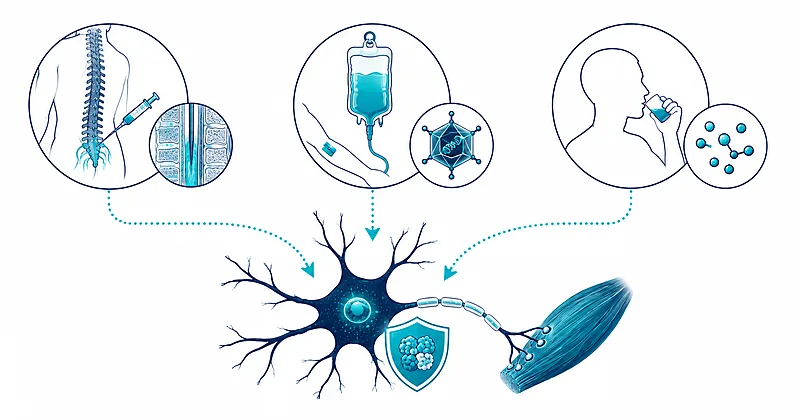
Between 2016 and 2020, three therapies with distinct mechanisms reached approval, all converging on one goal: raising functional SMN protein. Nusinersen, an intrathecal antisense oligonucleotide, and risdiplam, a daily oral small molecule, both modify SMN2 splicing; onasemnogene abeparvovec delivers a functional SMN1 copy by one-time intravenous gene transfer.
Because these agents were tested in separate trials with different designs, populations, and endpoints — and never against one another — clinicians must weigh their evidence side by side. This review synthesises the current comparative picture: where the data are strong, where they diverge, and what remains unresolved.
The Options Compared
The three therapies share a therapeutic aim but occupy different niches. The table below summarises each drug’s pivotal evidence, drawn only from primary trial reports verified for this synthesis. Every sample size and effect size traces to a retrieved source with a resolving DOI.
| Trial (drug) | Design | N | Population | Comparator | Key verified result |
|---|---|---|---|---|---|
| ENDEAR (nusinersen)V | Phase 3 RCT, sham-controlled (2:1) | 121 | Infantile-onset, symptom onset ≤6 mo, 2 SMN2 copies | Sham procedure | Motor-milestone (HINE) response 51% vs 0%; death or permanent ventilation HR 0.53 (95% CI 0.32–0.89) |
| CHERISH (nusinersen)V | Phase 3 RCT, sham-controlled (2:1) | 126 | Later-onset, onset >6 mo, age 2–12 yr | Sham procedure | HFMSE change at 15 mo +4.9 points (95% CI 3.1–6.7); ≥3-point responders 57% vs 26% |
| STR1VE-US (onasemnogene)V | Phase 3, open-label, single-arm | 22 | Infantile-onset, <6 mo, 2 SMN2 copies | PNCR natural-history cohort | Independent sitting ≥30 s at 18 mo 59% (13/22) vs 0%; ventilator-free survival at 14 mo 91% (20/22) vs 26% |
| START (onasemnogene)V | Phase 1, open-label, single-arm | 15 | Infantile-onset type 1 | Natural history | All 15 alive and free of permanent ventilation at 24 mo, vs ~8% natural-history survival |
| FIREFISH Part 2 (risdiplam)V | Phase 2/3, open-label, single-arm | 41 | Infantile-onset, 1–7 mo, 2 SMN2 copies | Historical controls | Sitting without support ≥5 s at 12 mo 29% (12/41); CHOP-INTEND ≥40 in 56% vs 17%; survival without permanent ventilation 85% vs 42% |
| SUNFISH Part 2 (risdiplam)V | Phase 3 RCT, placebo-controlled (2:1) | 180 | Type 2 / non-ambulant type 3, age 2–25 yr | Placebo | MFM32 change at 12 mo +1.55 (95% CI 0.30–2.81); RULM +1.59 |
HINE = Hammersmith Infant Neurological Examination; HFMSE = Hammersmith Functional Motor Scale–Expanded; CHOP-INTEND = Children’s Hospital of Philadelphia Infant Test of Neuromuscular Disorders; MFM32 = 32-item Motor Function Measure; RULM = Revised Upper Limb Module. [V] = figure verified against a primary source this session.
Two structural differences are worth flagging before interpreting these numbers. The nusinersen trials and the SUNFISH risdiplam trial were randomised and controlled, so their between-group differences can support causal language. The gene-therapy trials and the FIREFISH infant trial were single-arm and compared against natural-history or historical cohorts, which supports description but not the same strength of causal inference.
Motor Function and Milestones — How They Differ
Infantile-onset disease
In ENDEAR, nusinersen led to a motor-milestone response in 51% of infants versus none in the sham group, and a CHOP-INTEND response (a rise of at least 4 points) in 71% versus 3%. As a randomised comparison, this supports a causal effect on early motor development.
Onasemnogene produced its signal in a single-arm setting. In STR1VE, 59% of infants sat independently for at least 30 seconds by 18 months, a milestone reached by none of the untreated natural-history comparators. Mean CHOP-INTEND scores rose rapidly — by roughly 7, 12, and 15 points at 1, 3, and 6 months after infusion.
The earlier phase 1 START study reinforced the durability signal, with treated infants continuing to gain milestones over years. These are compelling responses, though the absence of a randomised control means the magnitude cannot be compared head-to-head with nusinersen.
Risdiplam in FIREFISH enabled 29% of infants to sit unsupported for at least 5 seconds at 12 months, rising to 44% able to sit for 30 seconds by 24 months. Notably, no infant stood or walked independently by 24 months.
The FIREFISH infants reached fewer standing and walking milestones than infants in some nusinersen and gene-therapy cohorts. An accompanying commentary attributed this partly to an older median age at enrolment in FIREFISH — a reminder that population and timing, not just the drug, shape outcomes when trials are compared indirectly.
Later-onset (type 2 and non-ambulant type 3) disease
Here two of the three therapies carry direct evidence. In CHERISH, nusinersen led to a least-squares mean HFMSE improvement of 4.9 points over sham at 15 months (95% CI 3.1–6.7), with 57% of treated children gaining at least 3 points versus 26% of controls.
In SUNFISH, risdiplam produced a placebo-controlled MFM32 treatment difference of 1.55 points at 12 months (95% CI 0.30–2.81) and an RULM difference of 1.59 points. Both trials showed a consistent pattern: younger children tended to improve, while older patients more often stabilised — meaningful in a relentlessly progressive disease.
Because CHERISH and SUNFISH used different motor scales (HFMSE versus MFM32), enrolled overlapping but not identical populations, and were conducted separately, their point estimates cannot be placed on a single ruler. Each supports its own drug against its own control.
Survival and Respiratory Outcomes — How They Differ
For type 1 disease, survival free of permanent ventilation is the outcome that first defined the therapeutic era, since untreated infants rarely reach it.
Nusinersen’s effect was quantified as a hazard ratio in a randomised trial: a roughly 47% lower risk of death or permanent ventilation, alongside a 63% lower risk of death (HR 0.37, 95% CI 0.18–0.77). Onasemnogene and risdiplam reported high survival proportions against external comparators — 91% and 85% respectively — each far above the untreated benchmark near 26–42%.
All three programmes therefore point in the same direction: substantially better survival than natural history predicts. What differs is the evidentiary architecture. Only nusinersen’s survival benefit rests on within-trial randomisation; the gene-therapy and risdiplam infant figures are single-arm comparisons, where secular trends in supportive care and differences between historical cohorts can influence the contrast.
Respiratory and feeding independence followed a similar pattern of benefit. In STR1VE, most infants avoided permanent ventilation and many maintained the ability to feed and thrive — gains previously unseen in type 1 — though again measured against natural history rather than a randomised arm.
Subgroups That Change the SMA Treatment Choice
With efficacy broadly established across all three agents, the practical decision often hinges on patient characteristics and how each therapy is delivered.
Age and weight
Intravenous onasemnogene was approved for children under 2 years, and real-world experience in patients older than 2 years or heavier than roughly 13.5 kg remains limited. Nusinersen and risdiplam were studied and approved across a wider age range, extending into later childhood and adulthood.
A recent development narrows this gap: an intrathecal formulation of onasemnogene received FDA approval in 2025 for patients aged 2 years and older, supported by the phase 3 STEER trial, which reported a between-group HFMSE difference of 1.88 points versus a sham procedure (95% CI 0.51–3.25). This offers a gene-therapy route to older children previously outside the intravenous indication.
SMN2 copy number and disease type
SMN2 copy number modifies severity and guided trial eligibility — the infant trials generally enrolled children with two copies. Copy number, symptom onset, and baseline motor status all inform how aggressively and how early to treat, and which endpoints are realistic.
Route of administration
Delivery route is often decisive. Nusinersen requires repeated intrathecal injections, which can be technically demanding in children with scoliosis or prior spinal fusion. Risdiplam is taken orally each day, the least invasive option and one with systemic rather than CNS-only distribution. Onasemnogene is a single intravenous infusion, attractive for its one-time nature but requiring monitoring for hepatotoxicity, thrombocytopenia, and cardiac markers.
Across all three programmes, the strongest and most consistent message is that earlier treatment yields better outcomes. Presymptomatic trials and newborn-screening data show markedly better milestone attainment when therapy begins before irreversible motor neuron loss — which is why timely genetic diagnosis is now central to care.
Suboptimal responders
For patients with an incomplete response to standard nusinersen, a higher-dose regimen received FDA approval in 2026 on the basis of the phase 2/3 DEVOTE trial, which showed a significant CHOP-INTEND improvement over a matched untreated comparator. Dose intensification adds an option short of switching modality in an increasingly complex sequencing landscape.
Quality and Consistency of the Evidence
Strength of evidence varies by the claim being made, not by the drug alone. The ratings below reflect the design and consistency of the supporting data.
- Survival benefit in type 1 — strong and consistent. Every therapy improved survival relative to untreated natural history, and the direction of effect is reproducible across programmes. Nusinersen’s benefit is additionally anchored by within-trial randomisation.
- Motor-function improvement — moderate. Randomised, controlled data support nusinersen (ENDEAR, CHERISH) and risdiplam in older children (SUNFISH). The gene-therapy and risdiplam infant results are single-arm comparisons against external cohorts, which are more susceptible to confounding.
- Durability — moderate and maturing. Extension data for onasemnogene extend several years with sustained effect, but the long-term trajectory of one-time gene transfer in a growing child is still accruing.
- Superiority of one therapy over another — limited. No randomised head-to-head trial exists. Only indirect comparisons are available, and they carry wide uncertainty intervals.
Two design features temper direct cross-drug conclusions: the reliance on natural-history and historical comparators for gene therapy and infant risdiplam, and the use of different motor scales across trials. Both make the RCT-based results (nusinersen and SUNFISH) the firmer ground for interpreting effect size.
What the Evidence Does Not Show
These are limits of the current evidence base, not generic calls for further study.
No head-to-head randomised comparison. Matching-adjusted indirect comparisons of the three therapies suggest broadly similar motor outcomes, but their intervals are wide and cross zero. The evidence cannot rank the drugs against one another.
In one such analysis comparing intrathecal gene therapy with the splicing modifiers, estimated HFMSE differences were small and uncertain — around 1.9 points versus risdiplam (95% CI −0.3 to 4.1) and near zero versus nusinersen (95% CI −2.9 to 2.7). Such indirect estimates are hypothesis-generating, not a substitute for a randomised comparison.
Long-term durability of one-time gene therapy. Because AAV9-delivered SMN1 is not expected to persist in dividing cells, whether a single infusion sustains benefit through the growth years and into adulthood is not yet demonstrated beyond available extension data.
Combination and sequential strategies. Real-world use of gene therapy followed by an oral or intrathecal maintenance agent is growing, but randomised evidence on whether layering therapies improves outcomes is lacking.
Older, heavier, and ambulant patients. Data in ambulant type 3 disease, in adults, and in heavier children remain thinner than in the infant populations that anchored the pivotal trials.
Predictive biomarkers. Early neurofilament responses are a promising marker of treatment effect, but whether they reliably forecast long-term function is unconfirmed.
Long-term safety of chronic splicing modulation. Because oral and intrathecal splicing modifiers act on SMN2 broadly, the long-term consequences of sustained systemic exposure are still being characterised.
Practical Implications
The evidence supports several practical positions, framed as what the data endorse rather than as directives.
Diagnose and treat early. The most robust cross-cutting finding is that earlier intervention is associated with better motor outcomes, which places newborn screening and prompt confirmatory genetics at the centre of care.
Individualise the choice. Because no trial ranks the therapies, selection reasonably weighs age, weight, SMN2 copy number, spinal anatomy, caregiver preference, and access — the same factors expert guidance highlights.
Onasemnogene. A one-time infusion is an appealing option for the youngest infants, with liver enzymes, platelets, and cardiac markers monitored after dosing; the newer intrathecal route extends gene therapy to older children.
Nusinersen. Its breadth across ages and types and its long real-world record are strengths; intrathecal delivery is harder with significant scoliosis, and a higher-dose regimen is now an option for selected patients.
Risdiplam. Daily oral dosing avoids repeated lumbar punctures and provides systemic distribution, at the cost of requiring consistent adherence.
None of the three is curative. Each modifies the disease, and multidisciplinary respiratory, nutritional, orthopaedic, and rehabilitative care remains essential alongside any SMN-restoring therapy.
Evidence Grade and Bottom Line
Evidence grade: HIGH for the claim that all three therapies modify the disease and improve survival and motor outcomes versus no treatment. LOW for any claim that one therapy is superior to the others.
- Nusinersen, onasemnogene abeparvovec, and risdiplam each transformed a historically fatal disease, with survival and motor gains far beyond natural history.
- Randomised evidence is strongest for nusinersen (ENDEAR, CHERISH) and for risdiplam in older children (SUNFISH); gene-therapy and infant risdiplam data are single-arm.
- The therapies have not been compared head-to-head; indirect comparisons suggest similar motor outcomes with wide uncertainty.
- The decision is individualised around age, weight, SMN2 copy number, delivery route, and access — and, above all, treating as early as possible.
Article Information and References
- Finkel RS, Mercuri E, Darras BT, et al. Nusinersen versus sham control in infantile-onset spinal muscular atrophy. N Engl J Med. 2017;377(18):1723–1732. DOI: https://doi.org/10.1056/NEJMoa1702752
- Mercuri E, Darras BT, Chiriboga CA, et al. Nusinersen versus sham control in later-onset spinal muscular atrophy. N Engl J Med. 2018;378(7):625–635. DOI: https://doi.org/10.1056/NEJMoa1710504
- Day JW, Finkel RS, Chiriboga CA, et al. Onasemnogene abeparvovec gene therapy for symptomatic infantile-onset spinal muscular atrophy in patients with two copies of SMN2 (STR1VE): an open-label, single-arm, multicentre, phase 3 trial. Lancet Neurol. 2021;20(4):284–293. DOI: https://doi.org/10.1016/S1474-4422(21)00001-6
- Mendell JR, Al-Zaidy S, Shell R, et al. Single-dose gene-replacement therapy for spinal muscular atrophy. N Engl J Med. 2017;377(18):1713–1722. DOI: https://doi.org/10.1056/NEJMoa1706198
- Darras BT, Masson R, Mazurkiewicz-Bełdzińska M, et al. Risdiplam-treated infants with type 1 spinal muscular atrophy versus historical controls. N Engl J Med. 2021;385(5):427–435. DOI: https://doi.org/10.1056/NEJMoa2102047
- Baranello G, Darras BT, Day JW, et al. Risdiplam in type 1 spinal muscular atrophy. N Engl J Med. 2021;384(10):915–923. DOI: https://doi.org/10.1056/NEJMoa2009965
- Mercuri E, Deconinck N, Mazzone ES, et al. Safety and efficacy of once-daily risdiplam in type 2 and non-ambulant type 3 spinal muscular atrophy (SUNFISH part 2): a phase 3, double-blind, randomised, placebo-controlled trial. Lancet Neurol. 2022;21(1):42–52. DOI: https://doi.org/10.1016/S1474-4422(21)00367-7
- Mercuri E, Muntoni F, Baranello G, et al. Onasemnogene abeparvovec gene therapy for symptomatic infantile-onset spinal muscular atrophy type 1 (STR1VE-EU): an open-label, single-arm, multicentre, phase 3 trial. Lancet Neurol. 2021;20(10):832–841. DOI: https://doi.org/10.1016/S1474-4422(21)00251-9
- Masson R, Mazurkiewicz-Bełdzińska M, Rose K, et al. Safety and efficacy of risdiplam in patients with type 1 spinal muscular atrophy (FIREFISH part 2): secondary analyses from an open-label trial. Lancet Neurol. 2022;21(12):1110–1119. DOI: https://doi.org/10.1016/S1474-4422(22)00339-8