
Croup Treatment: 5 Essential Practice Considerations
Steroid dosing and the observation window after nebulized epinephrine, weighed against the current trial evidence.
One-Minute Takeaway
- Croup treatment rests on one firmly supported step — a single glucocorticoid dose. High-certainty evidence shows low-dose and standard-dose dexamethasone, and prednisolone, all work about equally well, so the choice can follow cost and availability.
- That single dose eases symptoms and may reduce return visits or readmissions by roughly half versus placebo (RR 0.52, 95% CI 0.36–0.75; low-certainty).
- Low-dose dexamethasone (0.15 mg/kg) matched the standard 0.6 mg/kg on the one-hour Westley score in a 1252-child noninferiority trial (adjusted difference 0.03, 95% CI −0.09 to 0.15).
- Nebulized epinephrine acts fast but briefly; its benefit had faded by 120 minutes with no worsening below baseline, so structured observation, not fear of rebound, should guide disposition.
- Children with sustained improvement and no recurrent resting stridor were safely discharged after roughly two to four hours of observation.
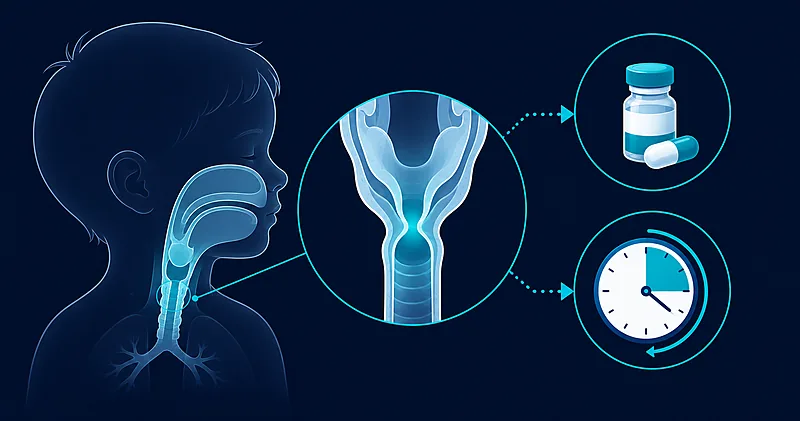
The Clinical Problem in Croup Treatment
Croup is an acute viral inflammation of the subglottic airway. Mucosal swelling below the vocal cords produces the barking cough, hoarseness, and inspiratory stridor that define the illness. Because the young child’s airway is narrow, small amounts of edema translate into audible obstruction.
Most children do well. The barking cough is dramatic, yet the underlying course is usually short and self-limited, which shapes how croup treatment is planned: the aim is to shorten symptoms and prevent escalation, not to cure an infection.
Severity is described most often with the Westley croup score, first reported by Westley and colleagues in 1978. It sums five clinical items, giving a range of 0 to 17.
About 85% of children presenting to emergency departments have mild croup. Roughly 5% are admitted, and only a small fraction of those require intubation. These proportions explain why most croup treatment happens as a single intervention followed by discharge.
The score matters because it standardises a moving target. A child’s stridor waxes with agitation and settles when calm, so a structured count guides both the first decision and the response to therapy. Re-scoring after a steroid or after epinephrine is how disposition is judged.
Two questions still generate day-to-day uncertainty in croup treatment, and both anchor this review: what dose of dexamethasone is needed, and how long should a child be watched after nebulized epinephrine before going home? The sections below weigh the trial evidence on each of these croup treatment questions.
Available Approaches in Croup Treatment
Effective croup treatment draws on a short list of interventions: glucocorticoids for nearly all symptomatic children, nebulized epinephrine for those with moderate-to-severe obstruction, and supportive care with structured observation. The comparative table below summarises the studies that inform these choices; each figure was checked against its source, with the sample size and a resolving DOI shown.
| Study / Source | Design | N | Comparison | Key verified result | Tier |
|---|---|---|---|---|---|
| Aregbesola 2023 (Cochrane) | Systematic review / meta-analysis | 45 RCTs; 5888 | Any glucocorticoid vs placebo; dose and type comparisons | Croup score at 2 h SMD −0.65 (95% CI −1.13 to −0.18); return visits/(re)admissions RR 0.52 (95% CI 0.36–0.75); 0.15 mg/kg may equal 0.60 mg/kg | [V] |
| Parker & Cooper 2019 | Double-blind noninferiority RCT | 1252 | Dexamethasone 0.6 vs 0.15 mg/kg vs prednisolone 1 mg/kg | 1-h Westley adjusted difference 0.03 (95% CI −0.09 to 0.15) for low dose; re-attendance 17.8% / 19.5% / 21.7% (not significant) | [V] |
| Bjornson 2004 (NEJM) | RCT | 720 | Dexamethasone 0.6 mg/kg vs placebo (mild croup) | Fewer return visits and reduced symptom burden vs placebo | [V] |
| Chub-Uppakarn 2007 | RCT | 41 | Dexamethasone 0.6 vs 0.15 mg/kg IV (moderate-to-severe) | No clinically important between-dose difference; onset within 1 h in both arms | [V] |
| Geelhoed 1995 | Two sequential RCTs | 120 | Oral dexamethasone 0.6 vs 0.3 vs 0.15 mg/kg | Similar median duration of hospitalisation across doses | [V] |
| Garbutt 2013 | Community-based RCT | 87 | Prednisolone vs dexamethasone 0.6 mg/kg | No significant difference in additional care, symptom duration, or disturbed sleep | [V] |
| Bjornson 2013 (Cochrane) | Systematic review / meta-analysis | 8 RCTs; 225 | Nebulized epinephrine vs placebo | Croup score at 30 min SMD −0.94 (95% CI −1.37 to −0.51); benefit not significant by 2–6 h; no worsening below baseline at 120 min | [V] |
| Ledwith 1995 | Prospective cohort | 55 | Racemic epinephrine + oral dexamethasone + mist, then observation | 55% discharged after 3 h with sustained response; no return visits (95% CI 0–8.0%) | [V] |
Corticosteroid choice and dose
Glucocorticoids are the one intervention that changes the trajectory of croup treatment for almost every symptomatic child. Pooled trial data show they ease symptoms within hours and reduce the need to return for care. A single dose is generally enough, since dexamethasone’s long half-life covers the usual symptom window.
The dose debate centres on 0.6 mg/kg versus 0.15 mg/kg. The largest head-to-head trial randomised 1252 children and found the low dose noninferior on the one-hour Westley score, with an adjusted difference of 0.03 (95% CI −0.09 to 0.15). Smaller trials in moderate-to-severe disease reached the same conclusion.
The symptom benefit deepens over the first hours rather than appearing all at once. Pooled croup-score reductions versus placebo grow from two through twelve hours, glucocorticoids shorten hospital stay versus placebo, and the effect lasts long enough that one dose covers most of the illness.
Steroid type matters less than clinicians once assumed. In a head-to-head comparison pooled within the Cochrane review, prednisolone and dexamethasone showed little to no difference in two-hour croup score (SMD 0.06, 95% CI −0.06 to 0.18; high-certainty). Prednisolone is a reasonable option where palatability or supply favours it.
Whether a second dose adds value is a separate question in croup treatment. In an observational series of 234 hospitalised children, 62% received a single dexamethasone dose and 38% received more, without a clear difference in presenting severity between the groups. One dose remains the sensible default for most children.
Nebulized epinephrine and the observation window
Nebulized epinephrine is reserved for moderate-to-severe croup, where its vasoconstricting effect shrinks airway edema quickly. In pooled trial data it produced a marked croup-score reduction at 30 minutes (SMD −0.94, 95% CI −1.37 to −0.51). It can avert intubation or stabilise a child before transfer.
Formulation is largely interchangeable. Racemic and L-epinephrine showed no croup-score difference at 30 minutes (SMD 0.33, 95% CI −0.42 to 1.08), though a single trial found L-epinephrine slightly longer-acting at two hours. Delivery by intermittent positive-pressure breathing, once thought useful, is no longer routine in croup treatment.
The benefit is short-lived. By two hours the pooled difference from placebo was no longer significant, which is expected given the drug’s brief duration of action. Crucially, the same analysis found no evidence that croup scores rose above baseline as the effect wore off.
This reframes the old worry about “rebound.” The observation period after epinephrine exists because the drug’s effect fades, not because it drives a child below where they started. A prospective cohort treated 55 children with epinephrine, dexamethasone, and mist; those with a sustained response were discharged after three hours with no return visits (95% CI 0–8.0%).
Supportive care and disposition
Beyond the two active drugs, croup treatment relies on keeping the child calm and well hydrated, since distress worsens stridor. Humidified air is often used for comfort, though trial support for a symptom benefit is limited. The decisive step is disposition: deciding who goes home and who stays.
Disposition turns on the response after treatment and on a handful of risk factors. Recurrent stridor at rest, a need for repeated epinephrine, a long distance from care, or an unreliable follow-up situation each push toward admission rather than discharge.
These disposition rules are where the two evidence threads of croup treatment meet. The steroid works slowly and durably; the epinephrine works fast and briefly. Watching the child through the epinephrine window, then confirming the steroid is holding, is what makes safe discharge in croup treatment possible.
Comparative Analysis
On the dose question, the honest reading is that the two doses are clinically interchangeable for most children in croup treatment. In the higher-powered pooled comparison, the standard 0.60 mg/kg was no better than 0.15 mg/kg on the croup score at two hours, and any separation that emerged later was small.
The size of that edge matters. A fraction of a point on a 17-point scale is unlikely to change what a family notices or what a clinician does. It did not translate into differences in the croup treatment outcomes that matter most: re-attendance rates in the 1252-child trial were 17.8% for the standard dose and 19.5% for the low dose, a non-significant gap.
So the dose choice is reasonable either way. Some clinicians default to 0.6 mg/kg for more severe presentations, where reserve is welcome; others use 0.15 mg/kg to limit steroid exposure. The evidence supports either within that range rather than mandating one.
On the observation question, the comparison is between physiology and disposition rules. Epinephrine buys roughly one to two hours of improved airway calibre. Because that window is short and is not followed by a dip below baseline, safe croup treatment means watching the effect wear off and confirming the child holds their gains.
The observational studies converge on the same pattern: children who improve, stay improved, and have no recurrent resting stridor after a period of watching can go home. What the trials cannot supply is a single exact number of minutes, which is why guidance frames the window as a range rather than a fixed cut-off.
Quality and Consistency of the Evidence
Evidence strength varies by outcome, so certainty is best read claim by claim rather than as a single verdict on croup treatment.
- High certainty — Prednisolone versus dexamethasone showed little to no difference in two-hour croup score (SMD 0.06, 95% CI −0.06 to 0.18), anchored by a single large trial of 1231 children.
- Low certainty — Glucocorticoids may reduce return visits or readmissions versus placebo (RR 0.52, 95% CI 0.36–0.75) and shorten hospital stay, though heterogeneity and risk of bias lower confidence in the size of the effect.
- Low certainty — The size of the croup-score reduction at 2, 6, and 12 hours varies across trials, with meaningful heterogeneity and frequent risk-of-bias concerns.
- Low certainty — Low-dose (0.15 mg/kg) noninferiority rests on a modest number of trials, several small, and fewer in severe disease.
- Moderate certainty — Nebulized epinephrine improves croup score at 30 minutes (SMD −0.94, 95% CI −1.37 to −0.51), from a small evidence base of eight trials totalling 225 children.
A recurring limitation cuts across the steroid literature: the review authors judged about 98% of glucocorticoid trials to be at high or unclear risk of bias, largely from incomplete reporting of randomisation and blinding. Across croup treatment, the direction of effect is consistent; the precision of individual estimates is not.
What the Evidence Does Not Show
The optimal type, dose, and route of glucocorticoid are not settled. The Cochrane authors state directly that uncertainty remains on these points, and that further trials would strengthen the case for routine low-dose dexamethasone.
Low-dose evidence is thin where it matters most. Most trials establishing 0.15 mg/kg noninferiority enrolled mild-to-moderate croup; the moderate-to-severe data rest on small numbers, so extrapolating the low dose to the sickest children is less certain.
No randomised trial defines the exact safe observation time after epinephrine. The two-to-four-hour window is drawn from prospective and retrospective cohorts, not from an RCT designed to test discharge timing. For this part of croup treatment, the evidence supports a range and a set of discharge criteria, not a precise minute count.
Disposition after repeated epinephrine is understudied. Children needing multiple doses are often admitted by reflex, and whether a subset could be observed and discharged has not been resolved by prospective work. This is a stated gap rather than a settled answer.
Practical Implications
The evidence supports a compact set of practice points for croup treatment. They are framed as what the data back, not as directives, and local pathways still apply.
Give a single glucocorticoid dose to symptomatic children. Dexamethasone anywhere in the 0.15–0.6 mg/kg range is supported; the lower end limits exposure, the higher end offers reserve for more severe disease. Prednisolone is a defensible alternative on cost or palatability grounds.
Reserve nebulized epinephrine for moderate-to-severe obstruction. Expect rapid relief that lasts only one to two hours, and pair it with a steroid so benefit is sustained after the epinephrine fades.
Observe after epinephrine, then decide on the response. A window of roughly two to four hours lets the drug’s effect wear off under supervision. Children who stay improved with no recurrent resting stridor were safely sent home in cohort data.
Admit when risk factors stack up. Recurrent stridor at rest, three or more epinephrine doses, significant comorbidity, dehydration, or an unreliable follow-up situation each favour admission over discharge.
Evidence Grade and Bottom Line
The core of croup treatment—that a single glucocorticoid dose helps and reduces return visits—is well supported. The finer points that define this review carry mixed certainty: steroid type is settled at high certainty, dose equivalence and observation timing rest on smaller or non-randomised evidence.
Bottom line. For croup treatment, give one dose of dexamethasone; 0.15 and 0.6 mg/kg are clinically interchangeable for most children, so choose within that range by severity and exposure concerns.
Prednisolone is a reasonable substitute. Use nebulized epinephrine for moderate-to-severe croup, expect a short-lived effect, and let a two-to-four-hour observation window—not a fear of rebound—drive the discharge decision.
Article Information and References
- Aregbesola A, Tam CM, Kothari A, Le M-L, Ragheb M, Klassen TP. Glucocorticoids for croup in children. Cochrane Database Syst Rev. 2023;1:CD001955. DOI: https://doi.org/10.1002/14651858.CD001955.pub5
- Gates A, Gates M, Vandermeer B, Johnson C, Hartling L, Johnson DW, Klassen TP. Glucocorticoids for croup in children. Cochrane Database Syst Rev. 2018;8:CD001955. DOI: https://doi.org/10.1002/14651858.CD001955.pub4
- Bjornson C, Russell K, Vandermeer B, Klassen TP, Johnson DW. Nebulized epinephrine for croup in children. Cochrane Database Syst Rev. 2013;10:CD006619. DOI: https://doi.org/10.1002/14651858.CD006619.pub3
- Parker CM, Cooper MN. Prednisolone versus dexamethasone for croup: a randomized controlled trial. Pediatrics. 2019;144(3):e20183772. DOI: https://doi.org/10.1542/peds.2018-3772
- Bjornson CL, Klassen TP, Williamson J, et al. A randomized trial of a single dose of oral dexamethasone for mild croup. N Engl J Med. 2004;351(13):1306-1313. DOI: https://doi.org/10.1056/NEJMoa033534
- Chub-Uppakarn S, Sangsupawanich P. A randomized comparison of dexamethasone 0.15 mg/kg versus 0.6 mg/kg for the treatment of moderate to severe croup. Int J Pediatr Otorhinolaryngol. 2007;71(3):473-477. DOI: https://doi.org/10.1016/j.ijporl.2006.11.016
- Geelhoed GC, Macdonald WB. Oral dexamethasone in the treatment of croup: 0.15 mg/kg versus 0.3 mg/kg versus 0.6 mg/kg. Pediatr Pulmonol. 1995;20(6):362-368. DOI: https://doi.org/10.1002/ppul.1950200605
- Garbutt JM, Conlon B, Sterkel R, et al. The comparative effectiveness of prednisolone and dexamethasone for children with croup: a community-based randomized trial. Clin Pediatr (Phila). 2013;52(11):1014-1021. DOI: https://doi.org/10.1177/0009922813504823
- Ledwith CA, Shea LM, Mauro RD. Safety and efficacy of nebulized racemic epinephrine in conjunction with oral dexamethasone and mist in the outpatient treatment of croup. Ann Emerg Med. 1995;25(3):331-337. DOI: https://doi.org/10.1016/S0196-0644(95)70290-3
- Kelley PB, Simon JE. Racemic epinephrine use in croup and disposition. Am J Emerg Med. 1992;10(3):181-183. DOI: https://doi.org/10.1016/0735-6757(92)90204-B