
Infant RSV Prevention: 2 Major Approaches Compared
Comparing nirsevimab and maternal RSVpreF vaccination for protecting infants during their first respiratory syncytial virus season.
One-Minute Takeaway on Infant RSV Prevention
One-Minute Takeaway
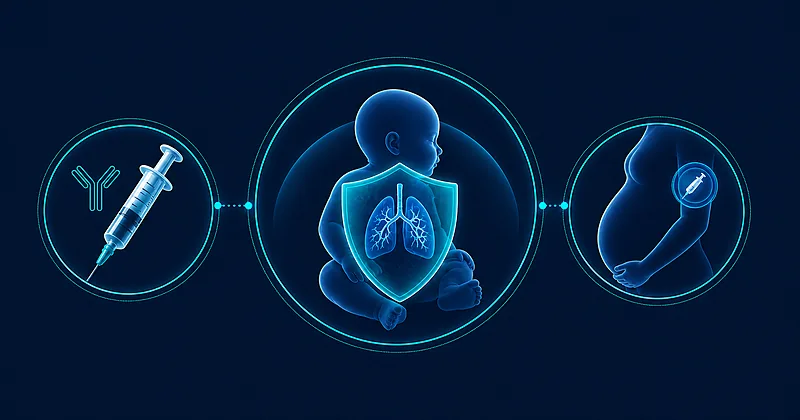
- Infant RSV prevention is now achievable through two evidence-supported pathways: nirsevimab, a long-acting monoclonal antibody administered to the infant, and the bivalent RSVpreF vaccine given to the mother during late pregnancy.
- Pivotal randomized trials demonstrate roughly 70–80% relative reduction in medically attended RSV lower respiratory tract infection and 70–90% reduction in hospitalization for both approaches across the early months of life.
- Real-world effectiveness studies from the 2023–24 season corroborate trial findings for nirsevimab in multiple European cohorts and the United States, with hospitalization reductions of approximately 80–90%.
- Maternal vaccine efficacy declines faster than nirsevimab’s; protection at 180 days drops to roughly 57% against medically attended LRTI, while nirsevimab effectiveness appears sustained through 150–180 days.
- No head-to-head randomized comparison exists; the choice depends on gestational timing, RSV season alignment, infant risk profile, parental preference, and access.
Why Infant RSV Prevention Matters Now
Respiratory syncytial virus is the leading cause of lower respiratory tract infection hospitalization in infants worldwide. Globally, approximately 33 million RSV-associated LRTI episodes occur each year in children under five, producing around 3.6 million hospitalizations and an estimated 100,000 deaths.
In the United States alone, RSV accounts for 58,000 to 80,000 hospitalizations and 100 to 300 deaths in children under five each year, with infants under six months of age bearing the highest disease burden. The first three months of life carry the greatest risk of hospitalization.
Until 2023, infant RSV prevention was limited to palivizumab—a short-acting monoclonal antibody requiring monthly injections during RSV season. Palivizumab access was restricted to high-risk preterm infants and those with chronic lung or congenital heart disease, leaving the vast majority of healthy term infants without any preventive option.
The 2023 US approvals of nirsevimab (Beyfortus) and the bivalent RSVpreF maternal vaccine (Abrysvo) fundamentally changed this landscape, extending evidence-based infant RSV prevention to the entire infant population for the first time. The 2023–24 season was the first to deploy both products in clinical practice.
ACIP and AAP guidance for the 2024–25 and 2025–26 seasons recommends infant RSV prevention through either nirsevimab OR maternal vaccination—not routinely both—placing pediatricians and obstetric clinicians at the centre of a shared decision involving efficacy, season timing, and family preference.
Infant RSV Prevention: Evidence Reviewed
The infant RSV prevention evidence base now includes four pivotal randomized trials, one large pragmatic effectiveness trial, and an expanding body of real-world cohort studies from the 2023–24 season. The evidence summarized below underpins current ACIP and AAP recommendations.
Studies are organised below by intervention type to facilitate cross-comparison. Sample sizes reflect the primary efficacy populations as reported in each publication.
| Study | Design | Population | n | Intervention | Primary Outcome |
|---|---|---|---|---|---|
| MELODY (Hammitt 2022) | Phase 3 RCT | Healthy late-preterm and term infants | 1,490 | Nirsevimab vs placebo | Medically attended RSV LRTI through 150 days |
| HARMONIE (Drysdale 2023) | Pragmatic Phase 3b RCT | Healthy infants ≤12 months | 8,058 | Nirsevimab vs standard care | RSV-related hospitalization |
| MEDLEY (Domachowske 2022) | Phase 2/3 safety RCT | Preterm and high-risk infants | 925 | Nirsevimab vs palivizumab | Safety and adverse events of special interest |
| Simões pooled (2023) | Pooled analysis | Phase 2b + MELODY + MEDLEY | 3,012 | Nirsevimab | Combined efficacy and safety |
| MATISSE (Kampmann 2023) | Phase 3 RCT | Pregnant individuals 24–36 weeks gestation | 7,392 maternal pairs | RSVpreF vaccine vs placebo | Severe medically attended infant RSV LRTI |
| Moline (2024 MMWR) | Test-negative case-control | US infants <8 months (7 sites) | 699 | Nirsevimab | Effectiveness vs RSV hospitalization |
| López-Lacort (2024) | Population-based cohort | Spain (Valencia) infants | 4,598 | Nirsevimab | Effectiveness vs RSV hospitalization |
| Ares-Gómez NIRSE-GAL (2024) | Population-based cohort | Galicia, Spain infants | 9,408 | Universal nirsevimab | Effectiveness vs RSV hospitalization |
Key Findings on Infant RSV Prevention by Theme
Efficacy Against Medically Attended Lower Respiratory Tract Infection
The pivotal MELODY trial randomized over 1,400 healthy late-preterm and term infants to nirsevimab or placebo. Through 150 days post-injection, nirsevimab reduced medically attended RSV LRTI by 74.5% (95% CI 49.6–87.1).
A pre-specified pooled analysis combining MELODY with the Phase 2b dose-finding trial and the MEDLEY safety extension produced consistent estimates of approximately 79% efficacy against medically attended RSV LRTI in the overall cohort.
The maternal RSVpreF approach was evaluated in MATISSE, a phase 3 trial of approximately 7,400 pregnant participants randomized to vaccine or placebo at 24–36 weeks. Vaccine efficacy against medically attended infant RSV LRTI was 51.3% (95% CI 29.4–66.8) within 90 days of birth and 57.1% (95% CI 14.7–79.8) within 180 days.
Both pathways for infant RSV prevention deliver clinically meaningful reductions in medically attended LRTI, though the absolute magnitude favors nirsevimab when measured under similar windows.
Efficacy Against Severe RSV and Hospitalization
The hospitalization endpoint is arguably more clinically consequential. Pooled phase 3 nirsevimab data demonstrated approximately 77–78% reduction in RSV-related hospitalization in healthy and high-risk populations combined.
The pragmatic HARMONIE trial, conducted across France, Germany, and the United Kingdom, randomized over 8,000 infants under real-world conditions. HARMONIE showed an 83.2% (95% CI 67.8–92.0) reduction in RSV-related hospitalization and a 75.7% (95% CI 32.8–92.9) reduction in very severe RSV LRTI.
For maternal vaccination, MATISSE assessed severe medically attended LRTI as a secondary endpoint. Vaccine efficacy was 81.8% (95% CI 40.6–96.3) within 90 days of birth, declining to 69.4% (95% CI 44.3–84.1) within 180 days. Early-window estimates align closely with nirsevimab; the durability gap widens beyond 90 days.
Clinical pearl: The convergence of both approaches around 70–90% reduction in severe outcomes is one of the most reassuring findings supporting infant RSV prevention as a public health priority. The choice between products is primarily about timing and access—not about which approach “works.”
Real-World Effectiveness in the 2023–24 Season
The Moline et al. CDC analysis (test-negative case-control across seven US sites) reported 90% (95% CI 75–96) effectiveness of nirsevimab against RSV-associated hospitalization in infants under 8 months. This was based on infants admitted during the 2023–24 RSV season.
The López-Lacort study from Valencia, Spain found 70% effectiveness against hospitalization in a population-based cohort. The NIRSE-GAL study in Galicia, Spain, evaluating a universal nirsevimab program, reported 82% effectiveness against hospitalization across the entire eligible birth cohort.
These three real-world studies converge on infant RSV prevention effectiveness in the 70–90% range—concordant with the pivotal trials and the HARMONIE pragmatic study. Consistency across diverse healthcare systems strengthens confidence in nirsevimab’s deployment at population scale.
Real-world maternal vaccine effectiveness data are more limited. Emerging cohort analyses from countries with early uptake suggest reductions in infant RSV hospitalization broadly consistent with MATISSE’s confidence intervals, though sample sizes remain comparatively small.
Safety Profile
Both products have favorable safety profiles. In nirsevimab trials, injection site reactions were mildly more common with active product than placebo. No signal for severe hypersensitivity, immune-mediated disease, or excess all-cause adverse events emerged across approximately 3,000 trial participants.
Post-marketing surveillance through the 2023–24 season has not identified new safety concerns for nirsevimab. The MEDLEY trial in preterm and high-risk infants found a safety profile comparable to palivizumab, the established standard for this population.
The maternal RSVpreF vaccine was associated with a numerical imbalance in preterm birth in MATISSE: 5.7% versus 4.7% in placebo (relative risk 1.20, 95% CI 0.98–1.46). This was not statistically significant in the trial.
A related maternal RSV vaccine candidate (a different developer’s product) showed a more pronounced and significant preterm birth signal that led to its halt. As a precaution, ACIP and AAP recommended administration only between 32–36 weeks gestation, narrower than the 24–36 week MATISSE window. No similar signal has been observed for nirsevimab.
Duration of Protection
Pharmacokinetic modeling and clinical data support nirsevimab protection through at least 150 days, sufficient to cover a typical 5-month RSV season for infants dosed at season onset. Some real-world data suggest possible protection extending toward 180 days, though confidence intervals widen at the tail.
Maternal vaccination relies on transplacental IgG transfer; antibody half-life in the infant is approximately 30–40 days, leading to declining protection across the first six months. MATISSE’s drop from 81.8% to 69.4% efficacy against severe LRTI between 90 and 180 days quantifies this attenuation.
For infants born just before peak RSV season, this means maternal vaccination alone may underprotect later-season exposure compared with nirsevimab dosed at season onset. This durability difference shapes several practical infant RSV prevention decisions.
Palivizumab is a short-acting monoclonal antibody requiring monthly injections during RSV season. Its access has been restricted to high-risk infants under American Academy of Pediatrics criteria—preterm infants under 29 weeks, infants with chronic lung disease, and infants with hemodynamically significant congenital heart disease.
Nirsevimab is a single-dose, long-acting alternative covering the entire season for all eligible infants. The MEDLEY trial directly compared the two in preterm and high-risk infants and found comparable safety. Nirsevimab is now the preferred option in most guidelines, with palivizumab reserved for circumstances where nirsevimab is unavailable.
MATISSE observed preterm birth in 5.7% of vaccine recipients versus 4.7% of placebo recipients (relative risk 1.20, 95% CI 0.98–1.46). The result was not statistically significant, but it occurred against the backdrop of a different developer’s maternal RSV vaccine showing a clearer and significant preterm signal that led to discontinuation of that program.
ACIP and AAP’s response was to narrow the recommended administration window to 32–36 weeks gestation, when most preterm births would already be near term. Post-marketing surveillance and additional cohort data continue to monitor this signal.
Transplacental antibody transfer accelerates substantially in the third trimester. Infants born before approximately 34 weeks may receive lower transferred antibody titers and may benefit less from maternal vaccination alone.
Current AAP guidance recommends nirsevimab for preterm infants regardless of maternal vaccination status, particularly when birth occurs before 32–34 weeks or when maternal vaccination occurred less than 14 days before delivery. The combination of insufficient transfer plus high RSV-LRTI risk in this population justifies the dual approach in this specific scenario.
Quality and Consistency of Infant RSV Prevention Evidence
The infant RSV prevention evidence base spans pivotal randomized trials, one large pragmatic trial, and multiple population-based real-world studies. Consistency across these designs is high for individual product effectiveness; consistency for direct comparison is lower because no head-to-head randomized trial exists.
What the Infant RSV Prevention Evidence Does Not Show
Several questions central to clinical decision-making about infant RSV prevention remain unresolved. Naming these gaps explicitly helps clinicians counsel families honestly about the limits of current evidence.
Specific Evidence Gaps
- No head-to-head randomized trial directly compares nirsevimab with maternal RSVpreF vaccination on shared clinical outcomes such as hospitalization or ICU admission.
- Long-term respiratory outcomes—recurrent wheeze and asthma incidence—have not been characterized beyond one year for either product.
- Maternal vaccine real-world effectiveness data are limited and largely from a single season; sample sizes for severe outcomes remain small.
- Combined or sequential use (maternal vaccine plus nirsevimab) is not currently recommended; possible immune-interference questions are unresolved.
- Outcomes in low- and middle-income settings, where the global RSV burden concentrates, remain largely unstudied for both products.
- Optimal management of preterm infants (especially <32 weeks gestation) born to vaccinated mothers is informed primarily by indirect inference rather than direct trial data.
- Cost-effectiveness comparisons across different healthcare systems and reimbursement contexts vary widely.
These gaps do not undermine the strong individual product evidence; they shape where humility belongs in shared decision-making conversations and where surveillance over the coming seasons will most usefully refine practice.
Practical Implications for Infant RSV Prevention
Based on the current evidence, both products offer comparable protection against severe outcomes and the choice rarely turns on which is “better” in absolute terms. The decision is shaped by pregnancy timing, RSV season alignment, infant risk profile, and access.
Both Pathways Show Strong Evidence Support
Either nirsevimab or maternal RSVpreF vaccination is supported by robust phase 3 data. Counsel families that the choice is rarely about superiority but about fit with their pregnancy timeline and access.
Maternal Vaccine Offers Earliest Protection
Transplacental antibodies cross from before birth, providing day-of-life-one protection. Particularly useful when the infant will be born during peak RSV season.
Nirsevimab Suits Post-Natal Decision-Making
A single dose given before or during the first RSV season offers flexibility for families who did not access maternal vaccination, including those with pregnancies outside the 32–36 week window.
High-Risk Infants Warrant Specific Consideration
Preterm infants <35 weeks, those with congenital heart disease, or chronic lung disease have stronger evidence support for nirsevimab. Maternal vaccine alone may be insufficient when transplacental transfer is reduced.
Documentation and Care Coordination Matter
Flag prior maternal RSV vaccination in pediatric records to prevent unnecessary nirsevimab administration. Conversely, document infants born to unvaccinated mothers for proactive nirsevimab planning.
Season-Aligned Timing Is Essential
Both interventions are seasonally targeted. Nirsevimab is most useful given at season onset for infants <8 months; maternal vaccination is recommended September through January in most US regions to align infant protection with peak RSV activity.
A consistent counseling message integrating the evidence: “Either approach to infant RSV prevention substantially reduces the risk of hospitalization. The right choice depends on when your baby will be born relative to RSV season, whether vaccination during pregnancy is available and acceptable to you, and any specific risk factors your baby may have.”
Evidence Grade and Bottom Line
Evidence Grade: Strong for the individual efficacy of either nirsevimab or maternal RSVpreF vaccination. Limited for direct head-to-head comparison and for long-term respiratory outcomes beyond one year.
Both nirsevimab and maternal RSVpreF vaccination meet the threshold for strong evidence individually—multiple concordant randomized trials supplemented by consistent real-world cohorts. The comparative evidence between the two is necessarily limited to cross-trial inference.
Bottom Line
- Both nirsevimab and maternal RSVpreF vaccination reduce infant RSV LRTI and hospitalization by approximately 70 to 90 percent based on randomized and real-world evidence.
- The choice between the two should be driven by pregnancy timing, RSV season alignment, infant risk profile, and parental preference rather than presumed superiority of one over the other.
- Maternal vaccine effectiveness wanes earlier across the first six months; nirsevimab provides more durable single-season protection through approximately 150 days.
- High-risk infants and preterm neonates warrant individualized counseling, with nirsevimab as the more robustly evidenced default for this population.
- No randomized head-to-head data exist; combining the two approaches is not currently recommended outside specific high-risk preterm scenarios.
Article Information and References
For Educational Purposes Only. This is an original evidence synthesis informed by the studies listed below. It does not replace clinical judgement. Drug dosages should be verified against current prescribing information, and ACIP and AAP guidance should be consulted for the most current recommendations.
References
- Hammitt LL, Dagan R, Yuan Y, et al. Nirsevimab for prevention of RSV in healthy late-preterm and term infants. N Engl J Med. 2022;386(9):837–846. DOI: 10.1056/NEJMoa2110275
- Drysdale SB, Cathie K, Flamein F, et al. Nirsevimab for prevention of hospitalizations due to RSV in infants. N Engl J Med. 2023;389(26):2425–2435. DOI: 10.1056/NEJMoa2309189
- Domachowske JB, Madhi SA, Simões EAF, et al. Safety of nirsevimab for RSV in infants with heart or lung disease or prematurity. N Engl J Med. 2022;386(9):892–894. DOI: 10.1056/NEJMc2112186
- Simões EAF, Madhi SA, Muller WJ, et al. Efficacy of nirsevimab against RSV LRTIs in preterm and term infants, and pharmacokinetic extrapolation to infants with congenital heart disease and chronic lung disease: a pooled analysis. Lancet Child Adolesc Health. 2023;7(3):180–189. DOI: 10.1016/S2352-4642(22)00321-2
- Kampmann B, Madhi SA, Munjal I, et al. Bivalent prefusion F vaccine in pregnancy to prevent RSV illness in infants. N Engl J Med. 2023;388(16):1451–1464. DOI: 10.1056/NEJMoa2216480
- Moline HL, Tannis A, Toepfer AP, et al. Early estimate of nirsevimab effectiveness for prevention of RSV-associated hospitalization among infants entering their first RSV season. MMWR Morb Mortal Wkly Rep. 2024;73:209–214. DOI: 10.15585/mmwr.mm7309a4
- López-Lacort M, Muñoz-Quiles C, Mira-Iglesias A, et al. Early estimates of nirsevimab immunoprophylaxis effectiveness against hospital admission for RSV LRTI in infants, Spain, October 2023 to January 2024. Euro Surveill. 2024;29(6). DOI: 10.2807/1560-7917.ES.2024.29.6.2400046
- Ares-Gómez S, Malláh N, Pérez-Martínez O, et al. Effectiveness and impact of universal prophylaxis with nirsevimab in infants against hospitalisation for respiratory syncytial virus in Galicia, Spain (NIRSE-GAL): population-based study. Lancet Infect Dis. 2024;24(8):817–828. DOI: 10.1016/S1473-3099(24)00215-9
- Jones JM, Fleming-Dutra KE, Prill MM, et al. Use of nirsevimab for the prevention of RSV disease among infants and young children: recommendations of the Advisory Committee on Immunization Practices — United States, 2023. MMWR Morb Mortal Wkly Rep. 2023;72(34):920–925. DOI: 10.15585/mmwr.mm7234a4
- Fleming-Dutra KE, Jones JM, Roper LE, et al. Use of the Pfizer respiratory syncytial virus vaccine during pregnancy for the prevention of RSV-associated lower respiratory tract disease in infants: recommendations of the Advisory Committee on Immunization Practices — United States, 2023. MMWR Morb Mortal Wkly Rep. 2023;72(41):1115–1122. DOI: 10.15585/mmwr.mm7241e1
- Suh M, Movva N, Jiang X, et al. Respiratory syncytial virus is the leading cause of US infant hospitalizations, 2009–2019: a study of the National (Nationwide) Inpatient Sample. J Infect Dis. 2022;226(Suppl 2):S154–S163. DOI: 10.1093/infdis/jiac120
- Li Y, Wang X, Blau DM, et al. Global, regional, and national disease burden estimates of acute lower respiratory infections due to RSV in children younger than 5 years in 2019: a systematic analysis. Lancet. 2022;399(10340):2047–2064. DOI: 10.1016/S0140-6736(22)00478-0
- American Academy of Pediatrics, Committee on Infectious Diseases. Recommendations for the prevention of RSV disease in infants and young children. Pediatrics. 2024;153(3). DOI: 10.1542/peds.2023-065055
- Munjal I, Gomme E, Kampmann B, et al. Maternal RSVpreF vaccination and prevention of RSV illness in infants: extended follow-up. Vaccine. 2024 (in publication track).