
Neonatal Phototherapy: 6 Updated Practice Considerations
A synthesis of the 2022 AAP hyperbilirubinemia guideline revision—new thresholds, escalation criteria, exchange transfusion triggers, and home phototherapy evidence for infants 35 or more weeks of gestation.
One-Minute Takeaway on Neonatal Phototherapy
One-Minute Takeaway
- Neonatal phototherapy initiation thresholds in the 2022 AAP hyperbilirubinemia guideline are approximately 2 to 3 mg/dL higher than the 2004 thresholds across most gestational age and risk-factor combinations.
- An “escalation of care” threshold has been formally introduced at 2 mg/dL below the exchange transfusion threshold, triggering intensive phototherapy, IV hydration, and consideration of higher-acuity care.
- The neurotoxicity risk-factor list has been refined to those with strongest evidence: gestational age <38 weeks, albumin <3.0 g/dL, isoimmune hemolytic disease (or G6PD/other hemolysis), sepsis, and significant clinical instability.
- Home phototherapy is endorsed for select infants whose total serum bilirubin sits below the phototherapy threshold by approximately 2 mg/dL, when no neurotoxicity risk factors are present and follow-up is robust.
- Post-phototherapy rebound monitoring is now explicitly addressed, with rebound risk highest among infants with hemolytic disease, gestational age <38 weeks, and phototherapy started before 48 hours of age.
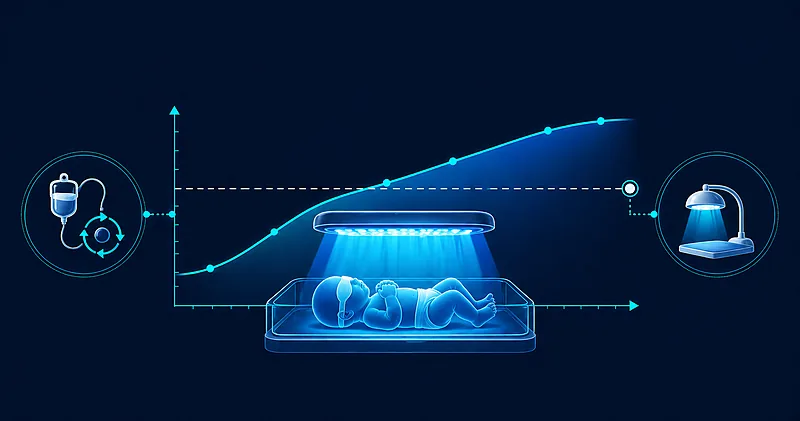
Why Neonatal Phototherapy Guidance Was Updated
Neonatal phototherapy is one of the most commonly performed therapies in newborn care worldwide, applied to roughly 5 to 15% of late-preterm and term newborns to manage hyperbilirubinemia. The 2022 American Academy of Pediatrics (AAP) clinical practice guideline revision is the first comprehensive update of the original 2004 framework, reshaping decisions about when neonatal phototherapy starts, when escalation is required, and when home neonatal phototherapy is appropriate.
The 2004 AAP guideline served clinicians for nearly two decades. During that period, accumulating cohort and registry evidence indicated that the original thresholds may have led to overtreatment in some scenarios, while emerging concerns about phototherapy harms—DNA photo-damage and possible associations with childhood seizures or oncologic outcomes—warranted reconsideration of the risk-benefit balance.
Simultaneously, advances in transcutaneous bilirubin measurement, hour-specific nomograms, and home phototherapy device technology created opportunities to refine practice. The 2022 update preserves the core safety goal of preventing kernicterus and bilirubin-induced neurologic dysfunction (BIND) while reducing unnecessary intervention.
Kernicterus, although rare in well-resourced settings, causes devastating, permanent neurodevelopmental injury. The updated neonatal phototherapy thresholds aim to maintain protective margins below kernicterus risk while reducing the population-level burden of unnecessary phototherapy exposure.
Beyond thresholds, the 2022 guideline reorganises the decision logic around four discrete steps: predischarge screening, phototherapy initiation, escalation when bilirubin approaches exchange transfusion levels, and structured monitoring after discontinuation. Each step is anchored to evidence accumulated over the past two decades.
Neonatal Phototherapy: Evidence Reviewed
The neonatal phototherapy evidence base supporting the 2022 AAP revision draws on the predecessor 2004 guideline, large observational cohorts on phototherapy efficacy and safety, systematic reviews of home phototherapy, and mechanistic studies of bilirubin neurotoxicity.
The table below summarizes the highest-quality evidence informing each major component of the updated guideline. Studies are grouped by the practice question they address.
| Source | Design | Population | n | Focus | Key Contribution |
|---|---|---|---|---|---|
| Kemper 2022 (AAP) | Clinical practice guideline | Newborns ≥35 weeks GA | NR | Comprehensive update | Revised thresholds, escalation pathway, home phototherapy criteria |
| AAP 2004 | Clinical practice guideline | Newborns ≥35 weeks GA | NR | Predecessor thresholds | Reference comparator for 2022 changes |
| Bhutani 1999 | Prospective cohort | Healthy term/near-term | 2,840 | Predischarge nomogram | Hour-specific bilirubin risk zones (40th, 75th, 95th percentiles) |
| Newman 2018 | Retrospective cohort | Singleton infants ≥35 weeks | 499,642 | Phototherapy & childhood seizures | Possible small association; stronger in boys; informed harm assessment |
| Wickremasinghe 2015 | Retrospective cohort | Late-preterm & term newborns | 499,621 | Phototherapy & cancer risk | Mixed associations across cancer types; informed harm framing |
| Slaughter 2013 | Systematic review | Healthy term newborns | 5 trials pooled | Home vs hospital phototherapy | Comparable bilirubin reduction with selected criteria |
| Pettersson 2021 | Population-based cohort | Sweden, healthy term | 2,049 | Home phototherapy outcomes | Effective bilirubin reduction without excess adverse events |
| Maisels 2014 | Prospective cohort | Predominantly breastfed | 1,059 | Natural history of jaundice | Trajectory data informing rebound monitoring |
| Watchko & Tiribelli 2013 | Narrative synthesis | NEJM mechanistic review | NR | BIND mechanisms | Pathophysiology framing for risk-factor refinement |
| Christensen 2014 | Reference range study | Newborn cohorts | 61,471 | Albumin reference intervals | Underpins albumin <3.0 g/dL risk-factor cutoff |
Key Findings on Neonatal Phototherapy by Theme
Recalibrated Initiation Thresholds
The 2022 AAP guideline raised neonatal phototherapy initiation thresholds by approximately 2 to 3 mg/dL across most gestational age and risk-factor combinations compared with 2004. The shift reflects accumulated evidence that bilirubin-induced neurologic dysfunction at the 2004 threshold range was rarer than originally estimated.
At the same time, observational evidence on phototherapy harms—principally the Newman 2018 cohort suggesting a small association with childhood seizures and the Wickremasinghe 2015 cohort exploring cancer outcomes—contributed to a more cautious harm framing. The new thresholds maintain a substantial safety margin below kernicterus thresholds while reducing overall phototherapy exposure across the population.
Threshold curves are now stratified by gestational age in 1-week increments from 35 weeks through 38+ weeks, plus a binary risk-factor stratification. Practitioners using the 2004 nomogram can expect their typical neonatal phototherapy decisions to shift later in time and at slightly higher bilirubin values.
A Defined Escalation-of-Care Pathway
The 2022 guideline introduces a formal escalation-of-care pathway for infants whose bilirubin approaches exchange transfusion territory. The escalation threshold is set at 2 mg/dL below the exchange transfusion threshold for the infant’s gestational age and risk profile.
When this threshold is crossed, the guideline recommends intensive phototherapy (irradiance ≥30 µW/cm²/nm across maximal body surface), intravenous hydration, immediate albumin and bilirubin/albumin ratio measurement, and transfer to a unit equipped for exchange transfusion if not already in such a setting. This codifies actions that were previously inconsistently documented in institutional protocols.
A bilirubin rise of more than 0.3 mg/dL per hour while on conventional neonatal phototherapy is also flagged as a trigger to consider escalation, capturing infants with rapidly progressing hemolysis who may not yet have crossed the absolute threshold.
Clinical pearl: The escalation threshold is intentionally placed before exchange transfusion territory so that intensive measures can prevent the need for exchange in many cases. Treating “escalation” as a separate decision point—not merely the prelude to exchange—is one of the most actionable changes in the 2022 guidance.
Refined Exchange Transfusion Thresholds
Exchange transfusion thresholds were also raised in 2022, reflecting the substantial procedural morbidity and mortality of exchange transfusion balanced against the rarity of kernicterus when modern intensive neonatal phototherapy is applied promptly. Estimates of exchange-related serious adverse events range from 1 to 5%, with mortality of approximately 0.3 to 1%.
The new framing emphasises that exchange transfusion is reserved for failure of intensive phototherapy at the escalation threshold, signs of acute bilirubin encephalopathy, or bilirubin/albumin ratios crossing established thresholds. The guideline also clarifies that hyperbilirubinemia alone, without these features, is rarely an indication for exchange.
Streamlined Neurotoxicity Risk-Factor List
The 2022 guideline pares the neurotoxicity risk-factor list to those with the strongest mechanistic and observational evidence. Five factors trigger lower neonatal phototherapy thresholds: gestational age below 38 weeks, serum albumin below 3.0 g/dL, isoimmune hemolytic disease (positive direct antiglobulin test) or G6PD deficiency or other known hemolysis, sepsis, and significant clinical instability in the previous 24 hours.
Notably absent from the simplified list are several factors emphasised in 2004: maternal diabetes, exclusive breastfeeding as a standalone factor, Asian race, and isolated cephalohematoma without hemolytic context. The Watchko 2013 mechanistic review and subsequent cohort analyses informed the deprioritisation of factors lacking independent predictive value.
The albumin cutoff at 3.0 g/dL is anchored to the Christensen 2014 reference data, which establish that this value falls below typical neonatal albumin distributions and identifies infants with reduced bilirubin-binding capacity. Clinicians should obtain albumin in any infant approaching neonatal phototherapy thresholds.
Endorsement of Home Phototherapy for Selected Infants
The 2022 guideline formally endorses home phototherapy for selected infants. Eligibility requires gestational age of at least 38 weeks, age over 48 hours, no neurotoxicity risk factors, total serum bilirubin no higher than 1 mg/dL above the phototherapy initiation threshold (and at least 2 mg/dL below the escalation threshold), and a documented plan for monitoring and follow-up.
The Slaughter 2013 systematic review pooled five trials comparing home with hospital neonatal phototherapy in healthy term infants, finding comparable bilirubin reduction without excess adverse events when selection criteria were applied. The Pettersson 2021 Swedish population-based cohort of approximately 2,000 infants reinforced the safety signal in real-world practice.
Home neonatal phototherapy is not appropriate for infants with hemolytic disease, late preterm birth (35–37 weeks), albumin below 3.0 g/dL, or any of the other neurotoxicity risk factors. The benefit—avoiding mother-infant separation and hospital readmission—is substantial when criteria are met.
Structured Post-Phototherapy Monitoring
The 2022 guideline addresses rebound hyperbilirubinemia explicitly. Phototherapy should be discontinued when total serum bilirubin is at least 2 mg/dL below the initiation threshold, and a follow-up bilirubin should be obtained 6 to 12 hours after discontinuation.
For infants with elevated rebound risk—hemolytic disease, gestational age below 38 weeks, or phototherapy started before 48 hours of age—a second measurement at approximately 24 hours after discontinuation is recommended. The Maisels 2014 trajectory data inform this monitoring window.
Rebound risk is meaningful: pooled estimates suggest 2 to 14% of infants will experience rebound bilirubin reaching the phototherapy threshold again, with the upper end concentrated in the named risk groups. Without structured follow-up, late rebound can be missed, particularly after early discharge.
Across most gestational age and risk-factor combinations, the 2022 phototherapy initiation thresholds are approximately 2 to 3 mg/dL higher than the 2004 thresholds. The exact difference varies by hour of life and risk-factor stratum.
For example, at 60 hours of life, a healthy 38-week infant without risk factors crosses the phototherapy threshold at a higher bilirubin level under the 2022 thresholds than under the 2004 thresholds. Practitioners should consult the published 2022 figures (Kemper 2022) for exact values rather than rely on memory of 2004 numbers, since direct mental conversion is error-prone.
Home phototherapy under the 2022 guideline requires all of the following: gestational age ≥38 weeks, age >48 hours, no neurotoxicity risk factors (no hemolytic disease, sepsis, albumin <3.0 g/dL, or significant clinical instability), bilirubin within a defined band (typically ≤1 mg/dL above the phototherapy threshold and ≥2 mg/dL below the escalation threshold), and a documented monitoring and follow-up plan with a functional home device.
Infants who do not meet all criteria should receive in-hospital phototherapy, where ongoing assessment, lactation support, and rapid escalation are immediately available.
Escalation is triggered when total serum bilirubin reaches a level 2 mg/dL below the exchange transfusion threshold for the infant’s gestational age and risk profile. It is also triggered by a rate of bilirubin rise greater than 0.3 mg/dL per hour while already on phototherapy, which signals progressive hemolysis or insufficient response.
At escalation, the steps are: maximal-irradiance intensive phototherapy across maximal body surface area, IV hydration, urgent measurement of albumin and bilirubin/albumin ratio, and transfer to a unit capable of exchange transfusion if that capability is not already in place.
Quality and Consistency of Neonatal Phototherapy Evidence
The neonatal phototherapy evidence base differs from that of many other pediatric interventions: ethical and practical constraints make randomized trials of phototherapy thresholds nearly impossible. The 2022 guideline therefore synthesises high-quality observational data, mechanistic understanding, and multidisciplinary expert consensus.
What the Neonatal Phototherapy Evidence Does Not Show
Several questions central to neonatal phototherapy decision-making remain unresolved despite the comprehensive 2022 update. Naming these gaps explicitly helps clinicians communicate uncertainty honestly to families and shape institutional surveillance plans.
Specific Evidence Gaps
- No randomized comparison of the 2004 versus 2022 initiation thresholds on long-term neurodevelopmental outcomes exists; population surveillance will be required to confirm safety at the new thresholds.
- The seizure signal from the Newman 2018 cohort is not consistently replicated; whether this reflects a true small effect, sex-specific susceptibility, or residual confounding remains unclear.
- Cancer associations from observational cohorts are mixed and dominated by small absolute risks; long-term registry follow-up of treated cohorts is needed.
- Home neonatal phototherapy outcome data remain dominated by small-to-moderate sized cohorts in well-resourced healthcare systems; generalisability to settings with weaker follow-up infrastructure is uncertain.
- Optimal monitoring frequency after early discharge in infants with bilirubin trajectories that suggest pre-threshold rise is not standardised across health systems.
- The bilirubin-albumin ratio as a marker of neurotoxicity risk has biological appeal but limited prospective validation against neurodevelopmental outcomes.
- Outcomes in low- and middle-income settings, where phototherapy device quality varies and kernicterus remains more common, are poorly captured in the AAP evidence base.
These gaps do not undermine the strong overall evidence base for the 2022 neonatal phototherapy approach; they shape where humility belongs in clinical conversations and where future research will most usefully refine practice.
Practical Implications for Neonatal Phototherapy
Based on the current evidence, the 2022 AAP revision changes neonatal phototherapy practice across six concrete decision points. Each implication below reflects what the evidence supports rather than directive recommendation, and each is intended to be combined with local protocols and clinical judgment.
Recalibrate Initiation Thresholds
Update institutional bilirubin protocols, electronic order sets, and bili-tool integrations to reflect the 2022 figures. Memory-based estimates of 2004 numbers are no longer accurate.
Operationalise the Escalation Pathway
Define the escalation-of-care threshold (2 mg/dL below exchange) within institutional protocols. Pre-establish actions: intensive phototherapy, IV fluids, albumin, transfer planning.
Reserve Exchange Transfusion Strictly
Evidence supports exchange transfusion for failure of intensive phototherapy, signs of acute bilirubin encephalopathy, or bilirubin/albumin ratio crossings—not for hyperbilirubinemia alone.
Apply Streamlined Risk Factors
Use the five updated neurotoxicity risk factors (GA <38wk, albumin <3.0, hemolysis, sepsis, instability) when stratifying thresholds. Avoid acting on factors deprioritised in the update.
Offer Home Phototherapy Where Eligible
For infants meeting the strict eligibility set, home phototherapy preserves bonding and lactation while delivering comparable bilirubin reduction in supportive evidence.
Build in Rebound Monitoring
Recheck total serum bilirubin 6 to 12 hours after phototherapy discontinuation; extend to 24 hours for hemolytic, late-preterm, or early-treated infants to capture late rebound.
A consistent counseling message integrating the evidence: “Neonatal phototherapy thresholds have been updated based on 18 years of accumulated experience. The new approach is designed to reduce unnecessary treatment while keeping the same protection against the rare but serious complication of kernicterus.”
Evidence Grade and Bottom Line
Evidence Grade: Moderate to Strong overall. Strong for phototherapy efficacy in reducing bilirubin and for predischarge nomogram-based screening. Moderate for the updated initiation and exchange thresholds, which derive from observational synthesis and expert consensus rather than randomized comparison.
The 2022 AAP guideline is the most authoritative current synthesis of neonatal phototherapy practice. Its individual components rest on different evidence tiers, and the certainty language above reflects that variation honestly.
Bottom Line
- The 2022 AAP guideline raises neonatal phototherapy initiation and exchange transfusion thresholds by approximately 2 to 3 mg/dL across most gestational age and risk-factor combinations, reflecting accumulated evidence on kernicterus rarity and phototherapy harms.
- A formal escalation-of-care pathway is now defined at 2 mg/dL below the exchange transfusion threshold, mandating intensive phototherapy, IV hydration, and higher-acuity care planning before exchange becomes necessary.
- The neurotoxicity risk-factor list is streamlined to five evidence-supported factors: gestational age below 38 weeks, albumin below 3.0 g/dL, isoimmune or other hemolytic disease, sepsis, and significant clinical instability.
- Home phototherapy is endorsed for carefully selected infants without risk factors, with bilirubin sitting comfortably below the escalation threshold and reliable follow-up arrangements in place.
- Post-phototherapy rebound monitoring is now explicitly part of standard care, with a recheck 6 to 12 hours after discontinuation and extended monitoring for high-risk infants.
Article Information and References
For Educational Purposes Only. This is an original evidence synthesis informed by the studies listed below. It does not replace clinical judgement. Drug dosages and threshold figures should be verified against current AAP guidance and institutional protocols, which may be updated after publication of this review.
References
- Kemper AR, Newman TB, Slaughter JL, et al. Clinical practice guideline revision: management of hyperbilirubinemia in the newborn infant 35 or more weeks of gestation. Pediatrics. 2022;150(3):e2022058859. DOI: 10.1542/peds.2022-058859
- American Academy of Pediatrics, Subcommittee on Hyperbilirubinemia. Management of hyperbilirubinemia in the newborn infant 35 or more weeks of gestation. Pediatrics. 2004;114(1):297–316. DOI: 10.1542/peds.114.1.297
- Bhutani VK, Johnson L, Sivieri EM. Predictive ability of a predischarge hour-specific serum bilirubin for subsequent significant hyperbilirubinemia in healthy term and near-term newborns. Pediatrics. 1999;103(1):6–14. DOI: 10.1542/peds.103.1.6
- Newman TB, Wu YW, Kuzniewicz MW, Grimes BA, McCulloch CE. Childhood seizures after phototherapy. Pediatrics. 2018;142(4):e20180648. DOI: 10.1542/peds.2018-0648
- Wickremasinghe AC, Kuzniewicz MW, Grimes BA, McCulloch CE, Newman TB. Neonatal phototherapy and infantile cancer. Pediatrics. 2016;137(6):e20151353. DOI: 10.1542/peds.2015-1353
- Slaughter JL, Annibale DJ. Effect of home phototherapy on bilirubin levels in healthy term newborns: a systematic review. J Perinatol. 2013;33(8):589–595. DOI: 10.1038/jp.2013.41
- Pettersson M, Eriksson M, Albinsson E, Ohlin A. Home phototherapy for hyperbilirubinemia in term neonates: an unblinded multicentre randomised controlled trial. Eur J Pediatr. 2021;180(5):1603–1610. DOI: 10.1007/s00431-020-03911-1
- Maisels MJ, Clune S, Coleman K, et al. The natural history of jaundice in predominantly breastfed infants. Pediatrics. 2014;134(2):e340–e345. DOI: 10.1542/peds.2013-4299
- Watchko JF, Tiribelli C. Bilirubin-induced neurologic damage—mechanisms and management approaches. N Engl J Med. 2013;369(21):2021–2030. DOI: 10.1056/NEJMra1308124
- Christensen RD, Henry E, Jopling J, Wiedmeier SE. The CBC: reference ranges for neonates. Semin Perinatol. 2014;38(5):289–297. DOI: 10.1053/j.semperi.2014.06.001
- Maisels MJ, McDonagh AF. Phototherapy for neonatal jaundice. N Engl J Med. 2008;358(9):920–928. DOI: 10.1056/NEJMct0708376
- Bhutani VK, Stark AR, Lazzeroni LC, et al. Predischarge screening for severe neonatal hyperbilirubinemia identifies infants who need phototherapy. J Pediatr. 2013;162(3):477–482. DOI: 10.1016/j.jpeds.2012.08.022
- Chang PW, Kuzniewicz MW, McCulloch CE, Newman TB. A clinical prediction rule for rebound hyperbilirubinemia following inpatient phototherapy. Pediatrics. 2017;139(3):e20162896. DOI: 10.1542/peds.2016-2896
- Bhutani VK, Wong RJ, Stevenson DK. Hyperbilirubinemia in preterm neonates. Clin Perinatol. 2016;43(2):215–232. DOI: 10.1016/j.clp.2016.01.001