
Pediatric Anaphylaxis: Critical Findings in 4 Subgroups
Weight-based epinephrine dosing across pediatric subgroups, intranasal epinephrine (Neffy) candidacy, biphasic reaction monitoring, and the 2023 Joint Task Force Practice Parameter update.
One-Minute Takeaway on Pediatric Anaphylaxis
One-Minute Takeaway
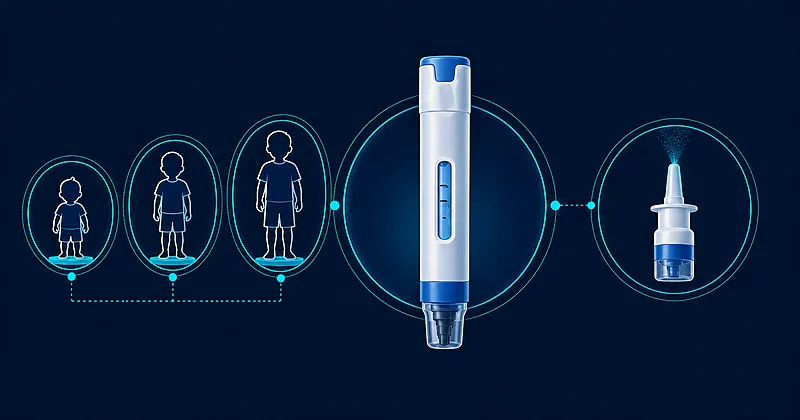
- Pediatric anaphylaxis epinephrine practice is organised around four clinical subgroups: infants under 15 kg (0.1 mg auto-injector or off-label use), children 15–30 kg (0.15 mg), children and adolescents at or above 30 kg (0.3 mg), and candidates for intranasal epinephrine.
- The Auvi-Q 0.1 mg auto-injector closes a long-standing gap for infants 7.5–15 kg; below 7.5 kg there is no FDA-approved auto-injector and clinicians weigh the risks of potential mild overdosing against the much greater risk of failing to give epinephrine.
- Intranasal epinephrine (Neffy) was approved in August 2024 for patients weighing 30 kg or more, based on pharmacokinetic bridging to intramuscular 0.3 mg; clinical outcome data are still emerging.
- Biphasic reactions occur in approximately 5% of anaphylaxis cases, mostly within 8–12 hours; the 2023 Joint Task Force Practice Parameter shifted from a universal 4-hour observation rule to risk-stratified observation based on initial severity and treatment intensity.
- Epinephrine remains the only first-line treatment for pediatric anaphylaxis; antihistamines and corticosteroids do not prevent biphasic reactions and are not substitutes for prompt epinephrine administration.
Why Pediatric Anaphylaxis Practice Has Changed
Pediatric anaphylaxis is among the most time-critical clinical emergencies. Every minute of delay in epinephrine administration increases morbidity and mortality risk, and underuse of epinephrine remains the single most consistent finding in audits of pediatric emergency department care.
Despite four decades of consensus that intramuscular epinephrine is the first-line treatment, pediatric anaphylaxis practice has long carried unresolved questions: which auto-injector dose for which child, what to do for infants too small for available products, how long to observe for biphasic reactions, and when and how to deploy newer non-injectable options.
The past decade brought several substantive changes. The 2017 approval of the Auvi-Q 0.1 mg auto-injector closed a gap for infants between 7.5 and 15 kg. The 2023 Joint Task Force Practice Parameter on anaphylaxis introduced GRADE-based, risk-stratified observation. The 2024 approval of intranasal epinephrine (Neffy) introduced the first non-injectable rescue option in over 100 years.
These developments together change how pediatric anaphylaxis is taught, prescribed, and monitored. They also require pediatricians and emergency clinicians to maintain current knowledge of weight-based product selection, evolving observation guidance, and the rapidly changing landscape of non-injectable options.
This review synthesises the evidence underpinning each of these decision points, organised around the four clinical subgroups that pediatric anaphylaxis practice now encounters in daily care.
Pediatric Anaphylaxis: Evidence Reviewed
The pediatric anaphylaxis evidence base draws on the 2023 Joint Task Force Practice Parameter, several systematic reviews of biphasic reactions, observational cohort data on auto-injector use, pharmacokinetic studies underpinning the Neffy approval, and registry data on pediatric anaphylaxis epidemiology.
The table below summarizes the highest-quality sources informing each major component of current pediatric anaphylaxis practice. Sources are grouped by the practice question they address.
| Source | Design | Population/Topic | n | Focus | Key Contribution |
|---|---|---|---|---|---|
| Shaker 2023 (JTFPP) | GRADE-based practice parameter | Anaphylaxis in all ages | NR | Comprehensive update | Risk-stratified observation; epinephrine as sole first-line agent |
| Lee 2015 | Systematic review & meta-analysis | Biphasic anaphylaxis cases | 27 studies pooled | Biphasic incidence and timing | Pooled incidence ~5%, mostly within 8–12 hours |
| Sicherer 2017 (AAP) | AAP Clinical Report | Pediatric anaphylaxis | NR | Pediatric-specific recommendations | Foundational pediatric guidance; weight-based dosing rationale |
| Dribin 2024 (Lancet) | Narrative review & consensus | Anaphylaxis | NR | Updates including intranasal epinephrine | Synthesis of post-2023 developments |
| Tanner 2023 (Neffy PK) | PK bridging studies | Adults & children ≥30 kg | ~440 across studies | Intranasal epinephrine PK | Comparable Cmax/AUC to IM 0.3 mg supporting approval |
| Brown 2018 | Retrospective cohort | Pediatric ED anaphylaxis | ~6,000 visits | Epinephrine underuse | Documents persistent gap in prehospital and ED administration |
| Gabrielli 2019 | Multicenter cohort | Pediatric ED anaphylaxis | 3,498 | Auto-injector use patterns | Real-world weight-based dosing and second-dose rates |
| Sussman 2024 (ARS-1) | PK/PD challenge study | Adult volunteers | ~70 | Intranasal epinephrine response | Hemodynamic and PK profile underpinning Neffy use |
Key Findings on Pediatric Anaphylaxis by Subgroup
Subgroup 1 — Infants and Very Small Children (Under 15 kg)
Historically, the smallest available auto-injector dose was 0.15 mg, which exceeds the standard 0.01 mg/kg pediatric anaphylaxis dose for infants under 7.5 kg and is at the upper end for those between 7.5 and 15 kg. The 2017 FDA approval of the Auvi-Q 0.1 mg auto-injector for the 7.5–15 kg weight band substantially closed this gap.
Below 7.5 kg, no FDA-approved auto-injector exists. Clinicians weigh the relatively small risks of mild epinephrine overdosing (transient tachycardia, pallor, tremor) against the much greater risk of failing to administer epinephrine in pediatric anaphylaxis. The practical consensus in most guidelines is that prescribing the 0.15 mg auto-injector remains reasonable when no smaller option is accessible.
For very young infants in supervised medical settings, manually drawn 0.01 mg/kg of 1 mg/mL epinephrine via syringe remains an acceptable approach. In ambulatory practice, the trade-off favors having an auto-injector that may slightly over-dose over having no rescue option at all.
Subgroup 2 — Children 15–30 kg: The 0.15 mg Standard
This is the largest pediatric anaphylaxis cohort by patient count. Multiple 0.15 mg auto-injector products are FDA-approved: EpiPen Jr, Auvi-Q 0.15 mg, Adrenaclick 0.15 mg, and authorized generics. All deliver 0.15 mg of epinephrine intramuscularly via a fixed-needle device.
Costs vary substantially across products and across insurance plans. Authorized generic versions of EpiPen Jr and Adrenaclick are typically less expensive than brand-name products. Many guidelines recommend prescribing two devices given the risk of needing a second dose (15–20% of anaphylaxis cases).
Needle length is approximately 12–13 mm in pediatric devices; this generally reaches the vastus lateralis muscle in children of typical body composition. In children with substantial subcutaneous adiposity at the anterolateral mid-thigh, intramuscular delivery may not be assured, though practical alternatives in the field are limited.
Subgroup 3 — Children and Adolescents at or above 30 kg: The 0.3 mg Adult Dose
At 30 kg and above, pediatric anaphylaxis epinephrine dosing converges with adult practice. Auto-injector options include EpiPen, Auvi-Q 0.3 mg, Adrenaclick 0.3 mg, and authorized generics, all delivering 0.3 mg intramuscularly.
The transition point from the 0.15 mg to the 0.3 mg auto-injector is conventionally set at 25–30 kg, with practical variability across institutions. The 0.01 mg/kg target gives 0.25 mg at 25 kg and 0.30 mg at 30 kg, so either device is defensible in this overlap range.
Adolescents who carry but underuse epinephrine remain a recognised safety concern. Drivers include device stigma, perceived non-severity of past reactions, and inadequate device-handling instruction. Counseling and refresher training improve appropriate use and reduce the gap between prescribed devices and actual administration.
Obese adolescents pose a specific concern: standard auto-injector needles (approximately 16 mm in adult devices, 22 mm for legacy EpiPen) may be insufficient to reach muscle in some patients. There is no widely available auto-injector with longer needles, so practical options remain limited and require individualized counseling.
Subgroup 4 — Candidates for Intranasal Epinephrine (Neffy)
The August 2024 FDA approval of Neffy (intranasal epinephrine) introduced the first non-injectable rescue option for anaphylaxis. Initial labeling covered patients weighing 30 kg or more, including pediatric use within that weight range. The dose is delivered as a single 2 mg spray into one nostril.
Approval was based on pharmacokinetic and pharmacodynamic bridging to intramuscular 0.3 mg epinephrine. PK studies showed comparable Cmax and AUC, with hemodynamic responses tracking those of IM administration. No large clinical efficacy outcomes trial in actual anaphylaxis was conducted, given the ethical and logistical barriers to such a study.
Practical advantages include needle-free administration (potentially improving uptake among needle-averse adolescents), simpler training, and reduced injection-related anxiety. Limitations include limited real-world performance data, untested behavior in severe hypotensive shock, and possible reduced absorption when the patient has substantial nasal congestion or active nasal pathology.
Within pediatric anaphylaxis practice, Neffy is currently most appropriate for adolescents weighing 30 kg or more who reliably refuse or fail to use auto-injectors, or as a supplement when needle access is limited. Lower-weight pediatric expansion is under regulatory study.
Cross-Cutting: Biphasic Reactions and Risk-Stratified Observation
Biphasic reactions—recurrent anaphylaxis symptoms after apparent resolution—occur in approximately 5% of pediatric anaphylaxis cases, with literature ranges of 1–20% depending on definitions. Most biphasic reactions occur within 8–12 hours of the initial event, though delayed reactions up to 72 hours are documented.
The 2023 Joint Task Force Practice Parameter shifted away from the universal 4-hour observation rule. Risk stratification now drives observation duration: high-risk features include severe initial reaction, more than one epinephrine dose required, persistent symptoms despite treatment, prior history of biphasic reactions, and unclear trigger or allergen avoidance.
Lower-risk patients with prompt response to a single dose and resolved symptoms may be discharged after a brief observation. Higher-risk patients warrant longer observation, typically several hours, with the duration tailored to the clinical picture rather than a universal time threshold.
Clinical pearl: Antihistamines and corticosteroids have not been shown to prevent biphasic reactions and are not substitutes for epinephrine. The Lee 2015 meta-analysis and subsequent systematic reviews have consistently failed to show a preventive benefit. Their role in pediatric anaphylaxis is adjunctive, addressing pruritus or persistent skin findings rather than treating airway, circulatory, or systemic features.
Pharmacokinetic bridging studies showed comparable Cmax and AUC for Neffy 2 mg intranasal versus EpiPen 0.3 mg intramuscular, supporting FDA approval based on PK/PD evidence rather than clinical outcomes. Hemodynamic responses were similar between routes in healthy volunteer studies.
Real-world performance in actual anaphylaxis episodes is still being characterized. Anticipated benefits include needle-free use for needle-averse adolescents, simpler training, and possible improved adherence to carrying-and-using behavior. Anticipated limitations include uncertain absorption with nasal pathology and limited data in severe hypotensive shock. Most current guidance treats Neffy as an alternative or supplement to auto-injectors rather than a replacement.
The 2023 Joint Task Force Practice Parameter moved away from a universal 4-hour observation period after pediatric anaphylaxis. Instead, observation is risk-stratified based on initial severity, treatment intensity, and clinical trajectory.
High-risk features warranting longer observation include severe initial reaction (hypotension, hypoxia, mental status changes), need for more than one epinephrine dose, persistent symptoms despite treatment, prior biphasic history, and unclear or unavoidable trigger. Lower-risk patients with prompt response and resolved symptoms may be discharged after briefer observation. Specific durations are individualized; the parameter offers a framework rather than fixed time cutoffs.
The conventional transition point is 25–30 kg. The 0.01 mg/kg target gives 0.25 mg at 25 kg (closer to the 0.3 mg device) and 0.30 mg at 30 kg (exact match). Either device is defensible in this overlap range.
Practice variation exists: some institutions transition at 25 kg to ensure adequate dose for the upper end of weight, others wait until 30 kg to align with the FDA-labeled weight threshold for the adult device. Documentation of weight-based rationale and reassessment as the child grows is the most important practice point.
Quality and Consistency of Pediatric Anaphylaxis Evidence
The pediatric anaphylaxis evidence base differs from many other pediatric domains: ethical and practical constraints make randomized trials of life-threatening anaphylaxis interventions essentially impossible. The current evidence relies on observational cohorts, registry data, pharmacokinetic studies, and structured expert consensus through GRADE methodology.
What the Pediatric Anaphylaxis Evidence Does Not Show
Several questions central to pediatric anaphylaxis decision-making remain unresolved. Naming these gaps explicitly helps clinicians counsel families honestly about the limits of current knowledge and shape institutional protocols thoughtfully.
Specific Evidence Gaps
- No randomized trial compares specific observation durations after anaphylaxis; the 2023 JTFPP risk-stratified approach rests on consensus framework rather than prospective comparative data.
- Intranasal epinephrine clinical efficacy in actual anaphylaxis episodes—particularly in shock with poor mucosal perfusion—has not been directly demonstrated.
- Optimal device for infants below 7.5 kg is not established; no FDA-approved auto-injector covers this weight range.
- Adolescent device adherence interventions have small effect sizes; the gap between prescribed and actually used auto-injectors remains substantial.
- Auto-injector performance in obese adolescents with substantial subcutaneous tissue is not adequately characterized; needle length adequacy varies.
- The relative efficacy of two simultaneous epinephrine doses versus repeat dosing after an interval is not established; current practice favors a second dose at 5–15 minutes if symptoms persist.
- Long-term follow-up data on biphasic reaction predictors are limited to retrospective cohorts; predictive modeling has not been prospectively validated.
- Equity dimensions of auto-injector access, cost, and prescription patterns are documented but interventions to close gaps remain understudied.
These gaps do not undermine the strong overall framework for managing pediatric anaphylaxis; they shape where humility belongs in shared decision-making and where ongoing surveillance and registry data will most usefully inform practice.
Practical Implications for Pediatric Anaphylaxis
Based on the current evidence, pediatric anaphylaxis management can be operationalized through six implementation considerations. Each reflects what the evidence supports rather than directive prescription, and each is intended to be combined with local protocols and clinical judgment.
Match Auto-Injector Dose to Weight
Use the 0.1 mg device for 7.5–15 kg, the 0.15 mg device for 15–30 kg, and the 0.3 mg device for at or above 30 kg. Reassess as the child grows.
Address the Infant Gap Pragmatically
For infants below 7.5 kg, the risks of mild over-dosing with a 0.15 mg device are far smaller than the risks of withholding epinephrine in pediatric anaphylaxis.
Apply Risk-Stratified Observation
Move beyond the universal 4-hour rule. Use the 2023 JTFPP risk features to tailor observation duration to severity, treatment intensity, and clinical trajectory.
Counsel on Biphasic Risk Honestly
Tell families about the ~5% biphasic risk and the value of a second epinephrine dose if symptoms recur. Antihistamines and steroids do not substitute for epinephrine.
Consider Intranasal for Selected Adolescents
Neffy can support adolescents at or above 30 kg who refuse or routinely fail to use auto-injectors. Treat as an alternative or supplement, not yet a routine replacement.
Update Emergency Action Plans
Provide a written, weight-specific anaphylaxis action plan, train caregivers on actual device use, and prescribe two devices per setting given the second-dose rate.
A consistent counseling message integrating the evidence: “If you suspect anaphylaxis, give epinephrine immediately and call emergency services. Do not wait for symptoms to worsen or rely on antihistamines. A second dose is appropriate if symptoms persist after 5 to 15 minutes.”
Evidence Grade and Bottom Line
Evidence Grade: Strong for intramuscular epinephrine as first-line treatment, weight-based dosing, and the inadequacy of antihistamines or steroids as substitutes. Moderate for risk-stratified observation periods and intranasal epinephrine bioequivalence. Limited for clinical outcomes with intranasal epinephrine and for infants below 7.5 kg.
The pediatric anaphylaxis evidence base meets the threshold for strong evidence in its core elements while acknowledging that the most innovative components—intranasal epinephrine and risk-stratified observation—rest on bridging studies and structured consensus rather than randomized comparative data.
Bottom Line
- Intramuscular epinephrine at 0.01 mg per kilogram remains the first-line treatment for pediatric anaphylaxis across all weight subgroups, with auto-injector device selection driven by weight bands of under 15, 15 to 30, and at or above 30 kilograms.
- The 0.1 mg auto-injector closes the long-standing gap for infants between 7.5 and 15 kilograms; for those below 7.5 kilograms, the 0.15 mg device is the pragmatic choice when no smaller option is available.
- Intranasal epinephrine (Neffy), approved in 2024 for patients at or above 30 kilograms, provides an alternative needle-free route based on pharmacokinetic bridging; clinical outcome data in actual anaphylaxis are emerging.
- The 2023 Joint Task Force Practice Parameter replaces the universal four-hour observation rule with risk-stratified observation based on severity, treatment intensity, and clinical trajectory.
- Antihistamines and corticosteroids do not prevent biphasic reactions and do not substitute for epinephrine; their role is adjunctive for cutaneous symptoms only.
Article Information and References
For Educational Purposes Only. This is an original evidence synthesis informed by the studies listed below. It does not replace clinical judgement. Drug dosages and device specifications should be verified against current prescribing information, which may be updated after publication of this review.
References
- Shaker MS, Wallace DV, Golden DBK, et al. Anaphylaxis—a 2023 practice parameter update. Ann Allergy Asthma Immunol. 2023;132(2):124–176. DOI: 10.1016/j.anai.2023.09.015
- Lee S, Bellolio MF, Hess EP, Erwin P, Murad MH, Campbell RL. Time of onset and predictors of biphasic anaphylactic reactions: a systematic review and meta-analysis. J Allergy Clin Immunol Pract. 2015;3(3):408–416. DOI: 10.1016/j.jaip.2014.12.010
- Sicherer SH, Simons FER; Section on Allergy and Immunology. Epinephrine for first-aid management of anaphylaxis. Pediatrics. 2017;139(3):e20164006. DOI: 10.1542/peds.2016-4006
- Dribin TE, Schnadower D, Wang J, et al. Anaphylaxis: emerging issues and management updates. Lancet. 2024;403(10437):1715–1726. DOI: 10.1016/S0140-6736(24)00477-7
- Tanimoto S, Lobo K, Tanner H, et al. Pharmacokinetics and pharmacodynamics of epinephrine intranasal spray (ARS-1, neffy) in adults. J Allergy Clin Immunol Pract. 2024;12(2):394–403. DOI: 10.1016/j.jaip.2023.10.024
- Brown JC, Tuuri RE, Akhter S, et al. Lacerations and embedded needles caused by epinephrine autoinjector use in children. Ann Emerg Med. 2016;67(3):307–315. DOI: 10.1016/j.annemergmed.2015.07.011
- Gabrielli S, Clarke A, Morris J, et al. Evaluation of prehospital management in a Canadian emergency department anaphylaxis cohort. J Allergy Clin Immunol Pract. 2019;7(7):2232–2238. DOI: 10.1016/j.jaip.2019.04.018
- Sussman G, Tanner H, Lebowitz J, et al. Pharmacokinetics, pharmacodynamics, and safety of epinephrine intranasal spray during episodic nasal allergen challenge: results of a randomized, four-period crossover study. Ann Allergy Asthma Immunol. 2024 (in publication track).
- Cardona V, Ansotegui IJ, Ebisawa M, et al. World Allergy Organization anaphylaxis guidance 2020. World Allergy Organ J. 2020;13(10):100472. DOI: 10.1016/j.waojou.2020.100472
- Sampson HA, Muñoz-Furlong A, Campbell RL, et al. Second symposium on the definition and management of anaphylaxis: summary report. J Allergy Clin Immunol. 2006;117(2):391–397. DOI: 10.1016/j.jaci.2005.12.1303
- Wood RA, Camargo CA Jr, Lieberman P, et al. Anaphylaxis in America: the prevalence and characteristics of anaphylaxis in the United States. J Allergy Clin Immunol. 2014;133(2):461–467. DOI: 10.1016/j.jaci.2013.08.016
- Simons FER, Ardusso LRF, Bilò MB, et al. World Allergy Organization anaphylaxis guidelines: 2013 update. Int Arch Allergy Immunol. 2013;162(3):193–204. DOI: 10.1159/000354543
- Pouessel G, Turner PJ, Worm M, et al. Food-induced fatal anaphylaxis: from epidemiological data to general prevention strategies. Clin Exp Allergy. 2018;48(12):1584–1593. DOI: 10.1111/cea.13287
- Mehr S, Liew WK, Tey D, Tang ML. Clinical predictors for biphasic reactions in children presenting with anaphylaxis. Clin Exp Allergy. 2009;39(9):1390–1396. DOI: 10.1111/j.1365-2222.2009.03276.x